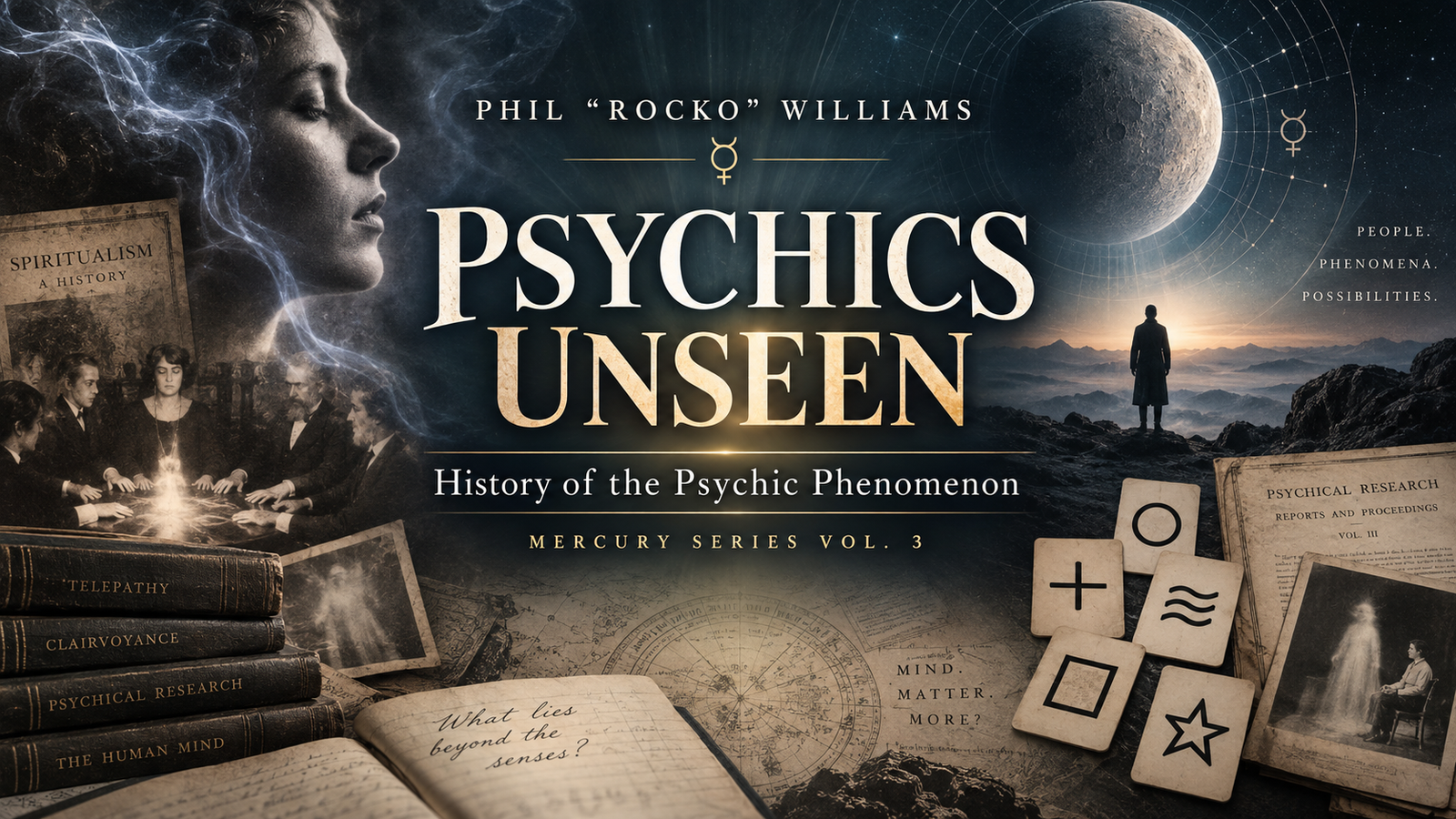
Psychics Unseen: History of the Psychic Phenomenon
Download Free Via the 3 Dots
Subscribe: VeiledMystic333
All About The Modern Psychic Phenomenon
Psychics Unseen: History of PSI Energy & Research is Mercury Series Vol. 3, a long-form history of the Psychic phenomenon from the ancient world to the modern era of laboratories, government programs, altered-state research, online teaching, and contested science. The book does not ask readers to choose between belief and disbelief before the evidence is examined. Instead, it asks a more demanding question: what happens when human beings repeatedly report access to information that ordinary perception does not appear to provide, and what can history teach us about evaluating those reports?
The subject is unusually difficult because the word Psychic covers experiences that emerged from very different traditions. Clairvoyance, telepathy, second sight, mediumship, precognition, remote viewing, psychometry, intuitive perception, and related claims were not born inside one system. Some grew from religious practice. Some developed through mesmerism and Spiritualism. Some entered psychology and psychical research. Others were redesigned for laboratories or intelligence work under terms such as ESP, psi, anomalous cognition, or remote viewing. The vocabulary changes, but the recurring human question remains recognizable.
Psychics Unseen follows that changing vocabulary across thirty-nine chapters. Ancient seers and oracles lead into prophets, visions, second sight, scryers, and cunning folk. Mesmer introduces the problem of altered states and invisible forces. Spiritualism creates a public culture of mediumship while fraud forces investigators to improve their methods. The Society for Psychical Research, William James, and F. W. H. Myers move the subject toward organized inquiry. J. B. Rhine and later researchers move it toward probability, experimental design, and replication. Then the book enters the Cold War era, where SRI, Ingo Swann, Pat Price, government sponsors, Robert Monroe, Hemi-Sync, the Monroe Institute, Itzhak Bentov, Gateway, SCANATE, and STARGATE turn Psychic research into a problem of information, training, and operational usefulness.
The final chapters bring that history back to the present. They examine skepticism as an institution, the modern Psychic marketplace, Internet culture, Psychic development today, what roughly 150 years of research actually found, and how a serious practitioner can become more difficult to fool. The goal is not a metaphysical verdict. The goal is a better standard for thinking.
The Mercury Series: From Mystical Practice to Energy to Information
Psychics Unseen makes the most sense when viewed beside the first two Mercury Series volumes, because the three books investigate neighboring territories without pretending they are identical. Eastern Mysticism Unveiled – Mercury Series Vol. 1 traced practices that modern readers often encounter only after centuries of transmission, reinterpretation, translation, cultural exchange, and commercialization. Its central value was historical orientation. A practice becomes easier to understand when the reader can distinguish an ancient source from a later school, a traditional discipline from a modern synthesis, and a documented lineage from a retrospective claim.
The Energy Body Encyclopedia – Mercury Series Vol. 2 widened the map. Instead of following a single spiritual system, it compared the many ways cultures have described subtle bodies, centers, channels, vital forces, breath energies, fields, and related ideas. Terms such as qi, prana, subtle anatomy, meridians, chakras, vital force, and biofield language can resemble one another when viewed from a distance, yet they emerged from distinct intellectual histories. The point was not to force all of them into one mechanism. The point was to make comparison possible without erasing difference.
Psychics Unseen moves from unusual force to unusual information. Many practitioners experience these areas as connected. Someone may report energy sensations during meditation and later describe intuition, telepathy, or mediumistic impressions. A remote viewer may use relaxation or altered-state methods. A spiritual healer may describe information arriving as bodily sensation. Historical traditions sometimes combine perception, energy, breath, trance, dream, and divination inside one worldview.
That overlap deserves investigation, but it does not yet justify a universal theory. The Mercury Series therefore treats connection as a hypothesis-generating observation rather than a conclusion. Perhaps some traditions describe different aspects of one underlying capacity. Perhaps several distinct mechanisms are being grouped together because human experience makes them feel similar. Perhaps some effects are physiological, some psychological, some cultural, and some genuinely anomalous. A responsible comparative project has to leave room for all of those possibilities until evidence narrows the field.
Why the Word Psychic Still Matters
The word Psychic has accumulated so much cultural baggage that serious investigators sometimes avoid it entirely. Scientific literature has preferred terms such as extrasensory perception, psi, anomalous cognition, exceptional human experience, or nonlocal perception. Remote viewers developed their own protocol language. Mediumship researchers use terminology designed to separate information reception from assumptions about spirits. Psychologists may describe experiences in terms of source monitoring, dissociation, intuition, pattern recognition, or altered states.
Yet the ordinary word Psychic remains useful because it connects public experience to the history of the field. It names the cultural category under which millions of people encounter claims of hidden knowledge. Avoiding the word can create an illusion of novelty. A practice may sound new simply because the vocabulary has changed. Clairvoyance becomes ESP. ESP becomes psi. Psychic spying becomes remote viewing. Mediumistic impressions become anomalous information reception. Each new term can improve precision, but each also creates distance from the earlier history.
Psychics Unseen deliberately keeps the common word while refusing the common looseness. Psychic is not used as a universal ancient identity. A Mesopotamian diviner, a Delphic oracle, a medieval visionary, a Scottish seer, a Spiritualist medium, an ESP subject, and a trained remote viewer are not presented as members of one timeless profession. Their cultures understood them differently. The comparison becomes meaningful only after those differences are preserved.
This is a broader lesson for controversial subjects. Professionalism does not come from replacing an embarrassing word with a technical one. It comes from method. A sensational topic becomes serious when claims are sourced, categories are defined, ordinary explanations are considered, controls are described, failures remain in the record, and conclusions are proportionate to evidence. The language matters, but the standard matters more.
Before Psychic Had a Name
The history begins long before the modern Psychic. Ancient societies repeatedly distinguished ordinary knowledge from another class of knowledge believed to arrive through dreams, prophecy, trance, revelation, omens, visions, sacred inspiration, or unusual personal sensitivity. That recurrence is historically important even though it does not prove paranormal causation.
Mesopotamian courts employed highly trained omen specialists who examined sacrificial animals, watched the sky, interpreted signs, and transmitted conclusions through administrative systems. Those practices were technical, learned, and institutional. Alongside them, ancient archives also preserve reports of prophetic messages delivered by people who claimed that a deity had communicated through them. The difference is crucial. Reading an external symbolic system is not the same claim as receiving information through the person.
Ancient Egyptian dream texts show another approach. Dreams could be interpreted as favorable or unfavorable and treated as information worthy of classification. Greek culture developed oracular institutions, independent seers, dream incubation, omen reading, and philosophical arguments about divination. Indian traditions preserved the figure of the seer and later developed elaborate discussions of extraordinary capacities associated with disciplined consciousness. Chinese traditions combined state divination, ancestral consultation, ritual specialists, and mediumistic roles. None of these traditions should be flattened into a modern Western definition of Psychic ability.
Still, a pattern emerges. Human communities repeatedly created roles for people believed to possess special access to hidden information. Those people could be trained, revered, regulated, employed, feared, tested, or accused of deception. They occupied social positions long before anyone spoke of ESP or anomalous cognition.
The skeptical explanation for part of this recurrence is obvious and deserves full respect. Human beings everywhere dream, infer, misremember, recognize patterns, fear uncertainty, and experience coincidence. Similar minds facing similar human problems can produce similar beliefs independently. Yet this does not exhaust the historical question. The persistence of special seer roles, the repeated cultivation of altered states, and the recurring concern with false prophecy, fraud, and verification show that unusual information has been a durable human problem for thousands of years.
Oracles, Prophecy, and the Social Power of Hidden Knowledge
The ancient oracle is one of the clearest predecessors of the modern Psychic because the human being becomes the instrument through which unusual information is believed to arrive. At Delphi, the Pythia did not simply read a coded system like a technical omen manual. She occupied an inspired role within a major institution whose authority extended into politics, war, colonization, law, religion, and private decision-making.
This history reveals something that remains true today: extraordinary perception almost never exists in a social vacuum. Institutions form around it. They control access, reputation, interpretation, training, payment, ritual, documentation, and legitimacy. A seer inside an accepted sanctuary may be respected while a similar claimant outside the institution may be dismissed or condemned. Later Christian history intensifies the same problem. Prophecy, visions, dreams, and apparitions could be accepted inside approved religious frameworks while other forms of divination or spirit contact were condemned.
The result is a distinction that modern readers often miss. Historical opposition to Psychic-type experience was not always skepticism in the modern scientific sense. Sometimes critics believed unseen forces were real but unauthorized, dangerous, demonic, or religiously forbidden. A nineteenth-century medium could therefore be attacked from opposite directions: one critic might insist spirit communication was impossible, while another might condemn it because communication with spirits was spiritually dangerous.
Scottish second sight later provides another transition. Reports of future events, distant scenes, deaths, arrivals, and apparitions began attracting collectors who asked whether testimony might point to a natural human faculty. The evidence was still anecdotal and vulnerable to memory, retelling, and retrospective fitting, but the question had shifted. Investigators could now ask not only what spiritual source caused the experience, but whether the experience happened in a repeatable way at all.
That move from theology toward natural inquiry laid groundwork for the modern Psychic problem. Once the question becomes empirical, mechanism can remain unknown while evidence is still examined.
Mesmer and the Shift From Revelation to Altered State
Franz Anton Mesmer changed the history even though his theory of animal magnetism did not survive as accepted science. Mesmer proposed an invisible fluid that could influence human health and function. His explanatory system became controversial, but the practices surrounding mesmerism created a new environment in which trance, suggestion, unusual sensitivity, and altered states could be observed systematically.
Later magnetic subjects sometimes entered quiet, articulate somnambulistic states very different from the dramatic crises associated with early mesmerism. Reports described subjects who appeared to diagnose illness, perceive distant locations, read concealed material, or show other forms of clairvoyance. Most such historical claims cannot be evaluated by modern experimental standards. Their importance lies partly in the conceptual transition they represent.
A vision no longer had to be discussed only as prophecy or divine revelation. It could be described as a capacity emerging in a particular state of mind or body.
This shift contains one of the most useful lessons in the entire field: an incorrect explanation can coexist with a real observation. Mesmer’s invisible fluid may have been wrong as a theory, while trance, suggestion, altered attention, hypnotic responsiveness, and changes in subjective experience were real phenomena that later science studied under different models. Rejecting the mechanism did not erase every event that occurred around the practice.
Psychic research repeatedly faces the same problem. A person can have an unusual experience and still be wrong about its cause. A statistical anomaly can appear without revealing a mechanism. A trance state can be genuine without proving clairvoyance. A medium can produce highly specific information without that fact alone deciding whether the source was telepathy, ordinary leakage, subconscious inference, survival, coincidence, or something else.
Experience and explanation must therefore be separated whenever possible.
Spiritualism, Mediumship, and the Birth of the Modern Psychic Public
Nineteenth-century Spiritualism transformed unusual perception into a mass social phenomenon. Mediumship moved from private reports and religious vision into parlors, churches, public halls, newspapers, investigations, performances, and commercial sessions. The possibility of communication with the dead attracted grieving families, religious reformers, scientists, skeptics, opportunists, entertainers, and professional mediums.
This period gave the modern Psychic field much of its recognizable public shape. The medium became a person whose special sensitivity could be tested, hired, admired, attacked, or exposed. Séances created conditions in which extraordinary claims were produced repeatedly before witnesses. Some cases became famous because observers reported striking information or physical phenomena. Others became notorious because hidden devices, accomplices, concealed information, manipulated furniture, costumes, or stage methods were discovered.
Fraud became inseparable from the history.
That fact should not be hidden by anyone who wants the Psychic subject taken seriously. Fraud harmed public trust and forced investigators to improve controls. Magicians and skeptical researchers demonstrated that ordinary techniques could produce apparently impossible events. A person could appear to know intimate facts through prior research, subtle cueing, observation, or confederates. A physical manifestation could be staged. Darkness could conceal more than mystery.
Yet documented fraud created a second error: the assumption that exposure in one case automatically explains every other case. It does not. A medium caught cheating has been caught cheating. That evidence should remain in the record permanently. But the historical reach of the evidence should not be expanded beyond what it demonstrates.
The same principle works in the opposite direction. A favorable observation does not erase cheating. A striking session does not grant permanent immunity from criticism. Mixed evidence should be allowed to remain mixed.
Fraud Changed Everything, and That Was Not Entirely Bad
The Psychic field often treats fraud as a wound, but historically it also became a source of methodological progress. Every successful deception teaches investigators something about the controls they forgot to build. If a sitter can unintentionally reveal information through facial reactions, the next experiment can reduce interaction. If a medium can research a client before a session, future tests can use anonymous sitters and blinded procedures. If a target can leak through handling or preparation, target generation can be separated from the experimenter.
This is one reason stage magicians occupy such an important place in Psychic history. A magician understands something scientists can underestimate: an effect can feel impossible while depending on perfectly ordinary mechanics. Human attention is selective. Memory is reconstructive. People confidently remember details that did not happen exactly as recalled. Witnesses infer causes from outcomes. A skilled performer exploits those weaknesses intentionally.
Psychic research therefore cannot rely on sincerity alone. A participant may be completely sincere and still receive cues. An investigator may be honest and still design a weak experiment. A critic may identify a vulnerability without proving that anyone deliberately exploited it. Good methodology distinguishes opportunity from demonstrated behavior.
That distinction becomes especially important in controversial cases. Saying that hot reading could explain a result is not the same as demonstrating that the reader researched the sitter. Saying that a laboratory arrangement allowed sensory leakage is not proof that a participant consciously used the leak. The vulnerability still matters because it lowers confidence, but accusation requires stronger evidence than possibility.
A mature field learns to describe weaknesses precisely rather than inflating them into misconduct. That protects both serious criticism and innocent people.
The Society for Psychical Research and the Attempt to Investigate Without a Verdict
The founding of the Society for Psychical Research in 1882 created one of the most important institutional turns in the history of the Psychic phenomenon. Instead of beginning with a required theology, investigators could collect cases, test claims, examine mediums, study apparitions, explore telepathy, and argue about competing explanations.
The people involved did not share one worldview. That disagreement was a strength. Some investigators were sympathetic to survival after death. Others preferred telepathy or subliminal processes. Some were skeptical. The common commitment was that unusual claims deserved investigation serious enough to distinguish stronger material from weaker material.
William James represents the intellectual courage of this era. James understood that fraud, suggestion, dissociation, error, and psychological complexity were real. He also resisted the idea that an empirical question becomes scientifically unworthy merely because charlatans occupy the same territory. A field can contain deception and still contain unresolved evidence.
F. W. H. Myers approached the Psychic problem through the concept of subliminal consciousness. His ideas emerged before modern neuroscience and should be read historically, but they represent a major attempt to describe hidden layers of mental processing without reducing unusual experience to simple fantasy. Myers also helped develop vocabulary that later researchers inherited, including telepathy.
The larger achievement of this period was methodological rather than doctrinal. Investigators learned that a claim could be tested without first granting its preferred interpretation. Information that appeared to pass between two people could be studied before deciding whether the cause was telepathy, cueing, coincidence, subconscious inference, or fraud. Mediumistic information could be scored without assuming survival. Apparitions could be documented without settling the metaphysics of spirits.
That habit remains one of the strongest tools available today.
When Psychic Became ESP
By the twentieth century, researchers increasingly tried to strip away séance language and ask narrower questions. Could a person identify a hidden target at rates above chance? Could information appear under conditions designed to remove ordinary sensory access? Standardized cards, repeated trials, probability, and statistics became central.
J. B. Rhine’s work at Duke University helped make ESP a laboratory problem. Forced-choice experiments transformed the appearance of Psychic research. A spectacular medium could be replaced by many trials. A single astonishing hit no longer carried the whole case. Instead, researchers could ask whether the overall distribution of responses differed from what chance predicted.
This was a major intellectual improvement, but it also changed what success looked like. Popular culture imagines Psychic ability as dramatic accuracy. Statistical research often produces a much stranger result: a participant may be wrong on most trials and still score above chance across a large dataset. A small effect can become statistically impressive without becoming practically impressive.
This difference matters. Statistical significance does not automatically mean large effect, useful effect, or understood mechanism. A result can be unlikely under a stated chance model and still require examination for poor randomization, optional stopping, data selection, sensory cues, recording errors, experimenter effects, or publication bias.
Psychics Unseen treats technical literacy as part of Psychic literacy for this reason. Anyone interested in the field should know enough probability and experimental design to understand what a headline is actually claiming. A statement that an experiment produced significant results is not the end of the analysis. It is the beginning of a more precise set of questions.
How to Read a Psi Experiment Without Getting Lost
One of the most useful additions a serious reader can make to Psychic study is a basic experimental checklist. The first question is whether the target was genuinely hidden. The second is whether the response was fixed before feedback. The third is whether scoring rules were decided in advance. The fourth is whether the comparison set was appropriate. The fifth is whether enough trials were run to make chance expectation meaningful.
Then come the harder questions. Was the participant selected because of prior ability? If so, were the selection criteria defined before the new experiment? Could experimenters accidentally cue the subject? Did anyone who knew the target interact with the participant? Could judges recognize target photographs from contextual details? Were unsuccessful studies less likely to be published? Did researchers stop collecting data when results looked favorable?
These are not accusations. They are ordinary scientific questions.
Free-response experiments create additional difficulty because resemblance is flexible. A target and response may share shape, category, color, symbolism, emotional tone, or spatial layout. If the correct target is shown next to the response after the fact, similarities can look obvious. The stronger procedure asks blinded judges to match responses against multiple possible targets without knowing which pairing is correct.
This becomes especially important in remote viewing, dream telepathy, and mediumship research, where the data are not a simple yes-or-no answer. Rich material is psychologically natural but statistically harder to score.
The purpose of learning these methods is not to become cynical. It is to move wonder toward the strongest evidence. A case that survives careful blinding is more interesting than one that depends on hindsight. A transcript sealed before feedback is more valuable than a story reconstructed years later. Better controls do not insult the Psychic claim. They give it a chance to become scientifically meaningful.
Beyond Zener Cards: Why Human State Became Part of the Experiment
Later Psychic research increasingly recognized that a human participant is not a passive measuring instrument. Performance may vary with personality, motivation, relationship, expectation, fatigue, state of consciousness, task design, and training. Practitioners had always said something like this. Laboratory science found the claim frustrating because reliable phenomena should ideally reproduce under standardized conditions.
Yet many human abilities are unevenly distributed. Musical expertise, athletic performance, memory skill, hypnosis susceptibility, meditation depth, and perceptual specialization all vary substantially among individuals. Recruiting random volunteers is not the obvious way to discover the upper limits of any of those capacities.
The problem is selection bias. If researchers choose participants only after seeing who succeeds, apparent ability may be exaggerated. A scientifically stronger approach defines selection criteria prospectively, then tests selected participants on new data. This distinction allows the study of unusual performers without turning every successful subject into a post hoc discovery.
Research formats also changed to create conditions that some investigators believed were more compatible with spontaneous Psychic experience. Dream studies, ganzfeld procedures, free-response targets, altered-state work, and later remote viewing moved away from repetitive card guessing. These approaches increased psychological richness while making judging and control more complicated.
That tradeoff is central to the field. A rigid test may suppress the phenomenon practitioners claim to experience, while a naturalistic test may introduce too many ordinary information channels. Good research tries to create a middle ground: psychologically appropriate conditions with scientifically meaningful controls.
When Governments Became Interested
The government history is one of the most sensationalized areas in the Psychic field, which is exactly why primary documents matter. Public retellings often reduce decades of work to one of two claims: the government proved Psychic spying, or the government wasted money on nonsense. The surviving record is much more complicated.
Intelligence organizations became interested because the operational question differs from the purely scientific one. A laboratory asks whether an effect exists under controlled conditions. Intelligence work asks whether information can help solve a real problem. A method can produce a small statistical anomaly and still be too unreliable for intelligence. Conversely, a source can provide occasionally useful information without proving a new theory of consciousness.
Government involvement also reflects the logic of risk. Intelligence agencies sometimes investigate low-probability possibilities because the strategic cost of ignoring them could be high. Continued funding does not prove that a phenomenon has been scientifically validated. Program closure does not prove that every result was worthless. Institutional decisions combine evidence, cost, reliability, politics, mission needs, management priorities, and competing programs.
Psychics Unseen therefore treats the declassified archive as history first. It establishes that programs existed, agencies funded work, personnel were trained, targets were assigned, sessions were recorded, successes were claimed, failures were documented, and evaluators disagreed. Those facts deserve to be separated from later mythology.
SRI and the Transformation of Psychic Ability Into an Information Problem
Stanford Research Institute became a major bridge between experimental parapsychology and intelligence interest. Researchers such as Harold Puthoff and Russell Targ explored whether selected participants could describe hidden targets under controlled conditions. The early work included both enthusiasm and failure, which is important because later popular accounts often preserve only the spectacular sessions.
One major conceptual change was the move from hidden symbols to remote locations. A card inside an envelope has little operational significance. A distant installation, building, facility, or geographic site potentially has enormous significance. Remote viewing reframed the Psychic claim as information acquisition across space.
That shift made judging more difficult but also more realistic. A viewer might report textures, temperature, height, movement, geometry, sound, or spatial layout rather than name the target. Researchers then had to determine whether those impressions matched the correct location better than alternatives.
SRI also exposed a disciplinary tension that remains relevant. Physicists tended to think in terms of shielding, signals, instrumentation, and distance. Psychologists emphasized cueing, expectation, judging, target construction, and information leakage. A laboratory could be electrically sophisticated while psychologically weak. A psychology experiment could be behaviorally rigorous while overlooking an instrumentation problem.
Psychic research sits at the boundary between human behavior and physical measurement, so strong work often requires expertise in both.
Ingo Swann and the Discipline of Raw Perception
Ingo Swann became historically important because he did not want to remain a mysterious gifted subject who either succeeded or failed. He was interested in understanding the process itself. He argued that remote impressions could be separated into stages and that raw sensory material should be distinguished from the ordinary mind’s tendency to interpret too quickly.
This problem later became associated with analytical overlay. A viewer may receive something like tall, metallic, cold, repeating, echoing. The mind immediately supplies an object: tower, bridge, factory, tunnel, ship. Once that label forms, later impressions may be bent toward the interpretation.
The distinction is valuable far beyond remote viewing. Mediums, intuitives, dreamers, and people reporting spontaneous Psychic impressions often describe fragmentary first information. A bodily sensation becomes a diagnosis. A color becomes a personality. An image becomes a specific location. Sometimes the interpretation may be correct. Sometimes it contaminates otherwise useful raw material.
A strong practice therefore records the first impression separately from the later explanation. “Pressure in the chest” is different from “the target person had heart disease.” “A vertical stone structure” is different from “a church tower.” “The name John” is different from “your deceased uncle John.”
This separation creates a record that can be judged more honestly after feedback. It also allows practitioners to study their own failure patterns. Perhaps colors are consistently reliable while names are not. Perhaps emotional tone is accurate while interpretation of location is weak. The result is a more precise understanding of performance than simply labeling a session a hit or miss.
Pat Price and the Difference Between Accuracy and Usefulness
Pat Price highlights another distinction that popular Psychic culture often overlooks. Scientific evidence and operational usefulness are not the same thing.
In a laboratory, a set of results can be meaningful because the overall pattern departs from chance. Intelligence work is different. A report must help someone make a decision. It can contain errors and still matter if one correct detail identifies a location, capability, or feature that analysts can verify. Conversely, a statistically unusual effect may be too weak, vague, or inconsistent to use in a real operation.
Price’s history is useful because it shows the recurring mixture of striking detail and interpretation error. A viewer may describe shapes, structures, materials, or spatial relationships with apparent accuracy while naming the wrong function. Basic form can be closer to the target than the story the mind builds around it.
This makes post-session judging essential. A target description should be compared with the record that existed before feedback, not reconstructed from memory after the answer is known. Analysts should ask what information would have been usable in advance, not simply what looks impressive afterward.
The operational problem also demands security discipline. If a viewer describes protected information, the first question should be whether ordinary information leakage occurred. Could the subject have learned the target beforehand? Could an experimenter have known it? Could target coordinates, paperwork, conversation, or prior exposure provide clues? Responsible security work investigates those possibilities before invoking Psychic perception.
Again, good controls are not enemies of the unusual claim. They are the only way the unusual claim can become more interesting than ordinary explanation.
Robert Monroe and the Attempt to Make Altered States Repeatable
Robert Monroe occupies unusual territory in the Psychic history because his importance does not depend on accepting every metaphysical conclusion he reached. Monroe began with spontaneous experiences that he interpreted as out-of-body states, then spent years trying to make altered-state exploration repeatable.
He developed vocabulary, mapped Focus levels, experimented with sound, built training programs, documented experiences, and helped create an institution where other participants could attempt related states. This changed the question from “Did one unusual event happen?” to “Can a person deliberately enter a state, remain conscious, perform a task, return, remember the experience, and compare repeated sessions?”
That is a meaningful methodological shift even before paranormal interpretation begins.
Consciousness is already known to be flexible. Meditation, hypnosis, sleep transitions, sensory reduction, rhythmic stimulation, biofeedback, and focused attention can all alter subjective experience. The unresolved issue is whether particular altered states also improve access to veridical information that ordinary sensory routes cannot explain.
Monroe’s greatest methodological contribution may therefore be state control. Spontaneous Psychic experiences often occur during dreams, grief, crisis, meditation, exhaustion, hypnagogia, or sudden intuitive flashes. Those states are difficult to schedule. A training system that helps a participant approach unusual states deliberately creates a bridge between personal experience and repeatable exploration.
Hemi-Sync, the Monroe Institute, and the Discipline of Interpretation
Hemi-Sync became the best-known sound technology associated with Monroe’s work. Whatever one concludes about its most expansive claims, the historical project is clear: use structured audio and guidance to support altered states while preserving awareness and memory.
The Monroe Institute later became important to parts of the government remote-viewing community. Declassified records document military interest in the Institute’s methods and training. That historical connection is often exaggerated online into a claim that the CIA scientifically validated astral projection or Monroe’s cosmology. The archive does not justify that leap.
A document being present in the CIA Reading Room does not mean the CIA authored it, endorsed every proposition inside it, or proved the system it describes. Records from multiple agencies entered that archive. The more defensible historical conclusion is narrower: personnel involved in intelligence-related Psychic work considered Monroe methods potentially useful enough to explore for relaxation, concentration, altered-state control, or remote-viewing performance.
This difference between experience and explanation remains essential. A participant can accurately report what was experienced without having to settle the ultimate nature of the event. Shared terminology helps people compare states, but it can also create expectation. If participants are taught that a certain Focus level should contain a specific type of experience, later reports may be shaped partly by the framework.
Good training therefore asks two questions at once: what happened, and what might have influenced how it was interpreted?
Itzhak Bentov, Gateway, and the Temptation of a Unified Theory
Itzhak Bentov approached meditation and consciousness with the habits of an inventor and engineer. He tried to connect bodily rhythms, resonance, physiology, subjective experience, and cosmology. Some parts of his thinking can be treated as plausible speculation; others are much more conjectural. His importance lies less in whether every model survived than in his refusal to assume that mystical experience must remain outside technical thought.
The later Gateway assessment drew on ideas associated with Monroe and Bentov. This document has become one of the most frequently misunderstood pieces of modern Psychic culture. It is often presented online as if a secret government program reached a final scientific conclusion about consciousness, reality, astral projection, or the universe.
That is not what a historical reading supports.
The document is evidence that a particular official analysis existed. It shows that people inside an institutional setting attempted to interpret a consciousness-training system using concepts available to them. It is not equivalent to a peer-reviewed consensus, and its presence in a declassified archive does not convert speculative ideas into established science.
This is a perfect example of why document literacy matters. Historical authenticity and scientific truth are different categories. A genuine memorandum can contain speculation. An official report can summarize a theory without proving it. Declassification tells us that the document is no longer classified; it does not tell us that every claim inside it was validated.
From SCANATE to STARGATE
The government Psychic story involved multiple program names, agencies, contractors, reorganizations, and changes in purpose. SCANATE, GRILL FLAME, CENTER LANE, SUN STREAK, and STARGATE belong to a long institutional history rather than one simple project.
The value of the archive lies partly in its messiness. It contains research reports, memoranda, taskings, training material, scoring systems, operational sessions, budgets, internal endorsements, criticism, and failures. Some records describe sessions with strong target correlation. Others explicitly report no target correlation. That mixture is more useful than a collection of only spectacular stories because it reveals how people inside the programs understood uncertainty.
The files also show that real intelligence tasking occurred. That does not prove the information source was paranormal. It proves that officials tried to use remote-viewing methods in operational contexts. The distinction matters because historical evidence and scientific evidence answer different questions.
A government document can strongly establish that a program existed. It can establish that an agency assigned a target, spent money, evaluated a session, or trained personnel. It may provide much weaker evidence about whether the claimed Psychic mechanism was real.
Confusing those levels is one of the fastest ways to turn archive research into mythology.
The 1995 Judgment and Why the Argument Did Not End
The 1995 review associated with the end of STARGATE is often used as a final rhetorical weapon. Critics cite program termination as proof that remote viewing failed. Supporters emphasize positive statistical interpretations and argue that the government abandoned something real. The actual record is more nuanced.
The review separated scientific evidence from operational usefulness. That distinction alone prevents a one-sentence conclusion. A small laboratory effect could be genuine and still be too unreliable for intelligence work. A method could occasionally help an analyst without being dependable enough to justify an ongoing program.
The outside reviewers also disagreed. Jessica Utts interpreted portions of the statistical evidence as supporting anomalous information acquisition. Ray Hyman remained unconvinced that methodological issues had been eliminated and did not accept the paranormal conclusion. Their disagreement was not proof that every interpretation was equally strong. It was evidence that qualified experts could agree on parts of the record while disagreeing sharply about what those parts established.
Program closure then became an institutional decision informed by evaluation, reliability, cost, and mission needs. It was not a universal experiment on the existence of psi.
This is one of the broader lessons of Psychics Unseen. Institutional action should not be translated automatically into metaphysical certainty. Funding proves interest, not truth. Termination proves a decision, not necessarily nonexistence. An official report proves that a judgment was made, not that all future inquiry is irrational.
When Skepticism Became an Institution
Skepticism has improved Psychic research repeatedly. Exposures of fraud forced better controls. Magicians demonstrated how powerful deception can be. Psychologists documented confirmation bias, cueing, cold reading, selective memory, expectation, dissociation, and source-monitoring errors. Statisticians challenged weak analyses. Replication failures exposed claims that were less stable than early reports suggested.
A serious Psychic history should be grateful for those contributions.
But skepticism also became organized, professionalized, and cultural. Institutions develop incentives regardless of worldview. Once a subject becomes associated with embarrassment, dismissal can carry social rewards just as belief can carry rewards inside spiritual communities. Ridicule may become a shortcut around investigation.
The solution is not anti-skepticism. It is symmetry.
If a Psychic claimant benefits from belief, that incentive should be noted. If a skeptical institution benefits from dismissal, that context may also matter. If a positive study contains methodological weaknesses, they should be reported. If a negative study has weaknesses, they should be reported too. If believers must count misses, critics should distinguish cases their preferred explanation actually resolves from cases it merely resembles.
Symmetry does not mean every explanation deserves equal probability. It means everyone faces the same demand for documentation, proportionate language, and correction of error.
The Psychic Marketplace
Psychic culture today is not only a research field. It is a marketplace. Readings, mediumship, intuitive coaching, tarot, energy work, development circles, remote-viewing courses, certifications, online schools, retreats, audio programs, and spiritual memberships operate in a space with limited regulation and no universally accepted standard of competence.
Money does not invalidate a practice. Skilled professionals in every field charge for time. The problem is that Psychic outcomes are difficult to measure and clients may be emotionally vulnerable. Grief, fear, relationship problems, illness, uncertainty, and financial stress can make a person unusually receptive to certainty.
That makes certain commercial patterns important warning signs. Fear-based predictions create dependence. Guaranteed outcomes exceed what the field can responsibly promise. Escalating spiritual hierarchies can pressure students to buy the next level rather than evaluate whether the previous level improved accuracy. Unverifiable certifications can create authority without evidence. Teachers who discourage independent checking create a social environment in which error becomes hard to detect.
A stronger Psychic marketplace would do the opposite. It would normalize uncertainty, preserve records, admit failures, explain limitations, distinguish training from certification theater, and make students more independent over time.
The best teacher should not need the student to become less capable of judging the teacher.
The Internet Psychic and the New Information Problem
The Internet reversed one of the historical problems of Psychic study. Earlier researchers struggled to obtain material. Books were rare, archives were distant, society proceedings were difficult to access, and government documents were classified. Modern readers face the opposite problem: too much information with too little ranking.
A viral post can strip a government document of authorship and context. An old experiment can be presented as a new discovery. A speculative theory can be repeated until it sounds established. A dramatic success can circulate without the failures from the same series. A contemporary teacher can rename an older practice and market it as a breakthrough.
At the same time, the Internet makes verification easier than ever. Primary sources can often be searched directly. Old books can be compared with modern summaries. Declassified files can be read without waiting for a documentary. Research papers, critiques, and replications can be placed side by side.
The information problem has therefore changed from access to discrimination.
The modern Psychic student needs source literacy as much as technique. Who wrote the document? When? For what purpose? Is the page a primary record or later commentary? Was the claim made before or after the outcome was known? Does the source contain failures as well as successes? Is the scientific language being used accurately?
These questions do not drain mystery from the field. They protect mystery from being buried under bad information.
Psychic Development Today
Psychic development has no central licensing body, no universally accepted curriculum, no settled theory, and no reliable border separating ancient practice from modern invention. A beginner may encounter mediumship circles, meditation, dream work, remote-viewing schools, tarot, energy practice, Hemi-Sync, social-media teachers, private mentors, research organizations, and commercial certification programs within the same month.
This abundance can create the illusion that progress means collecting methods. Another course, another deck, another audio program, another meditation, another teacher, another vocabulary. Yet more techniques do not necessarily create more discrimination.
Development may improve when a practitioner stays with one method long enough to discover its failure modes. Which impressions recur falsely? Which conditions improve clarity? Does the new technique improve accuracy or merely make the experience feel more vivid? Are the same errors appearing repeatedly? Do records show actual improvement across time?
Community can help when it supports independent judgment. A useful group normalizes unusual experience without requiring every experience to be interpreted as Psychic. Members can compare notes, share sources, provide feedback, and notice patterns that are hard to see alone. A group becomes dangerous when belonging depends on agreement, questioning is treated as betrayal, or the teacher’s interpretation overrides the student’s records.
The goal of development should be greater independence, not greater dependency.
What 150 Years of Psychic Research Actually Found
After more than a century and a half of organized research, the least accurate answer is a simple yes or no. The record contains small statistical effects, striking case material, exceptional individual performances, failed replications, successful replications, exposed fraud, methodological improvements, disputed meta-analyses, and recurring questions about why effects that sometimes appear compelling remain difficult to produce robustly on demand.
Telepathy research moved from spontaneous cases to card and drawing experiments. Rhine standardized forced-choice methods. Ganzfeld research attempted to reduce sensory noise while preserving free-response material. Remote-viewing studies emphasized target pools, judging, blinding, and selected participants. Mediumship research developed sitter blinding and information controls. Precognition and presentiment research explored time-oriented anomalies. Psychokinesis research moved toward random event generators and other measurable systems.
Supporters argue that portions of this literature produce patterns difficult to explain by chance alone. Critics point to methodological weaknesses, replication instability, small effects, publication bias, and theoretical gaps. Some exceptional cases appear stronger than group averages but are difficult to generalize. No accepted mechanism unifies the whole field.
Anyone claiming that science has completely proven Psychic ability is overstating the record. Anyone claiming that controlled research has produced nothing worth discussing is also giving an incomplete history.
The uncertainty is not a disappointing ending. It is a more accurate starting point.
Three Different Kinds of Evidence
One of the strongest disciplines in Psychics Unseen is the separation of historical, experimental, and experiential evidence.
Historical evidence tells us that something happened in the record. A society existed. A medium was tested. A government program received funding. A document was written. A viewer submitted a transcript. An official criticized or endorsed a method. Historical evidence can be very strong even when the underlying Psychic claim remains unresolved.
Experimental evidence tells us what occurred under specified controls. It asks about chance expectation, blinding, leakage, target selection, randomization, scoring, replication, and effect size. Experimental evidence can establish an anomaly without identifying the mechanism that caused it.
Experiential evidence tells us what a person reports perceiving or living through. A powerful dream, apparition, sensed presence, out-of-body experience, intuitive knowing, or mediumistic impression can be profoundly important to the experiencer. Yet subjective intensity does not automatically make the experience externally verifiable.
All three kinds of evidence matter. None can substitute for another.
A declassified memo is strong evidence that officials discussed remote viewing. It may be weak evidence that remote viewing worked. A statistically unusual result can be evidence for an anomaly without proving telepathy. A life-changing experience can be strong personal evidence without becoming universal scientific proof.
Confusion disappears when the evidence category is named correctly.
Experience and Explanation Are Not the Same Thing
This principle deserves its own section because it may be the most practical idea in the entire Psychic field.
A person can experience something genuinely unusual and still misidentify the cause. That is true inside and outside Psychic research. A bodily sensation can be real while its diagnosis is wrong. A sound can be real while its source is misidentified. A vivid dream can be psychologically meaningful without predicting the future. An apparent telepathic impression can be accurate while ordinary information leakage remains possible.
The moment an experience occurs, the mind begins interpretation. Culture supplies categories. A Christian visionary may interpret a presence through angels or saints. A Spiritualist may interpret it through the dead. A remote viewer may speak of signal and analytical overlay. A psychologist may speak of subconscious inference. A Monroe participant may use Focus terminology. A skeptic may interpret the same raw experience as expectation or memory construction.
The raw event and the theory attached to it should be recorded separately whenever possible.
This does not weaken belief or skepticism. It creates testable data.
Becoming Difficult to Fool
A serious Psychic practitioner should aim to become difficult to fool by other people and difficult to fool by the self. Human cognition is not designed as a perfect scientific instrument. We remember hits more readily than misses. We reinterpret vague predictions after events occur. We infer more information from body language than we realize. We become attached to explanations. We notice meaningful coincidence and forget ordinary coincidence.
The answer is not distrust of every experience. It is disciplined record keeping.
Write the impression before feedback. Preserve exact wording. Separate raw perception from interpretation. Use blind targets where possible. Count failures. Do not change scoring rules after seeing the result. Avoid treating one spectacular event as proof of a permanent ability. Learn ordinary explanations well enough to recognize when they fit.
A Psychic who becomes harder to fool does not become less open-minded. The opposite happens. Weak cases can be released without threatening identity. Skeptics become useful when they identify real vulnerabilities. Good controls become allies. Strong sessions become more interesting because easy explanations have been reduced.
The practical inheritance of 150 years of research is therefore not a command to believe or disbelieve. It is a method for making whatever survives investigation worth taking more seriously.
An Added Framework: The Four Layers of a Psychic Claim
The history in Psychics Unseen suggests a useful companion framework for readers who want to evaluate cases more consistently. A Psychic claim can be divided into four layers: event, record, control, and interpretation.
The event is what the person says happened. An image appeared. A voice was heard. A target was described. A prediction was made. A bodily sensation occurred. At this stage the safest language is descriptive.
The record asks when and how the event was fixed. Was it written before the outcome? Was there a timestamp? Was the transcript preserved? Did several witnesses independently record the same details? The quality of the record determines how much later memory can reshape the story.
The control layer asks what ordinary pathways could have supplied the information. Was the target blind? Did anyone present know the answer? Could prior research, cueing, social media, probability, shared context, or sensory leakage explain the result? Were alternative targets available for judging?
The interpretation layer asks what the event means after the first three layers are understood. Telepathy? Clairvoyance? Survival? Coincidence? Subconscious inference? Fraud? Unknown mechanism? Sometimes the correct answer is that several explanations remain possible.
This four-layer approach is intentionally conservative. It allows an unusual event to remain unusual without forcing a theory too early. It also prevents an ordinary explanation from being treated as an insult. The strongest Psychic case is not the one with the most dramatic interpretation. It is the one whose event is well recorded, whose ordinary information channels are tightly controlled, and whose remaining explanations can be stated precisely.
How to Audit a Psychic Claim
A practical audit begins by freezing the claim. What exactly was said or perceived before the answer was known? General statements should stay general. Specific statements should stay specific. If the original wording was “I sense water,” it should not later become “I saw the swimming pool.”
Next, reconstruct the information environment. What did the claimant know? What did the experimenter know? What could the sitter reveal through questions, clothing, accent, online information, social media, or emotional response? Could the target have been inferred from context?
Then compare hits and misses. A reading with ten statements should not be judged only by the two impressive statements. A remote-viewing session should include wrong impressions as well as matching ones. A prediction system should preserve failures instead of allowing them to vanish.
After that, examine the base rate. Some statements are common. Illness, relationship conflict, bereavement, financial worry, travel, career uncertainty, and family tension occur frequently. A prediction becomes more impressive as it becomes more specific, less common, and more securely documented in advance.
Finally, decide what confidence level the evidence earns. Confirmed ordinary explanation, likely ordinary explanation, unresolved, suggestive anomaly, strong anomaly, or something else. Not every case needs to end with paranormal or fraudulent.
This kind of graded judgment is less emotionally satisfying than certainty, but it produces a much stronger archive.
Why Psychic and Energy Traditions Should Be Compared Carefully
The first three Mercury Series volumes naturally invite a larger synthesis. Eastern mystical systems often combine meditation, breath, subtle anatomy, altered state, intuition, visionary experience, and extraordinary perception. The Energy Body Encyclopedia documents the recurring human tendency to describe subtle forces and structures. Psychics Unseen documents the recurring human claim of unusual information.
It is tempting to declare that these are all parts of one hidden energy system.
The evidence does not yet justify that certainty.
Some Psychic traditions use energy language. Others do not. Remote viewing was often framed as information acquisition rather than energy transfer. Telepathy has been modeled in multiple ways. Mediumship can be interpreted through survival, telepathy, subconscious inference, or cultural frameworks. Physiological sensations may accompany altered states without proving that a measurable external energy field carries information.
The better approach is comparative mapping. Ask when energy sensations and information effects occur together. Ask whether particular practices change both. Ask whether physiological measures correlate with subjective reports. Ask whether stronger energy experience predicts better blinded accuracy. Ask whether traditions that use different language produce comparable results.
That kind of research could eventually support a broader theory. Until then, resemblance should remain evidence for inquiry rather than proof of identity.
Why Uncertainty Is a Strength
Uncertainty is often treated as weakness because controversial subjects attract people who want decisive answers. Yet uncertainty is the condition that allows evidence to improve a conclusion.
Sometimes the correct classification is insufficient information. Sometimes the target procedure was flawed. Sometimes a prediction was too vague to score. Sometimes the documentation was created after the event. Sometimes nothing unusual happened. Sometimes a case remains interesting because ordinary explanations do not fit comfortably, but the mechanism is still unknown.
Preserving those categories prevents the Psychic field from becoming a machine that converts every outcome into confirmation. It also prevents skepticism from becoming a machine that converts every unresolved case into dismissal.
A practitioner who can tolerate uncertainty does not need to rescue every session. A researcher who can tolerate uncertainty does not need every anomaly to become a theory. A critic who can tolerate uncertainty does not need every strange case to be explained immediately.
This creates intellectual room for better evidence.
The Psychic Inheritance
The modern Psychic inherits a layered archive built by people who rarely agreed with one another. Ancient seers interpreted unusual perception through gods, dreams, ancestors, and sacred office. Mesmer described an invisible fluid. Later magnetic subjects turned trance into a quasi-natural phenomenon. Spiritualists placed the dead at the center of the explanation. Psychical researchers tried to separate phenomena from theology. Rhine replaced the séance with cards and statistics. Remote-viewing researchers turned clairvoyance into an assigned information task. Monroe mapped altered states through sound and training. Bentov tried to think technically about consciousness and resonance.
The field also inherits its wounds. Fraud damaged trust. Sensational journalism rewarded exaggeration. Stage magicians demonstrated how easily impossible effects could be simulated. Skeptical organizations improved criticism but sometimes encouraged cultural dismissal. Believers sometimes responded to criticism by lowering standards rather than raising them.
And the field inherits method. The SPR taught documentation. Rhine taught chance expectation and repeated trials. Later researchers learned the value of blinding, target randomization, judging, replication, and participant selection. Remote-viewing programs preserved transcripts before feedback and separated laboratory effect from intelligence usefulness. Modern practitioners can learn from all of it.
No single camp owns this inheritance.
Why Psychics Unseen Matters Now
Psychic culture is currently experiencing another period of rapid visibility. Remote viewing, Gateway, Hemi-Sync, mediumship, intuitive development, altered-state exploration, and declassified government material circulate widely online. At the same time, scientific discussions of consciousness, prediction, perception, and exceptional experience continue under terminology that often sounds disconnected from the older history.
This creates an ideal environment for reinvention and confusion. Old ideas can be marketed as new. Genuine documents can be misunderstood. Strong research can be mixed with weak claims. Personal experience can be treated as universal proof. Skeptical criticism can be mistaken for total explanation.
History gives the reader bearings.
It shows that training versus natural talent is an old question. It shows that fraud control is not hostility. It shows that altered states can increase unusual subjective experience while increasing the need for careful source discrimination. It shows why feedback should be delayed, why records should be created before verification, and why spectacular successes must be weighed beside ordinary misses.
Most importantly, it shows that the Psychic question has survived repeated changes in language because no single era completely settled it.
Psychics Unseen as Mercury Series Vol. 3
Psychics Unseen continues the Mercury Series by applying the same historical and comparative discipline to a subject that is usually either romanticized or dismissed. It does not ask readers to abandon extraordinary possibilities. It asks them to make those possibilities survive stronger scrutiny.
The book’s scope is deliberately broad because modern Psychic culture inherits many separate histories at once. Ancient prophecy, religious vision, second sight, folk practice, mesmerism, mediumship, psychical research, ESP laboratories, government remote viewing, altered-state technology, skepticism, and modern development all contribute vocabulary, techniques, warnings, and assumptions.
The result is not a single lineage. It is an ecosystem.
That is why a history of the Psychic phenomenon is useful even for readers who already have strong beliefs. Believers gain tools for separating strong evidence from weak evidence. Skeptics gain a record more complex than a catalog of fraud. Practitioners gain methods for recording experience without inflating it. Researchers gain historical context for problems that continue to reappear under new names.
A Book About the Psychic Without a Required Belief
Psychics Unseen does not end by telling the reader what must be believed about consciousness, spirits, telepathy, remote viewing, or the afterlife. That restraint is not an absence of conclusion. It is a conclusion about method.
Document what happened. Identify who claimed what. Preserve the original record. Separate experience from explanation. Remove ordinary information channels where possible. Count failures. Apply probability carefully. Read government documents as documents, not as magical endorsements. Treat skepticism as useful when it explains something. Treat unusual evidence seriously when ordinary explanations do not fit.
Then stop where the evidence stops.
If a real Psychic phenomenon exists, stronger standards will not destroy it. They will reveal it more clearly. If particular claims fail under those standards, the field becomes healthier by releasing them. Either result moves the investigation forward.
That is the purpose of Psychics Unseen: History of PSI Energy & Research, Mercury Series Vol. 3. It gives the reader the historical memory, methodological tools, and intellectual freedom needed to approach one of humanity’s oldest unresolved questions without surrendering either curiosity or judgment.

About the author


Root Dictionary V.1 : A Companion to The Magick Root of Language
Root Dictionary: A Practical Companion to The Magick Root of Language Download Free Via the 3 Dots The Magick Root of Language – Magick Language Investigation – Free Download Ultimate English Syllable List – Extra Ex-Ten-Sive A familiar English word can conceal a remarkable history. It may have been assembled from two older languages, inherited through generations of speech, borrowed during trade, or coined by scholars who needed a name for something new. The Root Dictionary, presented as Volume 2 of The Magick Root of Language by Phil “Rocko” Williams, provides a compact place to begin investigating those hidden structures. Instead of asking readers to memorize a long technical explanation for every word, its alphabetized entries identify a form, the language in which that form is documented, an accessible meaning, and words where the connection can be seen. The companion […]

Ultimate English Syllable List – Extra Ex-Ten-Sive
English Syllable List A–Z: A Preliminary Language Research Resource Language is built from sounds, patterns, and word histories that have traveled between people and cultures for centuries. As a companion resource to The Magick Root of Language, this A–Z index collects 24,219 different written chunks extracted from English word examples. It offers a starting point for investigating syllables, word formation, and the many cultural histories represented in English vocabulary. How to use the list: entries are alphabetized by their written form. Each entry shows up to three example words and a count of occurrences in the source extraction. The count refers to occurrences in the processed word list, not to usage frequency in everyday English. Browse by letter, search the page, and compare candidate chunks against documented word histories. Important research limitation: this is an automated inventory of written chunks […]

The Magick Root of Language – Magick Language Investigation – Free Download
Magick Language and the Questions Behind the Book Download Free Via the 3 Dots What does it mean to say that a word possesses power? The Magick Root of Language begins with a familiar observation: a spoken sentence can change what people do. A warning redirects a crowd. A promise establishes an expectation. A public ruling alters a legal status. A name allows an individual, place, or abstract idea to be identified and remembered. These effects are neither imaginary nor supernatural. They are consequences of how people think, cooperate, build institutions, and respond to shared signs. The harder question begins when a tradition attributes additional powers to a precise sound, a sacred name, a written character, or a ceremonial formula. The book investigates that historical claim without assuming in advance that every account describes a literal physical process.This is the […]
Don’t Be a Loosh Bag – By Masked Matrix – Full Album
Album: Don't Be a Loosh Bag By - Masked Matrix Release Date - 10/12/2026 1. Energy Vampires 2. Dark Clouds 3. Mind Traps 4. Loosh Farmers 5. Falling From Grace 6. Holographic Simulation 7. All Seeing Eye 8. Shadow People Under The Bed 9. See You in the Duat 10. The Mirror Level 11. The Jinn's Lamp 12. The Town With No Name 13. Madam Blavatsky 14. Unanswered Prayers 15. Legend of the Abyss 16. First Peak Behind the Veil 17. Apophis Is Coming <Download Album Free Here> 1. Energy Vampires [Verse] Night descends Shadows bite Dreams invaded Endless fight Astral claws They rip and tear Feeding hunger Unaware [Chorus] Energy drained Soul consumed In your sleep You're doomed They haunt the void Silent scream Energy vampires stalk your dream [Verse 2] Wings of black Eyes that gleam […]
The Secret Ladder of Existence – Inspired By Madam B | Free Download
The Secret Ladder of Existence: Two Editions, One Invitation to Explore Reality Download Free Via the 3 Dots Download Free Via the 3 Dots https://youtu.be/RJldG2HsYb4?si=pCMP2cRzEMjPS9Vw Subscribe: Veiled Mystic 333 A book can begin with a question that refuses to disappear. What does it mean to exist, and how much of existence can human beings actually perceive? We move through a world of bodies, landscapes, weather, and measurable forces. Yet we also inhabit a world of memory, imagination, dreams, relationships, moral commitments, and private experiences that no stranger can observe directly. The puzzle is not simply whether the physical world is real. The puzzle is whether our ordinary description of that world is complete, and what kind of evidence would justify any claim that more remains to be discovered. These questions inspire The Secret Ladder of Existence, a new exploration of […]

Angelometry: A History of Angels Across Religion, Myth, and Mysticism
Angelometry: A History of Angels Across Religion, Myth, and Mysticism Download Free Via the 3 dots https://youtu.be/ZxOdzI88Iy0?is=kKvvAn-zkfuMN_oF https://youtu.be/7KC7Wsht7u0?si=z4U65lMOECOnJ1uP Subscribe: Veiled Mystic 333 Angelometry is a useful word for a subject that refuses to remain inside a single religious box. The history of angels is not one continuous system handed down unchanged from antiquity. It is a layered record of messengers, heavenly attendants, watchers, throne beings, guardians, destroyers, healers, scribes, planetary intelligences, divine names, spirits, and even ancient gods who were later absorbed into angelic catalogs. To study Angelometry seriously is therefore to study how human beings across different times and cultures imagined the invisible world around the divine. The familiar image of a beautiful winged figure in white robes is only one late and highly influential expression of a much larger history. Earlier texts can describe angels as men, flames, wheels, […]
Related
Root Dictionary V.1 : A Companion to The Magick Root of Language
Root Dictionary: A Practical Companion to The Magick Root of Language Download Free Via the 3 Dots The Magick Root of Language – Magick Language Investigation – Free Download Ultimate English Syllable List – Extra Ex-Ten-Sive A familiar English word can conceal a remarkable history. It may have been assembled from two older languages, inherited through generations of speech, borrowed during trade, or coined by scholars who needed a name for something new. The Root Dictionary, presented as Volume 2 of The Magick Root of Language by Phil “Rocko” Williams, provides a compact place to begin investigating those hidden structures. Instead of asking readers to memorize a long technical explanation for every word, its alphabetized entries identify a form, the language in which that form is documented, an accessible meaning, and words where the connection can be seen. The companion […]
Ultimate English Syllable List – Extra Ex-Ten-Sive
English Syllable List A–Z: A Preliminary Language Research Resource Language is built from sounds, patterns, and word histories that have traveled between people and cultures for centuries. As a companion resource to The Magick Root of Language, this A–Z index collects 24,219 different written chunks extracted from English word examples. It offers a starting point for investigating syllables, word formation, and the many cultural histories represented in English vocabulary. How to use the list: entries are alphabetized by their written form. Each entry shows up to three example words and a count of occurrences in the source extraction. The count refers to occurrences in the processed word list, not to usage frequency in everyday English. Browse by letter, search the page, and compare candidate chunks against documented word histories. Important research limitation: this is an automated inventory of written chunks […]
The Magick Root of Language – Magick Language Investigation – Free Download
Magick Language and the Questions Behind the Book Download Free Via the 3 Dots What does it mean to say that a word possesses power? The Magick Root of Language begins with a familiar observation: a spoken sentence can change what people do. A warning redirects a crowd. A promise establishes an expectation. A public ruling alters a legal status. A name allows an individual, place, or abstract idea to be identified and remembered. These effects are neither imaginary nor supernatural. They are consequences of how people think, cooperate, build institutions, and respond to shared signs. The harder question begins when a tradition attributes additional powers to a precise sound, a sacred name, a written character, or a ceremonial formula. The book investigates that historical claim without assuming in advance that every account describes a literal physical process.This is the […]
Don’t Be a Loosh Bag – By Masked Matrix – Full Album
Album: Don't Be a Loosh Bag By - Masked Matrix Release Date - 10/12/2026 1. Energy Vampires 2. Dark Clouds 3. Mind Traps 4. Loosh Farmers 5. Falling From Grace 6. Holographic Simulation 7. All Seeing Eye 8. Shadow People Under The Bed 9. See You in the Duat 10. The Mirror Level 11. The Jinn's Lamp 12. The Town With No Name 13. Madam Blavatsky 14. Unanswered Prayers 15. Legend of the Abyss 16. First Peak Behind the Veil 17. Apophis Is Coming <Download Album Free Here> 1. Energy Vampires [Verse] Night descends Shadows bite Dreams invaded Endless fight Astral claws They rip and tear Feeding hunger Unaware [Chorus] Energy drained Soul consumed In your sleep You're doomed They haunt the void Silent scream Energy vampires stalk your dream [Verse 2] Wings of black Eyes that gleam […]
The Secret Ladder of Existence – Inspired By Madam B | Free Download
The Secret Ladder of Existence: Two Editions, One Invitation to Explore Reality Download Free Via the 3 Dots Download Free Via the 3 Dots https://youtu.be/RJldG2HsYb4?si=pCMP2cRzEMjPS9Vw Subscribe: Veiled Mystic 333 A book can begin with a question that refuses to disappear. What does it mean to exist, and how much of existence can human beings actually perceive? We move through a world of bodies, landscapes, weather, and measurable forces. Yet we also inhabit a world of memory, imagination, dreams, relationships, moral commitments, and private experiences that no stranger can observe directly. The puzzle is not simply whether the physical world is real. The puzzle is whether our ordinary description of that world is complete, and what kind of evidence would justify any claim that more remains to be discovered. These questions inspire The Secret Ladder of Existence, a new exploration of […]
Angelometry: A History of Angels Across Religion, Myth, and Mysticism
Angelometry: A History of Angels Across Religion, Myth, and Mysticism Download Free Via the 3 dots https://youtu.be/ZxOdzI88Iy0?is=kKvvAn-zkfuMN_oF https://youtu.be/7KC7Wsht7u0?si=z4U65lMOECOnJ1uP Subscribe: Veiled Mystic 333 Angelometry is a useful word for a subject that refuses to remain inside a single religious box. The history of angels is not one continuous system handed down unchanged from antiquity. It is a layered record of messengers, heavenly attendants, watchers, throne beings, guardians, destroyers, healers, scribes, planetary intelligences, divine names, spirits, and even ancient gods who were later absorbed into angelic catalogs. To study Angelometry seriously is therefore to study how human beings across different times and cultures imagined the invisible world around the divine. The familiar image of a beautiful winged figure in white robes is only one late and highly influential expression of a much larger history. Earlier texts can describe angels as men, flames, wheels, […]
Be the first to leave a comment