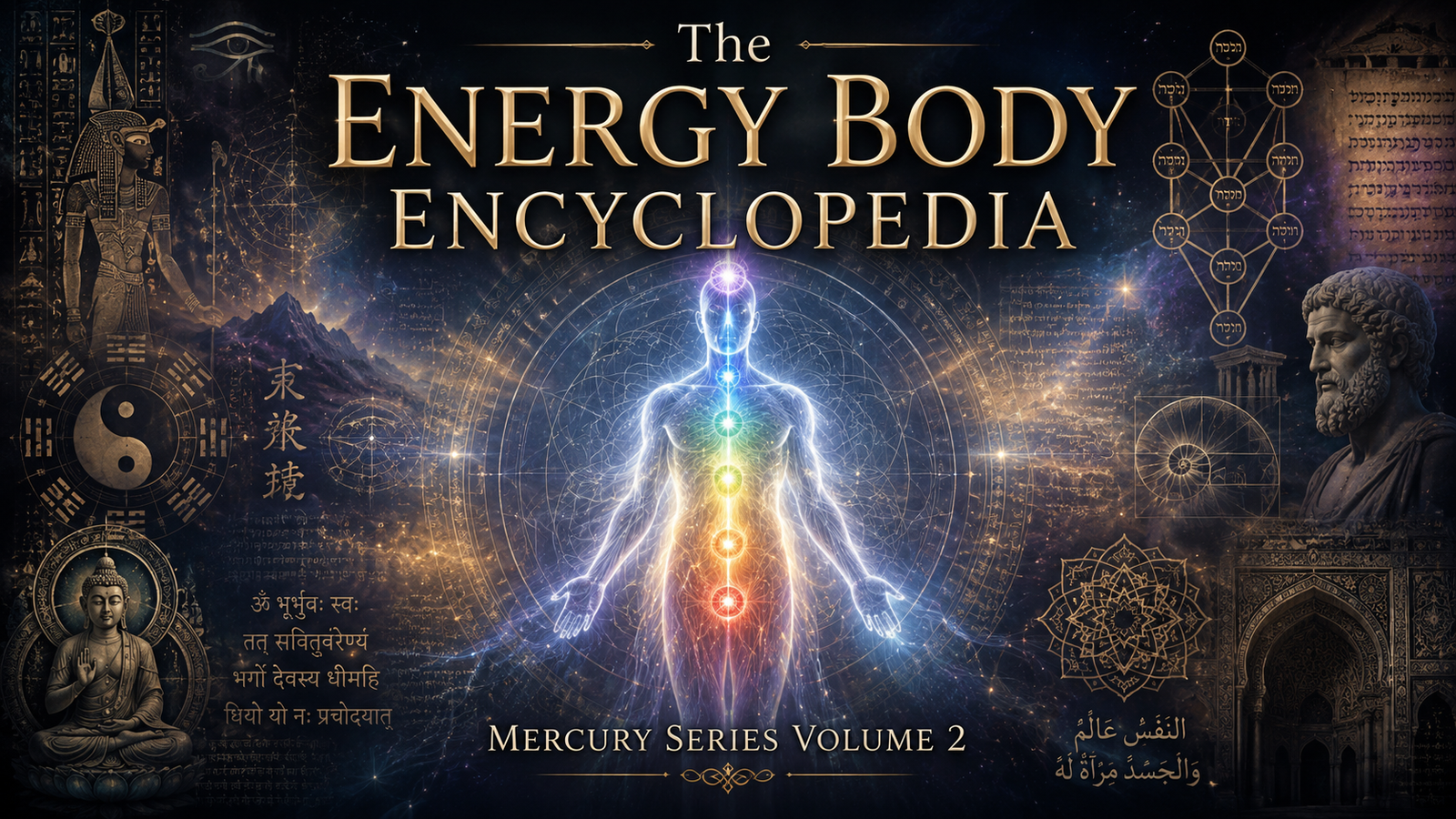
The Energy Body Encyclopedia: Mercury Series Volume 2
Download Free Via the 3 Dots
Subscribe: Veiled Mystic
The Energy Body Encyclopedia began with a question that was too large for a single chapter.
Across history, cultures have described forces, layers, centers, channels, breaths, lights, soul-components, and invisible powers associated with the human person. Some of the names are familiar. Prana. Qi. Chakras. Aura. Kundalini. Mana. Others are rarely placed beside them: the Egyptian ka, the Yoruba ase, the Greek pneuma, the Tibetan lung, the Kabbalistic Sefirot, the Polynesian wairua, the Norse ond, the Sufi lataif, the Navajo nilch’i, and hundreds more.
The Energy Body Encyclopedia, Mercury Series Volume 2, gathers 270 documented concepts from cultures around the world into one comparative reference work. The book is organized alphabetically, but it is meant to be read sideways as much as from beginning to end. Each entry asks where a term comes from, what its tradition says it means, how people historically worked with it, what parallels appear elsewhere, and what level of evidence actually supports the claim.
The PDF is free, as are the other books in this project. The point is to put carefully organized information into as many hands as possible, not to place a price barrier between a curious reader and the research.
This is the second book in the Mercury Series. Volume 1, Eastern Mysticism Unveiled, traced the historical development and mixing of major Eastern mystical traditions, including Yoga, Qigong, Tantra, Taoist internal alchemy, Buddhism, and Reiki. Volume 2 changes the scale. Instead of following one connected historical river, it asks what happens when related ideas are compared across the world.
Mercury Series Volume 3, Psychic History, is coming soon.
After that introduction to the book, this article will do what our companion articles are supposed to do: add value. Rather than summarize 270 encyclopedia entries, we will step back and look at the long human history behind the idea we now loosely call the energy body.
What Does “Energy Body” Actually Mean?
The phrase energy body sounds ancient, but the English phrase itself is not. It is a modern umbrella term. Ancient Egyptians did not say they had an energy body. Classical Chinese physicians did not call qi an energy body. Vedic priests did not use the phrase to describe prana. Polynesian communities did not organize mana, wairua, and related concepts under a single global category.
Each culture had its own language and its own theory.
That distinction is essential. If we translate every old concept as “energy,” we can create similarities that did not originally exist. A soul is not necessarily a force. A sacred blessing is not necessarily a bodily current. A divine radiance is not necessarily an aura. A channel in one system may function very differently from a channel in another.
Still, there is a reason modern readers keep grouping these ideas together.
Across many societies, we repeatedly find descriptions of a human being as something more than visible flesh. Sometimes the extra component is breath. Sometimes it is a vital force that can become strong or weak. Sometimes it circulates through named channels. Sometimes it gathers at centers. Sometimes the person is divided into several interacting souls or layers. Sometimes trained practitioners claim they can sense, direct, purify, preserve, increase, or transmit the invisible component.
The Energy Body Encyclopedia uses the modern phrase as a filing cabinet, not as a claim that all 270 entries are secretly the same thing.
That makes the historical question more interesting. We are not asking whether every culture discovered one identical invisible anatomy. We are asking why so many cultures created sophisticated models for aspects of life that ordinary anatomy did not seem to explain.
The Oldest Clue May Be the Simplest: Breath
Before laboratories, microscopes, anatomy textbooks, or electrical instruments, every human culture could observe one dramatic fact.
Living people breathe.
Dead people do not.
Breath is invisible most of the time, yet its presence is unmistakable. It moves in and out of the body. It changes with fear, exercise, sleep, illness, excitement, meditation, and death. It can be controlled voluntarily for a time, but it also continues without conscious command.
It is not surprising that breath became one of humanity’s most persistent bridges between body and spirit.
The Sanskrit prana carries meanings connected with breath and vital life. Chinese qi developed from a word-world involving vapor, air, and breath. Greek pneuma can mean breath or spirit. Hebrew ruach can mean wind, breath, or spirit. Latin spiritus carries the same basic association. Akkadian napishtu and related Semitic vocabulary connect life with breath and throat. Norse ond is also linked to breath and vital animation.
These words are not interchangeable. Their philosophies developed differently. Yet the recurring choice of breath as a model for life is understandable without assuming any hidden historical contact.
Every society could see the same phenomenon.
A person can survive without food for a considerable time. Water is more urgent. Breath is immediate. When breathing stops, the boundary between life and death suddenly becomes visible.
That observation may be one of the deepest roots of energy-body thinking.
Ancient Egypt and the Person Made of Many Parts
Ancient Egyptian religion offers one of the clearest warnings against reducing every old idea to a single “soul.”
Egyptian thought described the human person through several distinct components. The ka was associated with vital life and continuing sustenance. The ba was a mobile aspect of personality capable, in funerary thought, of movement beyond the tomb. The ib, or heart, carried moral and personal significance. The ren, the name, had to be preserved. The shadow could have its own spiritual importance. The akh described a successful transfigured state achieved after death.
This was not a simple body-versus-soul model.
The ka is especially relevant to an energy-body history because it was treated as a vital component that required nourishment. Tombs contained spaces for offerings. Food and drink were presented for the deceased. When physical offerings could no longer be guaranteed, images and written offering formulas could serve a continuing ritual function.
To the Egyptians, the invisible component of the person did not become irrelevant after physical death. It entered a different system of needs and relationships.
This matters because later Western popular spirituality often assumes that the “subtle body” is automatically a single luminous duplicate of the physical body. Ancient Egypt shows another possibility: the invisible person can be plural.
A complete human being may consist of several functions that modern language would divide among life force, personality, identity, conscience, memory, name, spirit, and transformed afterlife existence.
Egypt also developed the concept of heka, a power associated with effective ritual and creative action. Heka could be personified as a deity, but it also described a force or capacity employed through correctly performed words and rites.
This combination of vital components and effective sacred power makes Egypt one of the earliest richly documented civilizations relevant to a global history of subtle-person concepts.
Mesopotamia, Sacred Power, and the Life-Breath
Mesopotamian civilizations left some of humanity’s earliest written religious literature. Their surviving vocabulary does not give us one neat “energy body system,” but it does preserve concepts that belong in the broader comparison.
Akkadian napishtu connects breath with life and soul. The relationship is especially important because related Semitic languages developed comparable breath-life vocabulary. Here, similarity should not automatically be called independent convergence. Akkadian, Hebrew, and other Semitic languages share linguistic ancestry and centuries of regional contact.
That is one of the methodological rules that becomes important in any global comparison.
Similarity can have more than one cause.
Sometimes two cultures independently build comparable ideas because they are observing the same human experience. Sometimes ideas spread through trade, conquest, migration, translation, intermarriage, or religion. Sometimes two languages inherited a concept from an older common ancestor. Sometimes a later tradition deliberately borrows a foreign term and changes it.
Mesopotamian religion also used concepts such as melam, the awe-inspiring radiance or terrible splendor associated with gods and kings. This is tempting to compare with aura traditions, but caution helps. Melam was embedded in divine and royal authority. A modern colored aura chart is a very different construction.
The comparison becomes useful only when the differences stay visible.
India: Prana Before the Modern Chakra Chart
India produced one of the world’s most elaborate traditions of subtle physiology.
Prana is central to that history. In broad terms, it refers to vital breath or life force. Over centuries, Indian medical, philosophical, yogic, and tantric traditions developed increasingly detailed accounts of how prana functions.
Ayurvedic theory differentiated vital functions into vayus, or winds. Yogic practice developed pranayama, disciplined work with breathing. Later subtle-body systems described prana moving through nadis, or channels. Tantric systems placed centers along a central axis and connected those centers with sound, elements, deities, visualization, and transformation.
Modern wellness culture often presents this entire structure as one system that appeared fully formed in deep antiquity.
The history is more interesting than that.
Prana is older than the familiar seven-chakra diagram. Breath disciplines are older than many later tantric maps. The vocabulary changed and accumulated over time. Different texts used different numbers of channels and centers. Different schools emphasized different techniques.
This is exactly what we should expect from a living tradition extending across many centuries.
No one expects European medicine in 500 BCE, 1200 CE, and 1900 CE to be identical simply because all three are “Western medicine.” Indian religious and medical history deserves the same chronological respect.
Chakras Are Ancient, but the Familiar Seven-Chakra System Has a History
Few energy-body ideas are more recognizable today than the seven chakras.
The standard modern image shows seven colored centers rising from the base of the spine to the crown. Each has a name, location, color, psychological meaning, and often an associated endocrine gland.
That picture is useful for modern teaching, but it should not be projected backward unchanged.
Chakra means wheel or disc. Tantric Hindu and Buddhist traditions developed systems of subtle centers along the body. However, historical texts do not all present seven. Different traditions describe different numbers, arrangements, deities, seed syllables, petals, and functions.
The Energy Body Encyclopedia places the major systematization of chakra theory within tantric literature developing from roughly the middle of the first millennium CE onward, rather than presenting the modern seven-center scheme as an unchanged Vedic map.
This correction does not make chakras less interesting.
It makes them more interesting.
We can watch a religious technology develop. Earlier ideas of breath, channels, ascetic heat, meditation, sound, and ritual become organized into increasingly sophisticated maps. Buddhist and Hindu tantric systems influence one another. Later yoga traditions adapt them. Nineteenth- and twentieth-century interpreters bring them into Western esoteric thought. Modern psychology and wellness culture add new associations.
The chakra system therefore has two histories at once: an ancient and medieval South Asian history, and a modern global history.
Channels, Nadis, and the Idea That Vital Force Circulates
Once a tradition describes a vital force, a natural second question appears.
Does it move?
Indian systems answered yes. Nadis became channels through which prana was said to circulate. The best-known later trio is ida, pingala, and sushumna, with sushumna occupying the central role in many yogic and tantric systems.
Chinese medicine independently developed an elaborate channel network associated with qi. Tibetan systems describe tsa and lung. Other traditions use very different frameworks, but the recurring idea is that invisible vitality is not randomly distributed. It has pathways.
That is a significant conceptual step.
A vague life force is difficult to practice with. A mapped force creates technique.
If vitality moves through routes, then a practitioner can breathe in a particular way, press a point, insert a needle, assume a posture, visualize a path, contract a muscle group, use heat, chant a sound, or place the hands at a specific location.
In other words, invisible anatomy becomes operational.
This is one reason maps of subtle channels deserve historical attention even when their literal physical existence remains unconfirmed. They shaped real practices, institutions, medical systems, martial arts, and contemplative disciplines.
China: Qi Became an Entire Language of Life
Qi is probably the strongest global parallel to prana, but it should not be treated as the Chinese translation of an Indian concept.
Chinese traditions developed qi within their own intellectual world.
Qi could describe breath, vapor, vitality, material force, atmospheric influence, and the processes through which the world condenses and changes. In medicine, qi became differentiated into functional categories. In martial and cultivation traditions, it could be stored, refined, circulated, strengthened, or directed. In philosophy, it participated in broader accounts of cosmology and transformation.
Traditional Chinese Medicine developed meridian theory, commonly describing twelve primary channels along with extraordinary vessels. Acupuncture, moxibustion, herbal medicine, movement, breathing, and diet became integrated into a larger medical model involving qi, blood, organs, yin and yang, and the five phases.
Taoist internal alchemy added another layer. Practitioners worked with jing, qi, and shen through staged refinement. Dantian, often translated loosely as energy centers or fields, became major locations in internal cultivation.
The similarities with Indian subtle physiology are striking.
Both traditions developed vital-force concepts. Both linked them with breath. Both created channel systems. Both developed centers. Both produced highly technical exercises for deliberate internal transformation.
Yet their terminologies, cosmologies, medical theories, and historical sequences are different.
That makes prana and qi more valuable as a comparison, not less.
Independent Convergence or Historical Contact?
When two cultures have similar ideas, there is a temptation to choose one dramatic explanation.
Either they discovered the same hidden truth independently, or one secretly copied the other.
History is rarely that simple.
India and China had contact. Buddhism moved from India through Central Asia into China. Monks, merchants, translators, physicians, and travelers carried ideas across enormous distances. Later Chinese Buddhist traditions interacted with Taoist thought, while Indian and Tibetan systems continued to evolve.
However, core Chinese qi concepts and core Indian prana concepts developed early enough that many of their foundational features cannot simply be explained by late Buddhist transmission.
That leaves a genuine comparative problem.
Two civilizations can independently notice that breath changes consciousness. Both can discover that controlled breathing affects heart rate, tension, temperature, and attention. Both can develop body maps through accumulated practical experience. Later contact can then cause two already-existing systems to borrow from and reshape one another.
Independent development and later transmission can both be true.
That mixed model is often more historically realistic than searching for one original source behind everything.
Tibet: A Meeting Place of Indian and Indigenous Systems
Tibetan traditions are especially valuable because they show what cultural fusion looks like when we can trace much of the history.
Indian Buddhism entered Tibet and brought sophisticated tantric systems. Indigenous Tibetan and Bon traditions contributed their own ritual, cosmological, medical, and spirit-related frameworks. Over centuries, these materials interacted.
Tibetan Vajrayana describes channels, winds, drops, centers, and advanced contemplative practices. Terms such as tsa, lung, and thigle belong to specific Tibetan technical vocabularies. Tummo uses breath, visualization, and bodily technique in practices traditionally associated with inner heat. Dzogchen traditions use their own highly developed language of awareness and realization. Tibetan medicine incorporates wind and subtle-function concepts into diagnostic models.
Here, resemblance to Indian Tantra is not mysterious independent convergence. There is documented transmission.
That difference matters.
A good comparative encyclopedia should not count every similarity as an independent vote for one universal theory. Some similarities are evidence of cultural contact. Tibet gives us a clear case of traditions traveling, translating, and changing.
Ancient Greece: Pneuma, Psyche, Aether, and Vitality
The Greek world developed several concepts that later Western thought would repeatedly revisit.
Psyche eventually became the ancestor of our word psychology, but its ancient meanings included life and soul. Pneuma could mean breath, spirit, or vital principle. Stoic philosophers developed sophisticated theories in which pneuma played an organizing role in living bodies and the cosmos. Aristotle’s aether described a fifth celestial element distinct from the four terrestrial elements.
These ideas entered later medical, philosophical, religious, and esoteric traditions.
When modern people speak casually about “etheric energy,” they may not realize how long and tangled the Western history of ether actually is. Ancient aether was not the modern aura. Medieval and Renaissance thinkers reworked classical elements. Early modern science proposed mechanical ethers. Nineteenth-century physics seriously debated an electromagnetic luminiferous ether before experiments and relativity removed the need for that specific model.
Meanwhile, occult and Theosophical writers reused the language of ether in a different way.
One word can therefore pass through cosmology, physics, philosophy, and esotericism while changing meaning repeatedly.
Judaism: Breath, Soul, and the Later Kabbalistic Map
Jewish traditions also resist a simple one-word translation of “soul.”
Nefesh, ruach, and neshamah developed overlapping but distinct meanings across biblical, rabbinic, philosophical, and mystical literature. Breath and spirit language appears throughout the Hebrew textual tradition.
Later Kabbalah created one of the world’s most influential symbolic maps of divine emanation: the Sefirot.
The Sefirot are not chakras.
Modern diagrams sometimes place the Tree of Life beside the chakra system and imply that both are versions of one hidden anatomy. That can be visually suggestive, but historically they emerged in different theological worlds. The Sefirot primarily describe divine emanation and the relationship between the infinite divine and created reality, although later mystical practice can map aspects of the system onto the human form.
This is a good example of why structural comparison must not erase category.
Two systems can both use vertical arrangements, centers, polarity, ascent, and transformation without being historically or functionally identical.
Christian Mysticism and the Language of Divine Energy
Christian traditions are not usually included in popular “energy body” discussions, yet their history contains concepts worth comparing.
Eastern Orthodox theology developed the language of divine energeia, especially in the work associated with Gregory Palamas and Hesychast spirituality. In this framework, God’s essence remains transcendent while divine energies can be genuinely experienced.
Hesychast contemplative traditions describe prayer, stillness, breath-related discipline, and experiences associated with divine light. The Taboric or uncreated light became central to theological debates over whether direct contemplative experience of God was possible.
This should not be casually equated with qi, kundalini, or an aura.
It belongs to Christian theology.
But at the comparative level, it contributes to a recurring human pattern: advanced contemplative traditions often develop technical vocabularies for experiences of light, presence, warmth, interior movement, altered perception, and transformed identity.
The historical existence of those reports is well documented. Their ultimate metaphysical interpretation remains a separate question.
Islamic and Sufi Traditions: Baraka, Nur, and the Lataif
Islamic civilization also produced concepts that fit several different categories in the encyclopedia.
Baraka refers to blessing or sacred potency associated with God and, in many historical Muslim contexts, with holy people, objects, places, lineages, or actions. Nur means light and carries both scriptural and mystical importance. Sufi traditions developed sophisticated psychological and spiritual vocabularies including nafs, qalb, ruh, sirr, himma, and, in some systems, lataif.
The lataif are sometimes marketed today as the “Sufi chakras.” That label is convenient but historically misleading.
Different Sufi orders developed different subtle-center systems. Their colors, locations, meanings, and sequences are rooted in Islamic mystical anthropology rather than simply borrowing a seven-chakra chart.
The comparison is still valuable. Several traditions independently use inner centers as stages of spiritual transformation.
The mistake comes when resemblance becomes identity.
West Africa: Ase and Nyama
Global discussions of subtle energy have often been dominated by Asian terminology. That leaves out major African traditions.
Yoruba thought includes ase, a concept of creative, effective power associated with the ability to make things happen. Ase is present throughout the cosmos and is connected with divine beings, humans, nature, ritual, and authoritative speech.
This last point is especially interesting comparatively.
Vedic traditions developed mantra. Egyptian religion developed heka and authoritative divine speech. Yoruba traditions describe words spoken with proper authority as carrying ase. Norse and other ritual traditions also gave special power to correctly formed speech.
Again, the details differ. Yet human beings repeatedly treated language as more than communication. Under the right conditions, words were believed to act.
Mande traditions describe nyama, another form of potency or force embedded in social, ritual, craft, and natural relationships. Such concepts show that “energy body” history should not be reduced to colored centers inside individual bodies. In many cultures, power exists between people, places, objects, ancestors, words, and social roles.
Mana: One of the World’s Most Misused Spiritual Words
Mana is now a global pop-culture word. Fantasy games use it as a magical fuel meter. Self-help books use it loosely for personal power. Hawaiian-themed products use it as a synonym for good energy.
Its real history is much more specific.
Related mana concepts appear across Polynesian and Melanesian societies, but they are not identical everywhere. The term entered Western academic awareness through nineteenth-century work in Melanesia, especially R. H. Codrington’s study of Melanesian religion and society.
Mana was not simply “energy” in the modern physics sense. It could describe efficacy, potency, sacred authority, spiritual force, and the special power attached to people, objects, places, lineage, and ritual position.
That makes mana a useful comparison with Yoruba ase, Haudenosaunee orenda, Lakota wakan, Islamic baraka, and other concepts of distributed sacred potency.
It also demonstrates a recurring problem in cross-cultural spirituality.
A culturally precise word becomes popular. Its original context drops away. The word survives as a vague synonym for mystical energy.
A comparative history should restore the context rather than discard the word.
Native American Traditions and the Danger of a Single “Indian” Energy System
There is no single Native American spirituality.
North America contains hundreds of distinct nations with different languages, histories, ceremonies, cosmologies, and rules governing what knowledge may be shared publicly.
That means broad comparisons require special care.
Documented public sources preserve concepts such as Algonquian manitou, Haudenosaunee orenda, Lakota wakan, Navajo nilch’i, and Cherokee terminology relating to spiritual specialists and power. These concepts cannot responsibly be compressed into a generic “Native life force.”
Some refer to sacred potency. Some connect breath, wind, life, spirit, place, or personhood. Their meanings depend on their own cultures.
The Energy Body Encyclopedia deliberately limits itself to material already present in legitimate public academic or ethnographic records when dealing with traditions that maintain restricted ceremonial knowledge.
That principle is more important than completeness.
A researcher has no right to expose private sacred material merely because the material would make an interesting comparison.
Norse and Germanic Traditions: The Self Was Not Necessarily One Thing
Pre-Christian Norse and Germanic traditions provide another fascinating multi-part model of the person.
Terms such as hamr, hugr, fylgja, hamingja, megin, minni, ond, and wyrd occupy different parts of a complex spiritual vocabulary. Some concern form or shape, some thought or mind, some accompanying spirits, some luck or inherited fortune, some strength, some breath, and some fate.
Later popular treatments sometimes force these terms into a tidy modern subtle-body diagram.
The historical material is less tidy.
That is not a weakness. It may tell us something important about the human tendency to divide personhood into functions.
Ancient Egypt did it one way. Norse traditions did it another. Chinese thought differentiates hun and po. Jewish mystical systems distinguish layers or levels of soul. Tibetan traditions use their own categories.
The recurring pattern is not one universal list. The pattern is that many cultures resisted the idea that a human being could be fully described as one physical body plus one undifferentiated soul.
The Americas Beyond North America
Mesoamerican and Andean civilizations also developed complex theories of personhood, vitality, sacred power, and landscape.
Nahua traditions preserve terms such as tonalli, teyolia, and ihiyotl, which scholars have used to reconstruct a multi-component model of the person. Maya traditions developed concepts such as k’uh within a highly sophisticated ritual and calendrical worldview. Andean traditions include categories such as sami, hucha, and kawsay in discussions of vitality, reciprocity, sacred landscape, and human relationship with the wider living world.
These systems remind us that a modern Western individual-body model may be too narrow for comparative work.
In many traditions, vitality is ecological and social.
A mountain can be sacred. A lineage can carry power. A place can affect a person. Reciprocity can maintain or disrupt spiritual balance. The invisible world is not always imagined as something trapped inside the skin.
Sacred Geography Is Part of the Energy-Body Story
When people hear “energy body,” they usually picture a glowing outline around a person.
History often points in a different direction.
Sacred power is frequently attached to places.
Mountains, springs, caves, groves, rivers, temples, burial grounds, crossroads, and stones can become concentrations of spiritual significance. Japanese Shinto associates kami with places and natural features. Andean traditions developed strong relationships with sacred mountains. Islamic traditions recognize baraka associated with certain holy places and people. Sámi traditions preserve sacred geography of their own. Indigenous cultures around the world often describe land as active within spiritual relationships.
This suggests that the historical category we call energy is frequently relational rather than merely anatomical.
A person may become powerful because of where they are, who initiated them, what object they hold, what ancestor accompanies them, what words they speak, or what ritual relationship they maintain.
The invisible is often a network, not a bubble.
The Nineteenth Century Reinvented the Western Energy Body
Modern Western ideas of aura, etheric body, astral body, psychic energy, and invisible healing owe an enormous debt to the nineteenth century.
This period produced a remarkable collision among science, industrial technology, Spiritualism, colonial encounters, Asian religious translation, occult revival, electricity, magnetism, psychology, and medicine.
Western audiences learned more about Indian and Buddhist traditions. At the same time, new technologies made invisible forces part of ordinary life. Telegraph wires transmitted messages across distance. Electricity moved through circuits. Magnetism acted without visible contact. Photography captured images no human hand had drawn.
The cultural imagination changed.
If invisible electricity could move through a wire, perhaps life itself had an invisible current. If magnetism could act across space, perhaps minds or bodies could influence one another. If cameras could reveal what eyes missed, perhaps another instrument could photograph the soul.
Some of those hopes produced real science. Others produced dead ends. Still others created the vocabulary of modern esotericism.
Mesmer and Animal Magnetism
Franz Anton Mesmer became one of the most influential figures in the Western history of invisible healing forces.
In the eighteenth century, Mesmer proposed a universal magnetic fluid connected with health and illness. He believed blockages or imbalances could be corrected through techniques that came to include passes of the hands and dramatic group treatments.
Mesmerism became enormously popular and controversial.
In 1784, a French royal commission that included Benjamin Franklin investigated the claims. The commission rejected the proposed magnetic fluid and attributed observed effects largely to imagination and expectation.
From one angle, Mesmer’s central physical theory failed.
From another angle, his movement had a huge afterlife.
Mesmeric practices contributed to the development of hypnotism and the study of suggestion. They influenced Spiritualism, occultism, alternative healing, and later ideas about personal magnetism.
This is an important lesson for the history of energy concepts.
A theory can be scientifically wrong in its original explanation while still leading to real discoveries about psychology, expectation, attention, ritual, or interpersonal influence.
Theosophy and the Modern Layered Subtle Body
The Theosophical movement played a major role in creating the modern Western picture of subtle anatomy.
Founded in the late nineteenth century, Theosophy blended Western esoteric traditions with interpretations of Hindu and Buddhist ideas. Its writers developed elaborate models of physical, etheric, astral, mental, and spiritual bodies or planes.
Charles Webster Leadbeater and Annie Besant became especially influential in popular descriptions of subtle bodies and colored auras. Rudolf Steiner later developed Anthroposophy with its own related but distinct multi-body model.
This is where historical chronology becomes essential.
When a modern chart says that ancient civilizations all taught an identical seven-layer aura, that claim deserves skepticism.
Layered-body systems existed before Theosophy. Indian kosha theory is genuinely old. Other cultures had multi-part person models. But the specific modern Western synthesis of etheric, astral, mental, and related bodies has a traceable nineteenth- and twentieth-century history.
Modern spiritual culture did not simply preserve ancient teachings.
It also created new syntheses.
The Aura: Ancient Halo or Modern Construction?
The word aura has older linguistic roots related to air or breeze, but the modern spiritual aura is largely a synthesis.
Religious art across cultures has long depicted sacred people surrounded by light. Christian saints have halos. Buddhist and Hindu images may use nimbuses or radiant fields. Ancient rulers and gods could be described as shining or possessing terrifying splendor.
Those images make it easy to say, “Everyone believed in auras.”
But a halo in religious art is not automatically the same thing as a modern claim that every person possesses multiple colored layers corresponding to health and emotion.
The modern aura concept grew through Western occultism and Theosophical systematization. Leadbeater’s early twentieth-century work helped popularize detailed colored representations connected with emotions and spiritual development.
So the honest answer is both yes and no.
Humans have imagined sacred radiance for thousands of years.
The standardized modern aura chart is much younger.
Kirlian Photography and the Dream of Photographing the Aura
Twentieth-century technology gave aura claims a powerful new visual language.
Kirlian photography produces luminous corona patterns around objects exposed to high-voltage, high-frequency electrical fields. Photographs of fingertips, leaves, coins, and other objects can look astonishingly like glowing energy fields.
Popular interpretation quickly connected these images with the aura.
However, the visible corona can be explained through known electrical processes affected by variables such as moisture, pressure, grounding, voltage, and surrounding conditions. The photograph is real. The leap from corona discharge to proof of a spiritual aura is not established.
This is another recurring pattern.
New technology produces a genuine phenomenon. Existing spiritual language interprets the phenomenon. The interpretation may be compelling without being scientifically demonstrated.
A careful history should preserve both sides.
Reiki Shows How Old Ideas Become Modern Systems
Reiki is often advertised as an ancient Japanese healing art.
Its actual modern history is more recent and more traceable.
Mikao Usui developed the system in Japan in the early twentieth century. Chujiro Hayashi and Hawayo Takata played major roles in its later development and international transmission. Modern Reiki vocabulary includes concepts such as byosen and hibiki for sensations practitioners report during treatment.
Reiki draws on a wider East Asian cultural environment in which ki, the Japanese reading of qi, was already familiar. It also developed during a period when Japanese religious, therapeutic, martial, and self-cultivation movements were actively reorganizing older practices for modern society.
Scientifically, the United States National Center for Complementary and Integrative Health currently states that Reiki has not been clearly shown to be effective for health-related purposes and that there is no scientific evidence supporting the particular energy field proposed in Reiki theory.
That conclusion does not erase Reiki’s history or the experiences reported by practitioners.
It tells us where the external evidence stands.
That distinction is the same one used throughout the encyclopedia.
What Is the Modern “Biofield”?
Biofield is a modern scientific-sounding term used by some researchers and complementary-health communities for proposed fields associated with living organisms.
The term can create confusion because living bodies unquestionably produce measurable physical signals and fields. The heart produces electrical activity. The brain produces electrical activity. Muscles generate electrical signals. Bodies emit heat. Magnetic fields associated with physiological activity can be measured with sufficiently sensitive instruments.
Those established phenomena do not automatically prove the existence of the broader subtle field described in Reiki, aura, qi, or prana traditions.
Some researchers have attempted to create a broader biofield framework that includes both known biological fields and proposed forms of information or regulation not yet adequately explained. Clinical studies have also investigated practices commonly called biofield therapies.
The research remains contested.
That is the most useful description for a general audience.
There is a real research literature. There are published positive findings. There are also methodological problems, inconsistent results, small studies, difficulties with blinding, and no broadly accepted physical mechanism establishing a separate subtle energy field corresponding to traditional claims.
Anyone who says “science has proven the aura” is overstating the evidence.
Anyone who says “no scientist has ever studied any of this” is also wrong.
Science and Tradition Are Answering Different Questions
Part of the conflict surrounding energy-body ideas comes from asking one type of evidence to do another type of evidence’s job.
History can establish that people believed something.
A surviving Sanskrit text can prove that a chakra concept was documented at a particular time. It cannot prove that a chakra exists as a measurable anatomical structure.
Ethnography can establish how a living community understands mana or baraka. It does not independently prove the metaphysical reality described by that community.
A clinical trial can investigate whether a practice changes pain scores, anxiety, blood pressure, or another outcome. Even a positive result may not prove the traditional mechanism proposed to explain the result.
A practitioner’s experience can be psychologically or spiritually meaningful. It is not automatically universal scientific evidence.
These categories do not need to be enemies.
They simply need labels.
What Cross-Cultural Convergence Can Tell Us
The most provocative part of this subject is not any single tradition.
It is the repetition.
Breath becomes life.
Vitality can increase or decrease.
Invisible force moves.
Movement follows channels.
Channels meet at important centers.
Training changes the inner state.
Words can carry power.
Hands can transmit, detect, bless, or direct something unseen.
Light accompanies advanced spiritual states.
The self may have several components.
Places can possess power.
Specialists can cultivate unusual capacities.
These patterns recur widely enough to deserve investigation.
But convergence alone does not prove one hidden energy system.
Some similarities may arise because human bodies are similar everywhere. Everyone breathes. Everyone experiences heartbeat, warmth, tingling, dizziness, emotion, pain, fatigue, sexual arousal, dreams, altered states, and the effects of intense concentration.
Some similarities may arise because human minds classify experience in similar ways.
Some come from historical contact.
Some may be coincidence.
And some may point toward phenomena that current models have not fully described.
The evidence becomes more useful when all of those possibilities remain open.
What Cross-Cultural Convergence Cannot Tell Us
It cannot tell us that every similar word means the same thing.
It cannot tell us that a tradition is scientifically correct simply because it is old.
It cannot tell us that independent cultures must have received knowledge from a lost advanced civilization.
It cannot tell us that two maps prove an invisible organ exists.
It cannot tell us that a spiritual experience is meaningless because it is not measurable.
And it cannot tell us that every modern practice is genuinely ancient merely because its teachers use ancient vocabulary.
The comparative method works best when it produces better questions rather than premature certainty.
The Most Important Pattern May Be Technique
There is another feature of these traditions that deserves more attention than it usually receives.
They do things.
These are not merely abstract philosophies.
People breathe in prescribed rhythms. They hold postures. They chant. They fast. They dance. They drum. They visualize. They press points. They insert needles. They expose themselves to cold. They sit motionless. They move slowly. They repeat prayers. They use hand gestures. They engage in ritual purification. They isolate themselves. They maintain attention for long periods.
Many of those actions unquestionably change human experience.
Breathing changes physiology. Repetitive movement changes attention. Fasting changes metabolism. Cold changes the nervous system. Music and rhythm change arousal. Meditation can change perception and emotional regulation. Expectation changes subjective experience. Group ritual changes social and psychological states.
The traditional explanation of what those changes mean may differ from a modern physiological explanation.
But the underlying practice is still real.
This may be one reason energy traditions persist. A person can actually feel something happen.
Why Sensation Is So Persuasive
Practitioners across different systems report heat, coolness, pressure, pulsing, vibration, tingling, heaviness, lightness, expansion, currents, movement, flashes of light, altered body boundaries, or a sense of presence.
Those sensations can be intense.
The difficult question is interpretation.
A Qigong practitioner may call a sensation qi. A yogi may call a comparable sensation prana. A Reiki practitioner may interpret heat in the hands as energy flow. A neuroscientist may describe changes in attention, interoception, circulation, nerve activity, or autonomic state.
Those explanations operate at different levels.
The sensation itself may be genuine even when people disagree about its cause.
That is an important middle ground between belief and dismissal.
Why the Energy Body Became Global
For most of history, these systems were local or regional.
That changed dramatically during the nineteenth and twentieth centuries.
Colonialism, migration, translation, missionary activity, academic Orientalism, world fairs, immigration, print culture, travel, new religious movements, martial arts, psychotherapy, counterculture, wellness movements, and eventually the internet moved spiritual vocabulary around the world.
Yoga became global.
Chinese medicine spread internationally.
Reiki moved from Japan through Hawaii and North America.
Theosophy blended Asian and Western esoteric terminology.
New Age culture placed chakras, auras, crystals, kundalini, meridians, and reincarnation into one enormous spiritual marketplace.
That globalization created access, but it also created historical confusion.
Ideas from separate centuries and civilizations now appear together on the same website menu.
The Energy Body Encyclopedia is partly an attempt to untangle that mixture.
Why a Concordance Instead of Another Spiritual System?
There are already enough systems telling readers what to believe.
A concordance can do something different.
It can place terms beside one another without forcing them to merge.
The Energy Body Encyclopedia gives each concept an independent entry. It identifies language, culture, earliest documentation where available, traditional meaning, practice, parallels, and evidentiary status. Hub entries handle larger families such as chakras, koshas, Sefirot, and other multi-part systems.
The book also includes cultural and thematic indexes. That means a reader can approach it in several ways.
You can look up a single term.
You can follow one culture.
You can compare all the channel systems.
You can compare vital substances.
You can look at multi-part soul models.
You can examine modern proposals such as biofield, Kirlian aura, Mesmerism, orgone, and related concepts.
That structure encourages investigation rather than passive acceptance.
How to Read the Encyclopedia Comparatively
A useful method is to ask the same questions every time you open a new entry.
What kind of thing is being described?
Is it a force, a soul, a center, a channel, a substance, a spiritual attainment, a place, a technique, or a divine quality?
How old is the documentation?
Is the source a primary text, inscription, archaeological artifact, ethnographic record, later commentary, or modern teacher?
Could this culture have had contact with another culture describing something similar?
Does the parallel involve only a vague resemblance, or does it share unusual structure and function?
What is historically certain?
What is the tradition’s own claim?
What has been externally tested?
What remains unknown?
Asking those questions repeatedly changes the experience of the book.
The entries begin talking to one another.
Comparison Is Not the Same as Collapsing Traditions
This may be the most important rule in the entire project.
Seeing a similarity is not permission to erase a culture.
Prana is not simply qi with a Sanskrit name.
Mana is not just Polynesian prana.
Baraka is not an Islamic aura.
The Sefirot are not Jewish chakras.
Christian uncreated light is not automatically kundalini.
Ancient Egyptian ka is not an etheric body.
Each idea becomes valuable precisely because it emerged inside a specific history.
If we erase those differences, the comparison becomes meaningless.
The echo matters because the voices are different.
What Would Count as Strong Evidence?
If a literal energy body exists in a way that science can detect, the strongest evidence would not be another ancient text.
It would be repeatable measurement.
A reliable physical signal should be detectable under controlled conditions. A practitioner who claims to detect a field should perform above chance when blinded. A proposed channel should produce reproducible effects distinguishable from known nerves, blood vessels, connective tissue, expectation, and placebo. A healing intervention should outperform appropriate controls in well-designed studies.
That standard is demanding.
It should be.
Extraordinary claims become valuable when they survive good tests.
At the same time, failure to prove one mechanism does not invalidate every practice associated with the tradition. Acupuncture can be studied for clinical outcomes separately from the literal existence of meridians. Meditation can produce measurable effects without proving every Buddhist cosmological claim. Hypnosis remained useful after Mesmer’s magnetic fluid was rejected.
Good research separates outcome from explanation.
Why the Question Remains Worth Asking
After thousands of years, humans still do not fully understand consciousness.
We know vastly more about anatomy, neurology, electricity, biochemistry, immunity, genetics, hormones, and perception than ancient cultures did. Yet subjective experience remains difficult. Placebo and expectation remain powerful. Interoception remains an active area of research. Meditation continues to produce scientifically interesting changes. Social connection affects health. Breath training can alter autonomic state.
None of that proves prana or qi as literal substances.
But it does show why ancient attempts to map internal experience should not be dismissed as childish simply because their explanatory language differs from modern biomedicine.
They were maps made with different tools.
Some parts may be wrong.
Some may be metaphor.
Some may encode practical observations inside cosmological language.
Some may point to aspects of experience modern science can describe more precisely.
And some questions may remain open.
Sources and Further Reading
This companion article draws primarily on the research assembled in The Energy Body Encyclopedia and the historical framework developed in Eastern Mysticism Unveiled. Readers who want to check the modern scientific side of the discussion can also consult the United States National Center for Complementary and Integrative Health and the peer-reviewed literature indexed through the National Library of Medicine.
- The Energy Body Encyclopedia, Mercury Series Volume 2
- Eastern Mysticism Unveiled, Mercury Series Volume 1
- National Center for Complementary and Integrative Health: Reiki
- Biofield Science and Healing: History, Terminology, and Concepts
- Biofield Therapies: Guidelines for Reporting Clinical Trials
Closing Thoughts on the Energy Body
The most interesting fact about the energy body may not be whether one modern diagram is correct.
It may be that human beings have been trying to map invisible aspects of life for as long as they have been able to record their ideas.
They watched breath leave the dying.
They felt heat rise during ritual.
They noticed how fear changed the heart and stomach.
They discovered that breathing could alter consciousness.
They experienced dreams in which the self seemed to travel without the body.
They saw illness change vitality before obvious physical signs appeared.
They felt the emotional force of sacred places, music, crowds, grief, sex, prayer, danger, and awe.
They built vocabularies for those experiences.
Some became medical systems.
Some became religions.
Some became mystical technologies.
Some became philosophy.
Some became folklore.
Some entered modern science and failed.
Some changed form and survived.
And some remain open questions.
The Energy Body Encyclopedia does not settle those questions.
It makes them harder to ask carelessly.
That may be more useful.
About the author


Ultimate English Syllable List – Extra Ex-Ten-Sive
English Syllable List A–Z: A Preliminary Language Research Resource Language is built from sounds, patterns, and word histories that have traveled between people and cultures for centuries. As a companion resource to The Magick Root of Language, this A–Z index collects 24,219 different written chunks extracted from English word examples. It offers a starting point for investigating syllables, word formation, and the many cultural histories represented in English vocabulary. How to use the list: entries are alphabetized by their written form. Each entry shows up to three example words and a count of occurrences in the source extraction. The count refers to occurrences in the processed word list, not to usage frequency in everyday English. Browse by letter, search the page, and compare candidate chunks against documented word histories. Important research limitation: this is an automated inventory of written chunks […]
The Magick Root of Language – Magick Language Investigation – Free Download
Magick Language and the Questions Behind the Book Download Free Via the 3 Dots What does it mean to say that a word possesses power? The Magick Root of Language begins with a familiar observation: a spoken sentence can change what people do. A warning redirects a crowd. A promise establishes an expectation. A public ruling alters a legal status. A name allows an individual, place, or abstract idea to be identified and remembered. These effects are neither imaginary nor supernatural. They are consequences of how people think, cooperate, build institutions, and respond to shared signs. The harder question begins when a tradition attributes additional powers to a precise sound, a sacred name, a written character, or a ceremonial formula. The book investigates that historical claim without assuming in advance that every account describes a literal physical process.This is the […]
Don’t Be a Loosh Bag – By Masked Matrix – Full Album
Album: Don't Be a Loosh Bag By - Masked Matrix Release Date - 10/12/2026 1. Energy Vampires 2. Dark Clouds 3. Mind Traps 4. Loosh Farmers 5. Falling From Grace 6. Holographic Simulation 7. All Seeing Eye 8. Shadow People Under The Bed 9. See You in the Duat 10. The Mirror Level 11. The Jinn's Lamp 12. The Town With No Name 13. Madam Blavatsky 14. Unanswered Prayers 15. Legend of the Abyss 16. First Peak Behind the Veil 17. Apophis Is Coming <Download Album Free Here> 1. Energy Vampires [Verse] Night descends Shadows bite Dreams invaded Endless fight Astral claws They rip and tear Feeding hunger Unaware [Chorus] Energy drained Soul consumed In your sleep You're doomed They haunt the void Silent scream Energy vampires stalk your dream [Verse 2] Wings of black Eyes that gleam […]
The Secret Ladder of Existence – Inspired By Madam B | Free Download
The Secret Ladder of Existence: Two Editions, One Invitation to Explore Reality Download Free Via the 3 Dots Download Free Via the 3 Dots https://youtu.be/RJldG2HsYb4?si=pCMP2cRzEMjPS9Vw Subscribe: Veiled Mystic 333 A book can begin with a question that refuses to disappear. What does it mean to exist, and how much of existence can human beings actually perceive? We move through a world of bodies, landscapes, weather, and measurable forces. Yet we also inhabit a world of memory, imagination, dreams, relationships, moral commitments, and private experiences that no stranger can observe directly. The puzzle is not simply whether the physical world is real. The puzzle is whether our ordinary description of that world is complete, and what kind of evidence would justify any claim that more remains to be discovered. These questions inspire The Secret Ladder of Existence, a new exploration of […]
Angelometry: A History of Angels Across Religion, Myth, and Mysticism
Angelometry: A History of Angels Across Religion, Myth, and Mysticism Download Free Via the 3 dots https://youtu.be/ZxOdzI88Iy0?is=kKvvAn-zkfuMN_oF https://youtu.be/7KC7Wsht7u0?si=z4U65lMOECOnJ1uP Subscribe: Veiled Mystic 333 Angelometry is a useful word for a subject that refuses to remain inside a single religious box. The history of angels is not one continuous system handed down unchanged from antiquity. It is a layered record of messengers, heavenly attendants, watchers, throne beings, guardians, destroyers, healers, scribes, planetary intelligences, divine names, spirits, and even ancient gods who were later absorbed into angelic catalogs. To study Angelometry seriously is therefore to study how human beings across different times and cultures imagined the invisible world around the divine. The familiar image of a beautiful winged figure in white robes is only one late and highly influential expression of a much larger history. Earlier texts can describe angels as men, flames, wheels, […]
Getting to Know Thyself Better – Modern Tips for Spiritual Growth
Getting to Know Thyself Better https://youtu.be/rV53qO_Ocfg?is=VYcqCzUYUJ2Gu9G- Subscribe: Veiled Mystic For thousands of years, human beings have built systems for looking inward. Some used philosophy, some used prayer, some watched dreams, and others studied stars, cards, numbers, or the lines of the hand. Modern psychology added controlled observation, personality models, and behavioral research to the same ancient problem: how accurately can a person understand the person doing the observing? Today we have another instrument that earlier generations did not possess. A large language model can compare symbolic systems, organize personal observations, ask follow-up questions, and help a person examine patterns that might otherwise remain scattered across memory. Used carefully, these tools can help us Know Thyself Better without requiring us to treat every symbolic interpretation as a literal law of nature.The aim of this article is not to prove that a zodiac […]
Related
Ultimate English Syllable List – Extra Ex-Ten-Sive
English Syllable List A–Z: A Preliminary Language Research Resource Language is built from sounds, patterns, and word histories that have traveled between people and cultures for centuries. As a companion resource to The Magick Root of Language, this A–Z index collects 24,219 different written chunks extracted from English word examples. It offers a starting point for investigating syllables, word formation, and the many cultural histories represented in English vocabulary. How to use the list: entries are alphabetized by their written form. Each entry shows up to three example words and a count of occurrences in the source extraction. The count refers to occurrences in the processed word list, not to usage frequency in everyday English. Browse by letter, search the page, and compare candidate chunks against documented word histories. Important research limitation: this is an automated inventory of written chunks […]
The Magick Root of Language – Magick Language Investigation – Free Download
Magick Language and the Questions Behind the Book Download Free Via the 3 Dots What does it mean to say that a word possesses power? The Magick Root of Language begins with a familiar observation: a spoken sentence can change what people do. A warning redirects a crowd. A promise establishes an expectation. A public ruling alters a legal status. A name allows an individual, place, or abstract idea to be identified and remembered. These effects are neither imaginary nor supernatural. They are consequences of how people think, cooperate, build institutions, and respond to shared signs. The harder question begins when a tradition attributes additional powers to a precise sound, a sacred name, a written character, or a ceremonial formula. The book investigates that historical claim without assuming in advance that every account describes a literal physical process.This is the […]
Don’t Be a Loosh Bag – By Masked Matrix – Full Album
Album: Don't Be a Loosh Bag By - Masked Matrix Release Date - 10/12/2026 1. Energy Vampires 2. Dark Clouds 3. Mind Traps 4. Loosh Farmers 5. Falling From Grace 6. Holographic Simulation 7. All Seeing Eye 8. Shadow People Under The Bed 9. See You in the Duat 10. The Mirror Level 11. The Jinn's Lamp 12. The Town With No Name 13. Madam Blavatsky 14. Unanswered Prayers 15. Legend of the Abyss 16. First Peak Behind the Veil 17. Apophis Is Coming <Download Album Free Here> 1. Energy Vampires [Verse] Night descends Shadows bite Dreams invaded Endless fight Astral claws They rip and tear Feeding hunger Unaware [Chorus] Energy drained Soul consumed In your sleep You're doomed They haunt the void Silent scream Energy vampires stalk your dream [Verse 2] Wings of black Eyes that gleam […]
The Secret Ladder of Existence – Inspired By Madam B | Free Download
The Secret Ladder of Existence: Two Editions, One Invitation to Explore Reality Download Free Via the 3 Dots Download Free Via the 3 Dots https://youtu.be/RJldG2HsYb4?si=pCMP2cRzEMjPS9Vw Subscribe: Veiled Mystic 333 A book can begin with a question that refuses to disappear. What does it mean to exist, and how much of existence can human beings actually perceive? We move through a world of bodies, landscapes, weather, and measurable forces. Yet we also inhabit a world of memory, imagination, dreams, relationships, moral commitments, and private experiences that no stranger can observe directly. The puzzle is not simply whether the physical world is real. The puzzle is whether our ordinary description of that world is complete, and what kind of evidence would justify any claim that more remains to be discovered. These questions inspire The Secret Ladder of Existence, a new exploration of […]
Angelometry: A History of Angels Across Religion, Myth, and Mysticism
Angelometry: A History of Angels Across Religion, Myth, and Mysticism Download Free Via the 3 dots https://youtu.be/ZxOdzI88Iy0?is=kKvvAn-zkfuMN_oF https://youtu.be/7KC7Wsht7u0?si=z4U65lMOECOnJ1uP Subscribe: Veiled Mystic 333 Angelometry is a useful word for a subject that refuses to remain inside a single religious box. The history of angels is not one continuous system handed down unchanged from antiquity. It is a layered record of messengers, heavenly attendants, watchers, throne beings, guardians, destroyers, healers, scribes, planetary intelligences, divine names, spirits, and even ancient gods who were later absorbed into angelic catalogs. To study Angelometry seriously is therefore to study how human beings across different times and cultures imagined the invisible world around the divine. The familiar image of a beautiful winged figure in white robes is only one late and highly influential expression of a much larger history. Earlier texts can describe angels as men, flames, wheels, […]
Getting to Know Thyself Better – Modern Tips for Spiritual Growth
Getting to Know Thyself Better https://youtu.be/rV53qO_Ocfg?is=VYcqCzUYUJ2Gu9G- Subscribe: Veiled Mystic For thousands of years, human beings have built systems for looking inward. Some used philosophy, some used prayer, some watched dreams, and others studied stars, cards, numbers, or the lines of the hand. Modern psychology added controlled observation, personality models, and behavioral research to the same ancient problem: how accurately can a person understand the person doing the observing? Today we have another instrument that earlier generations did not possess. A large language model can compare symbolic systems, organize personal observations, ask follow-up questions, and help a person examine patterns that might otherwise remain scattered across memory. Used carefully, these tools can help us Know Thyself Better without requiring us to treat every symbolic interpretation as a literal law of nature.The aim of this article is not to prove that a zodiac […]
Be the first to leave a comment