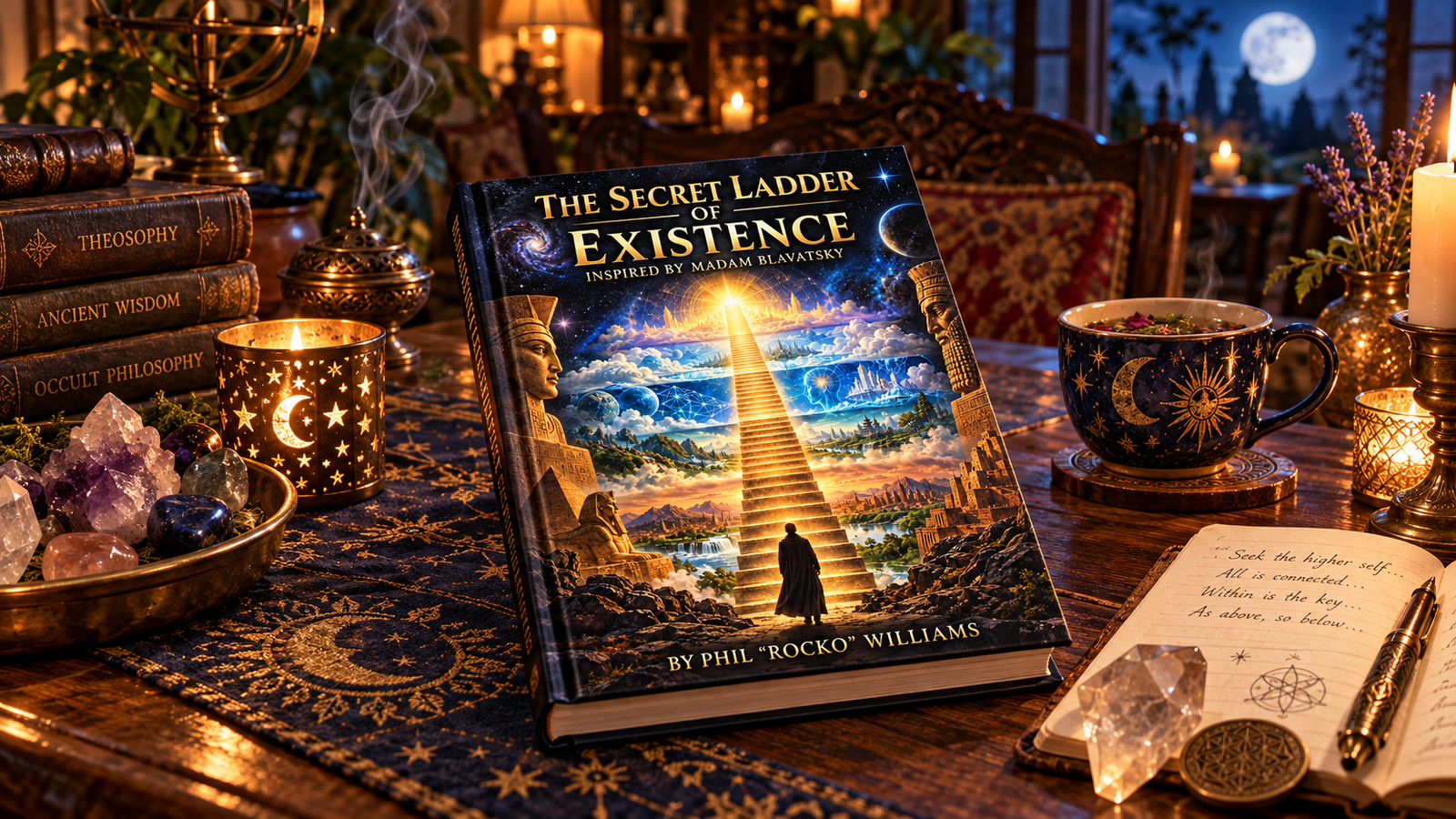
The Secret Ladder of Existence: Two Editions, One Invitation to Explore Reality
Download Free Via the 3 Dots
Download Free Via the 3 Dots
Why Release a Full Edition and a Compressed Edition?
Different readers meet a difficult subject in different ways. One person encounters Blavatsky’s name through a documentary, a podcast, a conversation, or a reference in another book. Another has already worked through considerable material about Theosophy and wants a structured synthesis. Someone else is drawn less to nineteenth-century esotericism than to the enduring mystery of consciousness. A compressed edition serves the first encounter. It presents the terrain without requiring the reader to master a specialized vocabulary on the opening page. It is a beginning that can stand on its own.
The full edition provides room for the distinctions that make the investigation worthwhile. The meaning of a plane of existence cannot responsibly be settled in a sentence. Neither can the distinction between cosmic planes and the principles of the human constitution, or between an ancient religious text and a later Theosophical reading of that text. Detailed argument requires examples, historical transitions, explanations of terminology, and the space to say where a tempting comparison stops being persuasive. Length is useful when it serves these purposes. It is not valuable simply because a manuscript becomes heavier or a chapter contains more repeated assurances.
Readers can use the two editions together. Begin with the shorter version to establish the main questions. Then move into the full edition wherever an idea calls for more attention. A reader interested in cosmology may linger over the sevenfold framework. A reader interested in comparative religion may concentrate on Egypt, Mesopotamia, India, Kabbalah, and Neoplatonism. A reader primarily concerned with the mind can turn to perception, dreaming, the philosophy of consciousness, and the practical exercises. This flexibility is deliberate. No one must accept an entire metaphysical system in order to learn something useful from its history, symbols, or methods of self-observation.
There is also a publishing principle behind offering both. Knowledge becomes more valuable when it can circulate in forms that respect the reader’s available time. The compressed edition is a gateway, not a substitute masquerading as the whole. The full edition is an invitation to sustained study, not a demand for agreement. Their common purpose is to encourage independent thought about ideas that have been influential, misunderstood, romanticized, and sometimes dismissed too quickly.
The Question Beneath the Ladder: What Does It Mean to Exist?
Consider a simple room. A table occupies space and bears weight. A photograph records a past moment. A song playing through a speaker arises from electrical signals, moving air, remembered patterns, and human interpretation. A promise made in that room may change several lives even though nobody can place it on a scale. All four belong to reality in meaningful senses, but not in the same manner. The physical table, the remembered moment, the performed melody, and the social obligation invite different kinds of explanation. Before asking whether several planes exist, we need to recognize how many meanings we have already placed inside the everyday word existence.
A dream sharpens the issue. A dream is a real event in a sleeping person’s life. The terror, relief, beauty, or astonishment it provokes can remain long after waking. Yet a castle seen in a dream is not thereby established as an independently existing castle in another dimension. The experience and its interpretation must be distinguished. That simple separation becomes essential when discussing visions, apparitions, out-of-body sensations, or mystical states. A person may sincerely describe an event and remain mistaken about its cause. Conversely, an explanation of physiological mechanisms does not erase the significance the event had for the person who experienced it.
Philosophers have long wrestled with variations of these problems. Are mathematical objects discovered or constructed? What makes a person the same person through bodily and psychological change? Can physical explanations account for the subjective character of consciousness? Is ultimate reality necessarily a thing among other things, or does the word ultimate describe a limit to ordinary categories? The full edition uses such questions to establish a vocabulary for the seven rungs. Its opening move is not to announce that an unseen universe has been verified. It is to equip readers to ask more exact questions than the familiar opposition between belief and disbelief usually permits.
This foundation is relevant far beyond occult philosophy. It improves how we read popular science, interpret sensational claims, discuss religious experience, and distinguish empirical observations from metaphysical proposals. If an argument depends on changing the meaning of the word real halfway through, readers should notice. If an attractive diagram quietly turns a metaphor into a photograph of cosmic geography, they should notice that too. A useful ladder strengthens judgment at every rung.
Madame Blavatsky and the Ambition of The Secret Doctrine
Helena Petrovna Blavatsky, commonly called Madame Blavatsky and affectionately known to many readers as Madame B., occupied an extraordinary position in the history of modern esotericism. Born in 1831, she helped found the Theosophical Society in 1875 and became one of the movement’s most consequential writers. Her work brought together materials drawn from Asian philosophical and religious traditions, Western occultism, comparative mythology, and the intellectual disputes of her time. Her major book The Secret Doctrine appeared in 1888, placing cosmic evolution, human origins, symbolism, and metaphysical principles into an ambitious synthesis.
A modern tribute should neither reduce that achievement to an easy caricature nor conceal its historical difficulties. Blavatsky read across traditions at a time when translations, scholarship, and European assumptions frequently distorted the materials available to her. Some of her claims concerning ancient transmission are not independently established. Parts of her account of human development and race are deeply problematic and should not be treated as credible anthropology. The enormous influence of her work is a historical fact; the truth of each cosmic assertion is a separate matter. Respect becomes more substantial when we make that distinction openly.
The original work is available for readers who wish to examine it directly through the Theosophical University Press online edition of The Secret Doctrine. This resource allows a careful reader to compare a modern explanation with the historical source. Such comparison matters because later interpreters have created additional charts, technical vocabularies, and familiar illustrations that are often mistaken for direct reproductions of Blavatsky’s own presentation. An interpretation may be useful without being a verbatim account of the original.
Her continuing importance lies partly in the scale of the inquiry. She refused the idea that the familiar physical description of the universe had exhausted every meaningful question. The intellectual response to that refusal need not be unquestioning acceptance. We can ask where she borrowed, where she innovated, which comparisons have historical support, and which aspects of her vision still provoke serious philosophical reflection. The Secret Ladder of Existence was conceived in that spirit: generous credit to a remarkable predecessor, joined to the expectation that readers deserve clarity about uncertainty and evidence.
Why Seven? Symbolism, Structure, and the Danger of Easy Equations
Seven is one of the most resonant numbers in the history of human symbolism. It occurs in religious narratives, calendrical traditions, astronomical inheritances, ritual classifications, and later esoteric schemes. Its recurrence can be compelling, especially to a reader who sees a pattern linking cosmology and personal development. Yet a recurring number is not by itself proof that different cultures possessed a single secret science. The historical reasons for a sevenfold arrangement can vary enormously. Some are associated with the seven classical wandering heavenly bodies, some with local ritual structures, and others with philosophical attempts to express ordered multiplicity.
In Theosophical literature, sevenfold organization takes several forms. There are teachings concerning planes of cosmic being, accounts of the human constitution, and larger cosmological cycles. The most tempting shortcut is to stack these separate frameworks in identical columns as though every seventh item must correspond perfectly to every other seventh item. Such diagrams may help memory, but they can also produce false precision. A cosmic plane is not automatically identical to a human principle, a chakra, a heaven in a different religion, or a step in a modern psychological model.
The full edition approaches the number seven as a subject requiring explanation rather than a mystical proof offered in advance. It asks what each list describes, where its terms came from, whether its ordering is stable, and how later schools adapted the material. This does not take away the poetic power of correspondence. In fact, a symbol becomes more interesting when its real history is visible. Readers can see how thinkers tried to express unity through differentiation and how imaginative systems evolved as they passed between generations.
The ladder therefore names a sequence of questions without pretending that its modern, reader-friendly rung titles reproduce a single canonical ancient chart. It moves through physical, subtle, mental, formative, and spiritual themes toward questions about universality and the Absolute. These labels serve the needs of exposition. They should be read as an interpretive pathway inspired by Theosophical themes, not as a discovered scientific taxonomy. That distinction is the difference between an honest teaching device and an assertion that outruns its evidence.
The Seven Rungs as a Journey of Understanding
The first rung concerns the physical world: bodies, energy, nature, measurement, and the discipline of studying processes that do not depend on personal preference. Even here, the universe exceeds the senses. Instruments reveal wavelengths, microorganisms, distant galaxies, and structures that no unaided observer could examine. The lesson is humility, but not an automatic endorsement of occult theories. A physically invisible object becomes part of reliable science through converging observations and testable consequences, not because invisibility alone makes a claim plausible.
The second rung turns toward subtle experience. Human beings know sensation, emotional atmosphere, bodily awareness, and states that feel unusually vivid or difficult to describe. Esoteric traditions often interpret these phenomena through concepts of subtle bodies or fields. The modern reader can study those doctrines and also investigate what psychology and physiology reveal about the experiences themselves. This rung invites close attention to the gap between a reported feeling and the metaphysical explanation offered for it.
The third rung examines mind. We think in images and words, construct expectations, remember imperfectly, and attach meaning to events. Attention directs what we notice, while memory changes the stories we tell about ourselves. The fourth rung explores formation: the ordering patterns, symbolic structures, and philosophical principles by which people understand a world. These middle stages are especially valuable because they show how an account can move from observable processes to conceptual frameworks. A thought can transform a life without becoming evidence for a free-standing mental country.
The fifth and sixth rungs introduce questions about spiritual intelligence and universal consciousness. Here, readers encounter traditions that interpret mind, value, and existence as expressions of a wider order. Such interpretations may possess coherence and transformative significance, but they require philosophical evaluation rather than automatic scientific endorsement. The seventh rung approaches the limit of the metaphor: the question of the Absolute. Within Blavatsky’s larger metaphysical vision, ultimate reality should not simply be treated as another floor added to a stack of celestial apartments. It points toward a boundary at which the language of separate objects, locations, and measurable levels may cease to function as expected.
Climbing is therefore not a literal itinerary. It is a progression in the scale and difficulty of questions. An important achievement is learning where a question changes its kind. An empirical claim invites evidence. A historical claim invites documents. A metaphysical claim invites argument. A personal report invites patient description and thoughtful interpretation. The ladder becomes useful when readers carry those distinctions from one rung to the next.
The Seven Principles of Man Are Not the Same as the Seven Planes
One of the more important clarifications in the full edition concerns the difference between a model of the cosmos and a model of the human being. Readers entering Theosophy often encounter lists of seven human principles alongside accounts of seven cosmic planes. Because both are sevenfold, they can appear to be versions of the same diagram. Yet their purposes and terminology differ. The principles concern ways of analyzing human embodiment, vitality, desire, mind, spiritual individuality, and higher consciousness within a historical esoteric system. The planes concern broader claims about modes or conditions of cosmic manifestation.
The distinction matters particularly when a popular summary substitutes modern psychological terms for historical Sanskrit-derived terminology without explaining the change. Words such as personality, soul, spirit, and mind already carry different meanings in philosophy, religion, and ordinary life. A reader may assume that an English approximation maps precisely onto the original system. Often it does not. The full edition introduces the problem deliberately, so that later comparisons can be understood as comparisons rather than silent equations.
Consider ordinary personal identity as a starting point. A person has a living body, changing desires, habits, memories, commitments, and the capacity to reflect upon those experiences. These dimensions belong to one life, but we can distinguish them for practical and philosophical purposes. An esoteric scheme may organize them into a spiritual anthropology that includes claims about continuity beyond physical death. Such a scheme can be analyzed for its internal structure and its ethical implications. Whether its proposed surviving principles correspond to independently established realities remains an additional question.
This approach offers something valuable to believers and skeptics alike. The believer gains a more precise understanding of what the tradition actually taught. The skeptic encounters an account with enough definition to assess rather than reject as vague language. The historian can examine the ways inherited terms changed as they crossed cultures. The reader interested in self-knowledge can consider the distinction between changing impulse and considered action without confusing an ordinary exercise in reflection with a proof of immortal metaphysical substance.
Ancient Egypt, Mesopotamia, India, and the Problem of Comparison
Comparative religion becomes most illuminating when it preserves the identities of the traditions being compared. Ancient Egyptian texts distinguish among aspects of the person using terms commonly rendered as ka, ba, and akh, among others. These concepts developed in the context of Egyptian ritual, funerary belief, sacred kingship, and evolving understandings of what continued after death. To identify every term with one rung of a later Theosophical diagram would conceal the very historical questions that make the material interesting. The Egyptian evidence deserves to speak first in its own vocabulary.
Mesopotamian traditions offer another landscape. Narratives about divine assemblies, the heavens, the human world, and the netherworld appear within texts produced across different languages and long periods. Their cosmologies cannot be condensed responsibly into a single universally agreed map. A descent narrative may express political, ritual, theological, and existential concerns at once. An underworld in a Mesopotamian literary text is not automatically the same as an astral plane in modern occult writing. Similarity is a reason to investigate, not a substitute for investigation.
Indian philosophical and religious histories are especially important because Theosophy borrowed and adapted many terms from them. Yet Hindu, Buddhist, and other South Asian traditions are internally diverse. They do not share one single teaching about selfhood, liberation, cosmic order, meditation, or ultimate reality. A term drawn from one Sanskrit source may acquire a different function in nineteenth-century Theosophical English. Careful readers should ask which text is being discussed, who interpreted it, and whether a modern explanation describes the original tradition or a later synthesis.
Kabbalah and Neoplatonism expand the comparison. Both have histories in which the relation between unity and multiplicity becomes central, but their internal terms and theological commitments are not interchangeable. Emanation in a particular philosophical text, the sefirot in Jewish mystical traditions, and cosmic planes in Theosophy should be compared through documented concepts and differences. A disciplined comparison can reveal common human questions about origin, return, hierarchy, intelligence, and the sacred. It need not invent a secret meeting at which every civilization received an identical blueprint.
The full edition places these traditions side by side as conversation partners. That is a more durable form of respect than claiming perfect identity. When a comparison survives attention to differences, it becomes more meaningful. When it does not, learning why can still deepen our understanding of how human beings have interpreted existence.
What Modern Science Can and Cannot Tell Us About Layered Reality
The scientific universe is more extensive and stranger than the world of direct sensation. We know this through methods that connect ideas with public evidence: carefully calibrated instruments, reproducible measurements, mathematical models, and theories exposed to criticism. Light outside the visible spectrum can be detected and translated into images. Deep geological time is reconstructed through multiple lines of evidence. Neuroscience connects changes in brain function to changes in perception, action, and conscious reports. These achievements demonstrate that unaided intuition is not the measure of everything real.
But they do not establish the existence of spiritual planes simply because the word invisible can apply both to a radio wave and to an occult claim. The radio wave is specified within a framework that generates measurable consequences. An assertion concerning a nonphysical domain may operate as metaphysics, testimony, or symbolism, depending on how it is framed. Calling both frequencies would conceal the difference rather than explain it. The same caution applies to the widespread use of quantum terminology in spiritual promotion. Words borrowed from physics do not transfer experimental confirmation to unrelated ideas.
The philosophy of consciousness remains a different kind of challenge. A scientist can examine neural activity associated with seeing red or experiencing pain; a philosopher can then ask what an adequate explanation of subjective experience requires. The existence of a difficult conceptual problem does not verify a particular spiritual solution. Equally, research into neural mechanisms does not make every question about first-person experience meaningless. Productive dialogue begins when each field identifies its methods and the kind of conclusion they can support.
One reason this matters to a public release is that readers deserve an invitation to wonder that does not depend on misleading certainty. Nature already contains staggering facts. History already contains elaborate attempts to interpret them. Human experience already raises difficult questions about identity, time, and awareness. We do not need to announce that science has vindicated every ancient belief in order to appreciate their influence. The full edition aims to preserve wonder and improve discrimination at the same time.
The Turn from Philosophy to Practice
The final portion of the full edition makes an important turn. After examining cosmology, comparative traditions, perception, and consciousness, the book asks what a reader can actually do with these ideas. It introduces the practical section called The Living Ladder, bringing the chapter sequence through Chapter 38. The purpose is neither initiation into a secret order nor a promise of supernatural mastery. It is to show how ordinary practices of attention, reflection, movement, sleep awareness, and personal recordkeeping may turn abstract questions into disciplined habits.
This practical direction also responds to a common problem in metaphysical reading. A person can spend years memorizing classifications of planes, subtle bodies, sacred numbers, and spiritual hierarchies without improving the quality of their attention or their treatment of other people. Knowledge becomes mere decoration when it does not change judgment. A useful exercise need not demonstrate a metaphysical proposition to possess value. Sitting quietly for a few minutes may reveal how quickly attention wanders. Keeping a journal may show how expectations distort memory. Studying an ancient tradition in its own historical terms may train intellectual humility.
The Living Ladder begins with preparation because a steady approach is more useful than a dramatic one. A beginner can choose modest periods of practice, establish consistency, and avoid treating every unusual sensation as proof of progress. A person who experiences discomfort can shorten an exercise, change posture, or stop. Nothing essential depends on fasting, forceful breathing, severe sleep deprivation, or the pursuit of an out-of-body event. An exploratory book should enlarge readers’ choices rather than pressure them to endure discomfort in pursuit of a promised result.
The deepest practical question may be ethical. Does a new belief make someone more careful with evidence? Does a contemplative habit create more patience? Does an interest in unity encourage compassion for other lives? Those outcomes can be examined in ordinary relationships, where lofty words meet real consequences. A ladder that never returns to the earth has missed the reason for climbing.
Meditation and Attention: Where Exploration Can Begin
Meditation is not a single uniform technique. Practices vary across historical traditions and contemporary settings. Some focus attention on breathing, sound, bodily sensation, or a repeated phrase. Others cultivate sustained observation of changing experience or engage in forms of contemplation structured by religious commitments. A beginner benefits from knowing that these approaches differ in purpose and context. The fact that several traditions use the word meditation does not make them interchangeable, and there is no requirement to adopt a foreign theological system before exploring a simple exercise in attention.
A modest starting practice is enough. Choose a place where interruptions are unlikely, sit in a stable and comfortable position, and allow the breath to continue naturally. Notice the physical sensations of breathing without trying to make them mystical or unusually deep. When attention moves toward a worry, memory, or plan, recognize the movement and return to the chosen focus. This is not a contest to remove all thoughts. The repeated recognition that attention has wandered is itself part of the exercise. Beginning with five minutes may be more sustainable than establishing an ambitious routine that produces fatigue or resistance.
Research on meditation and mindfulness offers potential benefits but also reasons for measured claims. The National Center for Complementary and Integrative Health overview of meditation and mindfulness summarizes evidence concerning areas such as stress, mood, pain, and sleep while discussing limitations and safety. Results vary by intervention, population, and study design. An educational spiritual exercise should not be represented as a guaranteed treatment or a substitute for medical support.
Meditation also creates a valuable occasion to examine interpretation. A person may notice warmth, emotional release, altered time perception, or an unusual feeling of spaciousness. These experiences can be described accurately without deciding immediately that they reveal another dimension. The practice teaches two skills at once: more careful awareness of what occurs and more patience about what the occurrence means. That combination is central to the entire book. The reader becomes an investigator of experience, not an unquestioning consumer of spiritual explanations.
Mantras, Mudras, Breath, and Yoga in Their Proper Contexts
Sacred sound and bodily gesture offer another path through the history of contemplative discipline. Mantras are found within diverse religious settings and may be associated with devotion, philosophical reflection, ritual obligation, and focused repetition. Their languages and meanings matter. A sacred syllable from one tradition should not be reduced casually to a universal mechanical code, nor should the practice be advertised as a proven way to alter external reality through vibration alone. Its historical significance and possible experiential effects can be discussed without collapsing these categories.
A beginner interested in repetition can select a phrase that is meaningful and appropriate to the chosen context, learn its meaning, and repeat it softly for a short period. Attention may be directed toward sound, rhythm, or the intention associated with the words. If a historical mantra is used, the reader should respect the tradition from which it comes and recognize that some forms of practice require instruction or initiation within their communities. Repetition is a broad human capacity, but specific liturgical usages have particular histories that deserve care.
Mudras likewise require context. A hand gesture can carry ritual, symbolic, artistic, or contemplative significance, and the same English description may conceal different meanings across lineages. Gentle gestures such as bringing the palms together or resting the hands in a comfortable shape can support a settled posture. They need not be explained as experimentally verified switches activating cosmic energies. The point is to notice how the body influences the atmosphere of practice while distinguishing personal effects from speculative interpretations.
Breathing deserves even greater care because it is directly connected to physical comfort. Natural, unforced breathing is an appropriate beginning. Extreme retention, aggressive hyperventilation, or deliberate attempts to induce dizziness are unnecessary and may be unsafe. Yoga, too, includes much more than stretching. Classical discussions of discipline, concentration, ethics, and liberation have a different emphasis from many modern fitness classes. A respectful introduction acknowledges this diversity, offers accessible movement and relaxation, and avoids difficult postures that a beginner cannot perform safely. The practical chapters bring these methods together through moderation rather than spectacle.
Diet, Sleep, and the Ordinary Conditions of Clear Thinking
Mystical literature often describes diet and discipline as preparation for contemplation. Those claims belong to particular historical settings and should be presented as such. Ideas associated with sattvic food, vegetarian commitments, fasting, purity, and ritual preparation do not all mean the same thing across Indian traditions or later Theosophical interpretations. They can illuminate how spiritual communities related ethics, embodiment, and attention, but they should not be confused with universal medical requirements.
Modern readers need practical advice that respects variation. Regular meals, adequate nourishment, hydration, manageable daily routines, and sufficient sleep are more sustainable foundations for attentive practice than severe restrictions. Specific dietary needs differ according to health, age, activity, and other circumstances. A spiritual book should not prescribe a single restrictive diet as the path to elevated consciousness. Nor should it turn ambiguous feelings after a dietary change into evidence that a subtle body has been purified. Better to ask what readers can observe about energy, concentration, mood, and comfort under ordinary conditions.
Sleep may be even more important for the next stages of inquiry. Dreams depend on sleep, and fragmented or insufficient sleep can impair memory, judgment, and emotional stability. Anyone interested in lucid dreaming should first protect the basic conditions of restful sleep. Keeping a regular schedule, reducing unnecessary nighttime interruptions, and recording dreams on awakening are practical measures that do not require adopting an elaborate metaphysical theory.
A strong philosophical work needs to pay attention to these ordinary conditions precisely because they are ordinary. The promise of transformation can tempt readers to overlook the environment in which learning occurs. Yet attention is shaped by fatigue, physical discomfort, social responsibility, and daily repetition. Real progress may look like better rest, fewer impulsive judgments, and a more reliable habit of observation. Those achievements do not make for sensational advertising, but they may offer the most durable value of a practical section.
Dream Recall and Lucid Dreaming: Exploring Awareness During Sleep
Dreaming offers an unusually vivid demonstration that experience can become a coherent world without direct correspondence to the sleeper’s immediate surroundings. Dream locations feel inhabited. Time may pass strangely. Characters can seem independent and persuasive. On awakening, some details survive while others disappear. The philosophical significance is considerable: conscious experience is constructed and interpreted, and the mind’s sense of certainty is not always evidence that its current representation describes an external environment accurately.
Lucid dreaming introduces another possibility. A lucid dream occurs when a person becomes aware of dreaming while the dream continues. Some individuals describe being able to direct aspects of the experience; others mainly observe it with a new level of awareness. Lucidity is not identical to perfect dream control. It also does not establish that consciousness has detached from the body or entered an independently existing spiritual realm. The full edition treats lucidity as a fascinating subject in sleep research and as an avenue for personal observation, while leaving metaphysical conclusions open to appropriate scrutiny.
For beginners, dream recall offers the simplest starting point. On awakening, remain still briefly if comfortable, notice any images or emotions, and write down what is remembered without embellishment. A few fragments are enough. Over time, recurring locations, situations, or themes may become easier to recognize. A gentle intention before sleep, such as remembering to notice when something unusual occurs in a dream, can support attention to the subject without requiring interrupted sleep. Individuals should not sacrifice rest in a relentless effort to induce an experience.
Controlled work on lucid dream induction has examined combinations of memory-based intentions, reality testing, and other methods. The International Lucid Dream Induction Study reported promising findings for mnemonic and senses-based techniques, while also revealing limits and individual variation. It is more responsible to say that some methods can improve the likelihood of lucidity for some participants than to promise that a reader will master the skill on a fixed schedule. The book introduces these techniques as experiments in awareness rather than guaranteed gateways to another world.
Astral Travel and Out-of-Body Experiences: Respecting Experience Without Inventing Proof
The language of astral travel has attracted generations of readers because it speaks to a profound possibility: might awareness exist or move independently of the ordinary body? Historical esoteric accounts describe subtle vehicles, journeys through nonphysical environments, and states of perception unlike everyday waking life. Such accounts are part of the intellectual and spiritual history explored by the book. Their variety is itself interesting, since different traditions and authors have understood the experience through different cosmologies.
Modern inquiry also studies out-of-body experiences and related states that can occur around sleep, waking, illness, or alterations in bodily self-perception. Sleep paralysis and hypnagogic imagery can be especially vivid. Some people describe floating, observing their body from elsewhere, or entering an extraordinarily convincing environment. The event can be memorable and meaningful even when no independent nonphysical journey has been established. A responsible approach does not mock the witness, but it does not treat sincerity and sensory vividness as sufficient proof of an external astral destination.
The practical material therefore emphasizes comfortable relaxation, visualization, the recording of subjective states, and careful separation between experience and interpretation. It does not require chemical aids, sleep deprivation, oxygen-altering practices, or dangerous attempts to provoke dissociation. A person who finds an exercise disturbing should stop and return to ordinary surroundings. These safeguards do not diminish the topic’s fascination; they make exploration compatible with everyday well-being.
Readers are invited to ask several distinct questions. What exactly happened in experience? Was the person falling asleep, waking, or fully alert? Which details were recorded immediately, and which were added later? What expectations preceded the event? Does the proposed interpretation generate evidence beyond the person’s subjective report? These questions allow a serious study of extraordinary experiences without requiring an answer before investigation begins. The strongest mystery is one that can survive careful description.
The Personal Spiritual Laboratory: Keeping an Honest Record
One of the most useful proposals in The Living Ladder is to treat personal spiritual inquiry as a disciplined record of observations rather than a sequence of conclusions declared in advance. The word laboratory is a metaphor here. A home notebook cannot reproduce every control available to a scientific institution, and first-person experience does not become public proof merely because it has been entered in a table. Yet the habits associated with good investigation can improve personal understanding: record conditions, distinguish observation from inference, notice variation, and preserve inconvenient results.
A journal might note the length of a meditation session, the chosen technique, the state of attention before and afterward, sleep duration, dream recall, and any unusual experiences. It may also record ordinary context: illness, fatigue, stress, a difficult conversation, or a change in schedule. Such factors matter because the human mind seeks patterns even where chance and expectation may play substantial roles. A vivid dream occurring after a particular mantra is an interesting observation. It is not evidence, from one occasion, that the mantra opened a literal doorway. The reader can be intrigued without rushing to explanation.
Keeping a baseline is especially helpful. Before adding new practices, spend several days noticing ordinary sleep, attention, and mood. Introduce one modest change at a time where possible. Later, compare results honestly. Did a breathing practice improve comfort, or was that assumption based on one particularly pleasant session? Did dream recall increase after consistent journaling, or did the reader simply begin remembering to write? The questions are humble, but they encourage more reliable self-knowledge than a narrative that declares every outcome a success.
This approach is also a defense against manipulation. Grand systems may promise proof that can only be recognized by believers, or interpret failure as evidence that the seeker lacked purity. An honest inquiry permits disappointment, ambiguity, and revision. It recognizes that a practice may be personally valuable without confirming the worldview in which it originated. A reader who learns to separate those judgments gains a capacity that travels beyond spiritual study into education, health claims, public debate, and everyday reasoning.
A Thirty-Day Living Ladder Practice Without False Promises
The practical section culminates in a flexible thirty-day program intended as a starting framework, not as a certificate of spiritual attainment. During the first week, the emphasis is on foundation. Readers can establish a short, comfortable period of quiet attention, observe their ordinary sleep patterns, and begin recording experiences in a notebook. The purpose is consistency and familiarity, not a sudden altered state. Someone who misses a session simply returns the next day. A sustainable routine is more valuable than a dramatic opening followed by exhaustion.
The second week introduces concentration. A reader may select a meaningful word or phrase for gentle repetition, continue natural breath awareness, or adopt a stable posture that supports attention. The important change is not intensity but deliberate selection. Instead of attempting many exercises simultaneously, the reader can discover which method is comfortable and what difficulties arise. Wandering thoughts, restlessness, impatience, and changes in emotion become observations, not marks of failure. Different bodies and temperaments require different approaches.
The third week turns toward dreams. The reader places a notebook within reach, makes a calm intention to remember dreams, and notes recollections on awakening. Awareness during dreams may or may not develop. There is no need to fragment sleep aggressively or to treat a lack of lucidity as a failed spiritual test. The aim is to develop a more attentive relationship with memory and the changing conditions of consciousness. What matters most is the ability to describe experiences accurately and recognize how easily interpretation arrives after the fact.
The fourth week is devoted to integration and review. Which practices were actually maintained? Did they influence patience, concentration, or sleep? Which explanations remain uncertain? What might be worth continuing, modifying, or abandoning? Readers may build a modest routine that suits ordinary responsibilities. They may also conclude that historical study is more valuable to them than any particular contemplative technique. That is an acceptable outcome. The philosophy behind the program is that inquiry should increase freedom of judgment rather than produce dependency on a prescribed path.
Who Should Read the Full Edition?
The Secret Ladder of Existence is written for several overlapping audiences. Readers fascinated by Theosophy can use it as an approachable companion to more demanding source material. People interested in the history of religion can encounter comparisons among Egypt, Mesopotamia, India, Kabbalah, and Neoplatonism while being reminded that resemblance does not erase difference. Readers interested in modern science and philosophy can follow the discussion of perception, consciousness, the limits of instrumentation, and the temptation to misuse scientific language in metaphysical arguments.
Those who have had striking dreams, meaningful contemplative experiences, or unusual changes in the sense of self may find a vocabulary for exploring what happened without being pressed into an immediate explanation. The book does not ask them to deny the experience or to accept a cosmic theory solely because it felt convincing. They can learn to distinguish the report, the emotional significance, the historical interpretation, and the evidential claim. For anyone who has felt trapped between unquestioning belief and dismissive skepticism, that middle space may be the book’s most useful offering.
The compressed edition is well suited to newcomers, listeners, and readers who prefer a quicker introduction. The full 169-page edition gives the subjects room to develop, including the practical chapters that take the book beyond theory. A person who reads both can use the shorter version as a map and the full version as the terrain. As with any map, the point is not to mistake a diagram for reality but to travel with better questions.
No religious identification is required, and no background in physics or ancient languages is assumed. The reader should bring curiosity and a willingness to distinguish claims of different kinds. The purpose of the work is not to recruit adherents to an institution or announce that every mystery has been solved. It is to make demanding ideas more accessible while keeping their complexity visible.
What the Full Edition Adds to the Conversation
A larger book earns its place when it changes what readers can understand. The full edition does that first by allowing the opening philosophical questions to breathe. Existence, perception, identity, and evidence receive more than passing mention. They form a foundation for later chapters, making it easier to see when a concept belongs to metaphysics, when it belongs to a historical tradition, and when it requires empirical testing. This groundwork discourages a common failure of popular esoteric writing: declaring that because science has discovered unexpected phenomena, any preferred invisible realm must therefore be real.
Second, the book treats Blavatsky as a historical thinker rather than a source of quotations detached from context. Her intellectual achievement remains central, but the manuscript is careful about the limits of nineteenth-century comparative work and the distinction between her writings and the later vocabulary of Theosophical movements. It preserves admiration without treating admiration as exemption from criticism. The same expectation guides its treatment of ancient texts. Egyptian and Mesopotamian ideas are not presented as interchangeable labels for modern spiritual planes simply because their narratives describe more than the visible world.
Third, the modern sections examine difficult questions without pretending that an analogy settles them. Neuroscience can reveal relationships between brains and experiences; philosophy can examine what those relationships imply; dreams can demonstrate that the mind produces convincing worlds. These are important observations, but they do not add up automatically to proof of astral geography. The book allows them to remain interesting on their own terms. That restraint is what makes a conversation between science and spiritual history worthwhile.
Finally, The Living Ladder gives readers an invitation to practice. Meditation, mantra, mudra, gentle yoga, lifestyle, dream recall, lucid dreaming, and personal experimentation receive dedicated attention. In a serious educational work, practical advice should be sufficiently clear to use and sufficiently modest to evaluate. Extraordinary outcomes are not guaranteed, and ordinary improvements deserve recognition. The final goal is a reader better able to observe, compare, question, and decide.
How to Begin Your Own Reading Journey
A reader approaching the subject for the first time may begin by asking which question has the greatest personal force. Is it why anything exists? Why consciousness has a subjective character? Why so many traditions describe hierarchies between humanity and an ultimate source? Why a dream can feel indistinguishable from waking life? Each question provides a useful entry point. The book’s structure makes it possible to follow the formal sequence or to concentrate on a particular area before returning to the broader argument.
For a first pass, read the compressed edition without attempting to memorize every technical term. Notice which ideas seem plausible, which are difficult, and which provoke questions. Keep a short list of passages that deserve more attention. The full edition can then become a guide for investigating those areas. Readers should feel free to consult primary texts alongside the discussion. Where a comparison involves a historical tradition unfamiliar to them, learning the context is more valuable than immediately adding the idea to a universal chart.
If the practical material is the main attraction, begin gently. A quiet period of natural breath observation, an ordinary dream journal, or a consistent bedtime routine is enough for an initial experiment. Record what happens, not what a theory says should happen. If an exercise is uncomfortable, modify or abandon it. If it proves useful, ask what kind of usefulness it offers. A calming effect, improved attention, or deeper appreciation for a tradition can be real benefits without confirming a claim about other planes of existence.
Over time, the book may become less an argument to finish than a reference to revisit. Different stages of life bring different questions to the same pages. A younger reader may focus on cosmic structure, while another may be drawn toward grief, continuity, and mortality. A practical reader may return to the chapters on disciplined observation. The common invitation remains the same: question boldly, study carefully, and allow wonder to coexist with a readiness to revise one’s beliefs.
The Secret Ladder of Existence and the Value of Intellectual Humility
There is a tendency in spiritual publishing to treat certainty as the measure of authority. A speaker announces that the invisible world has been mapped, ancient cultures have all been decoded, or contemporary science has finally proven what mystics always knew. Such claims can be emotionally satisfying because they end the search. They also risk converting intricate histories into slogans and genuine questions into unsupported conclusions. The more demanding path is to say exactly what is known, what is documented as a belief, and what remains an interpretation.
This is not an argument against imagination. Imagination allows philosophers to propose alternatives, historians to recognize distant conceptual worlds, and scientists to devise hypotheses that may later be tested. But its power depends in part on our ability to distinguish possibility from demonstration. A beautiful image of seven celestial levels can inspire a reader while remaining an illustration. A contemplative experience can reshape someone’s life without establishing an independently observed spiritual realm. A text from antiquity can preserve a profound idea while still belonging to a specific language, culture, and historical setting.
Madame Blavatsky’s legacy illustrates both the promise and the challenge of ambitious synthesis. Her writing enlarged the range of subjects that many readers considered worthy of serious attention. It also reflected intellectual assumptions and methods that subsequent scholarship has had reason to question. A thoughtful tribute accepts both realities. It does not demand that an admired author be beyond correction. Instead, it honors the energy of inquiry by applying that energy to the source itself.
The Secret Ladder of Existence is offered in precisely that spirit. Its compressed and full editions do not require identical levels of prior knowledge, but they share a refusal to pretend that every mystery is settled. They ask readers to keep a generous mind, a skeptical eye, and an interest in the practical consequences of their ideas. If the result is greater curiosity paired with greater discrimination, the project has achieved something worth publishing.
A Closing Invitation: Climb for Perspective, Return with Wisdom
The deepest value of a ladder is not that it allows someone to claim a higher position than everyone else. It changes the view. From one rung, the world appears as a collection of physical objects and events. From another, the intricacy of sensation and memory becomes visible. From another, the structures of thought and symbol begin to matter. From still another, we confront the difficult questions of unity, value, and ultimate explanation. Nothing about this progression requires arrogance. The point is to understand more and to mistake less.
That principle should guide the reading of both editions. The compressed version opens the conversation in a manageable form. The full 169-page book develops the philosophical and historical inquiry and adds the practical section where readers can examine attention, dreams, and everyday discipline for themselves. Together they express a hope that intellectual curiosity can remain alive without becoming gullibility, and that responsible criticism need not harden into contempt for the spiritual imagination.
Readers who follow Madame B’s writings may recognize an old ambition here: the conviction that existence deserves a much broader investigation than habit usually permits. Readers who do not accept Theosophical metaphysics can still learn from the history of the questions and from practical exercises that are evaluated on their own merits. The disagreement need not end the conversation. It may be the point at which real understanding begins.
The Secret Ladder of Existence is a book about the limits of what we know, but it is equally a book about the possibilities of better knowing. It invites us to study original sources, recognize the independence of ancient cultures, respect experience without exaggerating it, and let uncertainty sharpen rather than extinguish wonder. Most of all, it asks that a journey through the highest questions eventually return to human life with greater patience, clearer judgment, and a more generous understanding of what it means to exist.
Read More: Angelometry: A History of Angels Across Religion, Myth, and Mysticism
Psychics Unseen – History of the Psychic Phenomenon – Free Download

About the author


The Secret Ladder of Existence – Inspired By Madam B | Free Download
The Secret Ladder of Existence: Two Editions, One Invitation to Explore Reality Download Free Via the 3 Dots Download Free Via the 3 Dots A book can begin with a question that refuses to disappear. What does it mean to exist, and how much of existence can human beings actually perceive? We move through a world of bodies, landscapes, weather, and measurable forces. Yet we also inhabit a world of memory, imagination, dreams, relationships, moral commitments, and private experiences that no stranger can observe directly. The puzzle is not simply whether the physical world is real. The puzzle is whether our ordinary description of that world is complete, and what kind of evidence would justify any claim that more remains to be discovered. These questions inspire The Secret Ladder of Existence, a new exploration of the sevenfold vision […]

Angelometry: A History of Angels Across Religion, Myth, and Mysticism
Angelometry: A History of Angels Across Religion, Myth, and Mysticism Download Free Via the 3 dots https://youtu.be/ZxOdzI88Iy0?is=kKvvAn-zkfuMN_oF https://youtu.be/7KC7Wsht7u0?si=z4U65lMOECOnJ1uP Subscribe: Veiled Mystic 333 Angelometry is a useful word for a subject that refuses to remain inside a single religious box. The history of angels is not one continuous system handed down unchanged from antiquity. It is a layered record of messengers, heavenly attendants, watchers, throne beings, guardians, destroyers, healers, scribes, planetary intelligences, divine names, spirits, and even ancient gods who were later absorbed into angelic catalogs. To study Angelometry seriously is therefore to study how human beings across different times and cultures imagined the invisible world around the divine. The familiar image of a beautiful winged figure in white robes is only one late and highly influential expression of a much larger history. Earlier texts can describe angels as men, flames, wheels, […]

Getting to Know Thyself Better – Modern Tips for Spiritual Growth
Getting to Know Thyself Better https://youtu.be/rV53qO_Ocfg?is=VYcqCzUYUJ2Gu9G- Subscribe: Veiled Mystic For thousands of years, human beings have built systems for looking inward. Some used philosophy, some used prayer, some watched dreams, and others studied stars, cards, numbers, or the lines of the hand. Modern psychology added controlled observation, personality models, and behavioral research to the same ancient problem: how accurately can a person understand the person doing the observing? Today we have another instrument that earlier generations did not possess. A large language model can compare symbolic systems, organize personal observations, ask follow-up questions, and help a person examine patterns that might otherwise remain scattered across memory. Used carefully, these tools can help us Know Thyself Better without requiring us to treat every symbolic interpretation as a literal law of nature.The aim of this article is not to prove that a zodiac […]
Sleepnosis: The Mechanics of Sleep Hypnosis | Read or Download Free
Sleepnosis: The Mechanics of Sleep Hypnosis Read or Download the Free PDF Here Download the PDF Free Via the 3 Dots Above https://youtu.be/Dy9OElg7yXc?is=KEGIIkHusVNZXEvw Subscribe: Veiled Mystic Let's Get Into the Sleepnosis Study Sleepnosis is a Reality Science investigation into a subject that has spent far too long trapped between advertising language, mystical claims, old sleep-learning myths, legitimate hypnosis research, and rapidly improving neuroscience. The free PDF release of Sleepnosis: The Mechanics of Sleep Hypnosis was created to put those pieces into one usable map. The purpose is not to convince readers that the sleeping mind is a programmable machine. It is not to dismiss every unusual result because older claims were exaggerated. The purpose is to identify what has actually been demonstrated, what remains plausible but unsettled, what has been repeatedly misunderstood, and how a reader can think about […]

Emotional Intelligence Maturity: Finding Peace in the Chaos
https://youtu.be/3_DQtLsBpWo?is=BGKAG8X1MfbVGPxe Subscribe: veiledMystic333 Emotional Intelligence Maturity: Finding Peace in the Chaos and Strength in the Darknes Emotional Intelligence is often introduced as a set of skills: recognize what you feel, understand why you feel it, regulate your reactions, read other people accurately, communicate well, and make better choices. All of that matters. But the deeper question is what happens when these skills become part of a mature personality. Emotional Intelligence maturity is not simply knowing the right vocabulary for feelings or being able to remain calm during an easy conversation. It is the ability to stay in honest relationship with reality when your pride is hurt, your expectations fail, someone disappoints you, your nervous system is activated, or life becomes chaotic. It is the difference between having emotional knowledge and being able to live by it when it costs something. […]
Greynomenon: History of the Grey Phenomenon | Free PDF Download
Greynomenon: A History of the Face Humanity Cannot Stop Seeing Download Free Via the 3 Dots Above. Few images in modern culture are as immediately recognizable as the Grey alien. The enlarged head, dark almond-shaped eyes, slight nose, narrow mouth, thin body, and unreadable expression have become a global symbol for the unknown. A single silhouette can suggest extraterrestrial life, abduction, secrecy, telepathy, missing time, government cover-up, spiritual encounter, science fiction, or fear of forces beyond human control. Recognition, however, is not the same as understanding. That distinction is the starting point of Greynomenon, a free PDF book by Phil “Rocko” Williams and Merlin aka ChatGPT. Rather than beginning with a declaration that Grey aliens are real, unreal, extraterrestrial, interdimensional, spiritual, psychological, or technological, the book begins with a more useful question: what exactly has humanity grouped beneath the face […]
Related
Angelometry: A History of Angels Across Religion, Myth, and Mysticism
Angelometry: A History of Angels Across Religion, Myth, and Mysticism Download Free Via the 3 dots https://youtu.be/ZxOdzI88Iy0?is=kKvvAn-zkfuMN_oF https://youtu.be/7KC7Wsht7u0?si=z4U65lMOECOnJ1uP Subscribe: Veiled Mystic 333 Angelometry is a useful word for a subject that refuses to remain inside a single religious box. The history of angels is not one continuous system handed down unchanged from antiquity. It is a layered record of messengers, heavenly attendants, watchers, throne beings, guardians, destroyers, healers, scribes, planetary intelligences, divine names, spirits, and even ancient gods who were later absorbed into angelic catalogs. To study Angelometry seriously is therefore to study how human beings across different times and cultures imagined the invisible world around the divine. The familiar image of a beautiful winged figure in white robes is only one late and highly influential expression of a much larger history. Earlier texts can describe angels as men, flames, wheels, […]
Getting to Know Thyself Better – Modern Tips for Spiritual Growth
Getting to Know Thyself Better https://youtu.be/rV53qO_Ocfg?is=VYcqCzUYUJ2Gu9G- Subscribe: Veiled Mystic For thousands of years, human beings have built systems for looking inward. Some used philosophy, some used prayer, some watched dreams, and others studied stars, cards, numbers, or the lines of the hand. Modern psychology added controlled observation, personality models, and behavioral research to the same ancient problem: how accurately can a person understand the person doing the observing? Today we have another instrument that earlier generations did not possess. A large language model can compare symbolic systems, organize personal observations, ask follow-up questions, and help a person examine patterns that might otherwise remain scattered across memory. Used carefully, these tools can help us Know Thyself Better without requiring us to treat every symbolic interpretation as a literal law of nature.The aim of this article is not to prove that a zodiac […]
Sleepnosis: The Mechanics of Sleep Hypnosis | Read or Download Free
Sleepnosis: The Mechanics of Sleep Hypnosis Read or Download the Free PDF Here Download the PDF Free Via the 3 Dots Above https://youtu.be/Dy9OElg7yXc?is=KEGIIkHusVNZXEvw Subscribe: Veiled Mystic Let's Get Into the Sleepnosis Study Sleepnosis is a Reality Science investigation into a subject that has spent far too long trapped between advertising language, mystical claims, old sleep-learning myths, legitimate hypnosis research, and rapidly improving neuroscience. The free PDF release of Sleepnosis: The Mechanics of Sleep Hypnosis was created to put those pieces into one usable map. The purpose is not to convince readers that the sleeping mind is a programmable machine. It is not to dismiss every unusual result because older claims were exaggerated. The purpose is to identify what has actually been demonstrated, what remains plausible but unsettled, what has been repeatedly misunderstood, and how a reader can think about […]
Emotional Intelligence Maturity: Finding Peace in the Chaos
https://youtu.be/3_DQtLsBpWo?is=BGKAG8X1MfbVGPxe Subscribe: veiledMystic333 Emotional Intelligence Maturity: Finding Peace in the Chaos and Strength in the Darknes Emotional Intelligence is often introduced as a set of skills: recognize what you feel, understand why you feel it, regulate your reactions, read other people accurately, communicate well, and make better choices. All of that matters. But the deeper question is what happens when these skills become part of a mature personality. Emotional Intelligence maturity is not simply knowing the right vocabulary for feelings or being able to remain calm during an easy conversation. It is the ability to stay in honest relationship with reality when your pride is hurt, your expectations fail, someone disappoints you, your nervous system is activated, or life becomes chaotic. It is the difference between having emotional knowledge and being able to live by it when it costs something. […]
Greynomenon: History of the Grey Phenomenon | Free PDF Download
Greynomenon: A History of the Face Humanity Cannot Stop Seeing Download Free Via the 3 Dots Above. Few images in modern culture are as immediately recognizable as the Grey alien. The enlarged head, dark almond-shaped eyes, slight nose, narrow mouth, thin body, and unreadable expression have become a global symbol for the unknown. A single silhouette can suggest extraterrestrial life, abduction, secrecy, telepathy, missing time, government cover-up, spiritual encounter, science fiction, or fear of forces beyond human control. Recognition, however, is not the same as understanding. That distinction is the starting point of Greynomenon, a free PDF book by Phil “Rocko” Williams and Merlin aka ChatGPT. Rather than beginning with a declaration that Grey aliens are real, unreal, extraterrestrial, interdimensional, spiritual, psychological, or technological, the book begins with a more useful question: what exactly has humanity grouped beneath the face […]
Egyptian Spells: A Chronological History from Pyramid Walls to Magical Papyri
Egyptian Spells: A Chronological History from Pyramid Walls to Magical Papyri Egyptian Spells survived for more than three thousand years because ancient Egyptians did not treat sacred words as dead literature. A spell could be spoken, written, painted, carved, worn, buried, washed with water, placed beneath a head, wrapped into a mummy, inscribed on a figurine, or copied onto a roll of papyrus for use in the next world. Some spells protected a king as he rose among the stars. Others helped ordinary people survive childbirth, snakebite, fever, nightmares, hostile spirits, dangerous journeys, and death itself. The history of Egyptian spells is therefore much larger than the history of any single book. It is the history of a technology of sacred language that changed its physical form while preserving remarkably old ideas across dynasties, political collapses, foreign rule, religious change, […]
Be the first to leave a comment