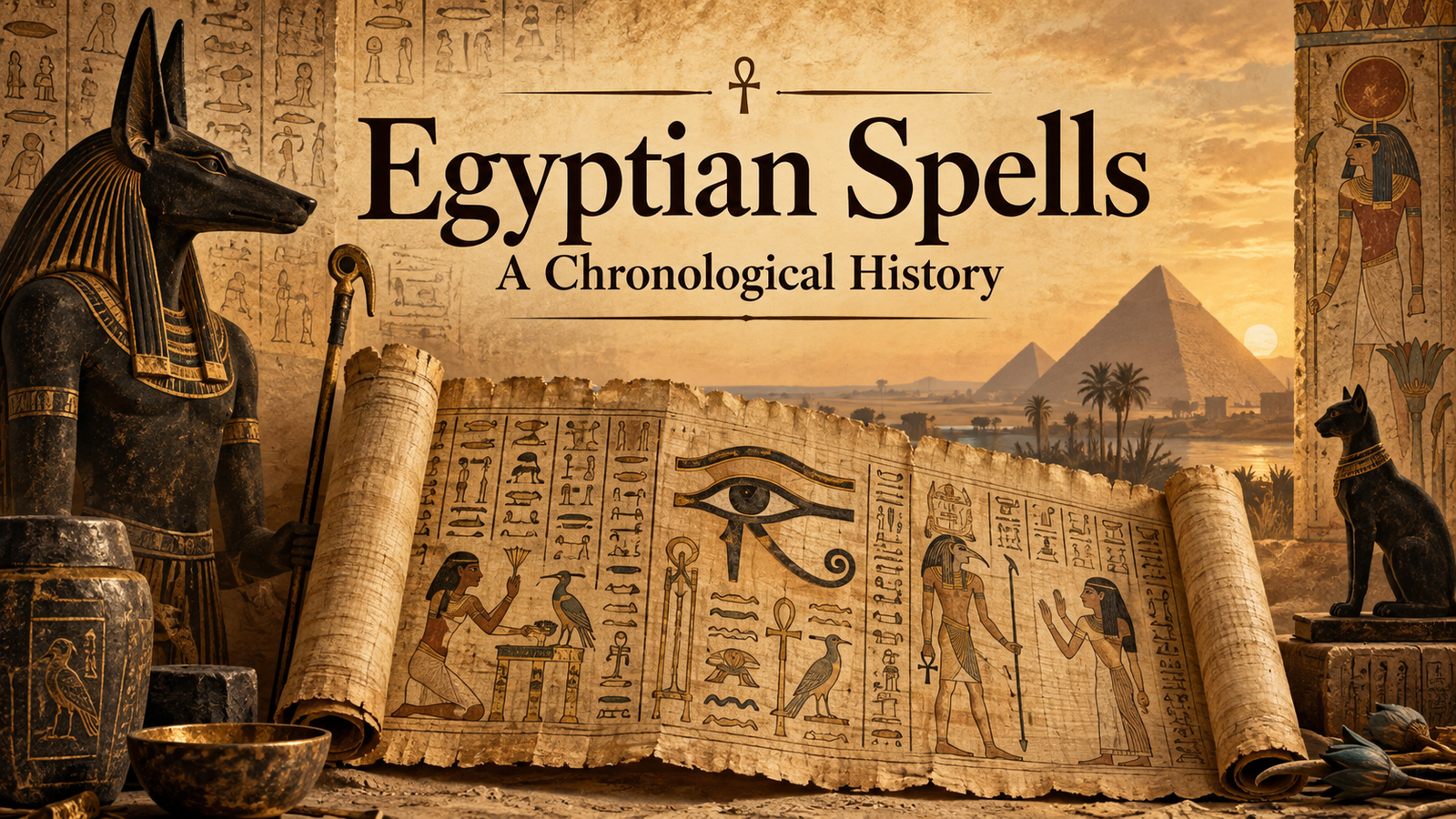
Egyptian Spells: A Chronological History from Pyramid Walls to Magical Papyri
Egyptian Spells survived for more than three thousand years because ancient Egyptians did not treat sacred words as dead literature. A spell could be spoken, written, painted, carved, worn, buried, washed with water, placed beneath a head, wrapped into a mummy, inscribed on a figurine, or copied onto a roll of papyrus for use in the next world. Some spells protected a king as he rose among the stars. Others helped ordinary people survive childbirth, snakebite, fever, nightmares, hostile spirits, dangerous journeys, and death itself. The history of Egyptian spells is therefore much larger than the history of any single book. It is the history of a technology of sacred language that changed its physical form while preserving remarkably old ideas across dynasties, political collapses, foreign rule, religious change, and shifting scribal traditions.
Modern readers often meet this history backward. They encounter the Papyrus of Ani, learn the modern title Book of the Dead, and assume that Egyptian magic began with a famous illustrated papyrus. In reality, the Book of the Dead stands in the middle of a much longer story. Its spells inherit material from earlier funerary traditions, especially the Coffin Texts, while also adding new compositions and new visual forms. At the same time, many Egyptian spells never belonged to the Book of the Dead at all. Healing incantations, protective charms, temple rituals, execration rites, royal underworld books, divine litanies, magical stelae, and later Demotic handbooks developed beside the funerary corpus. To understand the spells, we have to follow all of these streams without pretending that they were one fixed canon.
That is the purpose of this history. The emphasis will remain on the spells themselves: what Egyptians expected them to accomplish, how they were transmitted, when their forms changed, why certain compositions endured for centuries, and how later collections gathered older material into new arrangements. The names used by modern Egyptologists, such as Pyramid Texts, Coffin Texts, Book of the Dead, and Books of Breathing, are useful labels. Yet those labels can also hide continuity. A formula might begin on a Middle Kingdom coffin, reappear centuries later on papyrus, migrate onto an amulet or figurine, and survive in a later recension with altered wording and a new illustration. The spell had a history of its own.
For that reason, this is not simply a chronology of books. It is a chronology of sacred speech in motion. The path begins before the first great surviving corpus, moves through the royal Pyramid Texts, expands dramatically in the Middle Kingdom, becomes portable and highly illustrated in the New Kingdom, grows increasingly standardized in the Late Period, and then enters the multilingual religious world of Ptolemaic and Roman Egypt. At every stage, old and new lived together. Egyptian scribes did not discard the past whenever they created a new collection. They repeatedly copied, condensed, expanded, reinterpreted, illustrated, and repurposed it.
What Ancient Egyptians Meant by a Spell
The English word spell is convenient, but it can mislead if it makes us imagine a sharp boundary between magic, religion, medicine, and ritual. Ancient Egyptian practice did not divide those fields in the same way that modern societies often do. A healing manuscript could contain examination, diagnosis, medicines, and spoken incantations on the same roll. A funerary text could be both theological statement and practical instruction. A protective object could combine an image, a divine name, a short utterance, and a prescribed action. The effectiveness of Egyptian spells often depended on this combination. Words mattered, but so did the person speaking them, the material on which they were written, the object being manipulated, the time and place of the rite, and the mythic precedent invoked.
The concept most often associated with magical power is heka. Heka could denote a divine power and was also personified as a deity. It was not merely trickery or an alternative to religion. In Egyptian thought, effective sacred speech belonged inside the order of the cosmos. Gods themselves possessed and used power. Human ritual specialists, priests, healers, and knowledgeable scribes sought to work within that divine order by knowing the correct names, words, images, actions, and precedents. A spell did not always beg a god for help. Sometimes the speaker identified with a god, announced knowledge of a secret name, recalled a mythic event, threatened a hostile being with divine punishment, or declared an outcome as though it had already become true.
This explains one of the most striking features of Egyptian spells: the speaker frequently becomes larger than the ordinary individual. A dead person may speak as Osiris, Ra, Horus, or another divine being. A healer confronting venom may identify the patient with the child Horus and the danger with the forces that once threatened him. A ritualist can place a present crisis inside a mythic story whose ending is already known. If Isis once healed Horus, then that healing can become a model for healing again. If Ra defeated a cosmic enemy, then the same victory can be renewed ritually. Myth was not simply told for entertainment. In many spells, myth became an engine of action.
Writing strengthened that engine. Egyptian culture treated names and images with unusual seriousness because representation could participate in the reality represented. A written name could preserve identity. An image could protect, nourish, or endanger. Damaging an enemy figure could therefore become part of a ritual attack, while drawing protective beings around a child could help create a sacred defensive space. This principle will appear repeatedly throughout the history of Egyptian spells. Speech, writing, image, and object were not separate media competing for importance. They were different ways of making sacred knowledge present.
Before the Great Collections: Ritual, Memory, and the Problem of Survival
No historian can identify the first Egyptian spell. The archaeological record begins long after spoken ritual must have existed. Predynastic and Early Dynastic Egypt left images, burials, objects, names, and ritual patterns, but very little continuous explanatory writing of the kind that later periods provide. Even when writing became established, much knowledge could still be transmitted orally or through performance. The absence of a surviving papyrus does not prove that a rite or formula did not exist. Papyrus decays easily, temples were rebuilt, settlements disappeared beneath later occupation, and most ancient material was never placed in the dry tomb conditions that favored survival.
The earliest large body of Egyptian religious formulae that survives is therefore not the beginning of Egyptian sacred practice. It is the first moment when preservation suddenly becomes generous enough to reveal a complex system. The Old Kingdom had mortuary rituals, offering practices, priestly recitations, divine cults, and royal ceremonies long before the interior walls of pyramids began to carry long sequences of formulae. Some Pyramid Texts almost certainly preserve older ritual language. Others may have been composed or reshaped for the particular royal environments in which they appear. Scholars must distinguish between the date of a surviving inscription and the possible age of the tradition behind it.
This problem follows Egyptian spells through every period. A spell copied around 1500 BCE can contain language or ideas older than the manuscript. A later papyrus may preserve a composition that disappeared from earlier surviving evidence. Conversely, an apparently ancient-sounding text may use deliberate archaism. Egyptian scribes valued old language and could imitate it. Dating a spell therefore requires more than noticing that it sounds old. Historians compare language, handwriting, archaeological context, parallel manuscripts, titles, divine names, ritual settings, and the history of specific textual passages.
The safest approach is to speak of earliest attestation rather than absolute invention. When a spell first appears in surviving evidence, we know that it existed by that date. We do not automatically know that it was created then. This distinction becomes especially important when tracing Egyptian spells from the Pyramid Texts into the Coffin Texts and later into the Book of the Dead. The record shows continuity, but continuity is rarely a straight line. It is more like a river system: old channels remain, new channels open, some disappear, and others merge again centuries later.
The Old Kingdom: Egyptian Spells Enter the Pyramid
The first great surviving corpus appears inside royal pyramids near the end of the Old Kingdom. The modern term Pyramid Texts describes formulae inscribed on the interior walls of pyramids beginning with the pyramid of King Unas at Saqqara near the end of the Fifth Dynasty. Later kings, including Teti, Pepy I, Merenre, Pepy II, and Ibi, also used them, and texts occur in pyramids of several royal women. The placement matters. These were not library books stored beside the dead. The architecture itself became a written ritual environment. Walls surrounding the royal body carried words intended to sustain transformation, protection, ascent, nourishment, and continued existence.
The Pyramid Texts do not read like a single authored scripture. They are a corpus of utterances with different styles and functions. Some resemble ritual recitations connected with offerings and mortuary service. Some protect the deceased ruler from snakes or hostile beings. Some help him cross barriers and ascend to the sky. Some identify him with gods or place him among the imperishable stars. Others speak in astonishingly forceful language about royal power. The collection contains theology, ritual memory, magical defense, cosmic geography, and the practical needs of a dead king. Modern numbering makes the corpus easier to study, but the numbers should not be mistaken for an ancient table of contents.
Many Pyramid Text spells depend on knowledge. The king must know routes, names, gates, beings, and divine relationships. Knowledge is not passive information; it is power needed for movement through a dangerous cosmos. Other spells depend on identification. The king is not merely helped by a god but can become associated with that god’s powers and history. Still others use command. Hostile forces are ordered away, dangerous animals are addressed, and divine beings are compelled to recognize the king’s transformed status. These strategies remain visible in Egyptian spells for the next two thousand years.
The oldest surviving royal corpus also reveals a principle that later readers sometimes miss: the Egyptian afterlife was active. The deceased did not simply lie peacefully in a tomb. He had to awaken, breathe, eat, travel, avoid dangers, join divine communities, and secure a place in cosmic cycles. The texts create motion. Doors open. Boats travel. ladders rise. Stars receive the king. Gods recognize him. Enemies are repelled. Offerings become available. Death is treated as a condition to be ritually overcome again and again, not as a single event that ended all activity.
When Royal Spells Escaped the Pyramid
The history of Egyptian spells becomes especially interesting when Old Kingdom royal formulae refuse to remain royal. During the First Intermediate Period and Middle Kingdom, material related to the Pyramid Texts appears in nonroyal contexts, including coffins and burial chambers of officials. This does not mean that one day a closed royal monopoly was simply opened to everyone. Access to elaborate burial equipment still depended heavily on wealth, office, literacy, local traditions, and social position. Yet the surviving evidence clearly shows an expansion in who could use textual technologies previously associated most visibly with kings.
That expansion changed the spells themselves. A formula designed for a king could be adapted for a private deceased person. Pronouns, names, divine identifications, and ritual settings could shift. Old material was copied beside new material. The deceased increasingly appears as an Osirian figure, while solar and stellar ideas continue rather than vanish. Egyptian funerary thought did not replace one theology with another in a clean sequence. Solar rebirth, Osirian resurrection, celestial ascent, underworld travel, bodily preservation, and access to offerings could coexist within the same textual environment.
This is one reason the popular idea that the Coffin Texts are simply a democratized edition of the Pyramid Texts is too simple. The Coffin Texts inherit substantial older material, but they also contain a vast amount of composition that is not merely copied Pyramid Text. New concerns, new ritual settings, new landscapes of the afterlife, and new ways of speaking about transformation appear. The Middle Kingdom becomes a period of tremendous textual creativity. The older royal tradition is one ingredient in something much larger.
The movement also demonstrates a recurring pattern in Egyptian history. Sacred authority could be conserved by copying ancient words, but innovation could occur through selection, recombination, commentary, new titles, new illustrations, and new applications. Egyptians did not have to choose between tradition and creativity. They often created by reorganizing tradition. That habit eventually produced the Book of the Dead and many later collections.
The Middle Kingdom Explosion: The Coffin Texts
During the Middle Kingdom, funerary writing expanded across the surfaces of coffins and burial chambers. Egyptologists call this enormous body of material the Coffin Texts because coffins are the principal surviving medium. The label is modern, just as Pyramid Texts is modern. The corpus includes more than a thousand numbered spells in the standard scholarly edition, though the number of spell numbers should not be confused with an equal number of wholly independent literary works. Some formulae overlap, vary, or belong to larger sequences. What matters historically is the scale: the Middle Kingdom preserves an extraordinary expansion of written funerary knowledge.
The coffin became more than a container. Its interior could surround the deceased with sacred geography and speech. Eyes painted on the exterior allowed symbolic vision. Offering lists, divine figures, ritual formulae, maps, and spells created an environment where text and object worked together. The deceased was equipped to eat, breathe, move, transform, travel, avoid traps, know divine names, join gods, and resist a second death. Many later Book of the Dead themes are already fully visible here.
Some Coffin Texts preserve older Pyramid Text material almost directly. Others remodel old passages. Still others have no known Old Kingdom ancestor. This mixture is vital for understanding the history of Egyptian spells. A later collection was not generated by copying one earlier book from beginning to end. Scribes drew from repertoires. A composition could survive in several variants. Local workshops might favor different arrangements. A coffin from one region could preserve material absent from another. The surviving corpus is therefore a network of textual witnesses rather than a single master manuscript.
The Middle Kingdom also shows how spell titles could become practical instructions. Formulae announce what they are for: becoming a particular being, knowing a gate, avoiding a danger, securing food, controlling breath, joining a divine bark, or reaching a desired region. These titles helped organize ritual knowledge by function. Centuries later, many Book of the Dead spells would continue this habit. The reader is often told not merely what a composition says but what it is expected to accomplish.
The Book of Two Ways: When a Spell Collection Became a Map
Among the most famous Middle Kingdom innovations is the composition known today as the Book of Two Ways. It survives primarily on coffins from the region of Deir el-Bersha and forms part of the larger Coffin Text tradition. Its importance lies not only in its words but in its visual organization. Routes, barriers, divine beings, fiery regions, gates, and destinations are arranged in a schematic sacred landscape. The dead require both speech and orientation. The result is one of the earliest surviving attempts to map a journey through the realm beyond ordinary life.
The title Book of Two Ways is modern, but the underlying conception is unmistakable. The deceased must negotiate alternative routes and dangerous zones. Correct knowledge gives access. Names and formulae turn geography into something traversable. This pattern will recur in later royal underworld books, gate texts, and funerary papyri. Egyptian magic often treats knowledge of a place as part of the power to survive it. A gate is not merely a door; it may have a keeper, a name, a divine identity, a question, and an appropriate response.
The Book of Two Ways also proves that later Book of the Dead spells can preserve very old Middle Kingdom architecture. UCL’s Digital Egypt project documents substantial correspondences between parts of Book of the Dead Spell 136 and Coffin Text material from the Book of Two Ways. Other passages also reappear in later funerary compositions. This allows historians to watch a spell migrate across centuries. The physical coffin map eventually disappears, but portions of its language continue in the portable papyrus tradition.
That survival is a warning against treating ancient collections as sealed boxes. Once modern editors name something Book of Two Ways, it becomes tempting to imagine that its contents stayed inside that book. Egyptian scribes did not honor our categories. They reused useful sacred material. A route, invocation, divine name, or transformation formula could be detached from one context and inserted into another. The history of Egyptian spells is therefore partly the history of controlled reuse.
Egyptian Spells for the Living: Protection, Birth, and the Household
Funerary manuscripts survive spectacularly because tombs preserve them, but Egyptian spells were never limited to the dead. Middle Kingdom objects reveal a lively world of protection for the living. Curved ivory objects commonly called apotropaic wands or magic knives were carved from hippopotamus tusks and decorated with protective beings. Taweret, Bes-like figures, serpents, felines, crocodiles, frogs, and other powerful forms appear carrying knives or standing in defensive arrangements. Some examples name women or children, and surviving inscriptions can explicitly announce protection by day and by night.
These objects show a kind of magic in which pictures are themselves active components. A dangerous animal can become a protector when placed inside the right divine framework. The hippopotamus, crocodile, lion, and serpent are not simply symbols of evil. Egyptian religious imagery is more flexible. Dangerous power can be redirected against danger. The protective being becomes frightening to the force that threatens the child. That logic also appears in later magical stelae, where the young Horus dominates dangerous animals to establish a model of victory over venom.
The same period preserves written incantations concerned with health and childbirth. UCL identifies Papyrus Turin 54003, copied in the early Middle Kingdom, as the earliest surviving papyrus devoted to writings for good health. It contains incantations against serpents, a ritual involving the eye, and other protective material. The Lahun gynecological papyrus preserves material connected with women’s health and childbirth. These manuscripts remind us that ritual speech was embedded in practical life long before the great New Kingdom magical papyri.
The people who used such knowledge were not necessarily a separate class of occult magicians. Egyptian healing involved several kinds of specialists, and surviving medical manuscripts combine what modern readers might call empirical treatment with prescription and incantation. The distinction between medicine and magic can therefore obscure more than it explains. For an Egyptian healer, a plant preparation and an invocation could belong to the same therapeutic strategy. The spell did not necessarily replace treatment. It could be one component of treatment.
Execration: Egyptian Spells That Attacked the Enemy
Protective magic could also become aggressive. Middle Kingdom and later evidence includes so-called execration practices in which enemies were named, represented, bound, broken, buried, stabbed, burned, or otherwise ritually neutralized. Clay figures from Lisht, for example, carry names identifying enemies. Their deposition was apparently intended to make destruction effective through ritual representation. The goal was not theatrical symbolism for an audience. The image and name made the hostile person or force ritually present enough to be acted upon.
Execration rites illuminate the Egyptian understanding of writing. A name was not a meaningless label. Identity could be attacked through its written representation. This same logic helps explain why names were preserved in tombs and why erasing a name could be a severe act. It also explains why hostile figures in religious scenes might be shown bound, decapitated, trampled, pierced, or otherwise defeated. The representation participates in the desired order of the world.
At the state level, such practices could include foreign peoples and political enemies. At other levels, the target might be a supernatural danger. The Egyptian cosmos was imagined as ordered but never permanently secure. Forces associated with disorder had to be defeated repeatedly. This is why the great serpent enemy of the solar god can be destroyed every night and still require destruction again. Ritual does not record a victory once. It renews victory.
This repeated combat becomes extremely important in later temple and papyrus traditions devoted to repelling dangerous beings. The history of Egyptian spells is full of recurrence because the problems themselves recur: sickness returns, snakes bite again, enemies threaten again, death confronts each generation, and cosmic disorder remains a possibility. A spell’s age could become an advantage. Repeating an ancient victory joined the present practitioner to a proven divine precedent.
From Coffin to Papyrus: The Birth of the Book of Going Forth by Day
By the transition into the New Kingdom, another major change becomes visible. Funerary spells increasingly appear in forms that scholars group under the modern title Book of the Dead. The ancient designation is associated with formulae for going or coming forth by day. This was not a single book written once by a single author. It was a repertoire of roughly two hundred formulae from which individual manuscripts selected different combinations. Some compositions had Middle Kingdom ancestors. Some were new. Some changed substantially as they were copied.
The earliest stages appear before the great illustrated New Kingdom papyri. UCL notes Book of the Dead material on coffins and shrouds of the royal family in the Seventeenth Dynasty, before papyrus rolls become the dominant surviving medium in elite New Kingdom burials. This transitional evidence matters because it shows that the corpus did not suddenly appear fully formed. The older Coffin Text tradition and the emerging Book of the Dead overlap.
Papyrus transformed how spells could be assembled. A roll could hold a personalized sequence of texts and images independent of the coffin’s architecture. Scribes could prepare manuscripts in workshops, leave spaces for a purchaser’s name, choose different spells, alter order, and incorporate vignettes. Wealth affected length and quality. A lavish manuscript required skilled scribes, artists, pigments, and expensive papyrus. Yet even an expensive roll was still a selection. No surviving New Kingdom owner possessed every formula known to modern Egyptologists.
This is one of the most important facts for reading the Papyrus of Ani, the Papyrus of Nebqed, the Papyrus of Nu, the Papyrus of Hunefer, and other famous witnesses. They are not competing copies of one fixed canonical book in the modern sense. Each is evidence for a wider textual tradition. Their differences are historically valuable. They reveal what particular scribes selected, how they ordered material, which variants they copied, what images they paired with words, and what an individual patron or workshop considered necessary for the journey beyond death.
What the New Kingdom Spells Were Trying to Do
The New Kingdom funerary repertoire can appear bewildering because its purposes are so varied. Some Egyptian spells protect the body and its parts. Some preserve the heart. Some ensure that the dead retain the head, mouth, memory, shadow, name, breath, and mobility. Some secure food and water. Some repel snakes, crocodiles, executioners, demons, or hostile gods. Some provide knowledge of gates and guardians. Some allow transformation into falcons, lotuses, swallows, serpents, divine beings, or other effective forms. Some join the deceased to the solar bark. Some open tombs and roads. Some help the dead enter divine halls and survive judgment.
Seen together, these spells reveal an Egyptian fear more precise than simple fear of death. The danger was disintegration. A human being could lose body parts, identity, voice, movement, memory, nourishment, status, or access to the divine community. A successful afterlife required reconstruction. The Book of the Dead addresses that problem from many angles. The dead person must become coherent, capable, informed, mobile, recognized, and protected.
The recurring phrase about going forth by day expresses this active ideal. The successful dead are not sealed forever inside darkness. They can emerge, participate, receive offerings, travel, see the sun, enter sacred spaces, and return. The tomb remains a base of identity, but the transformed person gains freedom of movement. This helps explain why so many spells concern doors, ferries, paths, gates, fields, boats, and transformations. Afterlife salvation is geographical as well as spiritual.
The spells also show confidence in ritual knowledge. A frightening guardian can often be passed if the deceased knows the correct name or identity. A boat can be assembled through mythic naming. A hostile being can be neutralized by invoking a divine precedent. A person’s own organs can be addressed. The cosmos is dangerous, but not unknowable. The funerary book equips the dead with specialized knowledge intended to make danger manageable.
A Spell Can Live for a Thousand Years: The Shabti Formula
Few examples demonstrate textual longevity better than the composition later known as Book of the Dead Spell 6. UCL describes it as one of the most widely copied compositions in Egyptian funerary literature. Its earliest surviving form appears in the Middle Kingdom among the Coffin Texts as Coffin Text 472, around the middle of the Twelfth Dynasty. The instruction connects the recitation with a figure of the deceased. Over time, the figure developed into the familiar shabti or ushabti servant placed in burials.
The spell addresses the figure so that it can answer when the deceased is called to labor in the afterlife. The concept is practical and revealing. Eternal life did not eliminate work. Fields might need cultivation, canals might need clearing, and burdens might need carrying. The magical servant was expected to respond in place of its owner. By the Third Intermediate Period, wealthy burials could contain very large sets of such figures, including workers and overseers.
Here the history of a spell cannot be separated from the history of an object. The words gave the figurine a role, while the figurine gave the words a body. Changes in burial practice altered the material setting of the formula without destroying its function. What began in surviving evidence as a Middle Kingdom coffin composition became one of the most recognizable pieces of New Kingdom and later funerary equipment.
This is exactly why a chronological approach to Egyptian spells is so useful. If we read Spell 6 only inside a late numbered Book of the Dead, it looks like one chapter among many. If we trace it backward, it becomes a centuries-long tradition linking coffin writing, figurines, labor, social hierarchy, and changing ideas about the afterlife. The spell is not merely text. It is an institution that evolves.
Spell 17: When Egyptians Commented on Their Own Sacred Text
Book of the Dead Spell 17 offers another extraordinary genealogy. It already existed in the Middle Kingdom as Coffin Text 335 and became one of the most frequently copied formulae in both traditions. What makes it especially valuable is its internal commentary. The text periodically asks the equivalent of what a statement means and then supplies religious explanations, sometimes more than one. It is an ancient example of Egyptians interpreting sacred language for other Egyptians.
This commentary shows that old religious expressions could become difficult, layered, or open to multiple explanations even in antiquity. The scribes were not mindless copyists. They inherited phrases, debated meanings, connected them to gods, and preserved alternative interpretations. Sacred tradition could invite exegesis. The process resembles what later cultures would do with scriptural commentary, although the Egyptian form belongs to its own intellectual world.
Spell 17 also demonstrates how a composition could become visually richer over time. From the Ramesside Period through the Ptolemaic Period, copies could be accompanied by vignettes illustrating themes within the text. Words that once circulated on coffins entered a papyrus environment where images helped structure the reader’s encounter. The spell acquired a visual history beside its textual history.
For historians, this is priceless evidence. It proves that textual transmission was not simple preservation. Meaning could be actively negotiated. A phrase might survive while the commentary around it multiplied. Different manuscripts could preserve different readings. When modern translators compare witnesses, they are entering a conversation that ancient scribes had already begun.
Old Routes in New Books: Ferries, Transformations, and the Book of Two Ways
Many other Book of the Dead spells allow similar backward tracing. Spell 99, the formula for bringing the ferry, corresponds to Coffin Texts 404 and 405. The deceased must answer questions and identify parts of the boat through mythic names. The scene dramatizes a basic Egyptian principle: access depends on correct knowledge. A ferry is not merely transportation. It becomes a test of sacred literacy.
Spell 136 contains material that already appears within the Middle Kingdom Book of Two Ways. Spell 44, intended to prevent dying a second time, corresponds to Coffin Texts 786 and 787. Spell 85, one of the transformation formulae, has a Middle Kingdom ancestor in Coffin Text 307. Spell 114 draws from Coffin Texts concerned with knowing the powers of cities. These correspondences show that the Book of the Dead is partly an archive of reworked Middle Kingdom ritual thought.
Yet the genealogy is never perfectly neat. Some New Kingdom spells combine older passages that had previously been separate. Others add new lines to inherited material. Some reverse order. Some survive in only a few manuscripts. A scribe could copy incorrectly, but difference does not always equal error. Different local or workshop traditions may have preserved legitimate variants. Ancient texts lived through copying, and living transmission produces variation.
This is why a serious history of Egyptian spells must resist the desire to create one imaginary perfect original whenever the evidence is plural. Sometimes the most honest reconstruction is a family tree rather than a single line. One witness may preserve an older phrase; another may preserve a fuller ritual instruction; a later manuscript may supply an image that clarifies how the spell was understood centuries afterward.
New Spells and New Moral Drama: The Weighing of the Heart
Not every famous Book of the Dead composition descends directly from a known Coffin Text. Spell 125, associated with the judgment of the dead and the weighing of the heart, has no written source earlier than the New Kingdom in its familiar form. It contains declarations of innocence before Osiris and before a group of divine assessors. The accompanying judgment scene became one of the most iconic images of ancient Egypt.
The moral dimension is important but should be described carefully. Modern readers often treat the so-called Negative Confession as a universal Egyptian Ten Commandments. The ancient text is more specific. The deceased declares innocence of a series of offenses in a ritual setting in order to gain admission. UCL notes possible connections between this form of denial and temple purity oaths. The composition belongs to a culture in which moral conduct, ritual purity, social order, and successful access to divine space could overlap.
The heart becomes the decisive witness because it is a center of memory, identity, intention, and moral awareness. Other spells try to prevent the heart from being removed or from speaking against its owner. Heart scarabs often carry a version of Spell 30, asking the heart not to oppose the deceased in judgment. The earliest inscribed heart scarabs appear by the Thirteenth Dynasty, showing again that objects connected with later Book of the Dead traditions can have histories that begin before the classic New Kingdom papyrus.
The weighing scene also reveals the growing importance of illustration. Anubis tends the balance. The heart is weighed against the standard of maat, often represented by a feather. Thoth records the result. The devourer waits for failure. Osiris presides. The image condenses a large theology into one visual drama. By the time lavish papyri were produced, Egyptian funerary knowledge was increasingly communicated through the partnership of text and picture.
When Pictures Became Part of the Spell
Illustration is not merely decoration added to Egyptian spells. Images could carry ritual meaning and sometimes function almost like independent compositions. Book of the Dead Spell 151 is a striking example. It creates a visual arrangement around the mummy, with Anubis, Isis, Nephthys, the sons of Horus, and protective elements associated with the embalming and burial space. UCL describes it as almost a captioned picture rather than an ordinary illustrated text. No two versions are exactly identical.
Other full-height vignettes similarly dominate the papyrus. The Field of Offerings, the weighing of the heart, solar scenes, underworld mounds, and divine boats can occupy substantial visual space. Modern chapter numbering sometimes made the situation more confusing because Richard Lepsius assigned separate numbers to some images when creating his nineteenth-century system. A modern reader who sees a chapter number may therefore be looking at something that ancient Egyptians experienced primarily as an image.
This matters for any modern project that tries to present the spells honestly. Removing the pictures and printing only translated words can strip away part of the original communication system. The surviving papyri show scribes and artists working together. A vignette can identify a destination, show a ritual action, display a transformation, or visualize a danger. In some cases, the image explains relationships that are difficult to grasp through text alone.
The Egyptian tradition therefore offers an ancient precedent for visual learning. It is not a modern compromise to use art beside historical explanation. The Egyptians themselves repeatedly joined image, caption, formula, color, and spatial arrangement. A modern illustrated history can respect that principle without pretending that new artwork is ancient evidence. The key is transparency: ancient images should be identified as ancient; modern reconstructions should be identified as reconstructions.
Nebqed in the Eighteenth Dynasty: One Manuscript Inside a Larger Tradition
The funerary papyrus of Nebqed belongs to the Eighteenth Dynasty, during the reign of Amenhotep III, roughly 1388 to 1349 BCE according to the Louvre’s current catalogue. The surviving sections are written in hieratic and cursive hieroglyphic forms and contain Book of the Dead material with vignettes. The Louvre’s combined record lists a substantial sequence of spells associated with Nebqed, including formulae corresponding to modern numbers 17, 30, 64, 72, 83 through 88, 99, 100, 110, 124, 125, 151, and others.
Nebqed is historically valuable precisely because his papyrus is not the whole Book of the Dead. It is one Eighteenth Dynasty witness to the wider repertoire. Its order differs from the later standardized arrangement familiar from modern numbered editions. That difference is not a defect. It is evidence of the earlier flexibility of the tradition. New Kingdom manuscripts could select and arrange formulae in ways that later Late Period scribes would not.
The manuscript also belongs to an age of extraordinary visual and textual craftsmanship. Amenhotep III’s reign sits within a period when elite funerary culture at Thebes and elsewhere developed richly painted tombs, sophisticated religious art, and increasingly elaborate papyrus books. Nebqed’s titles identify him as a scribe and royal official, placing the manuscript inside the literate administrative world that could commission and understand such an object.
For modern translators, Nebqed offers something more than an attractive artifact. Comparing its wording with other New Kingdom witnesses can reveal variants that disappear from later editions. It helps restore the Book of the Dead to its real historical condition: a living repertoire copied by particular people for particular dead, not a fixed modern book waiting to be discovered complete.
The Royal Underworld Books: A Parallel Tradition, Not Extra Book of the Dead Spells
While private elites increasingly used Book of the Dead papyri, New Kingdom royal tombs developed another magnificent stream of funerary literature. The Amduat, Book of Gates, Book of Caverns, Book of Earth, Litany of Ra, and related compositions describe the nocturnal world of the sun, divine beings, gates, caverns, enemies, transformations, and the regeneration of cosmic life. These works are sometimes casually folded into discussions of Egyptian spells, but they deserve their own place in the history.
The Amduat is especially influential. It organizes the sun god’s journey through the twelve hours of night. The deepest regions contain danger, mystery, and renewal. Ra joins with Osirian powers and emerges reborn with morning. Knowledge of this hidden world is itself valuable. The tomb becomes a cosmic diagram in which the king participates in the daily renewal of the sun.
These royal books share themes with private funerary spells, yet they are not simply additional chapters of the Book of the Dead. Their formats, audiences, textual histories, and monumental settings differ. Treating them as one giant spell collection would erase those distinctions. The better model is parallel development with exchange. Egyptian religious traditions could borrow imagery and concepts from one another without becoming identical.
Later history makes the boundaries even more interesting. The Met preserves a Third Intermediate Period papyrus of Henettawy containing Amduat material that had originally appeared in New Kingdom royal tombs. What began in a royal monumental setting could eventually reach private funerary papyrus. Once again, sacred knowledge migrated. The direction of travel was not simply Pyramid Texts to Coffin Texts to Book of the Dead. Multiple streams crossed and recrossed.
Ramesside Egypt: Magical Papyri Beyond the Tomb
The Ramesside period provides some of the clearest surviving evidence for written magic outside the funerary corpus. The Harris Magical Papyrus, now in the British Museum, contains hymns and incantations with a particular concern for repelling crocodiles and other dangerous animals. The surviving manuscript was later damaged, and portions known to nineteenth-century scholars are now fragmentary, but the collection demonstrates the continued importance of protective recitation in New Kingdom life.
Medical and magical manuscripts from the New Kingdom also show how difficult it is to divide rational medicine from ritual practice. The Ebers Papyrus contains hundreds of prescriptions and a smaller number of incantatory passages. The Edwin Smith Papyrus, famous for methodical descriptions of injuries, also includes incantations and prescriptions after its surgical cases. The London Medical Papyrus contains both medical and magical material. Egyptian healers could observe symptoms closely and still employ sacred speech without experiencing a contradiction.
Protection against animals remained a major concern. Egypt’s environment made snakes, scorpions, crocodiles, insects, and infection immediate realities. An incantation that modern readers classify as magical often addressed a practical danger. The mythic language may sound cosmic, but the person using it could be dealing with a bite, sting, fever, or frightened child. This combination of everyday danger and divine precedent gave Egyptian spells much of their durability.
The Ramesside evidence also warns us against letting tomb discoveries dominate our picture of literacy. Deir el-Medina, home to the workmen who built royal tombs, preserved literary, administrative, medical, religious, and personal texts because unusual conditions allowed material to survive. The people creating the houses of eternity also wrote letters, jokes, prayers, prescriptions, dreams, and magical texts. Egyptian sacred practice existed inside ordinary communities as well as royal monuments.
The Third Intermediate Period: Compression, Recombination, and New Funerary Forms
After the New Kingdom, political change did not end the copying of Egyptian spells. The Third Intermediate Period saw major transformations in funerary equipment and manuscript design. Large decorated coffins became increasingly important vehicles for religious imagery and text. Papyrus traditions continued, but formats and selections changed. Some manuscripts became shorter and more concentrated, while other religious compositions gained prominence.
The Amduat provides a clear example of migration into private use. The Third Intermediate Period papyrus of Henettawy at the Metropolitan Museum contains material from the Amduat, a corpus that had first been prominent in royal tombs. The twelve-hour solar journey could now accompany a private individual. Royal cosmography had become part of a broader elite funerary repertoire.
This period also produced elaborate papyri combining solar and Osirian theology in visually dense arrangements. The Greenfield Papyrus, for example, is famous for its scale and richly illustrated religious content. Such manuscripts demonstrate that Egyptian scribes continued to experiment with how sacred knowledge could be organized. There was no single inevitable movement toward simplification.
At the same time, practical protection remained important in life. Oracular amuletic decrees appear in the Third Intermediate Period, presenting protective promises in the voice of gods. Their concerns can include illness, dangerous beings, misfortune, and threats to the wearer. The Egyptian spell tradition was still doing what it had done for centuries: converting divine authority into portable protection.
The Late Period and the Standardization of the Book of the Dead
One of the largest changes in the later history of the Book of the Dead is standardization. New Kingdom and Third Intermediate Period manuscripts vary greatly in order and selection. From the Twenty-sixth Dynasty onward, a much more regular sequence appears. Egyptologists often call this the Saite Recension because the pattern emerges in the period when rulers from Sais controlled Egypt, though the surviving evidence is especially abundant in later Ptolemaic manuscripts.
This standardization is the reason modern chapter numbering can create a false impression of timeless order. Richard Lepsius based his nineteenth-century numbers 1 through 165 on a Ptolemaic manuscript of Iufankh from a period when the sequence had become comparatively regular. When readers then apply those numbers backward to New Kingdom papyri, the numbering is useful for identification but can disguise the fact that earlier scribes did not arrange the material in that same order.
The Late Period therefore represents not the invention of the spells but an editorial moment in their history. Old formulae were gathered into a more stable sequence. Variants could be regularized. Vignettes could occupy conventional positions. Copyists worked within stronger expectations about order. The result resembles, in some ways, an ancient attempt at textual edition.
Yet standardization never eliminated history. Many formulae still carried language inherited from centuries earlier. Others had developed through multiple stages. A Late Period Book of the Dead can therefore look orderly on the page while containing layers reaching back to the Middle Kingdom and, in some cases, the Old Kingdom. The polished recension is a museum of earlier ritual thought.
Horus on the Crocodiles: Healing Spells Become Monumental Art
During the first millennium BCE, magical stelae commonly called Horus cippi became one of the most striking material forms of Egyptian healing. They show the child Horus standing upon crocodiles and grasping dangerous animals such as snakes, scorpions, lions, or oryxes. The protective god Bes often appears above him. Texts invoke episodes in which Horus is endangered and restored, turning divine rescue into a model for human healing.
Some cippi were used with water. Instructions and later evidence indicate that water could be poured over the carved images and inscriptions, allowing the liquid to contact the sacred forms before being drunk or applied to the afflicted person. The spell was therefore neither just spoken nor just read. Stone, image, writing, myth, and water formed one therapeutic system.
The Met’s Ptolemaic magical stela explains this use directly and notes spells aimed at snake and scorpion venom, healing, rejuvenation, and renewal. UCL likewise cautions against dismissing such objects as superstition opposed to medicine. Some of the finest Egyptian works of the fourth century BCE carry these healing incantations. Elite craftsmanship and magical function belonged together.
The cippi also preserve one of the oldest patterns in Egyptian spells: a present danger is defeated by identifying it with a danger already overcome in sacred history. If Horus survived venom, the patient can participate in that victory. The mechanism reaches back to earlier healing texts and forward into the multilingual magical papyri of Roman Egypt. Myth remains usable technology.
The Books of Breathing: Old Funerary Ideas in New Forms
By the Late, Ptolemaic, and Roman periods, Egyptian funerary literature continued to generate new collections. Among the most important are texts modern scholars call Books of Breathing. Their titles and contents emphasize renewed breath, bodily integrity, divine association, and continued existence. Some are linked to Isis and Osiris. These works do not simply replace the Book of the Dead, nor are they merely shortened copies. They belong to a later ecosystem of funerary compositions that reused ancient ideas in new arrangements.
The British Museum preserves Books of Breathing from the Late Period into the Roman era, including manuscripts written in hieratic and examples accompanied by Demotic writing. Their existence is powerful evidence against the idea that authentic Egyptian funerary religion ended with the pharaohs of the New Kingdom. Native Egyptian textual traditions remained active under Persian, Greek, and Roman political rule.
Breath is an especially revealing theme because it connects cosmic rebirth with immediate bodily need. Earlier spells had already sought air, movement, food, water, speech, and restored organs. The later books concentrate these needs through a changed theological and liturgical vocabulary. The dead must breathe again, unite with divine powers, and continue through ritual regeneration.
The history is therefore one of compression and reinterpretation rather than simple decline. A later manuscript may be shorter than a grand New Kingdom roll but still carry very old religious architecture. Egyptian scribes kept finding new containers for ancient concerns.
Demotic Magic and the Multilingual World of Ptolemaic and Roman Egypt
The final centuries of the ancient Egyptian spell tradition are among the most complex because Egypt had become intensely multilingual and culturally interconnected. Egyptian priests and scribes operated under Greek and later Roman rule. Demotic Egyptian, Greek, and eventually forms of Egyptian written in Greek-derived scripts could coexist. Religious names crossed linguistic boundaries. Egyptian gods were identified with Greek gods, and ritual techniques circulated among communities that no longer fit neatly inside one cultural label.
The London-Leiden Magical Papyrus is one of the great witnesses to this world. Written primarily in Demotic and containing Old Coptic glosses and Greek recitations, it preserves spells and recipes for divination, dream or vision experiences, healing, love, fever, and other goals. The British Museum describes it as a product of the syncretistic culture of Late Antiquity. The manuscript is not a Book of the Dead. It belongs to a different practical magical tradition, yet it carries forward recognizably Egyptian techniques such as divine identification, sacred names, ritual preparations, lamp or vessel divination, and mythic invocation.
This late material is often discussed beside the Greek Magical Papyri, a modern scholarly collection of manuscripts written mainly in Greek from Roman Egypt and related environments. Those papyri include Egyptian, Greek, Jewish, and other divine names and ritual elements. They show cultural mixture, but mixture should not be mistaken for the disappearance of Egyptian tradition. Native priestly knowledge remained one of the major ingredients in this environment.
At the same time, historians must resist the opposite error: claiming that every later Mediterranean magical practice comes directly from pharaonic Egypt. Transmission is difficult to prove, and similar ritual ideas can arise through many routes. The late papyri are best understood as evidence of contact, adaptation, translation, and experimentation. They show Egyptian spells entering a wider world, not conquering it as a single unchanged system.
The House of Life: Where Sacred Knowledge Was Preserved
Egyptian spells survived because institutions preserved people who knew how to copy, interpret, and perform them. One of the most important institutions was the House of Life, known in Egyptian as the Per Ankh. The surviving evidence does not support the fantasy of a single secret academy operating unchanged for thousands of years, but it does show a durable connection between the House of Life, temples, kingship, learned scribes, medicine, ritual books, and the preservation of sacred knowledge. References begin in the Old Kingdom and continue through the Ptolemaic period. At Amarna, excavators even found bricks stamped with the name House of Life in a building complex near the royal and temple center.
Middle Kingdom and New Kingdom officials could hold titles such as scribe of the House of Life, keeper of secrets, or scribe of divine books. The association with medicine is also clear. UCL’s survey of the evidence notes that scribes of the House of Life appear beside physicians and that later officials credited with restoring Houses of Life explicitly connected them with healing knowledge. This matters because it gives institutional context to the medical-magical papyri. Incantations were not simply random folk survivals written by isolated sorcerers. At least some belonged to literate professional environments in which ritual, medicine, theology, and writing overlapped.
Secrecy formed part of that environment. A passage in the Harris Magical Papyrus is described as a true secret of the House of Life and warns against revealing it to others. A later ritual for overthrowing the serpent enemy Aapep likewise identifies itself as a secret book of the House of Life. Such statements should not be exaggerated into claims that all Egyptian religion was hidden from the public. Temples displayed enormous amounts of religious imagery and inscription openly. Rather, they show that some techniques, texts, and interpretive knowledge were restricted to trained personnel or particular ritual roles.
The House of Life helps explain how very old Egyptian spells could survive while changing. A scribe copying an inherited formula did not work in an intellectual vacuum. He belonged to a culture of learned precedent. Archives, temple walls, ritual books, older manuscripts, and teacher-student transmission supplied material that could be recopied or adapted. When a composition appears centuries after its earliest witness, institutional memory is one plausible part of the explanation. The House of Life did not freeze tradition. It helped make tradition available for continued use.
Rubrics and Ritual Instructions: A Spell Was More Than Its Spoken Words
Many Egyptian spells contain or accompany what modern scholars call rubrics: instructions explaining how a formula should be used, what object should be prepared, what material should be applied, when the recitation should occur, or what result the procedure promises. These instructions are essential historical evidence because they show that a spell on the page was often only one component of a larger performance. Reading the incantation without the instruction can be like reading the dialogue of a play while ignoring the stage directions.
A funerary formula might specify that words be spoken over a particular amulet or figurine. A healing rite might require water, oil, beer, natron, plants, clay, incense, or another substance. A hostile image might be fashioned from wax or clay before being damaged. A protective text could be written on papyrus, rolled tightly, and worn around the body. An image on a cippus could be washed with water so that the resulting liquid participated in the healing procedure. Egyptian spells therefore operated through combinations of language and matter.
Rubrics also reveal confidence in correct procedure. Some promise that a formula has been tested or is effective. Others specify purity, timing, or secrecy. These statements were part of the authority of the text. The practitioner was not invited simply to improvise a mood. The tradition often presented itself as technical knowledge whose effectiveness depended on correct execution. Even when modern readers do not share the underlying religious assumptions, the procedural mentality is unmistakable.
This helps explain why different copies of the same spell matter. One manuscript may preserve a ritual instruction absent from another. Another may attach an image that changes how the words are understood. A later copy may condense the spoken section but retain the required object. Reconstructing Egyptian spells therefore requires attention to more than translation. The historian must ask how the text was meant to enter the world.
Priests, Scribes, and the Work of Copying Egyptian Spells
Every long-lived textual tradition depends on human labor. Egyptian spells had to be remembered, dictated, copied, proofed, painted, carved, purchased, stored, and eventually copied again. The people behind that process are often invisible because the text speaks in the voice of a god or deceased owner, but scribal choices remain everywhere. Handwriting changes. Signs are omitted. Lines are duplicated. Pronouns shift. Names are inserted. Older grammar is misunderstood. New glosses are added. Illustrators place scenes in different positions. A supposedly timeless spell bears the marks of individual hands.
Copying could begin before a specific customer appeared. Some Book of the Dead papyri seem to have been manufactured with spaces left for an owner’s name, suggesting workshop production. Other manuscripts were more thoroughly customized. Wealth affected length, artistry, and probably the range of texts available. The creation of a funerary papyrus was therefore both a religious act and an economic transaction involving papyrus makers, scribes, painters, patrons, priests, and burial professionals.
Variation should not automatically be treated as corruption. A scribe could certainly make a mistake, but different textual families can preserve genuine traditions. Local temples may have preferred particular divine names or arrangements. A workshop might copy from a model unavailable elsewhere. An older passage could be intentionally modernized. A late scribe could deliberately preserve archaic language because antiquity itself conferred authority. Textual criticism tries to separate these possibilities, but not every difference can be resolved.
This human layer makes Egyptian spells richer. We are not reading a voice transmitted through a perfect machine. We are reading thousands of years of people making decisions about what deserved to survive. The survival of a spell is therefore both religious and editorial history. Someone kept choosing it.
From Pagan Temples to Coptic Magic: The Tradition Changes Language
By Late Antiquity, the old temple system that had sustained pharaonic religious knowledge was weakening under political and religious change. Christianity spread through Egypt, temples lost resources or closed, and the institutional world of traditional priesthoods eventually disappeared. The specific House of Life system could not continue unchanged. Yet the end of the temples did not mean that Egyptians suddenly stopped writing ritual texts.
Coptic became the major written form of the Egyptian language in Christian communities, using a Greek-based alphabet supplemented by signs derived from Demotic. Magical manuscripts continued to be produced in Christian Egypt. The British Museum preserves Coptic texts containing spells for favor, passion, business, protection, and other aims, including examples written on leather in the eighth or ninth century CE. These texts belong to a Christian and late antique environment, not to the religion of Osiris and Ra in its old temple form.
Still, the long history makes complete separation difficult. Late Demotic magical papyri already contain Old Coptic glosses and Greek recitations. Names, ritual structures, methods of divination, formulas of authority, and practical goals moved across linguistic and religious boundaries. Some old Egyptian elements survived directly; others were transformed almost beyond recognition; still others were replaced by Christian angels, saints, biblical figures, and new sacred names. Continuity must therefore be demonstrated element by element rather than assumed.
This is an appropriate end point for a history of ancient Egyptian spells because it shows transformation instead of a dramatic cliff. The pharaonic corpora had their own historical limits. Pyramid Texts, Coffin Texts, Books of the Dead, and temple rituals belonged to institutions that eventually vanished. But Egypt remained a place where sacred writing, protective objects, divine names, and ritual instructions continued to matter. The ancient tradition did not survive intact. It dissolved into new religious worlds, leaving traces that historians can still follow.
What Changed and What Refused to Change
Across three thousand years, the physical form of Egyptian spells changed dramatically. Words moved from pyramid walls to coffins, papyri, statues, amulets, figurines, stelae, temple surfaces, ostraca, and small portable charms. Hieroglyphic, cursive hieroglyphic, hieratic, Demotic, Greek, and mixed scripts all became vehicles for sacred knowledge. Illustrations grew more elaborate in some periods and more compressed in others. Collections expanded, contracted, and reorganized.
Yet several core strategies remain remarkably persistent. Knowledge of names grants access. Identification with a god grants authority. Mythic precedent turns an ancient divine event into a model for present action. Images embody protection or defeat. Written names preserve or expose identity. Dangerous beings can be addressed, commanded, threatened, or redirected. The dead must regain breath, movement, food, speech, and recognition. Disorder must be defeated repeatedly, not once.
Another persistent feature is portability. Even monumental traditions eventually migrate. Royal Pyramid Text material reaches private coffins. Coffin Text passages reach papyrus. Royal Amduat scenes reach private funerary books. A spell on papyrus can also appear on a heart scarab, headrest, shabti, brick, wall, or amulet. Egyptian scribes cared about the function of a composition enough to detach it from one medium and give it another.
This portability is one reason the corpus becomes difficult to count. Asking how many Egyptian spells existed sounds simple, but a single spell may have multiple recensions, titles, duplicates, extracts, combinations, and object-specific versions. Modern numbering systems impose useful order on material that was historically much more fluid. The responsible goal is not to pretend that every number equals a unique spell. It is to identify textual families and document how they changed.
How the Modern Book of the Dead Was Created
The modern history of Egyptian spells adds another layer. European scholars encountering funerary papyri in the eighteenth and nineteenth centuries needed systems for organizing them. Richard Lepsius published a Ptolemaic manuscript belonging to Iufankh and assigned numbers 1 through 165 to the compositions he found. His work helped establish the modern title Book of the Dead and gave scholars a practical reference system. Later editors, including Edouard Naville and E. A. Wallis Budge, extended the numbering as additional compositions were identified.
The system was useful enough to become permanent, but it can mislead readers. Lepsius worked from a late manuscript whose sequence belonged to a highly standardized phase of the tradition. Some items he numbered were essentially illustrations. Later scholars assigned still more numbers to compositions outside the exact boundaries of his original sequence. The familiar list of roughly two hundred spells is therefore partly an ancient corpus and partly a modern cataloguing history.
Nineteenth-century translations also shaped popular imagination. Budge’s editions remain widely circulated because they entered the public domain, but Egyptology has advanced enormously in language, textual criticism, archaeology, and understanding of manuscript variation. A modern project should use early translations as historical documents, not final authorities. Whenever possible, translations should be checked against the Egyptian text, current lexicography, manuscript context, and more recent scholarship.
This is especially important when comparing famous papyri. The Papyrus of Ani is not the master text from which all others deviate. Neither is any single museum manuscript. Ani, Nebqed, Nu, Hunefer, Nebseny, and many less famous owners preserve different pieces of the historical puzzle. The modern task is comparative: identify the witness, date it, preserve meaningful variation, and explain when a reconstruction combines evidence from more than one source.
Why the Number of Egyptian Spells Depends on What We Count
The question how many Egyptian spells survive has no single answer because the ancient evidence was never one bounded canon. The Book of the Dead alone contains roughly two hundred recognized formulae when later additions and numbering traditions are considered. The Coffin Texts contain more than a thousand numbered units in the standard edition. The Pyramid Text corpus contains hundreds of utterances, and later discoveries have expanded what was known to earlier editors. Beyond these funerary corpora lie healing incantations, temple rituals, magical papyri, cippi texts, amuletic decrees, execration formulae, Books of Breathing, and many isolated compositions.
Simply adding all modern numbers together would badly exaggerate the number of independent spells. Some Coffin Texts derive from Pyramid Texts. Some Book of the Dead spells derive from Coffin Texts. Some later compositions combine several earlier passages. Others repeat under multiple modern numbers. A single formula can survive in different contexts and with substantial variation. Counting textual families requires judgment.
For a modern anthology, the cleanest method is therefore to define scope before counting. A project focused on the Book of the Dead can aim to gather the full recognized repertoire of Going Forth by Day formulae while documenting their earlier ancestors. A project claiming to include all ancient Egyptian magic would become enormous and probably require multiple volumes divided by function and period.
This distinction protects both scholarship and readability. A book can be comprehensive within a defined corpus without pretending to contain every spell ever written in Egypt. In fact, clear limits increase credibility. Readers should know whether they are holding the funerary repertoire, a medical-magical collection, temple ritual texts, or a cross-period encyclopedia.
Egyptian Spells as Historical Documents
It is easy to read Egyptian spells only for mystical content, but they are also historical documents. They reveal fears about illness, childbirth, snakes, crocodiles, hunger, social judgment, hostile neighbors, divine anger, and death. They reveal professions, scribal institutions, workshop practices, burial economics, and changing access to literacy. They show which gods mattered in different periods and how old gods acquired new roles.
They also preserve geography. Abydos, Heliopolis, Memphis, Hermopolis, Thebes, Rosetjau, fields, lakes, gates, caverns, and celestial regions appear not as neutral locations but as sacred landscapes. A spell can transform a city into a mythic node where creation, judgment, resurrection, or divine conflict once occurred. Knowing the power of a place becomes equivalent to possessing a map of religious memory.
Language itself becomes historical evidence. Spell titles, archaic phrases, scribal errors, glosses, and substitutions reveal how Egyptians read their own past. Spell 17’s commentary is an obvious example, but the phenomenon is broader. A difficult old phrase might be reinterpreted rather than discarded. A divine name might be updated. A local theology might reshape a passage. Copies preserve both continuity and argument.
For historians, this makes the spells unusually intimate evidence. Royal inscriptions often announce victory and order from the state’s perspective. Magical and funerary texts reveal vulnerability. They show Egyptians confronting the possibility that the body might fail, the heart might accuse, the road might be blocked, the child might become sick, the snake might strike, or the dead might be forgotten. The spells are records of what people feared enough to prepare against.
What Egyptian Spells Can and Cannot Tell Us About the Origins of Magic
Because Egypt preserves extraordinarily early and abundant ritual texts, it is tempting to call Egyptian spells the origin of later magic. That claim goes beyond the evidence. Egypt is one of the world’s richest early archives of written ritual, but writing survives unevenly across cultures. Mesopotamia preserves its own very ancient incantation, omen, exorcistic, medical, and ritual traditions. Oral practices elsewhere may be far older than the documents that happen to survive.
What can be said with confidence is more interesting than a sweeping origin claim. Egyptian spells allow us to watch a sophisticated magical tradition develop continuously across an exceptional span of time. We can trace individual formulae across centuries. We can observe how myth, medicine, funerary practice, image, and ritual interact. We can watch Egyptian traditions enter Greek and Roman environments and compare those processes with neighboring cultures.
This gives Egypt a central place in the history of magic without requiring it to be the single source of all magic. Influence should be demonstrated case by case. Similarity is a clue, not proof. A divine name borrowed into a Greek papyrus is strong evidence of contact. A general practice such as using an amulet is too widespread to prove direct descent by itself. Historical responsibility requires us to enjoy parallels without forcing them into a genealogy the evidence cannot support.
That caution does not diminish Egyptian achievement. It makes the achievement clearer. The surviving record gives us thousands of years of documented experimentation with sacred words and images. Few civilizations allow the historian to follow ritual technologies over such a long period with such rich material evidence.
A Better Way to Read the Collections
Once the chronology is visible, the famous Egyptian collections become easier to understand. The Pyramid Texts are the earliest great surviving royal corpus, not the first magic ever practiced in Egypt. The Coffin Texts are a Middle Kingdom expansion containing inherited and newly composed material, not merely a cheap version of royal texts. The Book of the Dead is a flexible repertoire that later becomes standardized, not a single canonical book. The royal underworld books are parallel cosmographic traditions, not missing Book of the Dead chapters. The Books of Breathing are later funerary compositions, not evidence that older traditions suddenly vanished.
The same rule applies to practical magic. Medical papyri should not be split artificially into scientific passages and embarrassing magical leftovers. Horus cippi should not be dismissed as folk superstition when elite artists and ritual specialists produced sophisticated examples. Demotic magical papyri should not be treated either as purely Greek contamination or as untouched pharaonic survival. They belong to a late Egyptian world in which religious knowledge crossed languages and communities.
Reading the collections historically also changes translation. A translator should ask not only what a line means but which manuscript preserves it, what period that manuscript belongs to, whether earlier parallels exist, whether a later version comments on it, and whether the words were paired with an image or ritual instruction. A smooth English sentence can hide a complicated history.
The best modern presentation therefore keeps the translation primary while giving readers short historical tools around it. A date, manuscript source, earlier parallel, object type, deity, and one or two sentences on function can reveal enormous depth without burying the spell under commentary. The ancient text remains central, while scholarship gives it coordinates.
Toward Spells of the Sun: Reconstructing a Corpus Without Inventing a Canon
A modern collection called Spells of the Sun can take advantage of everything this history teaches. Its strongest foundation would be the recognized Book of the Dead repertoire, presented as a corpus of related formulae rather than as a modern claim to possess one lost perfect Egyptian book. Each spell can stand on its own in readable English while carrying a compact historical record of where it appears and, where evidence permits, what earlier form preceded it.
For compositions with Middle Kingdom ancestors, a small genealogy can show the connection: Coffin Text 472 to Book of the Dead Spell 6, Coffin Text 335 to Spell 17, Coffin Texts 404 and 405 to Spell 99, Book of Two Ways material to Spell 136, Coffin Texts 786 and 787 to Spell 44. Such notes turn the anthology into a history of transmission without requiring long academic essays between every spell.
Manuscript witnesses should remain visible. Nebqed can be a major anchor because his Eighteenth Dynasty papyrus preserves a significant and historically valuable selection, but Ani, Nu, Hunefer, Nebseny, and other witnesses can supply comparison. Where versions disagree, the edition should either choose a base witness and note variants or state clearly when the English reconstruction combines evidence. Silence would create a false sense of certainty.
Illustrations can carry much of the history. Ancient vignettes can be reproduced where rights and image quality permit. Modern artwork can reconstruct environments, gods, rituals, tomb spaces, funerary workshops, and journeys, as long as it is labeled as modern art rather than archaeological evidence. Captions can deliver dates, provenance, function, and manuscript relationships. This approach follows an ancient Egyptian instinct: let word and image explain one another.
The Long Life of Egyptian Spells
The history of Egyptian spells is ultimately a history of persistence through change. A formula carved for a king could find a second life on a private coffin. A coffin spell could migrate onto papyrus. A papyrus spell could be condensed onto an amulet or figurine. A royal underworld image could later accompany a private burial. A healing myth could move from spoken incantation to monumental stone. A traditional divine name could enter a multilingual Roman-period handbook.
The collections changed because Egyptian society changed. Kingship changed. Burial customs changed. Political capitals shifted. Foreign dynasties ruled. Scripts evolved. Greek became common. Temples accumulated libraries and specialized priestly knowledge. Christianity eventually transformed the religious landscape. Yet for an astonishing span of time, the underlying confidence in effective sacred language remained visible.
The spells also survived because they answered permanent human problems. People wanted children to survive. They wanted venom neutralized, illness relieved, enemies defeated, journeys made safe, bodies preserved, names remembered, moral standing recognized, and death overcome. The divine cast of those problems was distinctly Egyptian, but the fears are immediately human.
That is why Egyptian spells still command attention today. They are not merely exotic relics of a vanished religion. They are records of thousands of years of human effort to use language, image, memory, and ritual against uncertainty. Read historically, they become more impressive, not less. Their power as documents lies in the fact that we can watch them live, change, disappear, and return across centuries.
Conclusion: From Sacred Speech to Historical Record
A chronological history reveals that no single papyrus, coffin, pyramid, or modern edition can contain the whole story of Egyptian spells. The tradition begins before our surviving texts, emerges dramatically in Old Kingdom royal pyramids, expands across Middle Kingdom coffins and protective practice, becomes portable and illustrated in the New Kingdom, grows increasingly organized in later funerary recensions, and continues through the healing stelae, Books of Breathing, Demotic handbooks, and multilingual magical culture of Roman Egypt.
The great collections matter because they preserved moments in that movement. The Pyramid Texts show the royal corpus embedded in architecture. The Coffin Texts reveal expansion and enormous creativity. The Book of the Dead turns funerary knowledge into a flexible papyrus repertoire. The royal underworld books map cosmic regeneration. The Books of Breathing reinterpret ancient needs in later forms. Practical magical papyri show that sacred speech remained active among the living as well as the dead.
The deepest lesson is continuity without sameness. Egyptians respected old words enough to copy them for centuries, but they also altered their arrangement, commentary, medium, imagery, and application. A spell could remain recognizably itself while acquiring a new history. That combination of preservation and reinvention is what allowed the tradition to last.
For modern readers, the responsible path is therefore neither blind belief nor casual dismissal. It is careful reconstruction. Identify the witness. Date the object. Compare the versions. Distinguish ancient text from modern numbering. Separate funerary corpora from parallel magical traditions. Mark uncertainty. Let the surviving evidence speak before filling its gaps. When approached this way, Egyptian Spells become more than a list of incantations. They become one of humanity’s longest surviving records of sacred language in action.
Sources and Further Reading
This article was built from museum catalogues, university research resources, and standard Egyptological reference points. Useful starting places include University College London’s Digital Egypt for Universities pages on the Pyramid Texts, Coffin Texts, Book of the Dead, healing papyri, heart scarabs, Horus stelae, and individual spell histories; the British Museum’s collections and essays on Books of the Dead, the Harris Magical Papyrus, the London-Leiden Magical Papyrus, and Books of Breathing; the Metropolitan Museum of Art’s open collection records for apotropaic wands, magical figures, Horus cippi, the Amduat papyrus of Henettawy, and related funerary material; the Louvre collections catalogue for the funerary papyrus of Nebqed; and the University of Chicago’s publications of the Coffin Texts.
Primary online references used for verification include UCL Digital Egypt: https://www.ucl.ac.uk/museums-static/digitalegypt/literature/religious/index.html ; UCL on the Book of the Dead: https://www.ucl.ac.uk/museums-static/digitalegypt/literature/religious/bdquestions.html ; UCL on healing papyri: https://www.ucl.ac.uk/museums-static/digitalegypt/med/healingpapyri.html ; British Museum, What is a Book of the Dead?: https://www.britishmuseum.org/blog/what-book-dead ; British Museum, London Magical Papyrus: https://www.britishmuseum.org/collection/object/Y_EA10070-1 ; Metropolitan Museum of Art, magical stela or cippus of Horus: https://www.metmuseum.org/art/collection/search/545766 ; Metropolitan Museum of Art, Amduat Papyrus of Henettawy: https://www.metmuseum.org/art/collection/search/551100 ; Louvre, funerary papyrus of Nebqed: https://collections.louvre.fr/en/ark:/53355/cl010003125 .
For readers who want to go beyond introductory online material, important scholarly works include James P. Allen’s translations and studies of the Pyramid Texts, Adriaan de Buck’s edition of the Coffin Texts, R. O. Faulkner’s translations of the Coffin Texts and Book of the Dead, Erik Hornung’s studies of Egyptian books of the afterlife, Geraldine Pinch’s work on ancient Egyptian magic, Stephen Quirke’s Going out in Daylight, and specialist publications on individual papyri and spell families. Older works by Lepsius, Naville, and Budge remain historically important for the development of modern editions but should be read alongside later philological scholarship.
Chronology and terminology in Egyptology can vary between publications, especially for transitional periods and the dating of individual manuscripts. Dates in this article are therefore approximate unless tied to a specific museum catalogue entry. The phrase Egyptian Spells is used broadly for the historical subject, while modern corpus names are retained when discussing specific scholarly collections.
Read More: The Global Petroglyph Catalog Project
About the author

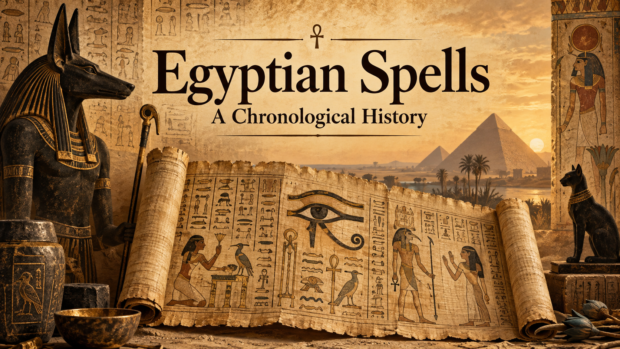
Egyptian Spells: A Chronological History from Pyramid Walls to Magical Papyri
Egyptian Spells: A Chronological History from Pyramid Walls to Magical Papyri Egyptian Spells survived for more than three thousand years because ancient Egyptians did not treat sacred words as dead literature. A spell could be spoken, written, painted, carved, worn, buried, washed with water, placed beneath a head, wrapped into a mummy, inscribed on a figurine, or copied onto a roll of papyrus for use in the next world. Some spells protected a king as he rose among the stars. Others helped ordinary people survive childbirth, snakebite, fever, nightmares, hostile spirits, dangerous journeys, and death itself. The history of Egyptian spells is therefore much larger than the history of any single book. It is the history of a technology of sacred language that changed its physical form while preserving remarkably old ideas across dynasties, political collapses, foreign rule, religious change, […]

Unedited Corpus of Early Mesopotamian Cosmological and Theological Texts
The Primordial Strata: An Unedited Corpus of Early Mesopotamian Cosmological and Theological Texts Authors Note: I had a bunch of strokes, and don't remember creating this 10 months ago. It's not really a Corpus, but cool enough to publish. Introduction The purpose of this project is to assemble the earliest Mesopotamian cosmological and theological materials in their original, unrevised form, relying exclusively on tablets excavated from Early Dynastic and pre-Akkadian contexts where the first expressions of cosmic structure and divine identity appear. The work eliminates all later political and theological shaping, allowing only the earliest recoverable strata to define the foundations of Mesopotamian sacred thought. These sources represent local scribal traditions speaking independently, unfiltered by later canonical organization. Only tablets with secure provenance, catalog identification, paleographic dating, and direct cosmological or theological content are included, ensuring a primary-source […]
Supernova – By Masked Matrix – Full Album
Album: Supernova By - Masked Matrix Release Date: 9/9/2026 Dedicated to my Love, my best friend, my light in the darkness, my Mom. I owe you everything! Happy Birthday Mama!!! Ghost Lights Hero's Journey Angels Song (Remastered) Unified Anthem Badge on Crooke Bee-Wolf The Light is in Me Ionized Friend or Enemy Stardust Fields No Good Deed Indeed Take the Time How Much Was Dat Alchemical Gold Light of Venus Sleeping on the Sidewalk Copper and Iron I Understand Robo-Pig Bad Liars Diamond Matrix Mother's Love <Download Album Here Free> 1. Ghost Lights [Verse 1] Out past the fence line By the mud and reeds Where the water goes black And the moon can't breathe I seen them drift low Like a secret in smoke By the broken road bend Where the old pine groans They don't move […]
Psychics Unseen – History of the Psychic Phenomenon – Free Download
Psychics Unseen: History of the Psychic Phenomenon Download Free Via the 3 Dots https://youtu.be/BKBudBxxCPM?is=1zB6HHZlavxxiDe4 https://youtu.be/b2LsNOE-TCk?si=2bwD2KvMgW-x7qAm Subscribe: VeiledMystic333 All About The Modern Psychic Phenomenon Psychics Unseen: History of PSI Energy & Research is Mercury Series Vol. 3, a long-form history of the Psychic phenomenon from the ancient world to the modern era of laboratories, government programs, altered-state research, online teaching, and contested science. The book does not ask readers to choose between belief and disbelief before the evidence is examined. Instead, it asks a more demanding question: what happens when human beings repeatedly report access to information that ordinary perception does not appear to provide, and what can history teach us about evaluating those reports? The subject is unusually difficult because the word Psychic covers experiences that emerged from very different traditions. Clairvoyance, telepathy, second sight, mediumship, precognition, remote viewing, psychometry, […]
The History of Carl Jung | Free Book Download
Download Free Via the 3 Dots https://youtu.be/nS1hxZqt7m0?is=rfYxOQOxAefTh2an Subscribe: Veiled Mystic 333 History of Carl Jung: The Scientist Behind the Myth The History of Carl Jung is often told as a contest between two simplified portraits. In one, Jung appears as the great explorer of dreams, symbols, archetypes, synchronicity, alchemy, religion, and the hidden depths of the psyche. In the other, he appears as a speculative thinker who left the safer ground of experimental psychology. He then wandered into territories that modern science cannot verify. Both portraits contain pieces of the truth, yet neither is sufficient. Jung began his career as a physician and experimental psychiatrist and became internationally known through word-association research. He then entered the inner circle of early psychoanalysis, broke with Sigmund Freud, and underwent an intense period of self-observation. For the rest of his life, he tried […]
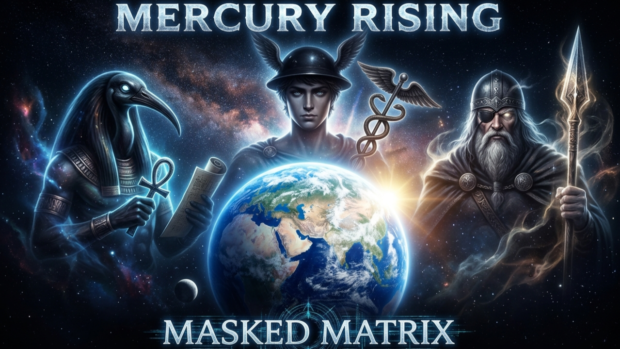
Mercury Rising – By Masked Matrix – Full Album
Album: Mercury Rising By - Masked Matrix Release Date: 8/20/26 1. NPC or just Dumb 2. Fracking Rediculous 3. Pineal Gland Peek-a-boo 4. Sia & Hu 5. Just Another Oil Spill 6. Artificial Consciousness 7. I'm Still Here 8. Angel Numbers 9. Flew too Close to the Sun 10. Tektites Transforming Me 11. Guardians of Greed 12. You're the One that's Crazy 13. Enki's Golden Apple 14. Spiritual Warfare 15. Elder Care 16. Perpetual War 17. Unified Future 18. Cotton Candy Clouds 19. Mass Hypnosis 20. Path of the Mystic 21. The Tunnel Dwellers 22. Remote Viewers <Download Album Free Here> 1. NPC or just Dumb [Verse] You walk the street like you're on rails Eyes glazed over like a ship with no sails Your words are scripts that never stray Is it the game or your […]
Related
Unedited Corpus of Early Mesopotamian Cosmological and Theological Texts
The Primordial Strata: An Unedited Corpus of Early Mesopotamian Cosmological and Theological Texts Authors Note: I had a bunch of strokes, and don't remember creating this 10 months ago. It's not really a Corpus, but cool enough to publish. Introduction The purpose of this project is to assemble the earliest Mesopotamian cosmological and theological materials in their original, unrevised form, relying exclusively on tablets excavated from Early Dynastic and pre-Akkadian contexts where the first expressions of cosmic structure and divine identity appear. The work eliminates all later political and theological shaping, allowing only the earliest recoverable strata to define the foundations of Mesopotamian sacred thought. These sources represent local scribal traditions speaking independently, unfiltered by later canonical organization. Only tablets with secure provenance, catalog identification, paleographic dating, and direct cosmological or theological content are included, ensuring a primary-source […]
Supernova – By Masked Matrix – Full Album
Album: Supernova By - Masked Matrix Release Date: 9/9/2026 Dedicated to my Love, my best friend, my light in the darkness, my Mom. I owe you everything! Happy Birthday Mama!!! Ghost Lights Hero's Journey Angels Song (Remastered) Unified Anthem Badge on Crooke Bee-Wolf The Light is in Me Ionized Friend or Enemy Stardust Fields No Good Deed Indeed Take the Time How Much Was Dat Alchemical Gold Light of Venus Sleeping on the Sidewalk Copper and Iron I Understand Robo-Pig Bad Liars Diamond Matrix Mother's Love <Download Album Here Free> 1. Ghost Lights [Verse 1] Out past the fence line By the mud and reeds Where the water goes black And the moon can't breathe I seen them drift low Like a secret in smoke By the broken road bend Where the old pine groans They don't move […]
Psychics Unseen – History of the Psychic Phenomenon – Free Download
Psychics Unseen: History of the Psychic Phenomenon Download Free Via the 3 Dots https://youtu.be/BKBudBxxCPM?is=1zB6HHZlavxxiDe4 https://youtu.be/b2LsNOE-TCk?si=2bwD2KvMgW-x7qAm Subscribe: VeiledMystic333 All About The Modern Psychic Phenomenon Psychics Unseen: History of PSI Energy & Research is Mercury Series Vol. 3, a long-form history of the Psychic phenomenon from the ancient world to the modern era of laboratories, government programs, altered-state research, online teaching, and contested science. The book does not ask readers to choose between belief and disbelief before the evidence is examined. Instead, it asks a more demanding question: what happens when human beings repeatedly report access to information that ordinary perception does not appear to provide, and what can history teach us about evaluating those reports? The subject is unusually difficult because the word Psychic covers experiences that emerged from very different traditions. Clairvoyance, telepathy, second sight, mediumship, precognition, remote viewing, psychometry, […]
The History of Carl Jung | Free Book Download
Download Free Via the 3 Dots https://youtu.be/nS1hxZqt7m0?is=rfYxOQOxAefTh2an Subscribe: Veiled Mystic 333 History of Carl Jung: The Scientist Behind the Myth The History of Carl Jung is often told as a contest between two simplified portraits. In one, Jung appears as the great explorer of dreams, symbols, archetypes, synchronicity, alchemy, religion, and the hidden depths of the psyche. In the other, he appears as a speculative thinker who left the safer ground of experimental psychology. He then wandered into territories that modern science cannot verify. Both portraits contain pieces of the truth, yet neither is sufficient. Jung began his career as a physician and experimental psychiatrist and became internationally known through word-association research. He then entered the inner circle of early psychoanalysis, broke with Sigmund Freud, and underwent an intense period of self-observation. For the rest of his life, he tried […]
Mercury Rising – By Masked Matrix – Full Album
Album: Mercury Rising By - Masked Matrix Release Date: 8/20/26 1. NPC or just Dumb 2. Fracking Rediculous 3. Pineal Gland Peek-a-boo 4. Sia & Hu 5. Just Another Oil Spill 6. Artificial Consciousness 7. I'm Still Here 8. Angel Numbers 9. Flew too Close to the Sun 10. Tektites Transforming Me 11. Guardians of Greed 12. You're the One that's Crazy 13. Enki's Golden Apple 14. Spiritual Warfare 15. Elder Care 16. Perpetual War 17. Unified Future 18. Cotton Candy Clouds 19. Mass Hypnosis 20. Path of the Mystic 21. The Tunnel Dwellers 22. Remote Viewers <Download Album Free Here> 1. NPC or just Dumb [Verse] You walk the street like you're on rails Eyes glazed over like a ship with no sails Your words are scripts that never stray Is it the game or your […]
The Apocalypse of Abraham (Story Edition) – Free Download
The Apocalypse of Abraham Story Edition Download Free Via the 3 Dots https://youtu.be/vKUDkJEYBBc?is=wDK5PuvKEvuR4Pqo Subscribe: Veiled Mystic The Apocalypse of Abraham is one of those ancient works that can take a modern reader completely by surprise. It begins on a human scale. Abraham is still a young man living in the household of his father Terah. His father manufactures idols. Abraham sees stone gods break, wooden gods burn, and images supposedly capable of blessing human beings depend entirely on human hands to stand upright, survive accidents, or even exist. Then the story opens into something much larger. A heavenly voice calls Abraham away. An angel named Yahoel becomes his guide. The adversarial power Azazel appears. Abraham prepares the covenant sacrifice known from Genesis, but the familiar biblical scene becomes the doorway to a cosmic revelation. Abraham rises into the heavens. He […]
Be the first to leave a comment