Download Free Via the 3 Dots
Subscribe: Veiled Mystic
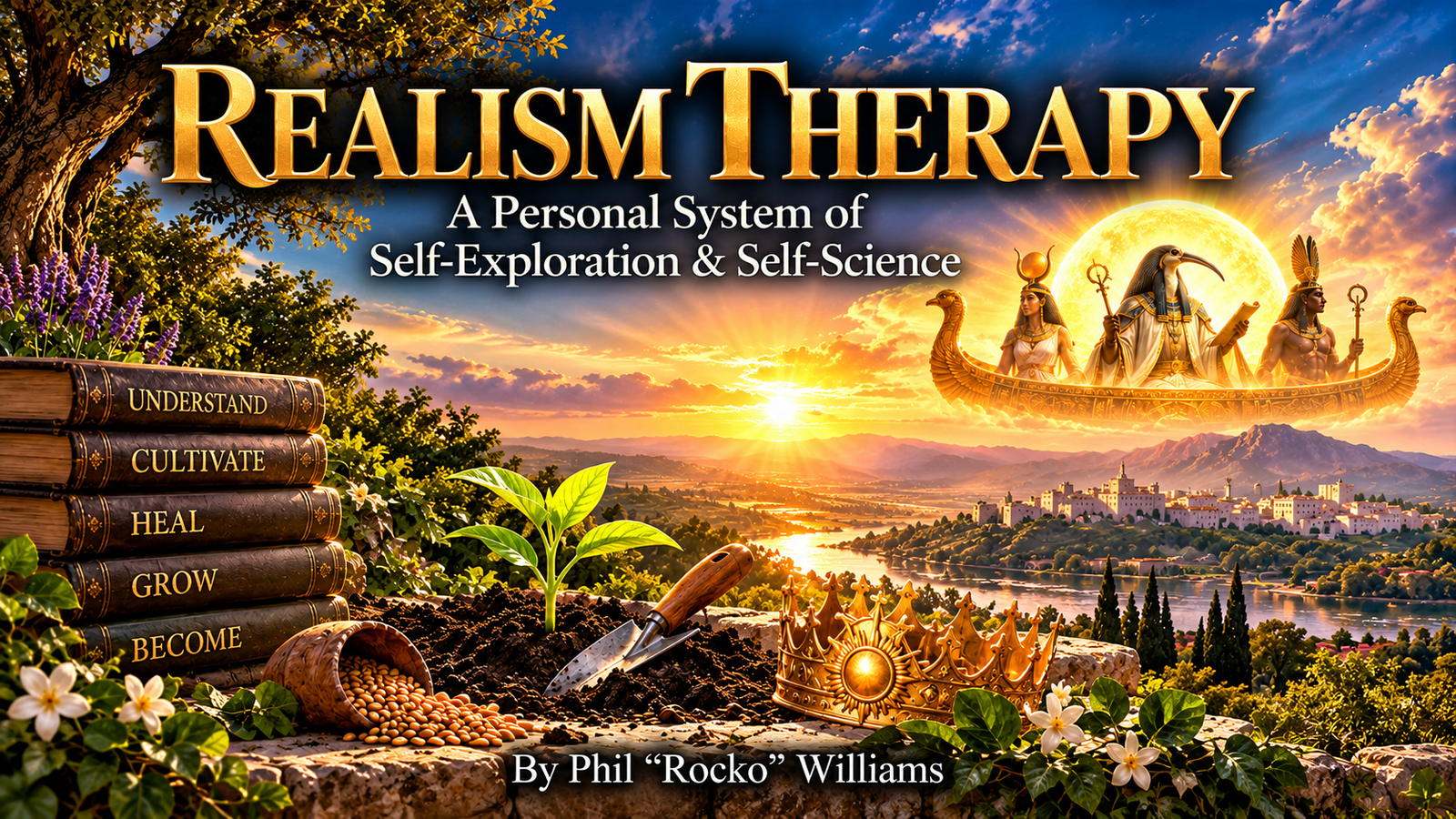
Realism Therapy: A Personal System of Self-Exploration & Self-Science, by Phil “Rocko” Williams, is a substantial exploration of what it means to know ourselves honestly, take responsibility for what belongs to us, and cultivate a better relationship with the person we are becoming. Across forty-two chapters arranged in seven parts, the book develops a simple but demanding idea: life gives us experiences every day, and those experiences can become sources of understanding rather than material for another round of shame. It is not a book about pretending to be positive, suppressing uncomfortable emotions, or performing a perfect personality for the approval of others. It is about learning to observe our lives with greater accuracy, understanding why certain responses have become familiar, and choosing what we might wish to cultivate next. The result is an invitation to self-exploration that treats ordinary experience as the material of personal growth.
The title deliberately puts realism first. The book does not assume that every difficulty begins inside the individual, that every conflict has one guilty party, or that people can control everything that happens around them. It recognizes the influence of family history, social expectations, conditioning, exhausting circumstances, and the actions of other people. It also recognizes that understanding those influences does not remove our ability to examine choices that are genuinely ours. A person can be honest about hardship without being defined forever by hardship. A person can acknowledge an unhelpful habit without concluding that their entire identity is defective. The book returns repeatedly to the distinction between a fair observation and a cruel judgment, because knowing what needs attention is only useful if we remain willing to attend to it.
Realism Therapy, often shortened to RT within the manuscript, is presented as a developing, self-directed framework rather than an established clinical psychotherapy. It draws from psychological knowledge, contemplative reflection, the author’s experience, and an optional vocabulary of spiritual transformation. Its promise is not a guaranteed cure or a universal system of rules. It is an approach readers may adapt to their own needs, values, capacities, and surroundings. Some will recognize its questions from personal experience. Others may encounter familiar struggles described in a way they have not considered before. Throughout the book, the aim remains the same: better understanding, more deliberate choices, patience with setbacks, and a life whose direction belongs to the person living it.
The Personal Beginning Behind the Book
The Introduction explains that Realism Therapy began with a personal effort to understand behavior after prolonged emotional hardship. The author describes reading widely in psychology, examining formative experiences, recognizing reactions he wished to change, and discovering how difficult it can be to act on an insight when a familiar emotional situation returns. He could sometimes identify a better response in contemplation and then revert to an old response in the heat of the next confrontation. Rather than concluding that his reflection was worthless, he began recognizing that each attempt revealed additional information about the behavior he was trying to change. That realization supplies the central tone of the book. A mistake may be disappointing, and it may require an apology or another form of repair, but it need not become a verdict against the whole person.
This origin matters because the manuscript does not speak from the position of someone claiming never to struggle. Its philosophy begins in the gap between understanding and action. It asks what happens after the exciting realization, after the promise to improve, after the situation in which we meant to remain patient but did not. It explores why an insight can be genuine and still require time, practice, rest, new circumstances, or outside help before it becomes a consistent behavior. The book also begins with a personal dedication and an original parable, making clear that this is both an intellectual project and a deeply human one. Its language seeks to be accessible rather than clinical, without abandoning the distinction between personal observations and scientific evidence.
The author’s central message is not that every individual ought to become a teacher, leader, or example to the world. Personal growth belongs to the person undertaking it. One individual may want to become a calmer parent; another may want to stop mistaking kindness for unlimited availability; another may be trying to rebuild a sense of possibility after long discouragement. Someone else may simply wish to understand why an old argument continues to produce the same reaction. The book allows those goals to remain different. What connects them is the willingness to become a more careful observer of the life one actually has, rather than a performer of the life one thinks others expect to see.
The Opening Parable: The Gardener and the Crown of the Sun
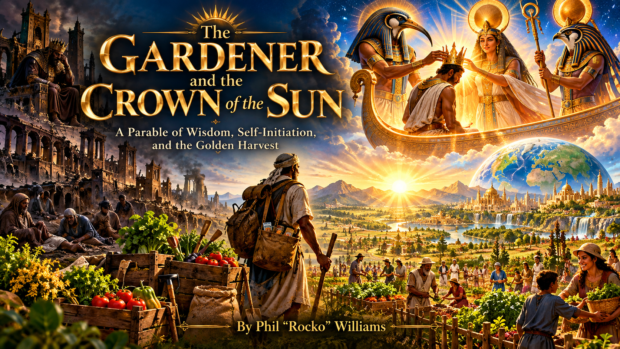
Before the Introduction, readers encounter The Gardener and the Crown of the Sun, an original short parable that establishes the imagery guiding the entire book. Its kingdom has been weakened by a corrupt Sun King who confuses obedience with harmony and possession with stewardship. As his rule deteriorates, the people lose confidence, their gardens fall into neglect, and the knowledge needed to care for themselves begins to disappear. When the ruler falls, the absence of tyranny does not automatically restore the community. The people remain exhausted and uncertain, unable to imagine how to begin again. The story gives the book a vivid starting image: a garden can still be alive even when the person responsible for tending it has been away for a long time.
The turning point comes from a man who left the kingdom earlier and traveled East to learn. He returns not with an army or a claim to the vacant throne, but with seeds, tools, knowledge, and an offer to teach. He does not accuse the townspeople of laziness or insist that their neglected plots prove they are worthless. He shows them how to examine the soil, recognize useful plants, and discover what may be saved. He also makes a crucial promise: each person’s garden remains their own. As neighbors begin to grow again, the absent fences allow separate yards to become a shared landscape of abundance. One harvest makes another possible. The kingdom changes through learned capacity and voluntary cooperation, not through a new demand for submission.
In the parable’s mythic ending, Thoth, Sia, and Hu appear upon the Solar Barque and crown the gardener as a worthy Sun King. The story does not suggest that the man’s greatest achievement is receiving authority over other people. Rather, his wisdom has enabled others to reclaim their own agency. That distinction returns in the closing chapters, where the crown becomes a symbol of personal sovereignty rather than superiority. The parable is not presented as a historical event or a clinical case study. It is an imaginative doorway into the book’s language of seeds, neglected roots, careful pruning, inner cultivation, and harvests that may be shared freely. It gives the reader something memorable to carry through the more detailed psychological discussions to come.
The Meaning of Realism in Personal Growth
A central strength of the book is its refusal to confuse honesty with harshness. Realism does not mean telling ourselves the most painful possible story and declaring it true because it hurts. Neither does it mean accepting every criticism or viewing every emotional response as evidence of a hidden defect. It means examining what happened, what we know, what we infer, what we feel, and what remains uncertain. The distinction becomes especially important in everyday conflict. A remark that feels insulting may have been deliberately hostile, carelessly phrased, or misunderstood. An old experience may make the present remark feel more threatening than it would otherwise. The book does not tell readers to dismiss their emotions. It asks them to investigate what their emotions may be responding to before turning an interpretation into an unquestionable fact.
The same fair-minded examination applies to personal behavior. When a person recognizes that they interrupted someone, reacted defensively, or failed to keep a promise, they have identified something specific that can be considered. Turning that observation into the statement that they are a hopeless person adds little useful information. The manuscript separates what we do from the sweeping labels we place upon ourselves. It also separates responsibility from blame. Sometimes an apology is needed. Sometimes a boundary is needed. Sometimes the responsible conclusion is that another person’s conduct was not ours to control. In each case, the quality of the next choice depends partly on whether we have described the situation accurately enough to understand what might change.
The book also makes space for the fact that not every weakness is waiting to become some spectacular strength. Human lives involve limited time, uneven abilities, unavoidable losses, health constraints, and different values. A realistic philosophy cannot promise everyone the same harvest. Its more grounded invitation is to recognize the possibilities available within actual circumstances and give those possibilities appropriate attention. This is why the garden remains a better image than a broken machine. The person is not an object that becomes worthless when one component malfunctions. The person is alive, influenced by seasons, conditions, relationships, and continuing growth. What deserves cultivation can change as life changes.
Life Comes First: Contemplation Without a Clock
Realism Therapy places everyday contemplation at the center of its practice, but refuses to turn contemplation into another obligation. There is no required hour, special posture, journal, ritual schedule, or sequence of exercises that a reader must complete to qualify as a practitioner. Instead, the book recognizes the unplanned moments in which thought naturally becomes available. A person may reflect while preparing lunch, taking a walk, showering, traveling home, or sitting quietly after a difficult conversation. An important realization may arrive while doing something entirely ordinary. Rather than prescribing the same form of discipline for everyone, the manuscript encourages people to recognize useful openings in the life they already lead.
This approach grows from an important observation about contemporary life. Work, family responsibilities, illness, finances, and everyday exhaustion already compete for attention. A person interested in self-development may still lack the time or energy for a demanding new routine. A beautifully designed worksheet can be helpful to one reader and a source of discouragement to another. The book therefore places thought-based observation before recordkeeping. Notes, journals, and structured exercises appear later as optional tools, but no reader has to complete them for the central philosophy to make sense. Personal development is not a school assignment. It is a relationship with one’s own experience, continued when possible and set aside when living requires undivided attention.
The manuscript is equally careful to distinguish useful contemplation from repetitive rumination. Examining a problem may produce clarity, an alternative interpretation, or a more realistic next step. Replaying the same humiliation for hours can instead deepen distress without yielding anything new. Realism Therapy does not ask people to examine every passing emotion until ordinary life becomes a continuous internal trial. The gardener is allowed to rest, to enjoy the garden, and to stop digging once the soil has yielded what it can. That understanding forms the groundwork for the first part of the book and prevents the desire to grow from hardening into a demand for constant self-monitoring.
Part I: The Invitation to Self-Science
The first six chapters introduce the reader to the book’s defining stance. The Garden Still Lives develops the image of returning to a neglected yet living place. Know Thyself asks how much of our identity comes from careful observation and how much comes from labels inherited from family, school, society, or repeated conflict. Life Comes First establishes that development must fit into a person’s actual circumstances rather than compete with them. Contemplation Without a Clock explains the kind of directed thinking the author means by meditation. Observe Before You Judge develops the ability to separate observation from interpretation. Your Life, Your Laboratory introduces the ordinary investigative attitude that the manuscript calls Self-Science.
These chapters are not arranged as compulsory lessons to pass. They establish a way of approaching experience. The reader learns what the book means when it speaks of observation as something more useful than reflexive accusation. A person’s first interpretation may be sincere yet incomplete. A recurring emotional reaction may be understandable and still require attention. A personal strength may have survived years of neglect without ever receiving recognition. The opening part therefore examines both difficulties and resources. It does not encourage a relentless search for defects. The author wants readers to notice where the garden flourishes as well as where it has struggled, and to resist making permanent conclusions from one unfavorable season.
By the end of Part I, the book has introduced its distinctive use of the word science without pretending that every personal insight is a laboratory discovery. Self-Science means observing patterns, examining possible causes, trying reasonable alternatives, and remaining willing to revise an explanation when experience suggests a better one. Private reflection can be valuable without being treated as universal evidence. A lesson that helps one person may not suit another person’s circumstances. That humility is central to the first part: the reader is not asked to imitate the author as though his life were the standard model. The reader is being invited to become more skilled at studying a life that only they can fully inhabit.
Part II: The Roots of Our Responses
The second part turns from the invitation to observe toward the more difficult question of why familiar responses appear so quickly. The Mind That Learns to Survive describes the ordinary human capacity to learn protective behavior from experience. Emotional Triggers: Recognizing the Signals examines circumstances that activate an established reaction, sometimes before we have consciously considered what is happening. Why Habits Become Automatic looks at repetition and the way short-term consequences can maintain a response even when its long-term results are costly. The Roots of Experience considers formative relationships and significant life events. Memory Is a Clue, Not a Verdict adds an essential warning against treating recollection as a perfect recording. The Social Mask and the Private Self closes the part by examining how behavior changes under social expectations.
These chapters explain why someone can know what they wish to do yet struggle when the relevant circumstances return. A person who has repeatedly been humiliated may become unusually sensitive to criticism. Someone who found safety through silence may later avoid conversations they genuinely need to have. Another person may learn to secure approval by agreeing to almost everything and discover years afterward that the habit has produced resentment and fatigue. The book treats such patterns as learned responses with histories, functions, and consequences. Understanding them does not automatically make them harmless, but it can replace a global insult with a more accurate explanation of what the person is experiencing and doing.
The treatment of memory is especially significant. The author places his own early contemplation of influential events within a larger discussion of uncertainty. Important experiences may help explain a present reaction, but we cannot always identify one origin or reconstruct every detail accurately. A vivid memory does not establish every surrounding fact. The book therefore avoids insisting that people excavate a hidden incident before attempting change. Sometimes a present pattern is clear enough to work with, even when its beginnings remain unknown. This is a key example of the book applying realism to its own method rather than allowing a compelling personal story to substitute for evidence.
The final chapter of Part II addresses one of the manuscript’s recurring social concerns: the difference between a useful role and a role that has swallowed the rest of our identity. Courtesy, professional restraint, and selective privacy are not automatically dishonest. Problems arise when someone becomes convinced they must always be strong, pleasing, cheerful, agreeable, or untroubled to remain acceptable. The book asks readers to recognize their roles without confusing those roles with the whole person. It prepares the way for the next part, where honest accountability must be separated from the social shame that so often accompanies personal criticism.
Part III: The Mirror Without Shame
The third part is the moral and emotional center of the book. Its chapters ask readers to face their own actions without turning reflection into a form of punishment. Accountability Without Accusation establishes that examining our contribution to an argument or difficulty does not mean declaring ourselves responsible for everything that happened. The Boundaries of Responsibility makes that distinction more explicit, especially when another person’s choices, an unequal relationship, or an unreasonable environment shaped the outcome. Shame, Guilt, and the Inner Court gives a memorable name to the internal judgments people make about their behavior. Self-Love Is the Starting Point then explains why basic self-respect and care should not be postponed until after every weakness has been overcome.
Forgiveness Without Excuses considers the relationship between accepting an error and continuing to live under a sentence of self-condemnation. The chapter does not suggest that forgiveness cancels consequences or that a sincere apology requires the other person to reconcile. It asks whether lifelong self-punishment actually improves the choices available now. Jung’s Shadow: The Light Among the Weeds closes the part by introducing the familiar concept of the shadow in plain language. The discussion includes impulses and motives we may dislike, but also qualities such as creativity, tenderness, courage, or assertiveness that we may have hidden because they did not fit the personality we felt permitted to display. The part therefore brings honesty and compassion into the same room, refusing to sacrifice either one.
The Inner Court metaphor gives these chapters a particular character. People can act as severe judges of their own lives, interpreting an ordinary mistake as evidence of permanent inferiority. They may also become defenders who refuse to admit any fault. Neither extreme produces accurate information. The book invites a fairer inquiry: what happened, what choices belonged to me, what effect did those choices have, and what can be learned without turning myself into an enemy? Shame can be considered as an emotional signal without being accepted as final proof that someone deserves condemnation. The manuscript makes a related distinction between guilt over an action and a global conclusion about the worth of the individual. Its recurring goal is to preserve the willingness to look honestly at ourselves because that willingness becomes much harder when every discovery invites another round of cruelty.
Part III also helps protect readers against an important misunderstanding of personal responsibility. A person who has been mistreated may be accustomed to carrying guilt that properly belongs to somebody else. A difficult relationship may teach someone to inspect every small movement of their own behavior while excusing repeated mistreatment by another person. Realism Therapy does not promote that imbalance. An honest mirror can show that a response might be improved, and it can also show that a boundary or a safer environment is needed. Responsibility remains proportionate to actual agency. The book’s insistence on this fairness gives substance to its central phrase: accountability without shame.
Part IV: The Mental Gym
With the groundwork established, Part IV turns toward practicing different responses in ordinary life. A Weakness Is a Seed introduces the image of a capacity that may be underdeveloped rather than a fixed personal defect. Understanding the Mechanics of Reaction looks more closely at emotional sequences: situations, interpretations, bodily sensations, familiar impulses, and behavior. Practicing Before the Heat of the Moment examines what it means to imagine and prepare a specific alternative before the next challenging situation arrives. Growing Discipline Without Cruelty considers how self-control can develop gradually through manageable practice. Every Failed Experiment Teaches addresses disappointment, repetition, and the temptation to view a setback as proof that the entire attempt was useless. Rest, Recovery, and the Mental Gym closes the part by arguing that effort without regard for limits can become another destructive pattern.
The mental gym is a particularly effective metaphor because it gives personal change a realistic pace. Understanding how to perform a difficult exercise does not mean that a person has already developed the strength to do it consistently. In the same way, understanding why a familiar emotional reaction arises does not guarantee a different response during the next confrontation. The book describes how a person may first recognize a reaction long afterward, then during the event, and eventually early enough to make a choice. These are illustrations of progress, not required milestones that every reader must reach in order. The important distinction is between discovering what a response means and developing greater ability to act upon that understanding when circumstances become demanding.
Mental rehearsal is discussed as preparation rather than magical prediction. A reader does not need to script an entire future conversation or imagine perfect control over another person. The book’s emphasis is on identifying a recognizable situation and contemplating a response that may be feasible within it. Sometimes the alternative is listening for one more moment before interrupting. Sometimes it is speaking a clear boundary without an unnecessary explanation. Sometimes it is choosing not to continue an argument that has become unsafe or unproductive. The value of the rehearsal lies in preparing a possibility that can later be examined against actual experience. What happened in real life remains more important than how convincing the imagined scene felt beforehand.
The chapter on failed experiments embodies a principle that runs through the manuscript. A repeated mistake is not automatically proof that the individual has not tried hard enough. It may reveal that the intended response was too complicated, that the trigger was recognized too late, that exhaustion played a greater role than expected, or that the environment itself requires attention. It may also reveal that a different method is needed. The book does not dismiss harm or treat all failures as harmless entertainment. It does insist that self-abuse adds no useful evidence. Rest and recovery belong in the same part because the person undertaking the work remains a human being with limited energy, not a machine that must operate at maximum intensity until a goal has been achieved.
Part V: Living in the Outer Garden
The fifth part asks what becomes of inner cultivation when we must live among other people. The World of Competition and Judgment introduces social expectations, comparison, harsh criticism, and the pressure to conform. Adaptability Without Self-Betrayal distinguishes the useful skill of adjusting to circumstances from the loss of one’s chosen values. Archetypes as Conscious Roles considers Robert Moore and Douglas Gillette’s familiar King, Warrior, Magician, and Lover as symbolic ways to think about different capacities. Boundaries Are Part of Kindness explains why compassion need not mean unlimited access or agreement. Selective Trust and Therapeutic Companions examines the wisdom of choosing appropriate confidants. Repairing Conflict Without Ruling Others completes the part with an account of apologies, listening, repair, and the limits of reconciliation.
The book is candid about the difficulty of the outer world. Social pressure does not disappear when someone becomes more self-aware. Workplaces can be competitive, families may carry years of assumptions, and strangers may be careless with one another’s feelings. Some people have experienced ridicule, exclusion, or persistent judgment that shaped their protective habits. Realism Therapy addresses such pressures without treating the historical ideology of Social Darwinism as a law of human nature. Its interest is in the concrete effects of social competition and the ways people learn to adapt. The same person may be warm and relaxed in one setting and guarded in another. The difference can tell us something about the individual, the surroundings, or both.
One of the most practical distinctions in this part concerns social masks. A role can help someone meet a situation effectively without becoming a false self. A person may act decisively at work, gently with a child, firmly when defending a boundary, and quietly when listening to a grieving friend. The book uses archetypes as memorable metaphors for such capacities, not as scientifically established personality types or spiritual identities everyone must possess. The deeper question is whether a role serves a chosen value or has become a compulsory performance designed to prevent rejection. A person can adapt without surrendering their privacy, dignity, tenderness, or independence. The text resists the simplistic idea that authenticity requires revealing everything to everyone.
The chapters about boundaries and trust bring that principle into relationships. Not every friend is willing or equipped to provide emotional support, and not every private problem should be shared indiscriminately. Choosing whom to trust is presented as good judgment rather than evidence of coldness. The book also asks readers not to make every person around them an unwilling therapist, or to impose their preferred approach on someone who has not asked for advice. In conflict, the task becomes identifying our own contribution, repairing what can reasonably be repaired, and understanding that reconciliation is not always possible, safe, or desirable. The outer garden contains other gardeners with their own choices. Personal growth should improve our conduct without becoming an excuse to control theirs.
Part VI: Cultivating a Life Worth Living
The sixth part turns toward periods when the garden has been neglected and the person tending it may no longer feel capable of beginning again. When the Garden Falls Into Neglect examines cycles of discouragement, avoidance, withdrawal, and inadequate care without describing people as lazy or morally defective. Reclaiming Agency and Hope addresses the gradual recovery of a sense that one’s choices can matter. Care for the Gardener places ordinary needs such as rest, nourishment, safety, connection, and appropriate support within the idea of self-respect. The Higher Shadow and Hidden Strengths explores qualities that have remained unrecognized or suppressed. The Self-Image We Can Rebuild examines the difference between a person’s actual experiences and the portrait they have developed of themselves. Progress Without Perfection brings these threads together in a description of growth that can be partial, uneven, and still significant.
The neglected garden becomes especially important in this part because neglect may result from exhaustion, illness, grief, insecurity, unequal resources, or hardship that the person did not choose. The manuscript does not ask readers to imagine that they could have overcome every obstacle through greater determination. It asks what care and choice may realistically be possible now. A difficult season may have reduced the time or ability available for other pursuits. Some plants may need immediate attention. Others may have survived surprisingly well. A useful starting point may be smaller than the ideal the reader once imagined. The book treats that small beginning as worthy of respect precisely because it is connected to circumstances rather than a fantasy of limitless power.
The Higher Shadow is one of the book’s more distinctive interpretive concepts. It does not refer to a newly discovered structure of the brain or an established clinical category. The term describes possibilities that may lie beyond a person’s familiar self-image, including more mature expressions of qualities they have previously experienced as problems and positive capacities that have scarcely been expressed. Anger may point toward a need for stronger boundaries, while sensitivity may contain perceptiveness that has been dismissed as weakness. A person accustomed to hiding ambition, creative work, tenderness, or independence may discover resources that were present but rarely welcomed. The author does not insist that every harmful impulse must be secretly beneficial. The invitation is to examine what is growing before labeling the entire area useless.
The discussion of self-image also avoids the idea that positive thinking alone can change reality. Inspired in part by Maxwell Maltz, the book asks readers to notice the stories they carry about their capabilities and compare those stories with actual experience. Someone may describe themselves as incapable despite having met difficult responsibilities for years. Someone else may appear confident while fearing the slightest correction. The manuscript treats these self-portraits as interpretations that can omit evidence. Rebuilding them involves taking seriously what a person has done, what remains difficult, what they value, and what can realistically be practiced. The closing chapter on progress without perfection makes room for the modest but meaningful signs of growth that do not look spectacular from outside: returning to an abandoned task, asking for help, noticing a trigger sooner, or speaking one honest sentence that once seemed impossible.
Part VII: The Journey of Self-Initiation
The seventh and final part unites the psychological foundation with the book’s optional symbolic dimension. Psychological Self-Science and Spiritual Self-Alchemy introduces two ways of understanding personal growth: investigating experience through observation and evidence, and interpreting transformation through meaningful spiritual imagery. The Ego That Learns to Serve asks readers to distinguish a healthy sense of self from defensiveness, superiority, and the need to dominate. The Golden Phoenix: Death and Rebirth presents renewal as the gradual release of unhelpful patterns and the cultivation of alternatives. The Inner Garden and the Outer Garden examines the relationship between private growth and the shared world. The Crown We Cultivate develops sovereignty without superiority. Edan and the Golden Harvest closes the book with the picture of a life that continues to grow beyond the final page.
Self-Initiation is not presented as entry into a club, proof of spiritual advancement, or a ceremony that grants special status. Its meaning here is personal: an individual begins to participate more consciously in the life they are shaping. A reader does not need another person’s authorization to ask difficult questions, change a habit, question an inherited expectation, or cultivate a neglected strength. Neither does the book suggest that every person must use the same spiritual vocabulary. Readers who find depth in alchemical symbolism may recognize the phoenix, the crown, and the cultivated garden as images of inner renewal. Others can understand the same passages as metaphors for psychological development and deliberate choice. The core practice remains accessible without any required belief about invisible forces.
The book’s treatment of ego is similarly constructive. Rather than advising readers to destroy their sense of self, it examines the ways identity can be defended too rigidly or used more maturely. Pride can become self-respect rather than superiority. Confidence can coexist with admitting error. A sense of responsibility can encourage leadership without demanding obedience. The Golden Phoenix then gives the reader an image of change that does not require self-destruction. Something in the way we respond may need to end for another possibility to grow, but the person undertaking the process does not have to be condemned or psychologically burned down to make that change possible. Death and rebirth remain symbols with diverse meanings across traditions, not claims that all religions teach one identical ritual.
The Inner Garden and the Outer Garden provide the book’s last major connection. The inner garden represents personal experience, habits, values, and private contemplation. The outer garden represents relationships, society, circumstances, and the wider world in which those qualities are expressed. Neither exists in complete isolation from the other. Outer events influence inner reactions; reflection may influence how we meet those events next time. The crown belongs to the person who accepts responsibility for their own choices, not to someone seeking to rule another person’s garden. Finally, Edan describes the cultivated relationship with life itself rather than an impossible condition in which no weed ever returns. The final movement closes with a living garden, continuing seasons, and the freedom to choose what comes next.
The Psychological Influences and the Book’s Commitment to Evidence
One of the reasons the manuscript is broader than a conventional inspirational essay is its willingness to bring different traditions into conversation while keeping their status clear. Carl Jung’s language of persona and shadow helps frame questions about the qualities we acknowledge and those we conceal. Robert Moore and Douglas Gillette’s archetypal figures supply memorable symbolic roles for approaching different situations. Maxwell Maltz’s emphasis on self-image and rehearsal helps open a discussion about the relationship between how we see ourselves and what we attempt. These influences are woven into a larger account of behavioral habits, personal values, self-compassion, emotional regulation, and learning from actual experience. They are not presented as interchangeable proofs of one underlying theory.
The Research Foundations and Sources section is unusually explicit about the difference between established techniques and the book’s own integrated philosophy. In describing the psychological background, the manuscript refers to traditions such as cognitive behavioral therapy, which examines relationships among thoughts, feelings, and behavior; Acceptance and Commitment Therapy, which emphasizes psychological flexibility and chosen values; and the body of self-compassion research examining how people respond to difficulty and personal mistakes. The article’s purpose in naming these sources is to describe the intellectual landscape readers will encounter inside Realism Therapy. The complete RT framework is not described as a newly validated clinical treatment merely because some ingredients have evidence behind them.
The manuscript also makes distinctions within its own vocabulary. Terms such as emotional trigger, habit learning, and personal responsibility can be discussed through familiar psychological ideas and everyday observation. The Higher Shadow, the Inner Garden, the Crown, the Golden Phoenix, and Edan belong to the author’s interpretive and symbolic language. Spiritual Self-Alchemy is offered to readers who find that language meaningful, not imposed upon readers who understand change in other terms. Even the word therapy is explained early in the book as a description of a reflective purpose rather than a claim of professional medical qualification. That transparency is consistent with the central promise of realism: a reader should not have to exaggerate a finding, confuse metaphor with mechanism, or adopt the author’s worldview in order to benefit from an honest question.
There is an equally important boundary concerning personal hardship. The book does not advise readers to replace professional treatment or safety planning with solitary contemplation when serious difficulties require qualified help. It recognizes that severe depression, suicidal thinking, trauma, dangerous substance use, and abusive circumstances may call for services and support beyond the reach of self-reflection alone. Such support is presented as compatible with personal responsibility, not as an admission that the reader has failed to cultivate enough strength. For a book centered on autonomy, recognizing where additional expertise can help is part of honest self-knowledge. This is not a minor disclaimer attached at the end; the distinction appears in the Introduction and returns throughout the discussion of care, relationships, agency, and limitations.
Why the Book Is a Framework, Not a Rulebook
Readers will notice that Realism Therapy does not build toward a rigid schedule of prescribed activities. It does not announce that growth requires exactly thirty days of meditation, a new notebook, the completion of weekly tests, or the memorization of a fixed number of principles. The book’s approach is deliberately adaptable because the conditions of individual lives differ. A parent caring for young children may have very different opportunities for quiet thought from someone living alone. A reader coping with physical illness may need more rest and less deliberate practice than a reader who has energy to pursue demanding changes. One person may benefit from writing; another may find that the most useful moments of reflection happen without any record at all. The text leaves that difference intact.
The optional exercises at the end clarify what the author means by providing tools without creating obligations. They include brief ways of checking assumptions, examining an uncomfortable moment, noticing an emotional pattern, or choosing a modest act of care. A reader may experiment with any of them or use none of them. Their presence adds convenience for those who appreciate structure, while the actual practice remains possible in everyday thought. The book consistently returns to the right of the individual to choose a useful method and set it aside when it stops helping. Adaptation is not described as carelessness. It is the application of careful observation to the unique conditions of one’s own life.
That freedom extends to the goal of personal development. The manuscript does not decide what a successful person must look like. It does not insist that every reader become publicly confident, endlessly productive, spiritually initiated, financially successful, or socially admired. One person may wish to strengthen a boundary. Another may wish to become more patient in disagreement. Another may want to revive a neglected creative practice or recover the ability to enjoy an ordinary day. These destinations may be modest in appearance and profound in personal meaning. In the book’s garden imagery, the value of a harvest cannot be measured by a single crop that everyone is required to grow. The reader is offered methods for investigation and cultivation, while the direction remains theirs to determine.
Who Realism Therapy Was Written For
The book is written for readers who recognize the distance between the person they hope to become and the habits they sometimes find themselves repeating. Some may be frustrated that an insight reached in a quiet moment disappears during an argument. Some may have spent years carrying harsh judgments inherited from other people. Some may be exhausted by the effort of pleasing everyone around them, and others may be tired of a defensive style that keeps people at a distance. The manuscript speaks to these experiences without assuming that they all have one origin or that one exercise will resolve them. It gives readers an approachable vocabulary for examining the particular patterns and circumstances that matter in their lives.
It also speaks to readers who are suspicious of personal-growth systems that demand constant performance. A person may admire self-discipline and still feel discouraged by programs that add another daily obligation to an already crowded schedule. Realism Therapy begins from the opposite direction. It makes room for honest thought during the life that is already happening. There is room for questions, uncertainty, long stretches of ordinary activity, and breaks when the person is tired. Learning can occur without public announcements or a visible record of achievement. The book treats the fact that someone is still willing to look at their life with curiosity as something worthy of respect, not something too small to count.
Readers interested in the relationship between psychology and symbolism will find another doorway. The book gives Jung, Moore, Maltz, and spiritual imagery their own roles without demanding that one vocabulary erase the others. Its references to the shadow, ego, inner temple, self-initiation, phoenix, and crown serve a larger account of personal responsibility and freedom. The appeal is not limited to those who already speak in esoteric terms. Much of the symbolic material is explained through familiar human situations: an argument, a difficult decision, a neglected responsibility, an exhausted caregiver, an unfair judgment, or the relief of finally recognizing a strength. Those examples are intended to help readers connect complex ideas to situations they can understand.
Finally, the book is for readers who wish to approach growth without contempt for themselves. Some have learned to interpret a setback as the collapse of everything they hoped to become. Others feel so ashamed of needing improvement that they avoid examining their habits at all. Realism Therapy offers a different relationship with the unfinished person. It does not claim that problems are imaginary or that all behavior is acceptable. It argues that self-compassion makes space for more useful honesty, that recovery and help-seeking can be responsible choices, and that imperfect effort is not a reason to surrender. The reader need not be a particular age, possess specialized training, or accept a single spiritual account of the world to understand that message.
What the Complete Edition Includes
The complete manuscript comprises forty-two chapters in seven thematic parts, preceded by the original Gardener and the Crown of the Sun parable, a personal dedication, and a detailed Introduction. Its movement is intentional: it begins with how a person may observe themselves, examines how responses take shape, develops an account of fair responsibility, turns toward patient behavioral practice, meets the challenges of the outer social world, returns to care and hope, and finally considers self-initiation and spiritual transformation. A reader can follow that movement from beginning to end or return later to a particular topic that has become relevant in daily life. The chapters aim to be substantial explanations rather than brief inspirational slogans.
The back matter extends that accessibility. A glossary explains terms from psychology, personal philosophy, and the symbolic vocabulary in ordinary language. Research Foundations and Sources maps selected psychological concepts to their intellectual background and states limits on what the evidence can establish about the new integrated framework. Optional Tools for Everyday Self-Science provides additional ideas for those who want structure without requiring every reader to keep a journal or follow a course. Together, these sections make the book useful both as a continuous reading experience and as a reference to revisit when a new life situation gives an old chapter a different meaning.
The book’s length is part of its character. The submitted manuscript runs 363 pages before the illustrated cover and blank page are added, allowing room for the author to develop ideas with context, comparisons, and examples. A reader encountering Realism Therapy for the first time does not have to arrive already familiar with Jung’s shadow, behavioral conditioning, psychological flexibility, or the concept of self-initiation. The writing introduces those subjects in accessible prose, explains why they matter to the larger philosophy, and avoids requiring a technical vocabulary before the journey can begin. Its ambition is breadth without turning that breadth into an oppressive collection of rules.
The Garden That Continues Beyond the Final Page
The central image of Realism Therapy is not an empty landscape waiting for somebody else to repair it. It is a living garden that may have endured difficult weather, neglect, injury, or years of limited attention. It may contain weeds, but it may also contain hardy growth, useful plants, and seeds that have been waiting for better conditions. The gardener is not asked to deny what has happened. They are asked to look closely enough to discover what is possible now. That idea connects the first parable to the final chapter and allows the same metaphor to carry different meanings as the book develops: observation, identity, protective behavior, responsibility, care, recovery, personal sovereignty, and renewal.
The story of the Sun King returns near the end because it clarifies what kind of crown the book values. A corrupt ruler tries to make the world obey him, while a gardener helps people rediscover the ability to cultivate their own lives. The highest expression of wisdom is therefore not greater control over everybody else. It is the capacity to take proportionate responsibility for oneself, remain compassionate toward others, and share knowledge without demanding imitation. The author does not make the reader responsible for feeding the entire world or healing every neighbor. A harvest may be private, shared with one person, or offered more widely. The scale of contribution is not used as a measure of anyone’s worth.
The final destination, Edan, is not a mythical condition of permanent perfection in which every difficult thought, harmful habit, and unwelcome season has disappeared. The book describes it as the continuing cultivation of a life shaped more consciously by knowledge, love, patience, and choice. This is why the last chapter does not award a certificate of completion. Human beings remain unfinished, relationships remain complicated, and new circumstances continue to teach. A reader may return to a question examined years earlier and understand it differently. They may discover that what once needed pruning now needs rest, or that a strength they never noticed has finally found room to grow. The framework is intended to remain useful precisely because it expects change to continue.
Realism Therapy: A Personal System of Self-Exploration & Self-Science is ultimately a book about making a more honest, compassionate, and deliberate relationship with one’s own life. It describes the courage of examining a difficult truth, the responsibility of responding to real consequences, the patience required to change familiar habits, and the dignity of continuing after setbacks. It leaves room for psychological evidence, spiritual meaning, personal freedom, selective companionship, and ordinary enjoyment. It does not ask readers to surrender their judgment to a new authority. It offers a garden of ideas and invites them to decide what deserves cultivation. The book’s final message is the one carried from the beginning: the garden is alive, the gardener may return, and the next season has not yet been written.
About the author

Realism Therapy | A Personal System of Self-Exploration & Self-Science
About Realism Therapy: A Personal System of Self-Exploration & Self-Science Download Free Via the 3 Dots https://youtu.be/BUubSGjJITE?si=rdW1p-QMX4py1lCO https://youtu.be/1PqYAb-06YM?is=kxT4CtJdF4g1ctD1 Subscribe: Veiled Mystic Realism Therapy: A Personal System of Self-Exploration & Self-Science, by Phil “Rocko” Williams, is a substantial exploration of what it means to know ourselves honestly, take responsibility for what belongs to us, and cultivate a better relationship with the person we are becoming. Across forty-two chapters arranged in seven parts, the book develops a simple but demanding idea: life gives us experiences every day, and those experiences can become sources of understanding rather than material for another round of shame. It is not a book about pretending to be positive, suppressing uncomfortable emotions, or performing a perfect personality for the approval of others. It is about learning to observe our lives with greater accuracy, understanding why certain responses have […]
The Gardener & the Crown of the Sun | Short Story
The Gardener and the Crown of the Sun: Wisdom, Renewal, and the Golden Harvest By Phil “Rocko” Williams Download Free Via the 3 Dots https://youtu.be/Wj7elNUShmA?si=4GinthpmDNyTsfjP Subscribe: Veiled Mystic About The Gardener and the Crown of the Sun The Gardener and the Crown of the Sun is a short mythological parable by Phil “Rocko” Williams about the difference between authority and wisdom, between telling people what to do and helping them recover the ability to act for themselves. The story begins in a kingdom that has lost not only its ruler but its confidence. A once-worthy Sun King has become a tyrant. The structures he damages outlast his reign, and his people inherit an impoverished country, neglected gardens, and a deeply learned expectation that tomorrow will resemble yesterday. Then one man returns from the East carrying something far more useful […]
Root Dictionary V.1 : A Companion to The Magick Root of Language
Root Dictionary: A Practical Companion to The Magick Root of Language Download Free Via the 3 Dots The Magick Root of Language – Magick Language Investigation – Free Download Ultimate English Syllable List – Extra Ex-Ten-Sive A familiar English word can conceal a remarkable history. It may have been assembled from two older languages, inherited through generations of speech, borrowed during trade, or coined by scholars who needed a name for something new. The Root Dictionary, presented as Volume 2 of The Magick Root of Language by Phil “Rocko” Williams, provides a compact place to begin investigating those hidden structures. Instead of asking readers to memorize a long technical explanation for every word, its alphabetized entries identify a form, the language in which that form is documented, an accessible meaning, and words where the connection can be seen. The companion […]

Ultimate English Syllable List – Extra Ex-Ten-Sive
English Syllable List A–Z: A Preliminary Language Research Resource Language is built from sounds, patterns, and word histories that have traveled between people and cultures for centuries. As a companion resource to The Magick Root of Language, this A–Z index collects 24,219 different written chunks extracted from English word examples. It offers a starting point for investigating syllables, word formation, and the many cultural histories represented in English vocabulary. How to use the list: entries are alphabetized by their written form. Each entry shows up to three example words and a count of occurrences in the source extraction. The count refers to occurrences in the processed word list, not to usage frequency in everyday English. Browse by letter, search the page, and compare candidate chunks against documented word histories. Important research limitation: this is an automated inventory of written chunks […]

The Magick Root of Language – Magick Language Investigation – Free Download
Magick Language and the Questions Behind the Book Download Free Via the 3 Dots What does it mean to say that a word possesses power? The Magick Root of Language begins with a familiar observation: a spoken sentence can change what people do. A warning redirects a crowd. A promise establishes an expectation. A public ruling alters a legal status. A name allows an individual, place, or abstract idea to be identified and remembered. These effects are neither imaginary nor supernatural. They are consequences of how people think, cooperate, build institutions, and respond to shared signs. The harder question begins when a tradition attributes additional powers to a precise sound, a sacred name, a written character, or a ceremonial formula. The book investigates that historical claim without assuming in advance that every account describes a literal physical process.This is the […]

Don’t Be a Loosh Bag – By Masked Matrix – Full Album
Album: Don't Be a Loosh Bag By - Masked Matrix Release Date - 10/12/2026 1. Energy Vampires 2. Dark Clouds 3. Mind Traps 4. Loosh Farmers 5. Falling From Grace 6. Holographic Simulation 7. All Seeing Eye 8. Shadow People Under The Bed 9. See You in the Duat 10. The Mirror Level 11. The Jinn's Lamp 12. The Town With No Name 13. Madam Blavatsky 14. Unanswered Prayers 15. Legend of the Abyss 16. First Peak Behind the Veil 17. Apophis Is Coming <Download Album Free Here> 1. Energy Vampires [Verse] Night descends Shadows bite Dreams invaded Endless fight Astral claws They rip and tear Feeding hunger Unaware [Chorus] Energy drained Soul consumed In your sleep You're doomed They haunt the void Silent scream Energy vampires stalk your dream [Verse 2] Wings of black Eyes that gleam […]
Related
The Gardener & the Crown of the Sun | Short Story
The Gardener and the Crown of the Sun: Wisdom, Renewal, and the Golden Harvest By Phil “Rocko” Williams Download Free Via the 3 Dots https://youtu.be/Wj7elNUShmA?si=4GinthpmDNyTsfjP Subscribe: Veiled Mystic About The Gardener and the Crown of the Sun The Gardener and the Crown of the Sun is a short mythological parable by Phil “Rocko” Williams about the difference between authority and wisdom, between telling people what to do and helping them recover the ability to act for themselves. The story begins in a kingdom that has lost not only its ruler but its confidence. A once-worthy Sun King has become a tyrant. The structures he damages outlast his reign, and his people inherit an impoverished country, neglected gardens, and a deeply learned expectation that tomorrow will resemble yesterday. Then one man returns from the East carrying something far more useful […]
Root Dictionary V.1 : A Companion to The Magick Root of Language
Root Dictionary: A Practical Companion to The Magick Root of Language Download Free Via the 3 Dots The Magick Root of Language – Magick Language Investigation – Free Download Ultimate English Syllable List – Extra Ex-Ten-Sive A familiar English word can conceal a remarkable history. It may have been assembled from two older languages, inherited through generations of speech, borrowed during trade, or coined by scholars who needed a name for something new. The Root Dictionary, presented as Volume 2 of The Magick Root of Language by Phil “Rocko” Williams, provides a compact place to begin investigating those hidden structures. Instead of asking readers to memorize a long technical explanation for every word, its alphabetized entries identify a form, the language in which that form is documented, an accessible meaning, and words where the connection can be seen. The companion […]
Ultimate English Syllable List – Extra Ex-Ten-Sive
English Syllable List A–Z: A Preliminary Language Research Resource Language is built from sounds, patterns, and word histories that have traveled between people and cultures for centuries. As a companion resource to The Magick Root of Language, this A–Z index collects 24,219 different written chunks extracted from English word examples. It offers a starting point for investigating syllables, word formation, and the many cultural histories represented in English vocabulary. How to use the list: entries are alphabetized by their written form. Each entry shows up to three example words and a count of occurrences in the source extraction. The count refers to occurrences in the processed word list, not to usage frequency in everyday English. Browse by letter, search the page, and compare candidate chunks against documented word histories. Important research limitation: this is an automated inventory of written chunks […]
The Magick Root of Language – Magick Language Investigation – Free Download
Magick Language and the Questions Behind the Book Download Free Via the 3 Dots What does it mean to say that a word possesses power? The Magick Root of Language begins with a familiar observation: a spoken sentence can change what people do. A warning redirects a crowd. A promise establishes an expectation. A public ruling alters a legal status. A name allows an individual, place, or abstract idea to be identified and remembered. These effects are neither imaginary nor supernatural. They are consequences of how people think, cooperate, build institutions, and respond to shared signs. The harder question begins when a tradition attributes additional powers to a precise sound, a sacred name, a written character, or a ceremonial formula. The book investigates that historical claim without assuming in advance that every account describes a literal physical process.This is the […]
Don’t Be a Loosh Bag – By Masked Matrix – Full Album
Album: Don't Be a Loosh Bag By - Masked Matrix Release Date - 10/12/2026 1. Energy Vampires 2. Dark Clouds 3. Mind Traps 4. Loosh Farmers 5. Falling From Grace 6. Holographic Simulation 7. All Seeing Eye 8. Shadow People Under The Bed 9. See You in the Duat 10. The Mirror Level 11. The Jinn's Lamp 12. The Town With No Name 13. Madam Blavatsky 14. Unanswered Prayers 15. Legend of the Abyss 16. First Peak Behind the Veil 17. Apophis Is Coming <Download Album Free Here> 1. Energy Vampires [Verse] Night descends Shadows bite Dreams invaded Endless fight Astral claws They rip and tear Feeding hunger Unaware [Chorus] Energy drained Soul consumed In your sleep You're doomed They haunt the void Silent scream Energy vampires stalk your dream [Verse 2] Wings of black Eyes that gleam […]

The Secret Ladder of Existence – Inspired By Madam B | Free Download
The Secret Ladder of Existence: Two Editions, One Invitation to Explore Reality Download Free Via the 3 Dots Download Free Via the 3 Dots https://youtu.be/RJldG2HsYb4?si=pCMP2cRzEMjPS9Vw Subscribe: Veiled Mystic 333 A book can begin with a question that refuses to disappear. What does it mean to exist, and how much of existence can human beings actually perceive? We move through a world of bodies, landscapes, weather, and measurable forces. Yet we also inhabit a world of memory, imagination, dreams, relationships, moral commitments, and private experiences that no stranger can observe directly. The puzzle is not simply whether the physical world is real. The puzzle is whether our ordinary description of that world is complete, and what kind of evidence would justify any claim that more remains to be discovered. These questions inspire The Secret Ladder of Existence, a new exploration of […]