Subscribe - Veiled Mystic
Download Free Via the 3 Dots.
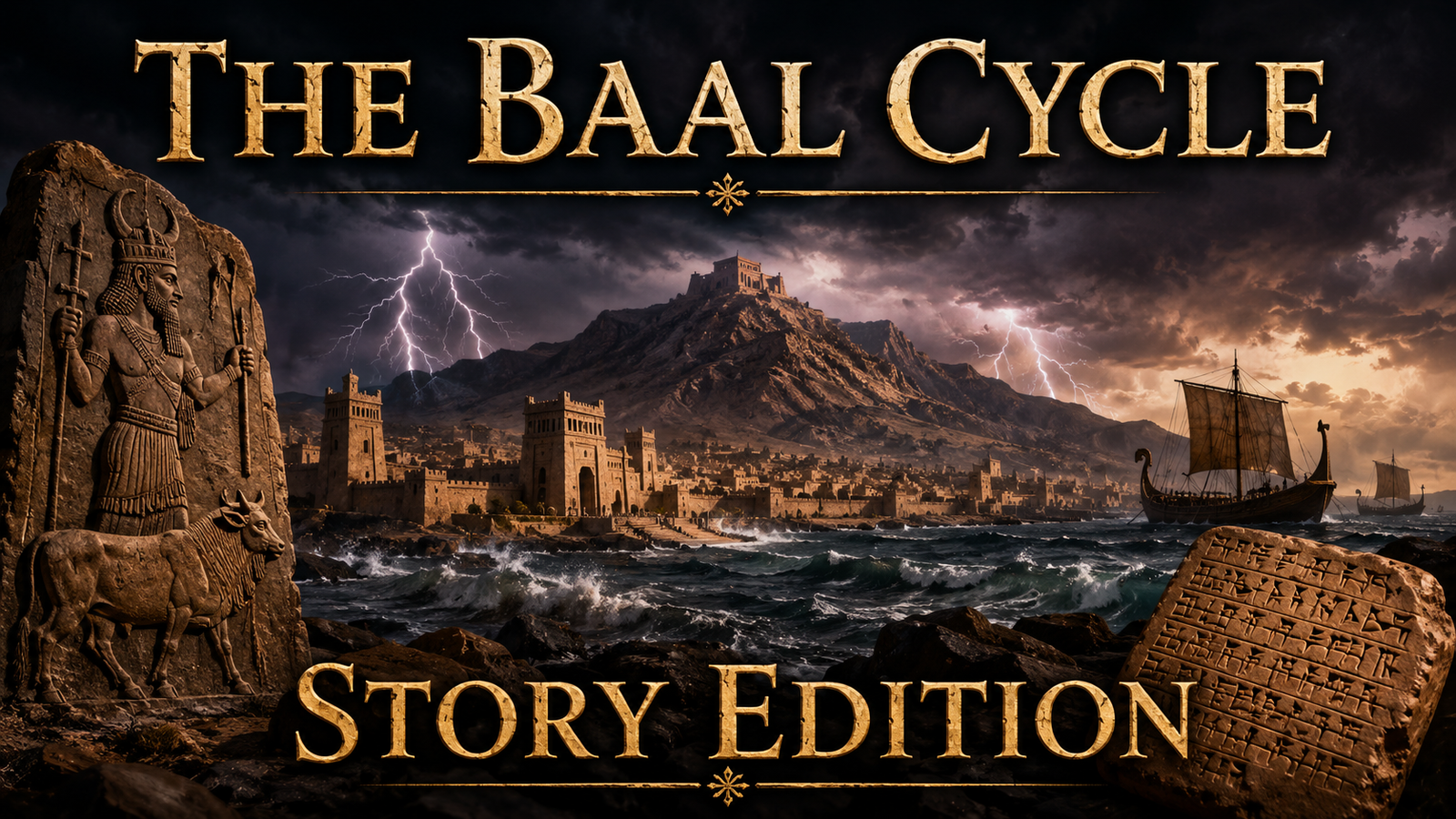
The Baal Cycle Story Edition: Our Free PDF and Video
The Baal Cycle is one of the most important mythological works to survive from the ancient city of Ugarit. For this project, we created a story edition designed for listening. It follows the main sequence preserved on the six tablets known as KTU 1.1 through KTU 1.6, but it is not a word-for-word reproduction of any modern copyrighted translation. Instead, it is a fresh narrative adaptation written in clear English for text-to-speech narration and general readers.
That distinction matters. The original Ugaritic poem is ancient, but modern English translations are often copyrighted. Our story edition therefore keeps the ancient characters, conflicts, order of events, and major images while using new wording. Where the clay tablets are broken, uncertain, or debated, the narration does not pretend that missing lines are known. It either marks the gap or moves carefully to the next part of the story that survives.
If you know Baal only from much later religious arguments, the Ugaritic material can be surprising. At Ugarit, Baal appears inside a complete divine society. He has a father figure above him, allies beside him, rivals who challenge him, a craftsman who equips him, a palace that confirms his kingship, and enemies who embody sea and death. The story is not a simple list of gods. It is a political, religious, and poetic drama from a real Bronze Age kingdom.
Why the Baal Cycle Matters
The Baal Cycle matters because it gives us a rare view of ancient Levantine religion from within its own cultural world. For centuries, many people in the West encountered the name Baal mainly through biblical texts written from the viewpoint of traditions that opposed Baal worship. Those texts are historically important, but they do not tell us how worshippers at Ugarit understood Baal or how Ugaritic poets imagined his place among the gods.
The discovery of Ugarit changed that. Suddenly, scholars could read myths, rituals, administrative records, treaties, letters, legal documents, and economic texts written by the people of a Late Bronze Age Syrian kingdom. The result was not one isolated story but an archive of a society.
The Baal Cycle is especially valuable because it is the longest major Ugaritic mythological narrative to survive. It presents three closely connected struggles. First, Baal confronts Yam, the Sea, in a contest over power. Next, Baal seeks and receives a royal palace on Mount Zaphon. Finally, Baal faces Mot, Death, disappears into the realm of death, and returns to kingship.
Those episodes give historians more than a mythic adventure. They reveal how Ugaritic thinkers used the language of kingship, household, council, diplomacy, war, feast, gift exchange, fertility, storm, drought, and death. The gods behave in exaggerated ways, yet their world often resembles the political world of ancient courts. Requests move through councils. Messengers carry demands. Powerful figures seek permission. Gifts influence negotiations. A palace is not merely a residence; it is a visible claim to status.
That is why the story becomes much clearer when we understand Ugarit itself.
Ugarit Before Its Rediscovery
Ancient Ugarit stood on the Mediterranean coast of what is now northern Syria, near modern Latakia. The ruins lie at Ras Shamra, a tell formed by many centuries of human settlement. The city was known by name from ancient Egyptian and Hittite records long before archaeologists could point to its location. Its physical remains, however, disappeared from historical memory after the city was destroyed near the end of the Bronze Age.
The site had a very long history. Human occupation at the mound reached back into the Neolithic period, thousands of years before the Baal Cycle was written down. By the early third millennium BCE, the settlement had grown substantially. Later texts from Mari on the Euphrates show that Ugarit was known during the Middle Bronze Age. Yet the period that matters most for the surviving archives came much later, especially the fourteenth and thirteenth centuries BCE.
During those centuries Ugarit became a prosperous city and the center of a small but strategically placed kingdom. Its position helped make that prosperity possible. A harbor lay to the west at Minet el-Beida. Routes running inland crossed the coastal mountains and connected Ugarit with Syria and Mesopotamia. A major north-south corridor linked regions toward Anatolia with the Levant and Egypt.
In other words, Ugarit sat where worlds met.
That location shaped its economy, politics, language, and religion. Foreign merchants lived or worked there. Imported pottery and luxury goods arrived from distant lands. Copper from Cyprus moved through commercial networks. Grain from inland regions passed through the kingdom. Diplomats and royal messengers carried letters between courts. The city heard multiple languages and used multiple writing systems.
The Baal Cycle came from this environment. It was not composed in cultural isolation. It belonged to a literate, international, commercially connected society that knew the politics of empires and the dangers of dependence on larger powers.
The Accidental Discovery of Ras Shamra
The modern recovery of Ugarit began by accident in 1928. An ancient tomb was found near the village of Ras Shamra. The discovery attracted scholarly attention, and a French archaeological mission led by Claude F. A. Schaeffer began excavations in 1929.
What followed transformed the study of the ancient Levant.
Excavators uncovered a large city with temples, houses, workshops, administrative spaces, and a royal palace. They also found clay tablets. Some were written in familiar forms of cuneiform. Others used an unusual system. The signs looked like cuneiform because scribes had pressed wedges into clay, but the script worked very differently from the large syllabic systems used for languages such as Akkadian.
The new script was alphabetic.
That discovery opened a door into a language that had not previously been available to modern scholarship in anything like this form. Ugaritic is a Northwest Semitic language. It belongs to the same broad language family that includes Hebrew, Phoenician, Aramaic, Arabic, and other Semitic languages, although each has its own history and structure.
As tablets were deciphered, the scale of the discovery became clear. Ugarit had preserved not only royal correspondence and business records but also literary works. Among them were mythological poems about Baal, Anat, El, Mot, Yam, Kothar wa Khasis, and other divine figures.
People who had been names in later sources suddenly had voices inside a much older literature.
A Bronze Age City of Trade and Diplomacy
To understand the Baal Cycle, it helps to picture the world in which Ugaritic scribes worked. The Late Bronze Age eastern Mediterranean was connected by long-distance systems of diplomacy and trade. Great kings exchanged letters and gifts. Smaller kingdoms negotiated with stronger neighbors. Ships moved raw materials and finished goods. Courts depended on administrators, translators, merchants, craftsmen, priests, and scribes.
Ugarit was wealthy, but it was not a great territorial empire. Its importance came from location, commerce, and political skill. The kingdom existed among much larger powers. Egypt remained influential to the south. The Hittite Empire expanded from Anatolia. Mitanni had earlier dominated much of northern Syria. Assyria grew increasingly important. Cyprus, known in many ancient texts as Alashiya, was a major source of copper and a close participant in eastern Mediterranean exchange.
By around the mid-fourteenth century BCE, Ugarit came under Hittite domination and became a subject kingdom. Treaties regulated that relationship. Ugarit retained its own dynasty, but it owed obligations and tribute to the Hittite king.
This political setting makes the divine politics of the Baal Cycle especially interesting. The poem is not a coded report of one historical treaty, and we should not force a one-to-one identification between gods and human kings. Still, the audience lived in a world where status had to be recognized, rulers received tribute, courts sent messengers, treaties mattered, and the right to occupy a throne depended on more than physical strength.
Baal’s story therefore speaks a political language that ancient listeners knew well.
The Royal Palace and the City Around It
Archaeology shows that Ugarit was an impressive urban center. The royal palace occupied a major area of the city and included many rooms, courtyards, halls, and administrative spaces. Hundreds of tablets came from the palace complex. They document taxation, diplomacy, property, trade, royal decisions, and international relations.
Elsewhere in the city stood substantial houses. Some had more than one story. Private archives show that wealthy merchants and officials could accumulate significant collections of tablets. The discovery of the archive associated with the merchant Urtenu, for example, revealed correspondence and records that reached far beyond ordinary household business.
This matters for the history of literature. Writing at Ugarit was not limited to one royal desk. Scribal activity existed in different institutional and private settings. Administrative and diplomatic writing coexisted with ritual and literary traditions.
The city also had major temples associated with Baal and Dagan. Their presence on the acropolis reminds us that religion, politics, and urban identity were deeply connected. Ancient temples were not simply modern churches with different gods. They could function as religious centers, economic institutions, repositories of wealth, workplaces, and symbols of civic order.
When the Baal Cycle describes Baal seeking a palace, an ancient audience did not hear that as a god asking for a comfortable home. A palace signified royal legitimacy. The construction of Baal’s house on Zaphon marked his position in the divine order.
Ugarit as a Multilingual Society
The tablets from Ugarit preserve an unusually multilingual world. Akkadian served as a major language of international diplomacy in the Late Bronze Age. Hittite and Hurrian also appear in the textual record. Other scripts and languages circulated through the wider region.
Ugaritic scribes therefore worked in an environment where language itself was political and practical. A royal court needed people who could communicate across borders. Trade required records. Treaties required precision. Rituals and local literature could preserve identities that differed from the international conventions of diplomacy.
One of Ugarit’s most striking innovations was its alphabetic cuneiform script. It used about thirty signs. Scribes still pressed wedges into clay, so the tablets look cuneiform at first glance. Yet most signs represented individual consonantal sounds rather than the hundreds of syllabic and logographic values found in traditional Mesopotamian cuneiform systems.
The result was a hybrid in appearance but not in basic organization: an alphabet written with cuneiform wedges.
That script preserved the language of the Baal Cycle. Because clay can survive fires and burial far better than papyrus, leather, or wood, the destruction of Ugarit ironically helped preserve material that might otherwise have vanished.
Writing the Baal Cycle on Clay
Modern readers often imagine an ancient text as if it had always existed as a fixed book. The Baal Cycle does not fit that model very well.
The surviving work is distributed across six principal tablets conventionally labeled KTU 1.1 through KTU 1.6. KTU is part of a modern cataloging system used by scholars for Ugaritic texts. The tablets do not survive in perfect condition. Edges are missing. Surfaces are damaged. Lines disappear into breaks. Some words are difficult to interpret. Scholars disagree about particular readings, restorations, and relationships between passages.
That means every smooth English version is already the result of scholarly decisions.
Even when a translator is extremely cautious, the surviving clay does not behave like a modern printed page. A word may be clear while the sentence around it is broken. A formula may appear in several places with small differences. A damaged line may invite more than one restoration. A rare Ugaritic word may have to be understood by comparing related Semitic languages or parallel passages.
For our story edition, we chose to preserve that uncertainty rather than hide it. We wanted the story to flow, but not at the cost of presenting invention as recovered text.
Ilimilku and the Scribal World
The end of the Baal Cycle preserves a colophon associated with a scribe named Ilimilku, also written Ilimalku in modern scholarship. His name appears in connection with several major Ugaritic literary texts.
This is a remarkable detail. Many ancient literary works survive without a named person directly associated with the act of writing them down. At Ugarit, the colophon gives us a glimpse of a real scribal identity behind the clay.
Scholars debate exactly how to describe Ilimilku’s role. A scribe could copy an older composition, edit a traditional work, arrange material, preserve an oral performance, or participate in literary creation. Ancient categories do not map neatly onto the modern idea of a single author sitting alone and inventing a book from beginning to end.
The safest statement is that Ilimilku was an important literate figure connected with the transmission of the text. The colophon also associates him with high religious or administrative status. That fits what we know about scribal culture in Ugarit, where writing was closely linked to palace, temple, and elite institutions.
His presence also reminds us that the Baal Cycle reached us through human decisions. Someone prepared clay. Someone knew the script. Someone selected words and signs. Someone organized columns. Someone preserved a version of a tradition that may already have been old.
What Does the Name Baal Mean?
The word baal did not originally function only as the personal name of one god. In Northwest Semitic languages, the term could mean lord, owner, or master. It could be used as a title.
That creates an important historical problem. References to a baal in ancient texts do not always identify the same divine figure. Different places could have a local Baal, and titles could become attached to specific cults.
In the Ugaritic mythological material, the great storm god is often understood as Baal Haddu, or Hadad, a storm deity known more widely in Syria and the ancient Near East. Ugaritic poetry gives him titles such as Rider on the Clouds. He is closely associated with Mount Zaphon, the sacred mountain north of Ugarit.
For farmers and herders in a Mediterranean climate, rain was not background scenery. Seasonal rainfall determined whether fields produced grain, whether pasture remained useful, and whether communities faced abundance or hunger. A storm god therefore represented one of the most immediate forces affecting human survival.
Yet Baal in the Baal Cycle is more than rain. He is a warrior, claimant to kingship, palace builder, feast giver, thunderer, brother, rival, and victim of Death. The poem turns a weather power into a political personality.
Mount Zaphon and the Geography of the Gods
Baal’s mountain is Zaphon, usually identified with Jebel Aqra, a prominent mountain north of Ugarit near the coast. Its location matters.
High mountains naturally gather clouds. From the viewpoint of people living near the Mediterranean coast, a mountain associated with storms could become a visible meeting place between weather and landscape. Clouds around its summit, lightning across the horizon, and rain arriving from the sea could all reinforce the mountain’s sacred character.
Ancient religions often located divine activity in recognizable geography. Sacred mountains, rivers, springs, caves, and cities created a map in which physical and mythological space overlapped.
In the Baal Cycle, Zaphon is both a place and a statement. When Baal receives his palace there, he does not simply move into a building. He occupies the cosmic height from which his thunderous voice can reach the world.
The palace episode therefore combines architecture, kingship, weather, and sacred geography in one image.
The Divine Council
The Ugaritic gods are organized socially. El stands as the elder patriarch and high authority. Athirat, often rendered Asherah in discussions of related traditions, occupies an important maternal and diplomatic position. Younger divine figures compete, cooperate, feast, quarrel, threaten, and negotiate.
The image of a divine council is one of the most important features of Ugaritic religion. The gods do not operate as unrelated supernatural individuals. They belong to a court.
That court resembles human political structures enough to be recognizable. There is seniority. There are messengers. Requests go before El. Divine status is negotiated. A rival can receive recognition. A palace can confirm a claim. Even powerful Baal cannot simply declare that every question is settled.
This helps explain why the conflict with Yam is not merely a monster fight. Yam receives political standing. His messengers come to the assembly. Baal’s resistance becomes a struggle over who will rule.
The gods are cosmic powers, but the poem presents those powers through the social language of kings and courts.
El, the Elder at the Head of the Pantheon
El is one of the most important figures in the Ugaritic religious world. The texts describe him as aged, wise, paternal, and powerful. He is often called Bull El, a title that conveys strength and dignity.
His dwelling is described at the sources of the rivers or at the meeting place of cosmic waters. The imagery places him at a remote center of creation and authority rather than on Baal’s storm mountain.
El’s role in the Baal Cycle is complicated. He can support Yam. He must be persuaded to permit Baal’s palace. He mourns when Baal dies. He considers a replacement for the vacant throne. His authority remains relevant even after Baal has proven himself in combat.
This is one reason simple equations such as “Baal was the supreme god” can mislead. Religious systems can hold several kinds of supremacy at once. El may possess senior patriarchal authority while Baal exercises dynamic kingship as storm warrior. Myth does not always reduce a pantheon to one organizational chart.
Athirat, Anat, and the Women of the Divine Court
Athirat and Anat play very different roles in the Baal Cycle.
Athirat is an elder maternal figure linked with El and the divine family. In the palace story, her support becomes politically useful. Baal and Anat approach her with gifts, and she intercedes with El. The scene makes sense in a world where access, favor, kinship, and gift exchange could shape decisions.
Anat is far more explosive.
She is closely associated with Baal and repeatedly acts as his defender. Her violence can be extreme. One of the most famous passages connected with the cycle depicts a horrifying slaughter in which the poet deliberately pushes the imagery beyond normal battle description. Later, when Baal falls under the power of Mot, Anat searches for him, mourns him, confronts Death, and attacks Mot with agricultural and destructive imagery.
Modern retellings sometimes try to make Anat into a familiar action heroine. That can flatten the ancient material. She is stranger than that. She combines family loyalty, divine ferocity, ritual violence, grief, and cosmic agency.
Her presence is central to the story because Baal’s kingship does not depend on Baal alone. His allies matter.
Kothar wa Khasis and the Power of Craft
Kothar wa Khasis is the divine craftsman. His name is associated with skill and wisdom. In the story he provides something brute force cannot: technology, design, and specialized knowledge.
During Baal’s conflict with Yam, Kothar produces named weapons. In the palace story, he becomes architect and builder. He understands how to create the material signs of divine power.
This is a familiar pattern across ancient mythology. Craftsmen occupy a special position because they transform raw materials into objects that change what gods and kings can do. Weapons, palaces, thrones, vessels, jewelry, and ritual equipment are not neutral things. They are extensions of authority.
Ugarit’s real economy depended on skilled craftspeople and imported materials. The city participated in trade networks that moved copper, timber, precious goods, ceramics, and luxury objects. Kothar’s mythological expertise therefore has a practical echo in the human world.
The god of the storm wins battles, but the god of craftsmanship gives him tools and a house.
Yam: Sea as Rival King
Yam means Sea. He is also connected with Nahar, River. To modern readers, it can seem odd to turn the sea into a political rival, but ancient Near Eastern mythology often personified major forces of nature.
The Mediterranean was both opportunity and danger for Ugarit. The city’s wealth depended in part on maritime exchange. Ships carried goods and connected ports. Yet the sea could also destroy vessels, isolate communities, and unleash storms along the coast.
In the Baal Cycle, Yam’s power is not merely watery. It is royal. He makes demands. He sends messengers. He expects Baal to be surrendered.
Baal resists and eventually defeats him with weapons supplied by Kothar wa Khasis. That victory establishes Baal as the stronger warrior, but the narrative does not stop there. He still needs a palace.
This sequence is crucial. Military victory alone is incomplete. Baal must move from champion to recognized king.
The Battle Between Baal and Yam
The battle with Yam is one of the most famous parts of the Baal Cycle. Its details survive imperfectly, but the overall movement is clear. Yam’s representatives demand Baal. Baal refuses submission. Kothar wa Khasis prepares weapons. Baal strikes his opponent and overcomes the Sea.
The episode belongs to a broader family of ancient Near Eastern stories in which a storm or warrior deity confronts sea, river, serpent, dragon, or watery chaos. Similarities appear in different cultures, but comparison requires discipline. A shared image does not prove that two stories are identical or that one was simply copied from the other.
Storm and sea are natural opponents for mythmakers living near coastlines. A thunderstorm over the Mediterranean already looks like a conflict between sky and water. At the same time, cultural contact in the ancient Near East was extensive, so motifs could travel, change, and be reinterpreted.
The best approach is to compare carefully. The Ugaritic story should first be understood on its own terms. Only then should we ask how its imagery relates to Hittite, Mesopotamian, biblical, or later Mediterranean traditions.
The Palace of Baal and the Meaning of Kingship
After Yam’s defeat, Baal still lacks a house. This may sound like a minor problem to a modern audience. In the ancient political imagination, it is not minor at all.
A palace materializes power.
It contains the throne room. It receives visitors. It stores wealth. It houses officials. It hosts feasts. It creates a visual center for authority. A ruler without a palace lacks one of the most obvious public signs of royal status.
Baal therefore seeks permission for a palace on Zaphon. Anat appeals to El. Athirat becomes involved. Gifts are prepared. The request eventually succeeds. Kothar wa Khasis builds the house using the language of precious materials, cedar, silver, gold, and fire.
The palace becomes the place from which Baal sends out his voice. Thunder expresses kingship.
The episode is especially meaningful when placed beside the archaeology of Ugarit. The real city had a large royal palace and monumental religious architecture. Ancient listeners knew exactly what a palace meant socially. The myth elevates that human experience into the divine realm.
The Window in Baal’s Palace
One of the most memorable details in the palace story concerns a window. Kothar wa Khasis proposes it. Baal initially refuses. Later, the opening is made.
The exact reasons and some surrounding lines remain debated because of textual damage. That uncertainty is worth preserving. Ancient literature can tempt modern readers to search for one symbolic explanation and then treat it as certain.
What the surviving story makes clear is that the window becomes associated with the release of Baal’s voice and power. Thunder goes out from his house. Earth and mountains respond.
For an audience that understood Baal as storm lord, the image is powerful. The palace is not a sealed monument. It is a source from which weather enters the world.
In our story edition, we keep the basic sequence while avoiding claims that depend on one disputed reconstruction of the damaged lines.
Mot: Death as a Divine Power
After Baal secures his palace, the poem introduces a rival that cannot be defeated in the same way as Yam.
Mot is Death.
The text imagines Death with appetite. His mouth is enormous. He consumes. His realm belongs to the world below. Baal, despite his victory over Sea, fears him.
This changes the emotional balance of the cycle. Baal could fight Yam as a warrior. Mot represents a limit that confronts every living being and every kingdom.
The confrontation is also difficult to reconstruct in detail. The tablets are damaged, and scholars have long debated parts of Baal’s descent and death. Some older interpretations treated the episode as a direct seasonal drama in which Baal dies during the dry season and returns with the rains. Seasonal and agricultural dimensions are certainly present in the broader mythic world, but modern scholarship often treats overly neat seasonal diagrams with caution.
It is better to say that the story links Baal’s absence with failed fertility and his return with abundance. Exactly how the myth corresponded to ritual calendars, seasonal cycles, or historical performance cannot be reconstructed with complete certainty.
Baal’s Death and the Mourning of El and Anat
The news of Baal’s death produces one of the most striking emotional scenes in Ugaritic literature.
El mourns.
The elder god descends from his throne and performs actions associated with grief. Anat also mourns and searches for Baal. The divine court does not treat his disappearance as a routine change of office. Cosmic order has been wounded.
This matters because Baal’s role is tied to the fertility of the land. The storm king’s absence is not merely a family tragedy. It has consequences for the world.
Yet the poem again mixes cosmic and political concerns. A dead king leaves a vacant throne. El and Athirat consider Athtar as a possible replacement.
Athtar cannot fill the seat.
The image is almost physical in its simplicity. The substitute does not fit Baal’s throne. He steps down. The scene communicates what pages of political theory might struggle to say: royal office requires the right occupant.
Anat’s Attack on Mot
Anat eventually confronts Mot and demands Baal’s return. When the conflict reaches violence, the poem describes Death through the language of processing grain.
Anat cuts Mot. She winnows him. She burns him. She grinds him. She scatters him.
The imagery is brutal, but it is also agricultural. The goddess treats Death as material to be harvested and processed.
That choice of imagery links violence, food production, seasonal renewal, and mortality in a way that is easy to feel even when the exact theological meaning remains debated.
Then comes one of the essential paradoxes of the story: Mot returns.
Death can be attacked, dismembered, burned, and scattered in myth. Yet Death does not remain dead.
Baal also returns.
Neither power gains a permanent final victory. The world of the Baal Cycle contains recurrence, conflict, and negotiated order rather than a simple ending in which one cosmic principle disappears forever.
Shapash, the Sun, Between Worlds
Shapash, the sun goddess, plays a quieter but important role. Because the sun crosses the sky by day and was imagined in ancient cosmology as traveling through hidden regions at night, solar deities could become natural intermediaries between the world above and the world below.
In the Baal Cycle, Shapash helps connect the living and the dead. She assists in the search for Baal and later intervenes in the conflict with Mot.
Her role is easy to overlook because Baal, Anat, Yam, and Mot dominate the dramatic scenes. Yet Shapash represents something crucial: movement between realms.
The sun rises, disappears, and returns. It sees what others cannot. It crosses boundaries.
The final portion of the surviving cycle gives Shapash a significant place, which is appropriate for a deity whose daily path symbolically joins worlds that otherwise seem separate.
The Baal Cycle and Agriculture
Ugarit’s economy was not based on mythology. It depended on real fields, harvests, animals, labor, rainfall, trade, and political stability. Yet mythology provided language for understanding those dependencies.
Rainfall in the Levant is strongly seasonal. Long dry summers are followed by a rainy season. Agriculture therefore depends on timing as well as total rainfall. Too little rain can destroy a crop. Poor harvests can affect taxation, trade, food storage, and political stability.
Baal’s identity as storm god made him central to this world. His power could be imagined in thunder, clouds, and rain. His absence could be imagined through dryness and loss of fertility.
Still, we should avoid reducing the entire Baal Cycle to a primitive weather forecast. The poem spends enormous energy on kingship, palace construction, divine hierarchy, battle, messengers, feasts, status, and recognition. Agriculture is fundamental, but it is one layer among several.
The strength of the work lies in the way these layers reinforce each other. The god who brings rain is also the king whose rule brings order. The palace from which he thunders is both meteorological and political. Death threatens both the god and the fertile world connected with him.
Feasting, Gifts, and the Politics of the Divine World
Food and drink repeatedly appear in Ugaritic literature. Feasts establish relationships. Hospitality confirms status. Gifts influence negotiations. Wine and abundance signal prosperity.
These scenes mirror real elite society. Diplomacy in the Late Bronze Age relied heavily on gift exchange. Courts sent precious materials, luxury objects, horses, metals, textiles, and other goods. Gifts could express friendship, hierarchy, obligation, or expectation.
When Baal approaches Athirat with valuable objects before seeking her support, an ancient audience would understand the political logic. A gift is not necessarily a bribe in the modern sense. It is part of a system of relationship.
Likewise, the feast celebrating Baal’s palace turns architecture into social reality. A palace becomes fully meaningful when the court gathers inside it. The house creates a setting where kingship can be performed.
The Baal Cycle and the History of Religion
The rediscovery of Ugarit reshaped the study of ancient religion because it supplied first-hand textual evidence from a Canaanite-speaking environment centuries before many later religious texts reached their surviving forms.
Before Ugaritic discoveries, scholars had to reconstruct much of Canaanite religion from later sources, hostile accounts, inscriptions, names, and archaeology. Ugarit did not solve every problem, and Ugarit should not be treated as identical with every Canaanite community. Still, its texts gave researchers a far richer vocabulary for discussing divine councils, storm imagery, sacred mountains, sea conflict, death, fertility, and divine titles.
This has had major consequences for biblical studies. Ugaritic poetry and biblical Hebrew belong to related Northwest Semitic cultural worlds. They sometimes share poetic structures, vocabulary, divine imagery, and motifs.
However, comparison does not mean identity.
A text written in ancient Israel or Judah may reuse, reject, transform, or polemicize against imagery known elsewhere in the Levant. A phrase that resembles Ugaritic language can preserve a wider regional poetic tradition rather than direct borrowing from the Baal Cycle itself.
Good historical comparison therefore asks how an image changes when it moves into a different religious system.
Baal and the Hebrew Bible
Baal appears frequently in the Hebrew Bible, especially in narratives and prophetic texts that criticize Baal worship. Those passages come from a different religious perspective and a later historical setting than the Ugaritic poems.
They are important evidence for the continuing presence or memory of Baal traditions in the Levant, but they should not be read backward as neutral descriptions of Ugaritic theology.
At the same time, Ugaritic discoveries have helped scholars recognize older West Semitic poetic imagery in biblical literature. Storm, cloud riding, divine council scenes, conflict with sea, defeat of sea monsters, sacred mountains, and the language of divine kingship all provide areas for comparison.
The most responsible method is neither to deny every relationship nor to claim that every resemblance proves direct dependence.
Religions develop in contact. People share languages, images, trade routes, political pressures, and inherited traditions. They also redefine those materials to make new claims.
The Baal Cycle gives us one of the clearest windows into that larger cultural background.
Sea, Dragon, and Chaos Comparisons
Baal’s battle with Yam has often been compared with other ancient stories in which a storm god or warrior god defeats a watery enemy. Mesopotamian, Anatolian, Levantine, and later Greek traditions contain their own versions of cosmic conflict.
There are also biblical passages in which the deity defeats Sea, crushes sea monsters, restrains waters, or rules from the storm.
These parallels are real enough to study, but they should be ranked by strength. A broad motif such as “god fights water” is weak evidence by itself because many cultures experience dangerous water. A cluster of unusual shared images, vocabulary, sequence, and regional contact offers stronger grounds for comparison.
This distinction helps prevent historical research from becoming a chain of superficial resemblance.
The Baal Cycle is especially useful because it provides a substantial narrative rather than one isolated line. We can compare entire relationships: Baal versus Yam, kingship after victory, palace building, divine council, storm imagery, and the later confrontation with Death.
Was the Baal Cycle Performed?
We know the poem was written on clay, but how did ancient people experience it?
That question is harder.
Ancient Near Eastern literature often existed in environments where written and oral traditions interacted. A tablet could preserve a text that was recited, taught, copied, studied, performed, or used in specialized settings. However, the precise performance context of the Baal Cycle is not securely known.
Older scholarship sometimes confidently reconstructed festivals in which the entire cycle was supposedly performed as seasonal ritual drama. Some of those reconstructions went beyond the available evidence.
Today, caution is useful. The poem has ritual and seasonal dimensions, and it came from a society with temples and festivals. That does not automatically tell us when, where, or how the whole composition was recited.
The safest picture is of a work embedded in scribal and religious culture, capable of being heard as well as read, but with its exact performance history partly lost.
How Old Is the Story?
The clay tablets belong to the Late Bronze Age scribal world of Ugarit, especially the thirteenth century BCE in many modern discussions. The traditions behind them may be older.
That statement requires care. It is common for myths to circulate before the surviving copy was made, but the age of an earlier oral or written version cannot simply be guessed. We cannot assign a precise date to a lost predecessor merely because a story feels traditional.
What we can say is that the surviving tablets preserve a mature literary composition. The language is poetic. Characters have established titles. Repeated formulas suggest traditional techniques. Other Ugaritic works share aspects of the same literary culture.
Ilimilku did not work in a vacuum. He belonged to a developed scribal environment with its own conventions and inherited knowledge.
The Six Tablets of the Baal Cycle
The modern designation KTU 1.1 through KTU 1.6 helps scholars organize the six main tablets. The numbering is modern. Ancient listeners would not have called the poem “KTU 1.1.”
The first two tablets center on the contest involving Baal and Yam, although the opening of the cycle is damaged and difficult. The middle tablets contain the great palace sequence, including Anat, Athirat, El, Kothar wa Khasis, and the building of Baal’s house. The last pair centers on Mot, Baal’s disappearance, mourning, Anat’s retaliation, Baal’s return, Mot’s return, and the final settlement.
Even this summary is smoother than the physical evidence. The tablets contain breaks. The order of some passages and the interpretation of some actions have produced scholarly debate.
That is normal for ancient textual reconstruction. We work with what survived, not with the complete work as an Ugaritic audience originally knew it.
Why Broken Tablets Matter
A missing line can change more than a sentence. It can change a character’s motive, the cause of an action, or the relationship between scenes.
This is why responsible retelling requires restraint.
Suppose the text says that a messenger arrives, then several lines are missing, and the next preserved section begins with a god traveling. A storyteller can easily invent a command that explains the journey. The invention may be plausible. It may even match one scholarly reconstruction. Yet plausible is not the same as preserved.
Our story edition tries to keep that difference visible. We smooth repetitive formulas where doing so does not alter meaning. We make syntax easier for modern listeners. We select natural English names. But when a gap affects what we can know, we do not conceal the uncertainty.
That approach makes the story slightly less seamless, but much more honest.
The Fall of Ugarit
The same archives that reveal Ugarit’s prosperity also bring us close to its destruction.
Near the end of the thirteenth and beginning of the twelfth century BCE, the eastern Mediterranean entered a period of severe disruption. Major kingdoms and palace systems collapsed or changed. The Hittite Empire disappeared. Cities were destroyed. Trade networks fractured. Population movements, warfare, internal instability, food shortages, environmental stress, and political breakdown all played roles in different places.
There is no single explanation that neatly accounts for every region.
Ugarit’s late letters reveal danger. Some texts refer to enemy ships and military pressure. Other evidence from the wider period points to drought and famine. The city could not rely on a stable international system that had supported its wealth.
Eventually Ugarit was destroyed, probably around the turn of the twelfth century BCE, commonly placed near 1200 to 1185 BCE depending on the chronology used.
It was never rebuilt as the same city.
That final destruction preserved a tragic historical irony. The collapse ended the society that produced the tablets, but fire, debris, and abandonment helped seal written records into the archaeological layers. Three thousand years later, those records brought Ugarit back into history.
The Late Bronze Age Collapse in Context
The phrase Late Bronze Age collapse can sound like one event that happened everywhere at once. The reality was more complicated.
Different societies faced different combinations of pressure. Some cities were destroyed. Others survived. Some political systems vanished while populations continued in altered forms. Trade routes changed. New groups rose to prominence. Iron gradually became more important. Regional powers reorganized.
Ugarit’s fall belongs to that broad transformation, but historians avoid reducing it to a single villain such as the Sea Peoples. Egyptian records describe groups often gathered under that modern label, and maritime raiding was a real factor. However, migration and warfare occurred alongside famine, drought, political fragmentation, and the failure of systems that had become highly interdependent.
The collapse reminds us that globalization is not only a modern phenomenon. Late Bronze Age courts depended on long networks of exchange. Copper, tin, grain, timber, luxury goods, horses, diplomatic marriages, tribute, and military support moved across large distances. When several links failed at once, the consequences could spread.
The Baal Cycle therefore survived from a society that stood near the end of an extraordinary international age.
What Happened to Baal After Ugarit?
The destruction of Ugarit did not erase Baal from the religious history of the Levant.
Storm gods and local Baal traditions continued in Syria, Phoenicia, and surrounding regions. The title baal could be attached to different local manifestations or divine figures. Phoenician expansion later carried related religious traditions across the Mediterranean, including to colonies in North Africa.
As centuries passed, the name Baal appeared in new political and religious contexts. This makes it dangerous to treat every Baal mentioned over a thousand years as the same god with an unchanged theology.
Religious traditions evolve.
A deity can absorb titles, lose functions, merge with other figures, become associated with a city, or be reinterpreted by opponents. The Baal of Ugaritic poetry should therefore be studied first in the Late Bronze Age context that produced the surviving texts.
Later history is valuable, but it is later.
Baal in Modern Popular Culture
Modern audiences often meet Baal through horror fiction, games, occult literature, sensational documentaries, or simplified religious polemics. Those versions may have entertainment value, but they can drift far from the Bronze Age evidence.
One common mistake is to treat “Baal” as the name of a single universal demon worshipped unchanged across thousands of years. Another is to merge Baal with every horned, storm, sun, fertility, or sacrificial deity encountered elsewhere.
Historical study requires more discipline.
The Ugaritic Baal is a storm warrior operating within a particular West Semitic pantheon. His surviving mythological cycle has identifiable characters, places, relationships, and narrative problems. The text is ancient enough and strange enough without adding modern inventions.
That is one reason we wanted our Baal Cycle story edition to stand beside a long historical article. The story is more interesting when readers know where it came from.
What Archaeology Adds to the Story
The text tells us about divine palaces. Archaeology reveals a human palace.
The text presents Baal as a storm king. Archaeology has uncovered artistic representations associated with storm-god imagery, including the famous Baal stele from Ugarit now in the Louvre.
The text assumes scribes. Archaeology gives us tablets, archives, writing exercises, letters, and administrative records.
The text describes gifts and valuable materials. Archaeology and archives document long-distance exchange.
The text imagines a court. The city’s political records show a kingdom embedded in real systems of diplomacy and hierarchy.
This does not mean myth is simply disguised history. Instead, material culture helps reconstruct the world that made the myth intelligible.
A palace means more when we have seen the footprint of Ugarit’s royal palace. A craftsman god means more when we know how dependent elite culture was on skilled production. A sea rival means more when we understand that Ugarit was a port kingdom. A storm king means more when we place him in a rain-dependent agricultural landscape.
The Famous Stele of Baal
One of the best-known images associated with Baal comes from Ugarit and is now held by the Louvre. The limestone stele shows a powerful standing god in a striking pose. One arm is raised with a weapon. Another weapon or spear is held forward, and vegetal imagery emphasizes the relationship between storm power and fertility.
The image is useful because it places the literary Baal beside the visual world of Ugarit. The god is not passive. He is armed. He dominates the composition. His identity joins warrior strength with the life-giving power of the storm.
However, visual interpretation also requires caution. Ancient symbols can have multiple meanings, and modern labels applied to artifacts are the result of scholarly identification.
Even so, the stele gives modern viewers something the tablets alone cannot: a possible visual impression of how Ugaritic culture represented the storm god’s power.
How the Baal Cycle Changed Biblical Scholarship
Few archaeological discoveries have had as much impact on the linguistic background of biblical Hebrew poetry as the Ugaritic tablets.
Because Ugaritic is a related Northwest Semitic language, it supplied parallels for words, poetic expressions, grammatical forms, and imagery that were difficult to understand from Hebrew alone. Scholars could compare how related languages used roots and formulas.
The Ugaritic texts also demonstrated that some poetic themes found in biblical literature belonged to a much older regional environment. Divine councils, storm imagery, sacred mountains, sea combat, and descriptions of divine power could now be studied against a substantial Late Bronze Age corpus.
This did not reduce biblical literature to copied Ugaritic mythology. It did something more useful. It restored cultural context.
A later author could inherit a poetic form while changing its theology. A familiar image could be reassigned to a different deity. A traditional motif could become a polemic against an older rival. Language can preserve cultural memory even when belief changes.
Why Canaanite Needs Careful Use
Ugarit is often called a Canaanite city, and its religion is frequently discussed as Canaanite religion. That usage is convenient, but the ancient world was more locally varied than the label suggests.
Canaanite can refer broadly to peoples and cultures of the Levant sharing related languages and traditions. It should not imply that every city from Ugarit to the southern Levant followed one standardized theology.
Ugarit had its own political history, local cults, foreign influences, and linguistic environment. Its texts preserve a particular city-state’s traditions.
That local evidence can illuminate the wider region precisely because we do not flatten the differences.
When we compare the Baal Cycle with material from Phoenicia, Israel, Judah, Ammon, Moab, or later Syrian states, we should look for both continuity and change.
What the Baal Cycle Does Not Tell Us
The survival of a long myth can create the illusion that we know more than we do.
We do not know exactly how an average farmer in Ugarit’s countryside understood every episode.
We do not know how often the poem was performed.
We do not know whether every worshipper interpreted Mot, Yam, Anat, or Athirat in the same way.
We do not possess all of Ugarit’s literature.
We do not have the undamaged original form of the Baal Cycle.
We do not know every stage through which the story passed before Ilimilku’s tablets.
And we should not assume that theology written in elite scribal circles perfectly describes everyday religion.
These limits are not failures. They are part of historical method. Knowing where the evidence stops is just as important as knowing what it says.
Why Our Story Edition Uses Modern English
A literal translation can be valuable for study, but literalness does not always produce a good listening experience.
Ancient Ugaritic poetry uses repetition, formulaic speech, parallelism, titles, and structures that can sound strange in modern English. A scholarly translation may also include brackets, restored letters, footnotes, uncertain readings, and technical notation.
For a narrated video, those features can make the story hard to follow.
Our story edition therefore uses short, clear English sentences. Repeated formulas are sometimes compressed. Names are presented in forms that text-to-speech software can pronounce more easily. The sequence is explained when a tablet break would otherwise confuse a listener.
What we do not do is silently invent a complete scene where the ancient text is missing.
The goal is accessibility with transparency.
Storytelling and Historical Accuracy Can Work Together
There is sometimes a false choice between an entertaining story and an accurate historical presentation.
A story becomes inaccurate when it changes evidence without telling the audience. It does not become inaccurate merely because the language is clear.
We can say that Baal fought Yam without reproducing every repeated line of the poem. We can describe El as the elder divine authority without pretending he fits a modern theological category exactly. We can acknowledge that a damaged section interrupts the narrative instead of filling it with invented dialogue.
This method is especially useful for ancient myths. Most modern audiences need orientation. They need to know who a character is, why a palace matters, why a storm god is connected with fertility, and why Sea and Death can act like political rivals.
Historical explanation gives the story depth rather than taking drama away from it.
The Baal Cycle as a Story About Power
At its deepest level, the Baal Cycle repeatedly asks who has the right to rule.
Yam claims power.
Baal defeats Yam.
Baal seeks a palace.
El’s permission matters.
Athirat’s support matters.
Kothar’s craft matters.
The divine court’s recognition matters.
Then Mot demonstrates that kingship has limits.
Baal can rule gods and peoples, but he cannot simply command Death to stop existing.
That is a sophisticated political image. Power is never absolute. It depends on relationships, institutions, symbols, and forces beyond the ruler’s control.
A storm god can win a war and still need a house. A king can occupy a throne and still die. Death can defeat a king and still fail to hold the world forever.
The Baal Cycle as a Story About Order
The cycle also explores order versus disruption.
Sea represents an uncontrolled rival power. Death consumes. Baal’s palace creates a center. Thunder and rain restore fertility. The divine council negotiates authority.
Yet order in this poem is never permanent stillness.
The sea remains part of the world after Yam’s defeat. Death returns after Anat attacks Mot. Storms themselves are violent. Fertility depends on cycles of rain and dryness. Divine kingship emerges from conflict rather than eliminating conflict forever.
The result is a dynamic cosmos.
For people living in a world of uncertain harvests, maritime danger, imperial politics, and mortal life, that may have felt realistic. Stability was something created and recreated, not something guaranteed.
Why This Ancient Story Still Works
The Baal Cycle comes from a vanished kingdom, yet its central images remain understandable.
A ruler wants recognition.
A rival issues an ultimatum.
A warrior wins a battle but still lacks legitimacy.
A palace becomes a symbol of office.
A family grieves.
Someone tries to replace an irreplaceable leader.
Death threatens every achievement.
Life returns, but Death also returns.
Those themes do not require a Bronze Age worldview to feel meaningful.
What makes the poem distinctly ancient is the way it expresses them. Sea becomes a king. Death becomes a hungry god. Thunder becomes a royal voice. A mountain becomes a throne. Agricultural processing becomes a weapon against mortality.
That combination of familiarity and strangeness is why the work remains powerful.
Reading the Baal Cycle Without Forcing a Conclusion
Ancient religious texts attract strong modern opinions. Some readers approach them as sacred history. Others see only mythology. Some search for astronomy, lost civilizations, ritual codes, political propaganda, psychological archetypes, or echoes of later religions.
Those questions can be explored, but the evidence should come first.
The starting point is the text on the tablets, the archaeological context of Ugarit, the language, the date, and the historical world around the city. After that foundation is secure, comparison becomes more useful.
A good investigation should distinguish among three things: what the tablets say, what scholars reconstruct, and what modern interpreters propose.
Mix those levels together and certainty becomes artificial.
Keep them separate and the Baal Cycle becomes even more interesting, because readers can see where the ancient evidence ends and interpretation begins.
A Short Guide to the Main Characters
Baal is the storm warrior and central claimant to kingship. His power is associated with thunder, clouds, rain, and Mount Zaphon.
El is the elder patriarch and high authority of the divine council. His recognition carries political weight throughout the cycle.
Athirat is a major maternal deity associated with El and the divine family. Her intercession helps Baal obtain permission for his palace.
Anat is Baal’s fierce sister and defender. She combines loyalty, grief, and extreme violence.
Kothar wa Khasis is the divine craftsman. He makes Baal’s weapons and builds his palace.
Yam is Sea, Baal’s rival in the first major conflict.
Mot is Death, the power that swallows Baal and later confronts him again.
Shapash is the sun goddess, an intermediary whose movement connects different realms.
Athtar is considered as a possible replacement when Baal is absent, but he cannot fill Baal’s throne.
What to Listen for in the Video
When you listen to our Baal Cycle video, notice how often political language appears beneath the supernatural action.
Listen for messengers and councils.
Notice that Baal’s defeat of Yam does not finish his rise. He still needs a palace.
Notice how Kothar’s skill changes events.
Listen for the change in tone when Mot enters the story. The battle with Sea feels heroic. The encounter with Death feels fearful.
Notice that Anat’s attack on Mot uses agricultural language.
Notice that the ending does not destroy Death forever. Mot yields, but he continues to exist.
Those details are part of what makes the ancient story more subtle than a simple tale of a storm god defeating monsters.
Sources and Further Reading
The historical discussion in this article was checked against museum, archaeological, and academic sources. Readers who want to go beyond this introduction can begin with the following:
- The Metropolitan Museum of Art, Ugarit
- The Metropolitan Museum of Art, The Gods and Goddesses of Canaan
- Archaeology Magazine, The Ugarit Archives
- Philip J. Boyes, Negotiating Imperialism and Resistance in Late Bronze Age Ugarit
- The Cambridge Companion to the Bible and Literature, Literature in the Ancient Near East and the Bible
- Mark S. Smith, The Ugaritic Baal Cycle, Volume I: Introduction with Text, Translation and Commentary of KTU 1.1-1.2, Brill.
- Mark S. Smith and Wayne T. Pitard, The Ugaritic Baal Cycle, Volume II: Introduction with Text, Translation and Commentary of KTU 1.3-1.4, Brill.
- Simon B. Parker, editor, Ugaritic Narrative Poetry, Society of Biblical Literature.
Closing Thoughts on the Baal Cycle
The Baal Cycle survived because clay endured what a kingdom could not.
Ugarit prospered at the crossroads of the Late Bronze Age world. Its merchants traded across seas. Its kings negotiated with empires. Its scribes wrote in several languages. Its temples rose above crowded streets. Its craftsmen worked imported materials. Its farmers depended on rain. Its citizens watched the Mediterranean bring both wealth and danger.
Then the international system broke apart. Ugarit burned and disappeared from living memory.
More than three thousand years later, archaeologists uncovered its tablets.
Through them, Baal thundered again.
What returned was not just a myth about a storm god. It was evidence for an entire historical world: a city, a language, a scribal tradition, a religious system, and a network of relationships that connected Syria with Egypt, Anatolia, Cyprus, Mesopotamia, and the Mediterranean.
That is why the Baal Cycle deserves to be read as both literature and history.
The story gives us Baal, Yam, Anat, Mot, El, Athirat, Kothar wa Khasis, Shapash, and the divine court. Archaeology gives us the streets, palace, temples, harbor, archives, trade, diplomacy, and destruction of Ugarit. Linguistics gives us the Ugaritic language and its alphabetic cuneiform script. Together, these lines of evidence let us hear an ancient civilization with unusual clarity.
Our story edition is only an entrance.
The deeper story is Ugarit itself.

About the author

Root Dictionary V.1 : A Companion to The Magick Root of Language
Root Dictionary: A Practical Companion to The Magick Root of Language Download Free Via the 3 Dots The Magick Root of Language – Magick Language Investigation – Free Download Ultimate English Syllable List – Extra Ex-Ten-Sive A familiar English word can conceal a remarkable history. It may have been assembled from two older languages, inherited through generations of speech, borrowed during trade, or coined by scholars who needed a name for something new. The Root Dictionary, presented as Volume 2 of The Magick Root of Language by Phil “Rocko” Williams, provides a compact place to begin investigating those hidden structures. Instead of asking readers to memorize a long technical explanation for every word, its alphabetized entries identify a form, the language in which that form is documented, an accessible meaning, and words where the connection can be seen. The companion […]
Ultimate English Syllable List – Extra Ex-Ten-Sive
English Syllable List A–Z: A Preliminary Language Research Resource Language is built from sounds, patterns, and word histories that have traveled between people and cultures for centuries. As a companion resource to The Magick Root of Language, this A–Z index collects 24,219 different written chunks extracted from English word examples. It offers a starting point for investigating syllables, word formation, and the many cultural histories represented in English vocabulary. How to use the list: entries are alphabetized by their written form. Each entry shows up to three example words and a count of occurrences in the source extraction. The count refers to occurrences in the processed word list, not to usage frequency in everyday English. Browse by letter, search the page, and compare candidate chunks against documented word histories. Important research limitation: this is an automated inventory of written chunks […]
The Magick Root of Language – Magick Language Investigation – Free Download
Magick Language and the Questions Behind the Book Download Free Via the 3 Dots What does it mean to say that a word possesses power? The Magick Root of Language begins with a familiar observation: a spoken sentence can change what people do. A warning redirects a crowd. A promise establishes an expectation. A public ruling alters a legal status. A name allows an individual, place, or abstract idea to be identified and remembered. These effects are neither imaginary nor supernatural. They are consequences of how people think, cooperate, build institutions, and respond to shared signs. The harder question begins when a tradition attributes additional powers to a precise sound, a sacred name, a written character, or a ceremonial formula. The book investigates that historical claim without assuming in advance that every account describes a literal physical process.This is the […]
Don’t Be a Loosh Bag – By Masked Matrix – Full Album
Album: Don't Be a Loosh Bag By - Masked Matrix Release Date - 10/12/2026 1. Energy Vampires 2. Dark Clouds 3. Mind Traps 4. Loosh Farmers 5. Falling From Grace 6. Holographic Simulation 7. All Seeing Eye 8. Shadow People Under The Bed 9. See You in the Duat 10. The Mirror Level 11. The Jinn's Lamp 12. The Town With No Name 13. Madam Blavatsky 14. Unanswered Prayers 15. Legend of the Abyss 16. First Peak Behind the Veil 17. Apophis Is Coming <Download Album Free Here> 1. Energy Vampires [Verse] Night descends Shadows bite Dreams invaded Endless fight Astral claws They rip and tear Feeding hunger Unaware [Chorus] Energy drained Soul consumed In your sleep You're doomed They haunt the void Silent scream Energy vampires stalk your dream [Verse 2] Wings of black Eyes that gleam […]
The Secret Ladder of Existence – Inspired By Madam B | Free Download
The Secret Ladder of Existence: Two Editions, One Invitation to Explore Reality Download Free Via the 3 Dots Download Free Via the 3 Dots https://youtu.be/RJldG2HsYb4?si=pCMP2cRzEMjPS9Vw Subscribe: Veiled Mystic 333 A book can begin with a question that refuses to disappear. What does it mean to exist, and how much of existence can human beings actually perceive? We move through a world of bodies, landscapes, weather, and measurable forces. Yet we also inhabit a world of memory, imagination, dreams, relationships, moral commitments, and private experiences that no stranger can observe directly. The puzzle is not simply whether the physical world is real. The puzzle is whether our ordinary description of that world is complete, and what kind of evidence would justify any claim that more remains to be discovered. These questions inspire The Secret Ladder of Existence, a new exploration of […]
Angelometry: A History of Angels Across Religion, Myth, and Mysticism
Angelometry: A History of Angels Across Religion, Myth, and Mysticism Download Free Via the 3 dots https://youtu.be/ZxOdzI88Iy0?is=kKvvAn-zkfuMN_oF https://youtu.be/7KC7Wsht7u0?si=z4U65lMOECOnJ1uP Subscribe: Veiled Mystic 333 Angelometry is a useful word for a subject that refuses to remain inside a single religious box. The history of angels is not one continuous system handed down unchanged from antiquity. It is a layered record of messengers, heavenly attendants, watchers, throne beings, guardians, destroyers, healers, scribes, planetary intelligences, divine names, spirits, and even ancient gods who were later absorbed into angelic catalogs. To study Angelometry seriously is therefore to study how human beings across different times and cultures imagined the invisible world around the divine. The familiar image of a beautiful winged figure in white robes is only one late and highly influential expression of a much larger history. Earlier texts can describe angels as men, flames, wheels, […]
Related
Root Dictionary V.1 : A Companion to The Magick Root of Language
Root Dictionary: A Practical Companion to The Magick Root of Language Download Free Via the 3 Dots The Magick Root of Language – Magick Language Investigation – Free Download Ultimate English Syllable List – Extra Ex-Ten-Sive A familiar English word can conceal a remarkable history. It may have been assembled from two older languages, inherited through generations of speech, borrowed during trade, or coined by scholars who needed a name for something new. The Root Dictionary, presented as Volume 2 of The Magick Root of Language by Phil “Rocko” Williams, provides a compact place to begin investigating those hidden structures. Instead of asking readers to memorize a long technical explanation for every word, its alphabetized entries identify a form, the language in which that form is documented, an accessible meaning, and words where the connection can be seen. The companion […]
Ultimate English Syllable List – Extra Ex-Ten-Sive
English Syllable List A–Z: A Preliminary Language Research Resource Language is built from sounds, patterns, and word histories that have traveled between people and cultures for centuries. As a companion resource to The Magick Root of Language, this A–Z index collects 24,219 different written chunks extracted from English word examples. It offers a starting point for investigating syllables, word formation, and the many cultural histories represented in English vocabulary. How to use the list: entries are alphabetized by their written form. Each entry shows up to three example words and a count of occurrences in the source extraction. The count refers to occurrences in the processed word list, not to usage frequency in everyday English. Browse by letter, search the page, and compare candidate chunks against documented word histories. Important research limitation: this is an automated inventory of written chunks […]
The Magick Root of Language – Magick Language Investigation – Free Download
Magick Language and the Questions Behind the Book Download Free Via the 3 Dots What does it mean to say that a word possesses power? The Magick Root of Language begins with a familiar observation: a spoken sentence can change what people do. A warning redirects a crowd. A promise establishes an expectation. A public ruling alters a legal status. A name allows an individual, place, or abstract idea to be identified and remembered. These effects are neither imaginary nor supernatural. They are consequences of how people think, cooperate, build institutions, and respond to shared signs. The harder question begins when a tradition attributes additional powers to a precise sound, a sacred name, a written character, or a ceremonial formula. The book investigates that historical claim without assuming in advance that every account describes a literal physical process.This is the […]
Don’t Be a Loosh Bag – By Masked Matrix – Full Album
Album: Don't Be a Loosh Bag By - Masked Matrix Release Date - 10/12/2026 1. Energy Vampires 2. Dark Clouds 3. Mind Traps 4. Loosh Farmers 5. Falling From Grace 6. Holographic Simulation 7. All Seeing Eye 8. Shadow People Under The Bed 9. See You in the Duat 10. The Mirror Level 11. The Jinn's Lamp 12. The Town With No Name 13. Madam Blavatsky 14. Unanswered Prayers 15. Legend of the Abyss 16. First Peak Behind the Veil 17. Apophis Is Coming <Download Album Free Here> 1. Energy Vampires [Verse] Night descends Shadows bite Dreams invaded Endless fight Astral claws They rip and tear Feeding hunger Unaware [Chorus] Energy drained Soul consumed In your sleep You're doomed They haunt the void Silent scream Energy vampires stalk your dream [Verse 2] Wings of black Eyes that gleam […]
The Secret Ladder of Existence – Inspired By Madam B | Free Download
The Secret Ladder of Existence: Two Editions, One Invitation to Explore Reality Download Free Via the 3 Dots Download Free Via the 3 Dots https://youtu.be/RJldG2HsYb4?si=pCMP2cRzEMjPS9Vw Subscribe: Veiled Mystic 333 A book can begin with a question that refuses to disappear. What does it mean to exist, and how much of existence can human beings actually perceive? We move through a world of bodies, landscapes, weather, and measurable forces. Yet we also inhabit a world of memory, imagination, dreams, relationships, moral commitments, and private experiences that no stranger can observe directly. The puzzle is not simply whether the physical world is real. The puzzle is whether our ordinary description of that world is complete, and what kind of evidence would justify any claim that more remains to be discovered. These questions inspire The Secret Ladder of Existence, a new exploration of […]
Angelometry: A History of Angels Across Religion, Myth, and Mysticism
Angelometry: A History of Angels Across Religion, Myth, and Mysticism Download Free Via the 3 dots https://youtu.be/ZxOdzI88Iy0?is=kKvvAn-zkfuMN_oF https://youtu.be/7KC7Wsht7u0?si=z4U65lMOECOnJ1uP Subscribe: Veiled Mystic 333 Angelometry is a useful word for a subject that refuses to remain inside a single religious box. The history of angels is not one continuous system handed down unchanged from antiquity. It is a layered record of messengers, heavenly attendants, watchers, throne beings, guardians, destroyers, healers, scribes, planetary intelligences, divine names, spirits, and even ancient gods who were later absorbed into angelic catalogs. To study Angelometry seriously is therefore to study how human beings across different times and cultures imagined the invisible world around the divine. The familiar image of a beautiful winged figure in white robes is only one late and highly influential expression of a much larger history. Earlier texts can describe angels as men, flames, wheels, […]
Be the first to leave a comment