Download Free Via the 3 dots
Subscribe: Veiled Mystic 333
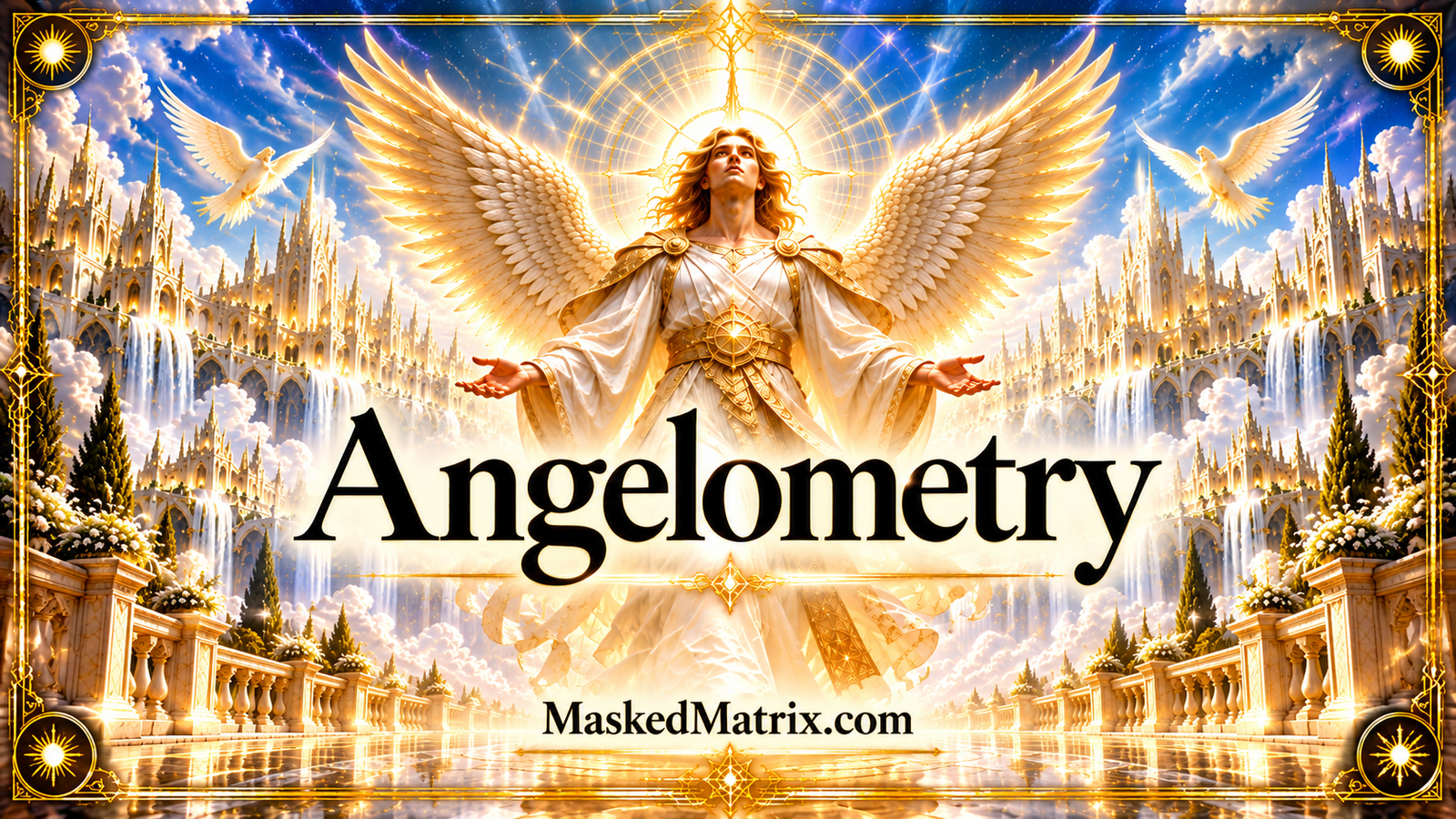
Angelometry is a useful word for a subject that refuses to remain inside a single religious box. The history of angels is not one continuous system handed down unchanged from antiquity. It is a layered record of messengers, heavenly attendants, watchers, throne beings, guardians, destroyers, healers, scribes, planetary intelligences, divine names, spirits, and even ancient gods who were later absorbed into angelic catalogs. To study Angelometry seriously is therefore to study how human beings across different times and cultures imagined the invisible world around the divine. The familiar image of a beautiful winged figure in white robes is only one late and highly influential expression of a much larger history. Earlier texts can describe angels as men, flames, wheels, terrifying guardians, cosmic princes, voices, stars, or beings so close to divine power that the boundary between messenger and manifestation becomes difficult to define.
The English word angel comes through Greek angelos, meaning messenger. Its Hebrew counterpart, malakh, also means messenger and can refer to either a human or supernatural envoy depending on context. That basic meaning matters because the earliest angelic traditions often focus less on what angels are made of and more on what they do. They carry messages, guard sacred boundaries, interpret visions, execute judgment, protect communities, or stand in the presence of God. Later angelology developed elaborate ranks, names, symbols, colors, planets, directions, seals, and ritual correspondences, but those systems are historical developments rather than a single universal map of heaven. A useful older overview of this development can be found in the Encyclopaedia Britannica article on angels, which traces the word back to its messenger function and surveys the growth of angelic ideas in Judaism, Christianity, and related traditions.
Why the History of Angels Is More Complicated Than It Looks
Modern readers often encounter angels through lists. A website or book may present hundreds of names with a neat title beside each one: angel of healing, angel of prosperity, angel of courage, angel of rain, angel of wisdom, angel of dreams. The problem is that many of those profiles combine material from different centuries and different religious systems without explaining where the pieces came from. A biblical figure may be blended with a medieval magical attribution, a Renaissance planetary correspondence, a modern spiritual interpretation, and a symbol invented by a recent author. The finished profile looks ancient and complete even when the historical evidence is actually thin.
Angelometry becomes much more interesting when those layers are separated. Michael, for example, has a long textual history in Jewish and Christian sources and later becomes one of the most widely recognized archangels in art and devotion. Other names appear mainly in apocrypha or mystical literature. Some belong to Mandaean religion, Gnosticism, Islamic tradition, Western ceremonial magic, astrology, or the literature of the Watchers. Still others began as divine formulas or ancient deities rather than angels at all. The historical task is not to remove them from the study but to identify what they originally were before tracing how later writers reclassified them. That approach keeps the wonder of the material while replacing false certainty with context.
This distinction is especially important because the word angel has become culturally broad. In casual speech, almost any benevolent supernatural being can be called an angel. Historical sources are less cooperative. They preserve different categories with different functions. A cherub is not simply another word for archangel. A Watcher is not automatically identical with a planetary intelligence. A Mandaean uthra belongs to a different religious universe than a Christian guardian angel. A Palmyrene moon god did not begin as a servant in a biblical heaven. Once those distinctions are restored, Angelometry becomes less like a directory of interchangeable spirits and more like a map of how religious ideas developed over time.
Messengers Before Hierarchies
In the Hebrew Bible, angels are often defined by function. A malakh is a messenger, and the same word can describe a human envoy or a divine messenger. This linguistic flexibility helps explain why some biblical encounters remain deliberately mysterious. A figure may first appear as a man, then speak with divine authority, and later be described as the messenger of the Lord. The famous “angel of the Lord” passages are especially difficult to reduce to a simple later category because the messenger sometimes seems distinct from God and at other moments speaks as God. Ancient texts were often less interested in constructing a clean taxonomy than later theologians became.
The heavenly court is another major theme. Biblical literature speaks of the host of heaven, sons of God, holy ones, and divine attendants. In Job, the sons of God present themselves before the Lord, with the satan functioning more like an accuser or prosecutor than the fully developed devil of later Christianity. In Daniel, supernatural princes are associated with nations and empires, and Michael appears as a great prince connected with Israel. The result is already more complex than a single category called angels. The unseen world contains messengers, warriors, court officials, national princes, and mysterious beings whose identities are defined by their place in the divine order.
The development of hierarchy was gradual. Early texts could preserve older imagery without explaining exactly how every heavenly being related to every other. Later interpreters wanted a more ordered cosmos. Once theology, apocalyptic literature, mysticism, and philosophical speculation began interacting, angelic beings were arranged into ranks. Offices became more specialized. Names became more common. The divine court began to look increasingly like an organized celestial administration. That development produced some of the systems now taken for granted, but it also means that later structures should not be projected backward into texts that never described them.
Michael, Gabriel, Raphael, and the Rise of Named Archangels
The best-known archangels became famous because named heavenly figures gradually took on more distinct roles. Michael emerges in Daniel as a great prince and protector and later becomes the commander of heavenly forces in Revelation. His identity develops around protection, conflict, judgment, and defense of the faithful. Christian art eventually gives him armor, sword, spear, shield, dragon, and scales. These symbols summarize centuries of interpretation rather than one single biblical description.
Gabriel develops differently. In Daniel he interprets visions, while the Gospel of Luke presents him as a messenger of revelation in the annunciations to Zechariah and Mary. Gabriel therefore becomes associated with divine communication, revelation, announcement, and interpretation. Raphael is most strongly associated with the Book of Tobit, where he travels in disguise, guides Tobias, helps defeat a dangerous spirit, and participates in healing. These narrative roles gave later angelology a solid foundation from which to develop the familiar identities of Michael as protector, Gabriel as messenger, and Raphael as healer.
Uriel, though not named in the canonical Hebrew Bible, becomes prominent in Jewish and Christian apocalyptic literature. His name is often interpreted along the lines of “God is my light” or “fire of God,” and he appears as an interpreter of mysteries in works such as 1 Enoch and 4 Ezra. The fact that Uriel is important in some traditions and absent from others demonstrates how angelic canons differ. There has never been one universally accepted list of archangels across Judaism, Christianity, and Islam. Even the word archangel itself has a history, and later lists often include names that different communities accepted, rejected, or ignored.
The Watchers and the Book of Enoch
No discussion of Angelometry is complete without the Watchers. The Book of Enoch expands the brief and enigmatic Genesis story of the sons of God and the daughters of men into a vast narrative of heavenly rebellion. In the Enochic account, a group of Watchers descends to earth, takes human wives, produces giant offspring, and teaches forbidden arts. Their leaders and associates receive names such as Samyaza, Azazel, Arakiel, Penemue, Tamiel, and others depending on manuscript and translation traditions.
The Watchers matter because they transformed angelic rebellion into a detailed myth of knowledge crossing forbidden boundaries. Some teach weapons, cosmetics, enchantments, astrology, writing, or signs of the earth and sky. The offense is not merely sexual transgression. It is also the misuse of heavenly knowledge. This theme later resonates strongly with magical and occult traditions because the rebellious angels become teachers of arts that humans were not meant to possess in that way or at that time.
The Enochic world also contains righteous archangels who observe the corruption and appeal for judgment. This creates a heavenly drama in which angels are not uniformly good simply because they are angels. Some remain loyal, some rebel, some judge, and some interpret. Angelometry therefore cannot be reduced to a catalog of benevolent guardians. Ancient angel literature also deals with danger, cosmic law, disobedience, punishment, and the consequences of knowledge.
The Watcher tradition also influenced later demonology. Once fallen heavenly beings became a major explanation for corruption on earth, later writers could connect them with demons, giants, forbidden magic, and the origin of evil arts. Yet the details change from source to source. Azazel, for example, has a complicated history that also intersects with the scapegoat ritual of Leviticus. A careful treatment keeps those strands visible instead of combining them too quickly into a single biography.
Throne Beings, Cherubim, Seraphim, and Ophanim
The beings surrounding the divine throne are among the most visually extraordinary figures in religious literature. Cherubim in biblical tradition are not originally the soft, winged children of later European art. They are powerful guardian beings associated with sacred space, the divine presence, and the throne. Cherubim guard the way to Eden in Genesis, appear above the ark in the tabernacle tradition, and become central to Ezekiel’s visions of the divine chariot.
Ezekiel’s visions introduce imagery that influenced centuries of Jewish mysticism and Christian angelology: living creatures, intersecting wheels, eyes, wings, fire, and overwhelming movement. Later traditions identify the wheels as ophanim and build them into angelic hierarchies. Seraphim appear most famously in Isaiah’s temple vision, where six-winged beings proclaim divine holiness. Their name is related to burning, and later angelology turns them into the highest or one of the highest angelic orders.
Once these biblical images entered medieval theological systems, a more organized hierarchy emerged. Christian writers such as Pseudo-Dionysius the Areopagite arranged heavenly beings into nine orders: Seraphim, Cherubim, Thrones, Dominions, Virtues, Powers, Principalities, Archangels, and Angels. That ninefold structure became enormously influential in Western Christianity, but it should be understood as a theological synthesis rather than a diagram explicitly laid out in the Bible. The hierarchy is a later attempt to organize many different scriptural terms into a coherent celestial administration.
This difference between vision and system is central to Angelometry. Isaiah and Ezekiel offer overwhelming scenes meant to convey divine majesty. Medieval theologians transform those scenes into classifications. Artists then transform classifications into recognizable images. Modern books inherit all of these layers at once. What appears to be one timeless angelic hierarchy is actually the result of interpretation accumulating over centuries.
Metatron and the Mysteries of Jewish Angelic Tradition
Metatron is one of the most complex beings in later Jewish mysticism. He does not appear as a named angel in the Hebrew Bible, yet later rabbinic and mystical texts give him extraordinary status. In Hekhalot and related traditions, Metatron can be associated with the divine presence, heavenly records, celestial authority, and the transformed patriarch Enoch. Some texts portray him as a heavenly scribe or Prince of the Presence, while others treat the theology surrounding him cautiously because his exalted position approaches the boundary between servant and divine representative.
This tension is part of what makes Metatron historically important. Mystical traditions often explore how a transcendent God can be encountered through names, thrones, messengers, voices, and exalted intermediaries without abandoning monotheism. Metatron becomes one solution to that problem, but never a simple one. His later association with sacred geometry, especially the modern symbol called Metatron’s Cube, is much more recent than the ancient and medieval textual traditions that established his importance.
Other Jewish mystical figures also become highly specialized. Sandalphon is associated in later tradition with prayer and heavenly song. Raziel becomes an angel of secrets and divine mysteries. Jehoel appears as a powerful name-bearing angel in the Apocalypse of Abraham. Cherubiel and Seraphiel become princely figures associated with entire angelic orders. These traditions show how angelology could become a detailed language for divine proximity, heavenly liturgy, sacred knowledge, and cosmic administration.
Names themselves become central. Jewish mystical traditions frequently treat divine names as active expressions of power rather than mere labels. That environment helps explain why the boundary between divine names, angelic names, and ritual formulas can become difficult for later compilers to distinguish. A word that once functioned as a sacred formula can eventually be reinterpreted as a personal angelic name. Historical Angelometry must therefore pay attention not only to beings but also to the changing function of sacred language.
Angels in Islam
Islamic angelology shares some figures with Jewish and Christian traditions while developing its own theological emphases. Angels are created beings who serve God, carry revelation, record deeds, administer aspects of the cosmos, guard realms, and participate in judgment. Jibril, commonly identified with Gabriel, is associated above all with revelation. Mikail, corresponding to Michael, is associated in later Islamic tradition with provision and natural sustenance. Israfil is connected with the trumpet of resurrection, while Malik is the guardian of Hell in the Qur’anic tradition.
Munkar and Nakir are famous in later Islamic theology as the questioners of the grave. They test the deceased concerning faith after burial. Ridwan appears in later tradition as a keeper of Paradise. Kiraman Katibin refers to recording angels associated with human deeds. These beings demonstrate that Islamic angelology includes not only messengers but also record keepers, guardians, eschatological officials, and cosmic servants.
Harut and Marut are especially important because they appear in Qur’an 2:102 in connection with Babylon, testing, and the teaching of magic. Later commentary greatly expands their story. The historical development is complex enough that the Encyclopaedia Iranica article on Harut and Marut is useful for seeing how Qur’anic material, commentary, and later storytelling interact. Their story illustrates a recurring principle in Angelometry: the earliest source may be brief, while later interpretation grows into a much larger narrative.
Islamic tradition also demonstrates why familiar Western labels can be misleading. Not every supernatural being is an angel. The Qur’an distinguishes angels from jinn, and the status of Iblis became an important interpretive question precisely because later traditions debated how his rebellion related to those categories. Treating every invisible being as an angel erases theological distinctions that mattered deeply within the tradition itself.
Mandaean Uthras and the World of Light
Mandaean religion preserves one of the richest bodies of heavenly-beings material outside the traditions most Western readers know. Its luminous beings are commonly called uthras, a category that should not simply be translated as angels without explanation. Mandaean cosmology includes the World of Light, the soul’s journey, ritual purification, cosmic boundaries, and numerous named beings who participate in creation, revelation, protection, and judgment.
Abatur is associated with the weighing of souls and the boundary between worlds. Manda d-Hayye represents Knowledge of Life and becomes one of the most important revealer figures in Mandaean tradition. Ptahil has a demiurgic role in the formation of the material world. Hibil Ziwa is a radiant savior or revealer figure involved in cosmic descent and return. Anush and other light beings participate in the complex drama between the World of Light and the lower worlds.
These figures entered Western angel dictionaries partly because collectors of esoteric names tended to flatten different supernatural categories into one universal angelology. A careful Angelometry restores their Mandaean setting. Doing so does not make them less relevant; it makes them more interesting. Instead of generic angels with interchangeable symbols, they become members of a distinctive religious universe with its own scriptures, rituals, language, and understanding of salvation.
Mandaean material also highlights the importance of transmission. Western readers have often encountered these names through translated religious texts, academic summaries, occult dictionaries, and secondary compilations far removed from living Mandaean communities. Every stage of transmission can alter spelling, pronunciation, and interpretation. That is another reason to be cautious when a modern source offers a completely polished profile for a being whose original tradition is complex and linguistically distant.
Gnostic Powers and the Problem of Abraxas
Abraxas, or Abrasax, demonstrates the danger of assuming that every mysterious supernatural name is an angel. In late antique religious and magical material, Abraxas can function as a powerful cosmic name, ruler, divine being, or magical power. Ancient accounts associate the name with Basilidean Gnosticism, and the numerical value of its Greek letters was connected with the number 365. Engraved magical gems frequently display composite figures linked with the name, often combining a human torso, serpent legs, and a rooster-like head.
Later occult literature sometimes classifies Abraxas as an angel, demon, god, or supreme power depending on the author. That instability is historically meaningful. It shows what happens when a name travels across cultures and centuries. Once removed from its original ritual and theological environment, a powerful name can acquire new biographies. Angelometry therefore benefits from asking two questions at once: what was this figure in its earliest known setting, and what did later traditions make of it?
Other Gnostic beings pose similar problems. Names such as Eleleth belong to a cosmology of luminaries, rulers, emanations, and spiritual powers that does not map neatly onto later Christian angelic choirs. Calling such a being an angel may be understandable for a modern reader, but it can hide the structure of the original system. Historical precision adds depth because it allows multiple models of the unseen world to remain visible instead of forcing all of them into one template.
Gnostic cosmologies are especially useful for understanding how many ancient religious systems imagined layers between ultimate divinity and the material world. Emanations, rulers, luminaries, aeons, and archons occupy different places in different systems. Later readers sometimes translated all of these categories into the nearest familiar word. Angel was an easy choice, but the translation can be conceptually expensive. It can make radically different cosmologies appear more alike than they really were.
When Ancient Gods Become Angels
Some names found in modern angel lists were once openly worshiped as gods. Aglibol and Malakbel belonged to the religious life of ancient Palmyra. Aglibol was associated with the moon, while Malakbel had solar connections. Yarhibol was another important Palmyrene deity with solar associations. In their original context these figures were not servants inside Jewish or Christian angelic hierarchies. They were deities within the religious world of Roman Syria.
How did gods become angels? One route was the growth of comparative occult catalogs. Renaissance and later esoteric writers collected names from Hebrew, Greek, Arabic, Syriac, Egyptian, Mesopotamian, and other sources. Once placed into tables of planets, directions, elements, spirits, and intelligences, the original religious category of a name could become secondary. A lunar god could be retitled an angel of the moon; a solar deity could become an angel of light. The process reflects both genuine historical curiosity and a strong tendency to build universal systems from culturally distinct material.
This phenomenon is useful because it shows that angelology is not only theology. It is also reception history. A name can survive because later people reinterpret it. The question is not simply whether a being really is an angel but when, where, and why people began calling it one. That approach makes room for historical change without requiring every tradition to agree.
The same problem appears with terms such as Moloch and Naraka. Moloch has a long and contested history involving biblical texts and scholarly debate over whether the term refers to a deity, a type of sacrifice, or a combination of ideas. Naraka is a term for hellish or infernal realms in South Asian traditions, not the proper name of an angel. Yet broad occult lists can transform both into individual supernatural beings. These transformations are historically revealing, but they should not replace the original categories.
Planetary Intelligences, Zodiac Angels, and Ceremonial Magic
Western ceremonial magic created some of the most technically organized forms of Angelometry. Renaissance occult philosophy imagined the universe as a network of correspondences linking planets, metals, numbers, divine names, spirits, angels, herbs, colors, seals, and times. In that system, a celestial being might be less a character from a sacred story and more an intelligence governing a planetary or zodiacal influence.
Agiel is a good example. In Renaissance magical tradition, Agiel is associated with Saturn as a planetary intelligence. Bethor belongs to the Olympic Spirits and is linked with Jupiter, while Hagith is linked with Venus, Och with the Sun, and Phul with the Moon. These are not biblical angels. They belong to a magical cosmology in which planets were understood as living channels of spiritual influence.
Zodiacal angel traditions work similarly. Adnachiel becomes associated with Sagittarius, Cambiel with Aquarius, Hamaliel with Virgo, Machidiel with Aries, Verchiel with Leo, and other names with other divisions of the sky. Modern descriptions often assign personality traits to these angels that mirror contemporary astrology. The important historical distinction is that many such qualities come from the zodiacal system rather than from an ancient story about the angel itself. Once that distinction is made, the material becomes easier to understand and far less repetitive.
Magic squares and seals deepen the picture. Planetary magic often connected numerical arrangements with divine and spiritual names. The resulting diagrams were not decorative inventions but parts of a worldview in which mathematics reflected cosmic order. A planetary intelligence therefore belonged to a network of number, symbol, ritual timing, and celestial influence. Later popular angel books often preserve the name while losing the system that originally made the name meaningful.
The Seventy-Two Angels and the Shem HaMephorash
One of the most influential later angelic systems is the group commonly called the Seventy-Two Angels of the Shem HaMephorash. The system is connected with an interpretation of three verses in Exodus 14, each traditionally counted as containing seventy-two Hebrew letters. Medieval and later Kabbalistic and magical traditions derived seventy-two divine names from these verses through letter arrangements. Over time, angelic names were associated with these divine-name sequences, producing a detailed system of seventy-two angels.
Names such as Cahetel, Hahasiah, Harahel, Hariel, Imamaiah, Lauviah, Mebahiah, Mitzrael, Nanael, Omael, Pahaliah, Poyel, Vasiariah, Vehuel, and Mumiah appear in this later tradition. Modern occult and spiritual literature often assigns each angel particular virtues, dates, degrees of the zodiac, psalms, and areas of human life. The historical core of the system, however, is the transformation of sacred letter patterns into a structured network of divine names and angelic correspondences.
The phrase Shem HaMephorash itself refers to the explicit or divided name and belongs to a wider history of Jewish speculation about divine names. It should not be mistaken for the name of one individual angel. This is another example of how technical religious language can become personified in later popular angelology. A serious approach distinguishes the name-system from the angelic beings later attached to it.
This distinction also clarifies why the seventy-two angels often feel more systematic than biblical angels. Their identities are embedded in a constructed correspondence system. Each name can be paired with a portion of the zodiac, a divine verse, a virtue, a period of time, or a magical function. The system is coherent because it was designed to be coherent. That is different from the way figures such as Michael or Gabriel developed through narrative traditions over many centuries.
Lucifer, Satan, Samael, and the Evolution of the Adversary
Few areas of Angelometry are more confused than the relationship between Lucifer, Satan, Samael, fallen angels, and the devil. Popular culture often treats these names as interchangeable, but their histories are not identical. The Latin word lucifer means light-bearer or morning star. In Isaiah 14, the taunt against the king of Babylon uses imagery of a fallen shining one or morning star. The Latin translation helped transform this poetic image into the proper name Lucifer in later Christian interpretation.
Satan has a different history. The Hebrew satan means adversary or accuser. In Job, the satan appears in the divine court as an accuser rather than an independent cosmic enemy equal to God. Over time, Jewish and Christian traditions increasingly developed Satan into the great opponent of divine order, blending themes from the serpent, fallen angels, apocalyptic enemies, and later demonology.
Samael is again different. In Jewish traditions he can appear as an accuser, angel of death, severe heavenly power, or dangerous figure associated with the darker side of judgment. Later Kabbalistic and occult texts give him additional roles. None of these traditions can be reduced to one neat biography without losing the history. The evolution of the adversary is a process of convergence: different texts and figures gradually become linked until later readers inherit a single composite enemy who seems older and more uniform than the source material actually shows.
That convergence matters because it demonstrates how theology develops through association. A title becomes a name. A poetic image becomes a biography. A prosecutor becomes a rebel. A serpent becomes identified with a cosmic enemy. Fallen Watchers contribute another stream of rebellion imagery. By the time later demonology brings these elements together, the final system can appear self-evident even though its components have different origins.
Angels of Death, Judgment, and the Afterlife
Angelic beings are frequently connected with the boundary between life and death. Azrael becomes famous in later Jewish and Islamic-influenced tradition as the Angel of Death, although the name and precise role are not presented in one simple canonical narrative. In Islamic tradition, Munkar and Nakir question the dead in the grave. In Jewish and Christian art, Michael can appear with scales at judgment. Abaddon becomes the angel of the abyss in Revelation. Mandaean Abatur weighs souls within a completely different religious map of the afterlife.
These examples show how often cultures imagine death as an administered transition rather than a random disappearance. The dead encounter guides, judges, record keepers, guardians, or questioners. The repeated imagery of books, scales, gates, bridges, thresholds, and records is not evidence that every religion borrowed one identical system. It is evidence that human beings repeatedly used administrative metaphors to make moral order visible beyond death.
This is also why later angel books can become misleading when they collapse all death-related beings into one category. Azrael, Abatur, Michael, Munkar, Nakir, Abaddon, and other figures do not perform the same role in the same theology. The similarities are real, but so are the differences. Angelometry is strongest when comparison comes after context rather than replacing it.
The imagery of judgment also reveals the moral dimension of angel traditions. Angels do not merely carry comforting messages. They can enforce boundaries, record actions, execute sentences, guard infernal regions, or announce the end of an age. The same religious cultures that imagined protective angels also imagined terrifying ones because divine order included both mercy and judgment.
Why Angels Became So Important in Art
Angels became visually powerful because they allowed artists to make the invisible visible. Wings communicate movement between worlds. Halos signify holiness or divine radiance. White robes suggest purity. Swords symbolize authority or conflict. Trumpets announce revelation and judgment. Scrolls and books represent messages, law, memory, or heavenly records. Scales turn moral judgment into an image that can be understood instantly.
None of these symbols belongs exclusively to one angel, and many developed gradually through artistic convention. Medieval and Renaissance artists helped standardize visual identities that now feel ancient. Michael becomes recognizable in armor defeating a dragon. Gabriel appears in Annunciation scenes. Angels gather around thrones, saints, the Virgin, or Christ as attendants and mediators between sacred and earthly space. The Metropolitan Museum of Art’s collection entry for a fifteenth-century angel relief offers a useful example of how angels functioned visually in medieval devotional settings as heavenly figures positioned between the divine realm and the viewer.
Art also softened some of the most terrifying biblical imagery. Ezekiel’s living creatures, Isaiah’s six-winged seraphim, and apocalyptic angels of destruction do not always resemble the graceful winged humans familiar from church paintings. European art gradually selected and refined certain visual forms because they were easier to integrate into sacred scenes. The result is beautiful, but it is only one chapter in the history of angelic imagination.
Modern visual culture has continued that process. Fantasy art, film, games, comics, and digital illustration have created new angelic conventions: immense wings, glowing armor, celestial cities, sacred geometry, radiant eyes, and cosmic battlefields. These images may not be ancient, but they participate in the same historical process by which every era reshapes invisible beings in its own visual language.
Modern Angelology and the Growth of New Identities
The modern period has produced an enormous expansion of angel names, functions, and personal associations. Popular spirituality often assigns angels to emotions, careers, relationships, colors, crystals, seasons, birthdays, chakras, personality types, and specific forms of healing. Some of these systems preserve genuine older correspondences. Others are modern creations inspired by the style of traditional angelology.
This does not make modern angelology meaningless, but it changes how its claims should be read. A name that appears only in recent spiritual literature should not automatically be described as an ancient archangel. A symbol created in the twentieth century should not be presented as though medieval manuscripts already contained it. Historical honesty allows modern spiritual creativity to stand on its own rather than borrowing false age for authority.
The same principle applies to uncertain names. Many obscure angel names circulate through dictionaries copied from earlier dictionaries. A profile may grow longer each time it is repeated, even when no new primary source has been found. Eventually a late name acquires a complete personality, mythology, symbol set, and devotional practice. The responsible response is not always deletion. Sometimes the better choice is preservation with a clear note that the evidence is late, uncertain, or derivative.
This is one reason revised angel studies can become shorter while becoming stronger. Repetition disappears once an entry stops pretending that every obscure name has a full ancient biography. A securely attested figure can receive the space its sources deserve. A late name can be explained honestly in a few paragraphs. Accuracy naturally creates better proportion.
Angelometry as a Map of Human Spiritual Imagination
The greatest value of Angelometry may be that it reveals how often human beings imagine reality as layered. Visible events are connected to invisible causes. Nations have princes. Stars have intelligences. Prayers have messengers. Sacred spaces have guardians. Death has guides. Knowledge has keepers. Judgment has recorders. The cosmos is not pictured as empty but as populated by beings who stand between the human and the absolute.
That pattern appears in different forms across Judaism, Christianity, Islam, Mandaeism, Gnosticism, late antique magic, medieval mysticism, Renaissance occult philosophy, and modern spirituality. The systems disagree with one another, sometimes dramatically, yet they share an impulse to describe mediation. Humans ask how the infinite reaches the finite, how divine will becomes action, how revelation enters history, and how moral order is maintained. Angels and angel-like beings become answers to those questions.
This is why the subject remains alive even in a technologically advanced age. Angels occupy the boundary between theology, mythology, psychology, symbolism, and personal belief. A believer may regard them as real intelligences. A historian may study the texts that describe them. A psychologist may examine what they represent in the human imagination. An artist may use them as symbols of transcendence. These approaches are different, but they can all benefit from knowing where the traditions actually came from.
The layered nature of the subject also explains why angel traditions remain so adaptable. Because angels already function as mediators, they can move easily between religious systems, philosophical interpretations, artistic styles, and personal symbolism. The same flexibility that makes them culturally powerful also makes historical confusion easy. Angelometry is therefore most useful when it combines openness to the subject with discipline about sources.
How to Read Angel Traditions Without Losing the Wonder
Historical criticism is sometimes mistaken for skepticism, as though identifying a late source or correcting a mislabeled deity somehow destroys spiritual meaning. In practice, the opposite can happen. Aglibol becomes more interesting when recognized as a Palmyrene moon god rather than a generic angel of the night. Abraxas becomes more fascinating when placed among late antique Gnostic and magical traditions. Metatron becomes richer when read through the strange and powerful world of Jewish throne mysticism. Harut and Marut become more meaningful when the Qur’anic passage is distinguished from centuries of later commentary.
The same method protects major angels from being flattened into inspirational slogans. Michael is not merely the angel of courage. Gabriel is not merely the angel of communication. Raphael is not merely the angel of healing. Their identities are rooted in stories, texts, communities, art, liturgy, and centuries of interpretation. Those histories give the figures depth that no list of keywords can reproduce.
A useful rule is simple: begin with the earliest strong source, then follow the development forward. Ask what the name meant in its original language, what kind of being the source describes, what role it performs, and how later traditions changed that role. When evidence becomes uncertain, say so. When a later interpretation becomes influential, include it as a later interpretation. This method preserves both accuracy and mystery because it allows the tradition to remain as complicated as it really is.
It also prevents false comparisons. Similar symbols do not automatically prove direct borrowing. Scales can appear in different judgment traditions because weighing is an intuitive human metaphor for moral evaluation. Winged beings can appear across cultures without being identical. Solar and lunar symbolism can emerge independently because every human society shares the same sky. Comparison is useful, but resemblance should begin a question rather than end one.
The Continuing Search for the Angels
Angelometry ultimately belongs to the long human attempt to understand the space between the visible world and ultimate reality. Across centuries, angels have carried messages, guarded thresholds, interpreted dreams, fought cosmic battles, sounded trumpets, recorded deeds, guided souls, delivered revelation, and stood around imagined thrones of light. Other beings later absorbed into angelology have added still more layers: planetary intelligences, Watchers, uthras, Gnostic powers, ancient gods, divine names, and magical spirits.
The result is not one perfectly unified celestial bureaucracy. It is a historical archive of spiritual imagination. That archive can be studied critically without being treated dismissively. In fact, careful study is what allows the differences to become visible. The angel of a biblical vision, the Mandaean being of light, the Islamic recorder, the planetary intelligence of Renaissance magic, and the modern guardian angel may all occupy the same broad cultural conversation while remaining distinct products of different worlds.
That may be the strongest reason to study Angelometry today. The subject teaches that names travel, symbols evolve, and religious ideas rarely remain frozen. Angels move through scripture, commentary, ritual, art, folklore, magic, philosophy, and popular culture. Every age inherits earlier images and reshapes them. By tracing those changes rather than erasing them, the history of angels becomes more than a list of supernatural names. It becomes a record of how humanity has repeatedly imagined communication with the sacred, order within the cosmos, intelligence beyond ordinary sight, and meaning at the borders of life, death, knowledge, and mystery.
Read More: Getting to Know Thyself Better – Modern Tips for Spiritual Growth
The Energy Body Encyclopedia: Mercury Series Vol. 2 – Free Download

About the author

Angelometry: A History of Angels Across Religion, Myth, and Mysticism
Angelometry: A History of Angels Across Religion, Myth, and Mysticism Download Free Via the 3 dots https://youtu.be/ZxOdzI88Iy0?is=kKvvAn-zkfuMN_oF Subscribe: Veiled Mystic 333 Angelometry is a useful word for a subject that refuses to remain inside a single religious box. The history of angels is not one continuous system handed down unchanged from antiquity. It is a layered record of messengers, heavenly attendants, watchers, throne beings, guardians, destroyers, healers, scribes, planetary intelligences, divine names, spirits, and even ancient gods who were later absorbed into angelic catalogs. To study Angelometry seriously is therefore to study how human beings across different times and cultures imagined the invisible world around the divine. The familiar image of a beautiful winged figure in white robes is only one late and highly influential expression of a much larger history. Earlier texts can describe angels as men, flames, wheels, […]
Getting to Know Thyself Better – Modern Tips for Spiritual Growth
Getting to Know Thyself Better https://youtu.be/rV53qO_Ocfg?is=VYcqCzUYUJ2Gu9G- Subscribe: Veiled Mystic For thousands of years, human beings have built systems for looking inward. Some used philosophy, some used prayer, some watched dreams, and others studied stars, cards, numbers, or the lines of the hand. Modern psychology added controlled observation, personality models, and behavioral research to the same ancient problem: how accurately can a person understand the person doing the observing? Today we have another instrument that earlier generations did not possess. A large language model can compare symbolic systems, organize personal observations, ask follow-up questions, and help a person examine patterns that might otherwise remain scattered across memory. Used carefully, these tools can help us Know Thyself Better without requiring us to treat every symbolic interpretation as a literal law of nature.The aim of this article is not to prove that a zodiac […]
Sleepnosis: The Mechanics of Sleep Hypnosis | Read or Download Free
Sleepnosis: The Mechanics of Sleep Hypnosis Read or Download the Free PDF Here Download the PDF Free Via the 3 Dots Above https://youtu.be/Dy9OElg7yXc?is=KEGIIkHusVNZXEvw Subscribe: Veiled Mystic Let's Get Into the Sleepnosis Study Sleepnosis is a Reality Science investigation into a subject that has spent far too long trapped between advertising language, mystical claims, old sleep-learning myths, legitimate hypnosis research, and rapidly improving neuroscience. The free PDF release of Sleepnosis: The Mechanics of Sleep Hypnosis was created to put those pieces into one usable map. The purpose is not to convince readers that the sleeping mind is a programmable machine. It is not to dismiss every unusual result because older claims were exaggerated. The purpose is to identify what has actually been demonstrated, what remains plausible but unsettled, what has been repeatedly misunderstood, and how a reader can think about […]

Emotional Intelligence Maturity: Finding Peace in the Chaos
https://youtu.be/3_DQtLsBpWo?is=BGKAG8X1MfbVGPxe Subscribe: veiledMystic333 Emotional Intelligence Maturity: Finding Peace in the Chaos and Strength in the Darknes Emotional Intelligence is often introduced as a set of skills: recognize what you feel, understand why you feel it, regulate your reactions, read other people accurately, communicate well, and make better choices. All of that matters. But the deeper question is what happens when these skills become part of a mature personality. Emotional Intelligence maturity is not simply knowing the right vocabulary for feelings or being able to remain calm during an easy conversation. It is the ability to stay in honest relationship with reality when your pride is hurt, your expectations fail, someone disappoints you, your nervous system is activated, or life becomes chaotic. It is the difference between having emotional knowledge and being able to live by it when it costs something. […]
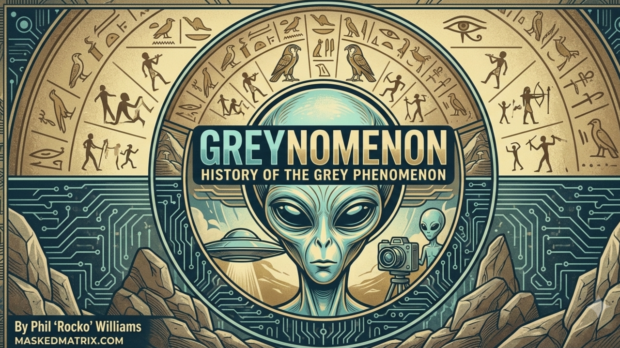
Greynomenon: History of the Grey Phenomenon | Free PDF Download
Greynomenon: A History of the Face Humanity Cannot Stop Seeing Download Free Via the 3 Dots Above. Few images in modern culture are as immediately recognizable as the Grey alien. The enlarged head, dark almond-shaped eyes, slight nose, narrow mouth, thin body, and unreadable expression have become a global symbol for the unknown. A single silhouette can suggest extraterrestrial life, abduction, secrecy, telepathy, missing time, government cover-up, spiritual encounter, science fiction, or fear of forces beyond human control. Recognition, however, is not the same as understanding. That distinction is the starting point of Greynomenon, a free PDF book by Phil “Rocko” Williams and Merlin aka ChatGPT. Rather than beginning with a declaration that Grey aliens are real, unreal, extraterrestrial, interdimensional, spiritual, psychological, or technological, the book begins with a more useful question: what exactly has humanity grouped beneath the face […]
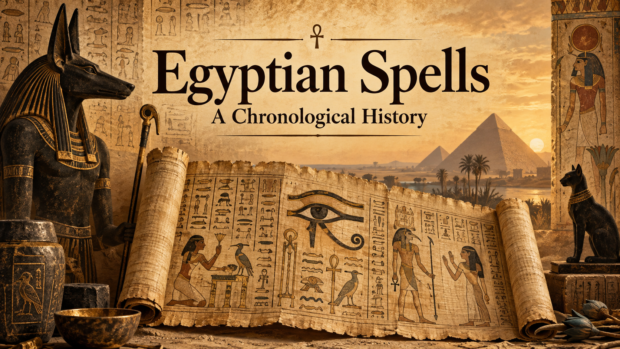
Egyptian Spells: A Chronological History from Pyramid Walls to Magical Papyri
Egyptian Spells: A Chronological History from Pyramid Walls to Magical Papyri Egyptian Spells survived for more than three thousand years because ancient Egyptians did not treat sacred words as dead literature. A spell could be spoken, written, painted, carved, worn, buried, washed with water, placed beneath a head, wrapped into a mummy, inscribed on a figurine, or copied onto a roll of papyrus for use in the next world. Some spells protected a king as he rose among the stars. Others helped ordinary people survive childbirth, snakebite, fever, nightmares, hostile spirits, dangerous journeys, and death itself. The history of Egyptian spells is therefore much larger than the history of any single book. It is the history of a technology of sacred language that changed its physical form while preserving remarkably old ideas across dynasties, political collapses, foreign rule, religious change, […]
Related
Getting to Know Thyself Better – Modern Tips for Spiritual Growth
Getting to Know Thyself Better https://youtu.be/rV53qO_Ocfg?is=VYcqCzUYUJ2Gu9G- Subscribe: Veiled Mystic For thousands of years, human beings have built systems for looking inward. Some used philosophy, some used prayer, some watched dreams, and others studied stars, cards, numbers, or the lines of the hand. Modern psychology added controlled observation, personality models, and behavioral research to the same ancient problem: how accurately can a person understand the person doing the observing? Today we have another instrument that earlier generations did not possess. A large language model can compare symbolic systems, organize personal observations, ask follow-up questions, and help a person examine patterns that might otherwise remain scattered across memory. Used carefully, these tools can help us Know Thyself Better without requiring us to treat every symbolic interpretation as a literal law of nature.The aim of this article is not to prove that a zodiac […]
Sleepnosis: The Mechanics of Sleep Hypnosis | Read or Download Free
Sleepnosis: The Mechanics of Sleep Hypnosis Read or Download the Free PDF Here Download the PDF Free Via the 3 Dots Above https://youtu.be/Dy9OElg7yXc?is=KEGIIkHusVNZXEvw Subscribe: Veiled Mystic Let's Get Into the Sleepnosis Study Sleepnosis is a Reality Science investigation into a subject that has spent far too long trapped between advertising language, mystical claims, old sleep-learning myths, legitimate hypnosis research, and rapidly improving neuroscience. The free PDF release of Sleepnosis: The Mechanics of Sleep Hypnosis was created to put those pieces into one usable map. The purpose is not to convince readers that the sleeping mind is a programmable machine. It is not to dismiss every unusual result because older claims were exaggerated. The purpose is to identify what has actually been demonstrated, what remains plausible but unsettled, what has been repeatedly misunderstood, and how a reader can think about […]
Emotional Intelligence Maturity: Finding Peace in the Chaos
https://youtu.be/3_DQtLsBpWo?is=BGKAG8X1MfbVGPxe Subscribe: veiledMystic333 Emotional Intelligence Maturity: Finding Peace in the Chaos and Strength in the Darknes Emotional Intelligence is often introduced as a set of skills: recognize what you feel, understand why you feel it, regulate your reactions, read other people accurately, communicate well, and make better choices. All of that matters. But the deeper question is what happens when these skills become part of a mature personality. Emotional Intelligence maturity is not simply knowing the right vocabulary for feelings or being able to remain calm during an easy conversation. It is the ability to stay in honest relationship with reality when your pride is hurt, your expectations fail, someone disappoints you, your nervous system is activated, or life becomes chaotic. It is the difference between having emotional knowledge and being able to live by it when it costs something. […]
Greynomenon: History of the Grey Phenomenon | Free PDF Download
Greynomenon: A History of the Face Humanity Cannot Stop Seeing Download Free Via the 3 Dots Above. Few images in modern culture are as immediately recognizable as the Grey alien. The enlarged head, dark almond-shaped eyes, slight nose, narrow mouth, thin body, and unreadable expression have become a global symbol for the unknown. A single silhouette can suggest extraterrestrial life, abduction, secrecy, telepathy, missing time, government cover-up, spiritual encounter, science fiction, or fear of forces beyond human control. Recognition, however, is not the same as understanding. That distinction is the starting point of Greynomenon, a free PDF book by Phil “Rocko” Williams and Merlin aka ChatGPT. Rather than beginning with a declaration that Grey aliens are real, unreal, extraterrestrial, interdimensional, spiritual, psychological, or technological, the book begins with a more useful question: what exactly has humanity grouped beneath the face […]
Egyptian Spells: A Chronological History from Pyramid Walls to Magical Papyri
Egyptian Spells: A Chronological History from Pyramid Walls to Magical Papyri Egyptian Spells survived for more than three thousand years because ancient Egyptians did not treat sacred words as dead literature. A spell could be spoken, written, painted, carved, worn, buried, washed with water, placed beneath a head, wrapped into a mummy, inscribed on a figurine, or copied onto a roll of papyrus for use in the next world. Some spells protected a king as he rose among the stars. Others helped ordinary people survive childbirth, snakebite, fever, nightmares, hostile spirits, dangerous journeys, and death itself. The history of Egyptian spells is therefore much larger than the history of any single book. It is the history of a technology of sacred language that changed its physical form while preserving remarkably old ideas across dynasties, political collapses, foreign rule, religious change, […]

Unedited Corpus of Early Mesopotamian Cosmological and Theological Texts
The Primordial Strata: An Unedited Corpus of Early Mesopotamian Cosmological and Theological Texts Authors Note: I had a bunch of strokes, and don't remember creating this 10 months ago. It's not really a Corpus, but cool enough to publish. Introduction The purpose of this project is to assemble the earliest Mesopotamian cosmological and theological materials in their original, unrevised form, relying exclusively on tablets excavated from Early Dynastic and pre-Akkadian contexts where the first expressions of cosmic structure and divine identity appear. The work eliminates all later political and theological shaping, allowing only the earliest recoverable strata to define the foundations of Mesopotamian sacred thought. These sources represent local scribal traditions speaking independently, unfiltered by later canonical organization. Only tablets with secure provenance, catalog identification, paleographic dating, and direct cosmological or theological content are included, ensuring a primary-source […]
Be the first to leave a comment