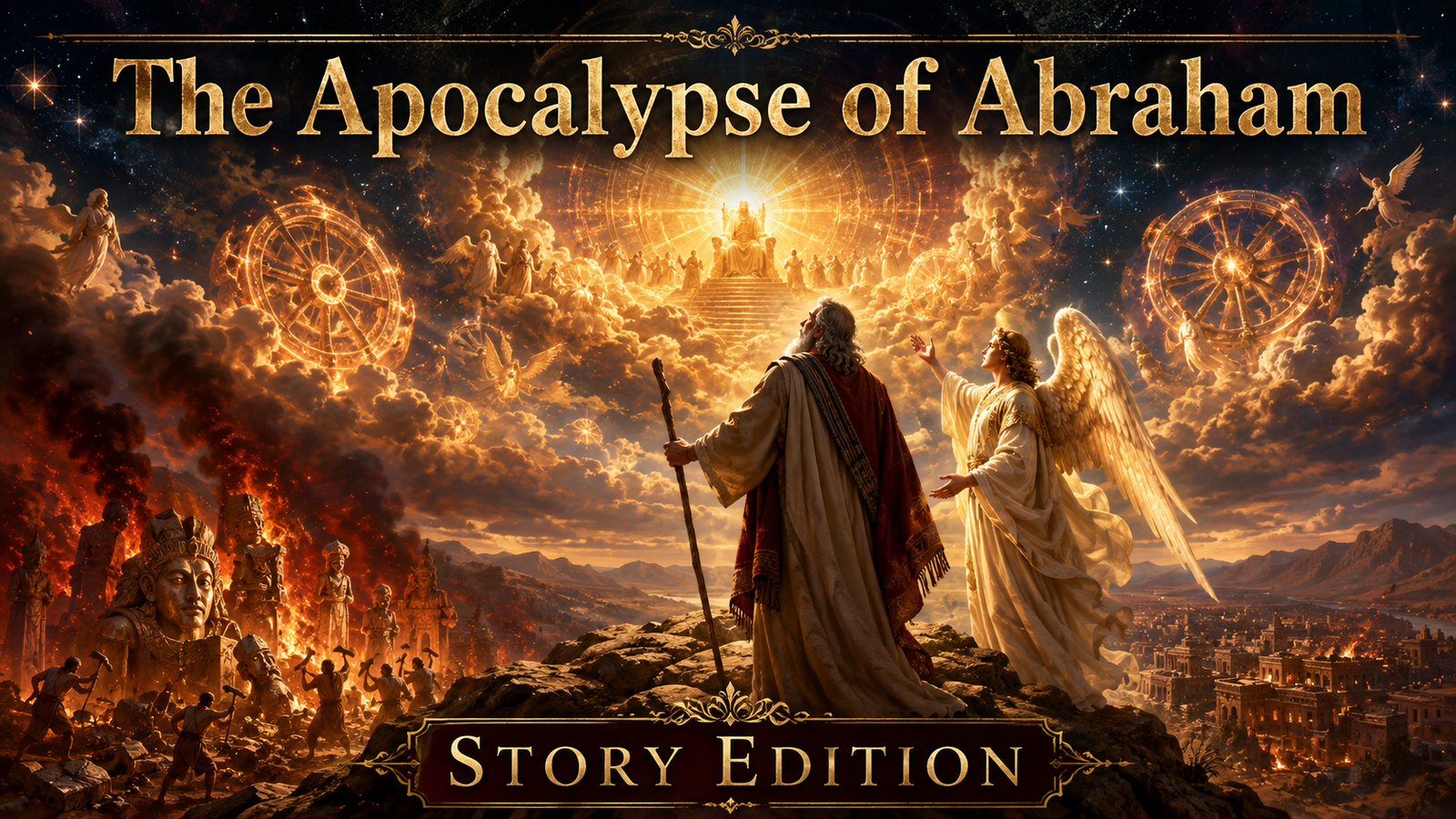
The Apocalypse of Abraham Story Edition
Download Free Via the 3 Dots
Subscribe: Veiled Mystic
The Apocalypse of Abraham is one of those ancient works that can take a modern reader completely by surprise.
It begins on a human scale. Abraham is still a young man living in the household of his father Terah. His father manufactures idols. Abraham sees stone gods break, wooden gods burn, and images supposedly capable of blessing human beings depend entirely on human hands to stand upright, survive accidents, or even exist.
Then the story opens into something much larger.
A heavenly voice calls Abraham away. An angel named Yahoel becomes his guide. The adversarial power Azazel appears. Abraham prepares the covenant sacrifice known from Genesis, but the familiar biblical scene becomes the doorway to a cosmic revelation. Abraham rises into the heavens. He encounters fire, living creatures, wheels, voices, and the terrifying presence of the divine throne. He is shown Adam and Eve, the spread of evil through human history, the future of his descendants, the destruction of the Jerusalem Temple, the judgment of the nations, and the end of the present age.
For our Story Edition, the aim was simple: make this extraordinary ancient text accessible without pretending that a modern retelling is a scholarly translation.
The free PDF uses newly written English designed for reading, text-to-speech narration, and video. It follows the surviving sequence and preserves the important characters, images, events, and arguments of the ancient Apocalypse of Abraham. It does not copy the wording of a modern copyrighted translation. Its principal English textual foundation was the public-domain G. H. Box and J. I. Landsman edition first published in 1918, checked against modern scholarship for questions of history, manuscripts, transmission, Yahoel, Azazel, and disputed passages.
The PDF tells the story. This article takes the next step.
What exactly is the Apocalypse of Abraham? When was it written? How did a Jewish apocalypse from the Roman world survive only in medieval Slavonic manuscripts? Why does Azazel appear in the Garden of Eden? Who is Yahoel? Why does Abraham see the Temple destroyed? Why does the text resemble Ezekiel and the Enochic tradition? And why should readers resist the tempting idea that it came from Nag Hammadi?
The answers lead into one of the more unusual journeys in the history of ancient religious literature.
What Is the Apocalypse of Abraham?
The Apocalypse of Abraham is a Jewish pseudepigraphal apocalypse attributed to the biblical patriarch Abraham.
That sentence contains two words worth unpacking.
Pseudepigraphal means that a work is written under the name or voice of a famous figure from the past even though the surviving work was composed much later. Ancient literature contains many such works. Enoch, Moses, Ezra, Baruch, Adam, Abraham, and other revered figures became literary speakers through whom later writers explored revelation, history, judgment, angels, creation, and the future.
Calling a work pseudepigraphal does not mean that the text is a modern fake. It describes a literary practice found throughout the ancient world. The work’s authority comes from placing the reader inside the perspective of a foundational figure.
The word apocalypse also needs clarification.
Today, apocalypse often means catastrophe, nuclear war, zombies, ecological collapse, or the end of civilization. In ancient religious literature, the core idea is revelation or unveiling. Hidden realities are disclosed to a human recipient through dreams, visions, angelic guides, journeys, heavenly books, symbolic pictures, or direct divine speech.
The Apocalypse of Abraham is an apocalypse in this older sense. Abraham is allowed to see what ordinary human perception cannot reach.
He sees the heavens.
He sees the hidden structure of history.
He sees the consequences of idolatry and evil.
He sees the destruction of the Temple from a heavenly perspective.
He sees that the suffering of the present age is not, in the logic of the book, the final word.
The work is therefore not merely a collection of predictions. It is an attempt to explain history by moving the observer outside ordinary history.
The Apocalypse of Abraham Has Two Very Different Halves
One of the strangest features of the work is how sharply its tone changes.
Chapters 1 through 8 tell the story of Abraham and the idols of his father Terah. The material is almost comic in places. A large stone god falls over. Its head breaks. Terah simply fixes the head to another body. Other gods shatter after being dropped. Abraham later places a wooden idol named Barisat beside a fire and tells it to guard the flames. When he returns, the god has fallen into the fire and burned.
Abraham’s reasoning becomes increasingly serious.
If fire can destroy the idol, perhaps fire is greater than the idol.
But water overcomes fire.
Earth contains water.
The sun dries the earth.
Clouds and darkness obscure the sun.
The moon and stars also appear and disappear according to appointed times.
Every power that appears supreme is limited by another power.
Therefore, Abraham concludes that none of them is the ultimate Creator.
Then the first section ends dramatically. A heavenly voice calls Abraham away from Terah, and fire destroys the house.
Beginning in chapter 9, the work becomes the apocalypse proper.
The tone changes from satirical reasoning about idols to angelic revelation, sacrifice, cosmic ascent, throne mysticism, demonology, creation, Eden, national catastrophe, and eschatological judgment.
The two halves may feel as though they belong to different books, yet the surviving work deliberately connects them. Yahoel later tells Abraham that he was involved in the destruction of Terah’s house. The theme of idolatry also continues into the heavenly vision, where Abraham sees the corruption of worship and the destruction that follows.
The little idol in the workshop and the burning Temple ultimately belong to the same argument.
Genesis Says Almost Nothing About Abraham’s Youth
The Book of Genesis introduces Abram as an adult within the family of Terah. It says almost nothing about his childhood or the process by which he came to reject the religious environment around him.
Later Jewish tradition found that silence irresistible.
If Abraham became the great patriarch of monotheistic tradition, readers naturally wondered how he discovered the true God in the first place.
Stories developed in which Abraham reasoned against idolatry, challenged his father, destroyed images, or recognized that heavenly bodies could not be ultimate gods because they rose and set.
The Apocalypse of Abraham participates in that wider interpretive tradition, but it has its own memorable scenes.
Merumath, the fallen stone god, is especially effective because Abraham does not need a sophisticated philosophical argument. The god cannot stand up.
Terah must rescue it.
When the idol’s head breaks, the supposedly divine being becomes a repair project.
Barisat is even more absurd. Abraham places the wooden god beside the cooking fire and assigns it a job. The idol fails at the task and is consumed by the very fire it was told to protect.
The satire works because it attacks the practical contradiction in manufactured divinity.
Who is more powerful: the craftsman or the thing he made?
The Argument Against Idolatry Becomes a Cosmic Argument
The opening chapters are more than religious comedy.
Abraham’s reasoning expands step by step.
He does not merely conclude that poorly manufactured statues are bad gods. He asks whether any visible part of creation deserves ultimate worship.
Fire is powerful, but water defeats it.
Water is powerful, but earth contains it.
The sun is glorious, yet the sun can be obscured.
The moon changes.
The stars move according to patterns they do not appear to choose.
That leads Abraham beyond the visible cosmos to the idea of a Creator who established the powers of the world rather than being identical with any one of them.
This pattern resembles a form of ancient natural theology: reasoning from the limitations and order of visible things toward an invisible source above them.
The author uses Abraham’s awakening to establish the central contrast that governs the entire apocalypse.
True worship belongs to the Creator.
False worship attaches ultimate value to something within creation.
That distinction later becomes political, national, and eschatological.
Why the Apocalypse of Abraham Was Probably Written After 70 CE
The strongest historical clue inside the Apocalypse of Abraham is the destruction of the Jerusalem Temple.
In the vision, Abraham sees foreign forces attack his descendants. The sanctuary is burned. Sacred objects are plundered. Abraham is devastated and demands an explanation.
Within the story, these things belong to Abraham’s distant future.
For the ancient author, they almost certainly belonged to remembered history.
The Second Temple was destroyed by Roman forces in 70 CE during the First Jewish Revolt. The catastrophe transformed Jewish religious, political, and cultural life. The Temple had been the central sacrificial sanctuary of Judaism. Its destruction raised enormous theological questions.
Had God abandoned the people?
Why had the sanctuary been permitted to fall?
How could covenant history continue without the Temple?
Was Roman victory evidence that Rome’s gods were stronger?
Had Israel’s own sins brought the catastrophe?
What would restoration look like?
Jewish literature after 70 CE answered these questions in different ways. The Apocalypse of Abraham belongs naturally in that world of response.
The destruction of the Temple is not a minor prophecy inserted for dramatic effect. It is one of the emotional and theological centers of the book.
Modern scholars therefore commonly place the work in the late first or early second century CE, although exact dating remains debated. Andrei Orlov describes it as an anonymous Jewish work composed soon after the destruction of the Second Temple. Amy Paulsen-Reed likewise treats the apocalypse as deeply shaped by the theological crisis created by the events of 70 CE.
A Jewish Work Preserved by Christian Scribes
The transmission history of the Apocalypse of Abraham is almost as surprising as the story.
No ancient Hebrew manuscript survives.
No ancient Aramaic manuscript survives.
No Greek manuscript of the full apocalypse survives.
The complete work reached modern scholarship through Slavonic manuscripts copied by medieval Christians.
That creates a historical paradox.
A Jewish work responding to Roman-era Jewish concerns survived because Christian scribes living in a very different linguistic, geographical, and religious environment continued to copy it.
The medieval manuscripts are not simply neutral photocopies of an ancient original. Texts change during transmission. Scribes make mistakes. Marginal comments enter the body of a text. Explanations are added. Material is abbreviated. Older wording is misunderstood. Christian copyists may consciously or unconsciously reshape Jewish material.
That means modern scholars must work backward.
They compare Slavonic manuscripts, identify variants, reconstruct earlier stages where possible, and ask which features probably belong to the ancient Jewish composition and which may reflect later transmission.
The result is not perfect recovery.
It is disciplined reconstruction.
The Codex Sylvester and the Medieval Survival of the Text
One of the most important manuscript witnesses used by early editors is the Codex Sylvester, a parchment manuscript dating to the first half of the fourteenth century.
In that codex, the Apocalypse of Abraham appears as an independent work among other religious writings.
Other Slavonic forms survive in collections often called Palaea, compilations that retold and expanded biblical history with additional interpretive and apocryphal material.
The history becomes increasingly complicated because later versions could absorb the Apocalypse of Abraham into larger narratives about the patriarch rather than preserve it as a separate book.
Early modern scholars therefore inherited not one pristine manuscript but a family of related witnesses.
Nineteenth-century Russian scholars began publishing important Slavonic texts. G. Nathanael Bonwetsch produced a major German edition and translation in 1897. G. H. Box, working with J. I. Landsman, published an English edition in 1918.
That English publication matters for our Story Edition because it is now in the public domain in the United States. Internet Archive lists the 1918 edition as not in copyright.
Modern translations, however, remain protected by copyright.
That is why a legal modern story adaptation should use the ancient work and public-domain textual resources as its foundation while writing its own contemporary prose rather than copying a recent translator’s English sentences.
Was the Original Written in Hebrew or Aramaic?
The exact linguistic history of the Apocalypse of Abraham remains uncertain.
The surviving text is Slavonic.
Scholars have long argued that the Slavonic translation reflects an earlier Greek version. Behind that Greek text, many have proposed a Semitic original, commonly Hebrew or Aramaic.
Older scholarship often stated the Semitic origin with considerable confidence. Modern scholarship continues to examine the problem more carefully because reconstructing an absent original from a translation of a translation is difficult.
A Semitic turn of phrase can survive into Greek and then into Slavonic. It can also be created by translators working in a biblical style. A strange sentence may reflect the original language, a Greek intermediary, or a Slavonic scribe.
So the safest historical picture is a chain rather than a certainty:
an ancient Jewish composition, probably transmitted through Greek, preserved in Old Church Slavonic and later Slavonic manuscripts.
The exact first language remains a question of scholarship rather than something we can inspect directly.
The Apocalypse of Abraham Is Not a Nag Hammadi Text
Because the Apocalypse of Abraham feels strange, visionary, and outside the biblical canon, people sometimes assume it came from Nag Hammadi.
It did not.
The Nag Hammadi codices were discovered in Egypt in 1945. They are manuscripts written in Coptic and preserve a collection of works associated with several currents of early Christianity, Gnosticism, philosophical speculation, revelation dialogue, and related traditions.
The Apocalypse of Abraham has a completely different manuscript history.
Its full text was known through Slavonic Christian manuscript traditions long before the Nag Hammadi discovery. The work itself is generally regarded by modern scholarship as fundamentally Jewish, even though it survived in Christian hands.
There are points of contact with ideas that appear in Gnostic or Christian literature, but similarity of subject does not establish manuscript origin.
Ancient Jewish apocalypticism had already developed heavenly journeys, angelic mediators, cosmic visions, revealed mysteries, and elaborate demonologies.
A text can feel “Gnostic” to a modern reader simply because modern readers are less familiar with the enormous imaginative range of ancient Judaism.
The Wider World of Jewish Apocalyptic Literature
The Apocalypse of Abraham makes more sense when read beside other Jewish apocalypses.
1 Enoch sends its visionary through heavenly regions and presents elaborate traditions about fallen angels, cosmic order, judgment, and the fate of the righteous.
4 Ezra wrestles with the destruction of Jerusalem and the apparent triumph of the wicked.
2 Baruch also responds to national catastrophe through revelation attributed to an ancient biblical figure.
Daniel presents symbolic visions in which earthly empires are interpreted from a heavenly point of view.
These works differ substantially, but they share a strategy.
History looks unbearable from below.
So the visionary is taken above it.
The apocalypse does not deny suffering. It changes the scale from which suffering is interpreted.
The Roman army may burn the Temple, but heaven has not disappeared.
Empires may dominate the present, but they do not control the final structure of history.
That is the psychological and theological power of apocalyptic literature.
Genesis 15 Becomes a Launching Point Into Heaven
The biblical foundation of the Apocalypse of Abraham’s second half is Genesis 15.
In Genesis, Abraham is told to take a heifer, a goat, a ram, a turtledove, and a pigeon. The larger animals are divided. Birds of prey descend upon the carcasses and Abraham drives them away. As darkness falls, Abraham enters a terrifying revelatory experience. God makes a covenant and foretells that Abraham’s descendants will live as strangers in another land, suffer oppression, and eventually return.
The Apocalypse of Abraham takes this compact biblical episode and explodes it into cosmic drama.
The bird becomes associated with Azazel.
The sacrifice becomes a ritual threshold.
The two unslaughtered birds become part of Abraham’s ascent.
The darkness and revelation become entrance into the heavens.
The prophecy of Abraham’s descendants becomes a survey of creation, Eden, sin, the Temple, exile, judgment, and restoration.
This is ancient interpretation at its most creative.
The author is not abandoning Genesis.
He is entering its gaps.
Yahoel: Abraham’s Angelic Guide
Yahoel is one of the most distinctive figures in the Apocalypse of Abraham.
Older English scholarship often printed the name as Jaoel or Iaoel. Modern discussions frequently use Yahoel.
The name is important because it appears to incorporate a form associated with the divine Name. That gives Yahoel unusually elevated status.
He is not simply an angel who delivers one message and disappears.
He raises Abraham when the patriarch collapses in fear.
He guides him toward the place of sacrifice.
He rebukes Azazel.
He teaches Abraham heavenly praise.
He accompanies him into the celestial realm.
He exercises authority around the terrifying living creatures associated with the divine throne.
Some scholars have compared Yahoel with other exalted angelic figures in Jewish mystical and apocalyptic traditions, including Michael and later Metatron traditions. The relationships are complicated, and Yahoel should not simply be renamed as another angel.
What matters is the larger pattern.
The human visionary cannot cross the heavenly boundary alone.
He needs a mediator.
Why Yahoel Matters to the History of Jewish Mysticism
Modern scholarship has paid particular attention to the priestly character of the Apocalypse of Abraham.
Andrei Orlov has argued that the work presents Abraham not merely as a tourist in heaven but as an initiate entering a celestial priestly setting. The sacrifice, angelic instruction, sacred songs, heavenly sanctuary, and confrontation with Azazel can be read against Jewish priestly and Yom Kippur traditions.
This matters because the work appears after the earthly Temple’s destruction.
If the Jerusalem sanctuary has been lost, where does true worship now reside?
One answer available to apocalyptic and mystical imagination is heaven.
The earthly Temple can burn.
The heavenly sanctuary cannot be conquered by Rome.
That makes Abraham’s ascent more than spectacle.
It becomes a theological relocation of sacred space.
Azazel Before the Apocalypse of Abraham
Azazel has a long and difficult history.
The name first appears in Leviticus 16 within the Day of Atonement ritual. Two goats are chosen. One is sacrificed. The other is associated with Azazel and sent away into the wilderness after bearing the people’s sins.
The precise meaning of Azazel in Leviticus has been debated for centuries. Is the term a place, a wilderness being, a demon, or something else?
Later Jewish literature gives Azazel a more developed identity.
In the Enochic tradition, Azazel becomes one of the rebellious heavenly beings associated with forbidden knowledge and the corruption of humanity.
By the time we reach the Apocalypse of Abraham, Azazel is a major adversarial power.
He appears at Abraham’s sacrifice in the form of an unclean bird and tries to persuade him to abandon the holy ascent.
The text therefore takes a biblical ritual name and develops it into a cosmic opponent.
Azazel and the Reversal of the Heavenly Garment
One of the most interesting scenes occurs when Yahoel rebukes Azazel.
Azazel is told that Abraham’s portion is in heaven while Azazel’s chosen place belongs to corruption below.
Then the text describes a striking reversal.
A heavenly garment once associated with Azazel is said to have been set aside for Abraham.
The fallen being loses heavenly status.
The human seeker receives elevation.
This theme appears in different forms throughout ancient apocalyptic and mystical literature: human beings can become participants in heavenly glory while rebellious heavenly beings fall from it.
Hierarchy is not determined simply by species.
An angel can fall.
A human can rise.
The moral and ritual direction of the being matters.
Azazel in Eden Is Stranger Than the Genesis Serpent
The Apocalypse of Abraham’s version of Eden is one of its most visually startling passages.
Abraham sees Adam and Eve standing near a tree. The fruit appears like a cluster of grapes.
Behind the tree is a strange serpent-like figure.
This being is not simply the ordinary snake familiar from popular pictures of Genesis. The transmitted apocalypse gives it fantastic, partly humanlike and winged features.
The heavenly explanation identifies the corrupting power with Azazel.
That move joins two traditions that Genesis itself does not explicitly join.
Genesis describes the serpent.
Leviticus names Azazel in a ritual.
Enochic literature develops Azazel as a fallen heavenly corrupter.
The Apocalypse of Abraham brings these streams together into one vision of the origin and continuation of human ungodliness.
This is precisely why the work is so valuable for understanding how biblical characters and symbols continued evolving in later Jewish imagination.
The Apocalypse Does Not Blame Azazel for Everything
The presence of a cosmic adversary creates an obvious philosophical problem.
If Azazel corrupts humanity, are humans responsible for evil?
The Apocalypse of Abraham refuses to make the adversary an all-purpose excuse.
Azazel tempts and corrupts, but human choice remains important.
Abraham asks why God permits the adversary to have any power at all. The response does not become a modern philosophical essay about determinism and free will. Instead, the book returns Abraham to his own experience.
Terah and Abraham encountered the same world.
Terah continued in idolatry.
Abraham rejected it.
The narrative therefore preserves two realities at once.
Cosmic evil exists.
Human willing still matters.
The book never completely resolves the tension.
That may be one reason the question still feels recognizable.
The Ascent Is Deliberately Terrifying
Modern spiritual culture often portrays heavenly ascent as gentle, luminous, and comforting.
The Apocalypse of Abraham is not like that.
Abraham is frightened.
He collapses.
He is surrounded by fire.
He hears voices like immense waters.
The living beings around the throne are unstable and dangerous enough that Yahoel must regulate them.
The heavens are glorious, but glory is not safe.
This is a common feature of ancient biblical and apocalyptic encounters.
Isaiah is overwhelmed in the Temple vision.
Ezekiel falls before divine glory.
Daniel loses strength.
Revelation repeatedly depicts heavenly beings telling terrified humans not to fear.
Ancient holiness is often experienced as dangerous intensity rather than emotional reassurance.
Ezekiel Is Everywhere in the Throne Vision
The Apocalypse of Abraham’s throne imagery strongly recalls the Book of Ezekiel.
Ezekiel sees living creatures with multiple faces and wings.
He sees wheels associated with the creatures.
The wheels are full of eyes.
Above the living beings appears a throne-like structure and overwhelming divine glory.
The Apocalypse of Abraham reworks this visual vocabulary.
Abraham sees fiery creatures, multiple faces, wings, wheels filled with eyes, and a throne surrounded by fire and light.
Yet the later apocalypse adds its own features.
Yahoel moves among the creatures and regulates their dangerous interaction.
He teaches or directs heavenly praise.
Abraham participates in worship while being protected from the overwhelming forces around him.
The imagery therefore belongs to a developing tradition of throne mysticism rather than simple literary copying.
The Most Important Thing Abraham Does Not See
One of the most intriguing features of the throne vision is the restraint surrounding the form of God.
Abraham encounters fire.
He encounters light.
He hears a voice.
He sees the throne and the beings around it.
But the divine form itself is not simply described as a humanlike figure available for visual inspection.
This has attracted considerable scholarly attention.
The work begins with a rejection of visible idols, then culminates in a heavenly revelation where the true God resists visual containment.
The structure is elegant.
Terah makes gods that can be seen, carried, repaired, sold, dropped, and burned.
Abraham’s God cannot be manufactured or contained in an image.
The anti-idolatry argument reaches its highest point in the throne vision.
Heaven Gives Abraham a View of the Entire Created Order
After the ascent, Abraham is told to look downward.
The heavens open beneath him.
He sees stars and the powers associated with cosmic order.
He sees earth, rivers, seas, islands, creatures, human beings, lower regions, and places of punishment.
He sees Eden.
He sees enormous multitudes divided within the visionary picture.
The scene turns creation into something like a cosmic map.
This is a classic apocalyptic technique.
A human being who normally occupies one tiny location in space and time is temporarily given an impossible perspective.
History becomes visible as structure.
From that viewpoint, the author can ask not merely what happens but where everything belongs.
The Stars and the Promise to Abraham
The Apocalypse of Abraham also reuses another famous biblical image.
Abraham is told to consider the stars.
He cannot number them.
The impossibility becomes an image for the multitude of his descendants.
This biblical promise appears simple in Genesis, but after the destruction of Jerusalem it acquires painful irony.
How can the descendants promised by God be conquered?
How can the chosen sanctuary burn?
How can covenant and catastrophe exist together?
The apocalypse does not abandon the promise.
It places catastrophe inside a longer story.
That is one of the defining functions of the book.
The Temple Vision Is the Historical Heart of the Apocalypse
Abraham sees a beautiful sanctuary and altar.
He also sees corruption connected with that sacred space: an idolatrous image and violent sacrifice.
Then foreign attackers come.
The Temple burns.
Its holy objects are taken.
Abraham is horrified.
The scene gathers the central themes of the entire book.
Idolatry begins in Terah’s workshop.
Later it becomes national corruption.
True worship is revealed in heaven.
The earthly sanctuary is sacred, but sacred institutions can be corrupted.
Foreign destruction is terrible, yet the apocalypse interprets it within a moral history rather than as evidence that God has ceased to exist.
For a Jewish audience living after 70 CE, this was not abstract theology.
It was a way of thinking about a catastrophe that had changed their world.
Did the Author Blame Jews for the Destruction of the Temple?
The Apocalypse of Abraham connects the catastrophe with idolatry and wrongdoing among Abraham’s descendants.
That can sound uncomfortable to modern readers, and it should.
Ancient religious literature often explains national catastrophe through covenantal theology: defeat is interpreted as judgment for collective sin.
This pattern appears throughout biblical literature, including prophetic interpretations of earlier destructions of Jerusalem.
The Apocalypse of Abraham continues that tradition.
However, it does not celebrate the destruction.
Abraham grieves.
The loss is presented as horrifying.
The foreign nations who inflict suffering are not simply declared righteous because they are instruments of punishment. They too face judgment.
The logic is therefore more complicated than victim-blaming.
The author tries to preserve divine justice while condemning both internal corruption and external oppression.
The Question “How Long?” Is the Language of Apocalyptic Suffering
After seeing the suffering of his descendants, Abraham asks how long it will continue.
That question appears repeatedly in Jewish and Christian apocalyptic literature.
How long will the wicked prosper?
How long will the righteous suffer?
How long will the sanctuary remain violated?
How long until judgment?
The Apocalypse of Abraham answers with symbolic calculations involving the age and its divisions. The transmitted wording is difficult and has generated debate.
But the central point is clear.
The present age has a limit.
Oppression is not eternal.
Apocalyptic chronology is therefore not merely an ancient attempt to calculate dates.
It performs a psychological function.
Suffering is given an endpoint.
The Ten Plagues at the End of the Age
The apocalypse describes a final sequence of calamities before the restoration to come.
The imagery includes hunger, burning cities, violence, warfare, earthquake, severe weather, pestilence, wild beasts, and destructive cosmic disturbance.
The number ten naturally recalls the plagues of Egypt.
That connection matters because the Exodus is one of the foundational biblical patterns of oppression followed by divine deliverance.
The Apocalypse of Abraham reuses that pattern on a cosmic scale.
Just as Egypt’s domination ends in judgment, the domination of the present age will end.
History becomes a greater Exodus.
The Elect One and the Hope of Restoration
Near the end of the apocalypse, an Elect One appears in connection with divine judgment and the gathering of the chosen people.
Messianic language in ancient Jewish literature is not uniform. Different texts imagine restoration through kings, heavenly agents, priestly figures, divine intervention, resurrected righteous ones, or combinations of these themes.
The Apocalypse of Abraham should therefore be read within the diversity of Jewish expectations rather than forced into one later theological template.
The central hope is clear even when every detail is not.
The scattered are gathered.
The oppressors face judgment.
The power of the corrupt age ends.
The righteous inherit the restored order.
The Strange Man in Chapter 29
One passage has generated an unusually persistent debate.
In chapter 29, Abraham sees a man associated with the nations. Some people worship him. Others insult or strike him. The scene involves both Gentiles and Abraham’s descendants, and even Azazel appears in the picture.
Many older interpreters identified the man as Jesus and concluded that the passage must be a Christian interpolation added to an originally Jewish apocalypse.
That solution seems simple.
But simplicity is not proof.
Daniel C. Harlow argued in a 2013 study that the passage may actually belong to the Jewish composition and function as anti-Christian polemic. In that reading, the figure is indeed Jesus, but the author presents him as a false or pseudo-messianic figure contrasted with the true deliverer still to come.
This remains a debated interpretation.
That is exactly why our Story Edition keeps the passage without telling the reader which theory must be correct.
Deleting a difficult passage can create the illusion of certainty.
Preserving it with a note allows the evidence to remain visible.
Christian Transmission Does Not Automatically Make the Work Christian
Because every complete surviving manuscript was copied by Christians, scholars must constantly ask whether a particular phrase reflects the ancient Jewish text or later Christian editing.
But there is a methodological danger.
If every passage that sounds remotely Christian is automatically deleted as an interpolation, the reconstructed Jewish text can become whatever the editor expected Judaism to look like.
Ancient Jewish and Christian worlds overlapped.
They shared scriptures.
They argued about interpretation.
They developed related angelic and messianic vocabularies.
Ideas moved across community boundaries.
The chapter 29 debate is therefore a good example of a broader principle.
Textual history is not solved merely by labeling surprising material “later.”
How the Apocalypse of Abraham Relates to 1 Enoch
The Book of Enoch and the Apocalypse of Abraham are separate works, but their worlds overlap in important ways.
Both belong to Jewish traditions interested in heavenly revelation.
Both use angelic intermediaries.
Both develop the problem of rebellious heavenly powers.
Both are interested in cosmic geography and judgment.
Azazel creates the most obvious connection.
In 1 Enoch, Azazel is associated with forbidden teachings and the corruption of humanity. In the Apocalypse of Abraham, he becomes an adversarial ruler linked with deception, impurity, Eden, and the present realm of ungodliness.
Yet the works use him differently.
That difference shows how ancient traditions grow.
A named figure can migrate between stories, acquire new functions, absorb other symbols, and become part of a new theological argument.
How the Apocalypse of Abraham Relates to Ezekiel
Ezekiel provides the visual grammar for much of the heavenly throne scene.
This is not surprising.
Ezekiel’s opening vision became one of the most powerful sources for later Jewish speculation about the divine throne, heavenly beings, and mystical ascent.
The Hebrew term merkavah, chariot, later became associated with traditions of throne and chariot mysticism.
The Apocalypse of Abraham stands at an important point in that larger history.
It combines biblical throne imagery with an angelic guide, ritual preparation, ascent, heavenly praise, and transformation of the human participant’s status.
Scholars therefore study the work not only as an apocalypse but also as evidence for the development of Jewish mystical traditions.
Is the Apocalypse of Abraham “Merkabah Mysticism”?
The label should be used carefully.
Later Hekhalot and Merkabah texts from late antiquity and the early medieval period describe elaborate journeys through heavenly palaces, angelic gatekeepers, dangerous names, hymns, seals, and throne visions.
The Apocalypse of Abraham is earlier than those mature literary collections.
It would therefore be misleading to treat it as if it were simply one more medieval Hekhalot manual.
But it preserves themes that later become central:
heavenly ascent, throne vision, angelic mediation, dangerous celestial beings, sacred song, and transformation through proximity to divine glory.
It is better understood as part of the ancient stream from which later Jewish mystical literature developed.
The Apocalypse of Abraham and the Problem of Images
The work has an unusually consistent theology of vision.
It begins with physical images that pretend to be gods.
Abraham learns that anything manufactured, manipulated, or destroyed cannot be the ultimate Creator.
Later, when he actually reaches the heavenly throne, the true God is not reduced to an idol-like body.
Divine presence comes through voice, fire, light, command, glory, and overwhelming holiness.
This creates a deliberate contrast between an idol and a vision.
An idol claims to contain divinity in an object.
The apocalypse claims that divine reality exceeds the human ability to contain it.
Abraham sees more than ordinary humans, yet even Abraham does not master God by seeing a face and describing it.
Why Fire Appears Again and Again
Fire begins as a destroyer of false gods.
Barisat burns.
Terah’s house burns.
Later, fire fills heaven.
The throne is fiery.
The living creatures are associated with fire.
The divine presence comes through fire and overwhelming light.
The same element therefore has opposite theological functions.
Fire exposes false divinity by destroying the idol.
Fire also expresses true divine glory by exceeding human control.
Terah can place wood into a fire.
Abraham cannot command the heavenly fire.
The difference is power and source.
Why Birds Matter So Much in the Story
The birds in the Apocalypse of Abraham come directly from the creative expansion of Genesis 15.
In Genesis, birds of prey descend upon the divided sacrificial animals, and Abraham drives them away. The turtledove and pigeon are not divided.
The apocalypse transforms these details.
The threatening bird becomes Azazel’s vehicle or manifestation.
The undivided sacrificial birds become connected with the means by which Abraham and Yahoel rise toward heaven.
The author has taken details that can seem incidental in Genesis and turned them into the machinery of revelation.
This is a useful reminder when reading ancient interpretive literature.
Nothing in scripture is too small to become the seed of a new story.
The Apocalypse Is Deeply Interested in Priesthood
At first glance, the book seems to be about monotheism, angels, and the end of the world.
But priestly imagery runs through the apocalypse.
Abraham prepares sacrifice.
He undergoes purification and fasting.
He is instructed by a heavenly figure.
He learns sacred praise.
Azazel is expelled in a way scholars have compared with scapegoat ritual.
Heaven itself functions as the true sanctuary.
This makes sense in the aftermath of 70 CE.
The physical Temple is gone.
The apocalypse responds by placing the ultimate cultic order beyond earthly destruction.
Rome can conquer Jerusalem.
Rome cannot conquer the heavenly throne.
The Story Is About Idolatry, but Idolatry Means More Than Statues
Terah’s statues provide the simplest example of idolatry.
They are obviously manufactured objects.
But the apocalypse gradually enlarges the category.
Idolatry becomes a wrong ordering of allegiance.
Human beings attach themselves to created powers rather than the Creator.
Azazel represents one form of corrupted allegiance.
The Temple vision shows worship itself being distorted.
The national catastrophe becomes connected with that distortion.
By the end of the book, idolatry is not merely the mistake of believing a statue can hear.
It is the larger human tendency to give ultimate loyalty to what does not deserve it.
Why the Apocalypse of Abraham Still Feels Unusually Modern
The mythology is ancient, but several questions feel surprisingly current.
How can people distinguish a manufactured authority from a real one?
Why do human beings continue serving systems they themselves created?
If evil has external influences, how much responsibility still belongs to the individual?
How should a community interpret the collapse of an institution it believed sacred?
Can religious tradition survive the destruction of its physical center?
How do people maintain hope when history appears to contradict their deepest convictions?
The Apocalypse of Abraham answers these questions in ancient theological language.
We do not have to accept its answers to recognize the questions.
Why Abraham Is the Perfect Character for This Apocalypse
Abraham stands at the beginning of Israel’s covenant story.
That makes him an ideal fictional visionary for a writer trying to interpret Israel’s later history.
If Abraham can be shown the Temple’s destruction, then the catastrophe can be placed inside the covenant before the nation itself even exists.
The choice is powerful.
The author reaches backward before Moses, before the monarchy, before Jerusalem, before the Temple, and before exile.
From that beginning point, the entire national story can be surveyed as revelation.
History becomes part of a plan known before its painful events occur.
This is one of the central techniques of pseudepigraphal apocalypse.
Why the Work Survived Outside the Canon
The Apocalypse of Abraham did not become part of the Jewish Bible.
It did not become part of the standard Christian Old Testament.
That does not mean ancient readers found it uninteresting.
Canonical boundaries developed differently across communities, languages, and centuries. Many influential ancient works circulated outside later biblical canons.
Some disappeared completely.
Some survive only in quotations.
Some survive in one translation.
Some were preserved by communities that did not share the theology of the original author.
The Apocalypse of Abraham belongs to this last category.
Its survival in Slavonic is a reminder that the history of literature is partly the history of accidents.
A book can disappear in the language that created it and survive in a distant translation.
What the Text Can Tell Us and What It Cannot
The Apocalypse of Abraham is excellent evidence for ancient religious thought.
It tells us that an ancient Jewish author or community wrestled with idolatry, heavenly worship, Azazel, angelic mediation, the destruction of the Temple, human evil, Israel’s destiny, and final judgment.
It tells us that biblical texts such as Genesis and Ezekiel were being creatively reread.
It tells us that throne visions and heavenly ascent had become sophisticated literary and theological tools.
It tells us that later Christian scribes considered the work worth preserving.
It does not prove that Abraham literally traveled to heaven.
It does not establish the objective existence of Yahoel or Azazel.
It does not give us a transcript of a historical Abraham speaking thousands of years earlier.
History can document a text and its beliefs without pretending that historical documentation settles the metaphysical claims inside that text.
That distinction allows us to take the work seriously without demanding that every reader believe the same thing about it.
What Makes Our Story Edition Different
The ancient work is public domain.
But ancient public-domain status does not make every modern translation free to copy.
A translator’s English wording is a creative work and can remain copyrighted long after the ancient source itself has entered the public domain.
For that reason, our Story Edition does not reproduce a recent translation.
It uses the public-domain Box and Landsman edition as the main English textual foundation for sequence and detail. Modern scholarship is used to check historical framing and difficult questions. The narration itself is newly written.
That means it should be described accurately.
It is a modern Story Edition.
It is not a critical translation.
It is not a replacement for a scholarly edition when precise wording matters.
It is designed to make the story accessible while preserving the substance of the surviving ancient narrative.
How to Use the Free PDF
The PDF can be read straight through as a short book.
It can also be used as a narration script.
The language was deliberately written to work with text-to-speech software, so sentences are generally clean and direct. Names are standardized for readability. The history section follows the story so readers who simply want the narrative are not interrupted by academic commentary.
For deeper study, compare the Story Edition with a scholarly translation or the public-domain Box edition.
Pay special attention to the places where the Story Edition explicitly notes uncertainty.
Those places are not editorial weaknesses.
They are reminders that the ancient wording has passed through a complicated manuscript history.
What to Listen for in the Video
The story changes character several times, and those changes are worth noticing.
At first, listen for the humor.
The idol-maker’s son is surrounded by gods that cannot protect themselves.
Then notice the philosophical expansion from statues to natural powers. Abraham is not satisfied merely to prove that Barisat is a bad god. He wants to know what stands behind fire, water, earth, sun, moon, and stars.
When Yahoel arrives, the story becomes initiatory.
When Azazel arrives, it becomes confrontational.
When Abraham rises, it becomes mystical.
When the Temple burns, it becomes historical trauma.
When Abraham asks how long the suffering will last, it becomes apocalypse in the fullest sense.
The emotional range is one reason the work feels far more like a complete religious drama than a collection of disconnected visions.
Sources and Further Reading
The following works are useful starting points for readers who want to move beyond this article and the Story Edition.
- G. H. Box and J. I. Landsman, The Apocalypse of Abraham, 1918 public-domain edition
- Andrei A. Orlov, Heavenly Priesthood in the Apocalypse of Abraham
- Amy Paulsen-Reed, The Apocalypse of Abraham in Its Ancient and Medieval Contexts
- Daniel C. Harlow, Anti-Christian Polemic in the Apocalypse of Abraham
Important primary texts for comparison include Genesis 15, Ezekiel 1 and 8, Leviticus 16, and the Enochic traditions surrounding Azazel.
Closing Thoughts on the Apocalypse of Abraham
The Apocalypse of Abraham begins with something almost ridiculous.
A god falls over.
Abraham has to help pick it up.
Its head breaks.
His father repairs it.
Another god burns in a cooking fire.
From those simple contradictions, Abraham begins asking what deserves worship.
The question grows.
It moves from wooden idols to fire.
From fire to water.
From water to earth.
From earth to the sun.
From the sun to the stars.
From creation to the Creator.
Then the scale changes again.
Abraham leaves the workshop.
He meets Yahoel.
He confronts Azazel.
He rises into heaven.
He hears the divine voice.
He sees the throne.
He looks down upon the world.
He sees Adam and Eve.
He sees murder, corruption, and idolatry.
He sees the Temple burn.
He sees his descendants scattered.
And he asks the question suffering people have asked in every age:
How long?
The author of the Apocalypse of Abraham lived in a world where Jerusalem’s Temple had fallen and Roman power appeared overwhelming. Instead of writing a political history, he placed the crisis in Abraham’s eyes.
The result is a work suspended between memory and prophecy.
For Abraham, the Temple’s destruction is future.
For the author, it is past.
For the reader, it becomes a question about how human beings make meaning when the structures they believed permanent collapse.
That may be the greatest reason the Apocalypse of Abraham still deserves attention.
Its angels are strange.
Its cosmology is ancient.
Its manuscript history is complicated.
Its theology belongs to another world.
But its central problem is not strange at all.
What do you trust when the visible world appears to contradict everything you thought was true?
The Apocalypse of Abraham answers by moving beyond the visible world.
First an idol falls.
Then a house burns.
Then a bird speaks.
Then heaven opens.
About the author

Root Dictionary V.1 : A Companion to The Magick Root of Language
Root Dictionary: A Practical Companion to The Magick Root of Language Download Free Via the 3 Dots The Magick Root of Language – Magick Language Investigation – Free Download Ultimate English Syllable List – Extra Ex-Ten-Sive A familiar English word can conceal a remarkable history. It may have been assembled from two older languages, inherited through generations of speech, borrowed during trade, or coined by scholars who needed a name for something new. The Root Dictionary, presented as Volume 2 of The Magick Root of Language by Phil “Rocko” Williams, provides a compact place to begin investigating those hidden structures. Instead of asking readers to memorize a long technical explanation for every word, its alphabetized entries identify a form, the language in which that form is documented, an accessible meaning, and words where the connection can be seen. The companion […]
Ultimate English Syllable List – Extra Ex-Ten-Sive
English Syllable List A–Z: A Preliminary Language Research Resource Language is built from sounds, patterns, and word histories that have traveled between people and cultures for centuries. As a companion resource to The Magick Root of Language, this A–Z index collects 24,219 different written chunks extracted from English word examples. It offers a starting point for investigating syllables, word formation, and the many cultural histories represented in English vocabulary. How to use the list: entries are alphabetized by their written form. Each entry shows up to three example words and a count of occurrences in the source extraction. The count refers to occurrences in the processed word list, not to usage frequency in everyday English. Browse by letter, search the page, and compare candidate chunks against documented word histories. Important research limitation: this is an automated inventory of written chunks […]
The Magick Root of Language – Magick Language Investigation – Free Download
Magick Language and the Questions Behind the Book Download Free Via the 3 Dots What does it mean to say that a word possesses power? The Magick Root of Language begins with a familiar observation: a spoken sentence can change what people do. A warning redirects a crowd. A promise establishes an expectation. A public ruling alters a legal status. A name allows an individual, place, or abstract idea to be identified and remembered. These effects are neither imaginary nor supernatural. They are consequences of how people think, cooperate, build institutions, and respond to shared signs. The harder question begins when a tradition attributes additional powers to a precise sound, a sacred name, a written character, or a ceremonial formula. The book investigates that historical claim without assuming in advance that every account describes a literal physical process.This is the […]
Don’t Be a Loosh Bag – By Masked Matrix – Full Album
Album: Don't Be a Loosh Bag By - Masked Matrix Release Date - 10/12/2026 1. Energy Vampires 2. Dark Clouds 3. Mind Traps 4. Loosh Farmers 5. Falling From Grace 6. Holographic Simulation 7. All Seeing Eye 8. Shadow People Under The Bed 9. See You in the Duat 10. The Mirror Level 11. The Jinn's Lamp 12. The Town With No Name 13. Madam Blavatsky 14. Unanswered Prayers 15. Legend of the Abyss 16. First Peak Behind the Veil 17. Apophis Is Coming <Download Album Free Here> 1. Energy Vampires [Verse] Night descends Shadows bite Dreams invaded Endless fight Astral claws They rip and tear Feeding hunger Unaware [Chorus] Energy drained Soul consumed In your sleep You're doomed They haunt the void Silent scream Energy vampires stalk your dream [Verse 2] Wings of black Eyes that gleam […]
The Secret Ladder of Existence – Inspired By Madam B | Free Download
The Secret Ladder of Existence: Two Editions, One Invitation to Explore Reality Download Free Via the 3 Dots Download Free Via the 3 Dots https://youtu.be/RJldG2HsYb4?si=pCMP2cRzEMjPS9Vw Subscribe: Veiled Mystic 333 A book can begin with a question that refuses to disappear. What does it mean to exist, and how much of existence can human beings actually perceive? We move through a world of bodies, landscapes, weather, and measurable forces. Yet we also inhabit a world of memory, imagination, dreams, relationships, moral commitments, and private experiences that no stranger can observe directly. The puzzle is not simply whether the physical world is real. The puzzle is whether our ordinary description of that world is complete, and what kind of evidence would justify any claim that more remains to be discovered. These questions inspire The Secret Ladder of Existence, a new exploration of […]
Angelometry: A History of Angels Across Religion, Myth, and Mysticism
Angelometry: A History of Angels Across Religion, Myth, and Mysticism Download Free Via the 3 dots https://youtu.be/ZxOdzI88Iy0?is=kKvvAn-zkfuMN_oF https://youtu.be/7KC7Wsht7u0?si=z4U65lMOECOnJ1uP Subscribe: Veiled Mystic 333 Angelometry is a useful word for a subject that refuses to remain inside a single religious box. The history of angels is not one continuous system handed down unchanged from antiquity. It is a layered record of messengers, heavenly attendants, watchers, throne beings, guardians, destroyers, healers, scribes, planetary intelligences, divine names, spirits, and even ancient gods who were later absorbed into angelic catalogs. To study Angelometry seriously is therefore to study how human beings across different times and cultures imagined the invisible world around the divine. The familiar image of a beautiful winged figure in white robes is only one late and highly influential expression of a much larger history. Earlier texts can describe angels as men, flames, wheels, […]
Related
Root Dictionary V.1 : A Companion to The Magick Root of Language
Root Dictionary: A Practical Companion to The Magick Root of Language Download Free Via the 3 Dots The Magick Root of Language – Magick Language Investigation – Free Download Ultimate English Syllable List – Extra Ex-Ten-Sive A familiar English word can conceal a remarkable history. It may have been assembled from two older languages, inherited through generations of speech, borrowed during trade, or coined by scholars who needed a name for something new. The Root Dictionary, presented as Volume 2 of The Magick Root of Language by Phil “Rocko” Williams, provides a compact place to begin investigating those hidden structures. Instead of asking readers to memorize a long technical explanation for every word, its alphabetized entries identify a form, the language in which that form is documented, an accessible meaning, and words where the connection can be seen. The companion […]
Ultimate English Syllable List – Extra Ex-Ten-Sive
English Syllable List A–Z: A Preliminary Language Research Resource Language is built from sounds, patterns, and word histories that have traveled between people and cultures for centuries. As a companion resource to The Magick Root of Language, this A–Z index collects 24,219 different written chunks extracted from English word examples. It offers a starting point for investigating syllables, word formation, and the many cultural histories represented in English vocabulary. How to use the list: entries are alphabetized by their written form. Each entry shows up to three example words and a count of occurrences in the source extraction. The count refers to occurrences in the processed word list, not to usage frequency in everyday English. Browse by letter, search the page, and compare candidate chunks against documented word histories. Important research limitation: this is an automated inventory of written chunks […]
The Magick Root of Language – Magick Language Investigation – Free Download
Magick Language and the Questions Behind the Book Download Free Via the 3 Dots What does it mean to say that a word possesses power? The Magick Root of Language begins with a familiar observation: a spoken sentence can change what people do. A warning redirects a crowd. A promise establishes an expectation. A public ruling alters a legal status. A name allows an individual, place, or abstract idea to be identified and remembered. These effects are neither imaginary nor supernatural. They are consequences of how people think, cooperate, build institutions, and respond to shared signs. The harder question begins when a tradition attributes additional powers to a precise sound, a sacred name, a written character, or a ceremonial formula. The book investigates that historical claim without assuming in advance that every account describes a literal physical process.This is the […]
Don’t Be a Loosh Bag – By Masked Matrix – Full Album
Album: Don't Be a Loosh Bag By - Masked Matrix Release Date - 10/12/2026 1. Energy Vampires 2. Dark Clouds 3. Mind Traps 4. Loosh Farmers 5. Falling From Grace 6. Holographic Simulation 7. All Seeing Eye 8. Shadow People Under The Bed 9. See You in the Duat 10. The Mirror Level 11. The Jinn's Lamp 12. The Town With No Name 13. Madam Blavatsky 14. Unanswered Prayers 15. Legend of the Abyss 16. First Peak Behind the Veil 17. Apophis Is Coming <Download Album Free Here> 1. Energy Vampires [Verse] Night descends Shadows bite Dreams invaded Endless fight Astral claws They rip and tear Feeding hunger Unaware [Chorus] Energy drained Soul consumed In your sleep You're doomed They haunt the void Silent scream Energy vampires stalk your dream [Verse 2] Wings of black Eyes that gleam […]
The Secret Ladder of Existence – Inspired By Madam B | Free Download
The Secret Ladder of Existence: Two Editions, One Invitation to Explore Reality Download Free Via the 3 Dots Download Free Via the 3 Dots https://youtu.be/RJldG2HsYb4?si=pCMP2cRzEMjPS9Vw Subscribe: Veiled Mystic 333 A book can begin with a question that refuses to disappear. What does it mean to exist, and how much of existence can human beings actually perceive? We move through a world of bodies, landscapes, weather, and measurable forces. Yet we also inhabit a world of memory, imagination, dreams, relationships, moral commitments, and private experiences that no stranger can observe directly. The puzzle is not simply whether the physical world is real. The puzzle is whether our ordinary description of that world is complete, and what kind of evidence would justify any claim that more remains to be discovered. These questions inspire The Secret Ladder of Existence, a new exploration of […]
Angelometry: A History of Angels Across Religion, Myth, and Mysticism
Angelometry: A History of Angels Across Religion, Myth, and Mysticism Download Free Via the 3 dots https://youtu.be/ZxOdzI88Iy0?is=kKvvAn-zkfuMN_oF https://youtu.be/7KC7Wsht7u0?si=z4U65lMOECOnJ1uP Subscribe: Veiled Mystic 333 Angelometry is a useful word for a subject that refuses to remain inside a single religious box. The history of angels is not one continuous system handed down unchanged from antiquity. It is a layered record of messengers, heavenly attendants, watchers, throne beings, guardians, destroyers, healers, scribes, planetary intelligences, divine names, spirits, and even ancient gods who were later absorbed into angelic catalogs. To study Angelometry seriously is therefore to study how human beings across different times and cultures imagined the invisible world around the divine. The familiar image of a beautiful winged figure in white robes is only one late and highly influential expression of a much larger history. Earlier texts can describe angels as men, flames, wheels, […]
Be the first to leave a comment