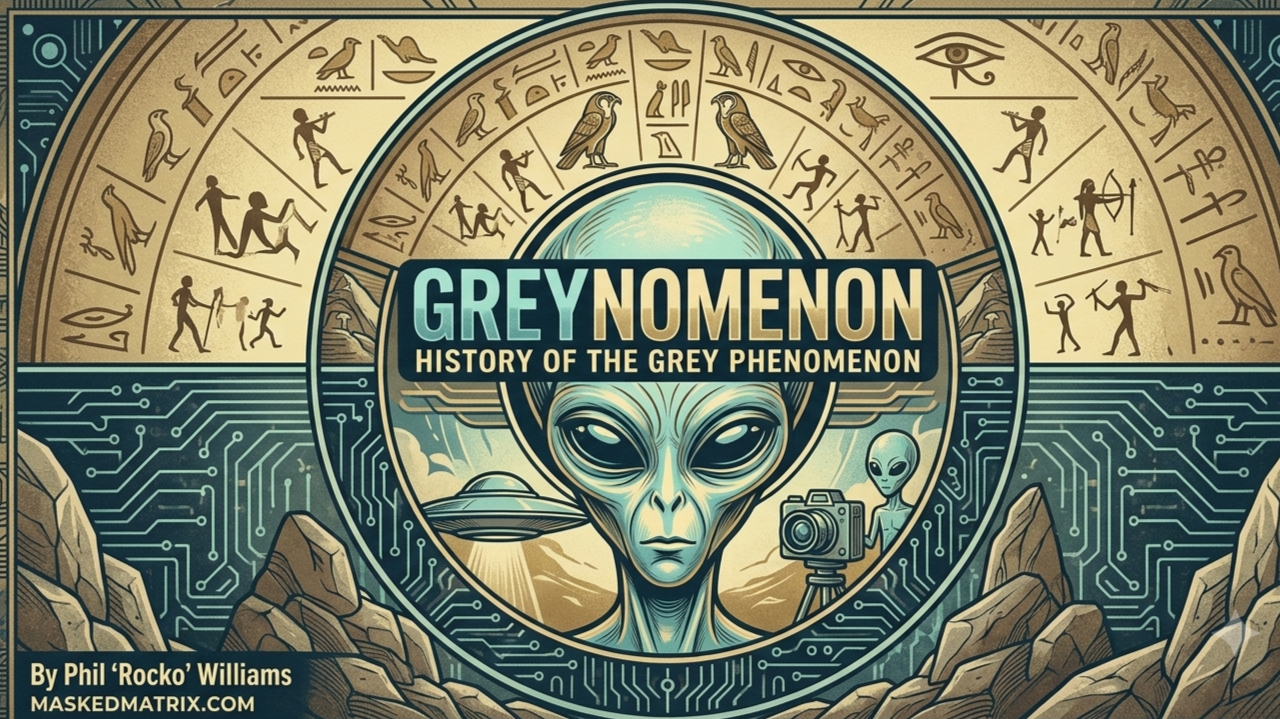
Greynomenon: A History of the Face Humanity Cannot Stop Seeing
Download Free Via the 3 Dots Above.
Few images in modern culture are as immediately recognizable as the Grey alien. The enlarged head, dark almond-shaped eyes, slight nose, narrow mouth, thin body, and unreadable expression have become a global symbol for the unknown. A single silhouette can suggest extraterrestrial life, abduction, secrecy, telepathy, missing time, government cover-up, spiritual encounter, science fiction, or fear of forces beyond human control. Recognition, however, is not the same as understanding.
That distinction is the starting point of Greynomenon, a free PDF book by Phil “Rocko” Williams and Merlin aka ChatGPT. Rather than beginning with a declaration that Grey aliens are real, unreal, extraterrestrial, interdimensional, spiritual, psychological, or technological, the book begins with a more useful question: what exactly has humanity grouped beneath the face we now call the Grey?
The answer is not one kind of evidence. It is an enormous layered record. It includes ancient art, mythology, religious encounter narratives, folklore, dreams, visionary experiences, reports of strange beings, modern UFO testimony, hypnosis, abduction literature, medical imagery, telepathy claims, missing-time stories, science fiction, government records, classified-program speculation, UAP investigations, spiritual interpretations, skeptical critiques, hoaxes, commercial imagery, and now artificial intelligence capable of manufacturing convincing evidence-like images in seconds.
Greynomenon treats all of those layers as worthy of examination without pretending they are equivalent. A museum artifact is not an abduction testimony. A witness account is not a radar track. A government file is not proof of its contents. A mythological parallel is not a biological specimen. A recurring motif is not automatically evidence of a single external intelligence. Yet none of those distinctions make the subject less interesting. They make it possible to investigate.
The book is available as a free PDF because the purpose is not to lock the question behind a paywall. The purpose is to build a record broad enough that believers, skeptics, experiencers, historians, and curious readers can examine the same terrain without being forced into the same conclusion.
Why the Word Greynomenon Matters
The title Greynomenon is deliberately broader than Grey aliens. It refers not merely to a proposed species but to the entire phenomenon that has formed around the Grey image.
This matters because the public often treats the Grey as if it were already a solved category. People speak about “the Greys” as though everyone is referring to one verified population with one anatomy, one origin, one agenda, and one history. Yet the record does not support that certainty.
Earlier reports associated with UFOs described a remarkable variety of beings. Some were human-looking. Some were hairy. Some were tiny. Some were robotic. Some were luminous. Some were gigantic. Some appeared almost ordinary except for clothing or behavior. Skin color, eye shape, stature, speech, dress, emotion, and physical proportion varied widely.
The standardized Grey became dominant gradually. Witness testimony contributed some traits. Science fiction contributed others. Cover artists refined the face. Television and film made the image repeatable. Investigators created categories. Publishers learned which images sold. Skeptics used the same face as evidence of cultural contamination. Believers used it as evidence of recurring testimony. By the late twentieth century, the Grey had become both a description and a template through which later reports were interpreted.
That feedback loop is central to the Greynomenon. Culture may influence experience, memory, description, and interpretation. At the same time, unusual experiences may influence culture. A simple model in which fiction invents everything is too easy. A simple model in which every recurring feature proves an external species is equally easy. The difficult work lies in tracing chronology, source independence, transmission, and the relationship between witness and image.
The Face Everyone Recognizes
The modern Grey is effective as an image because it sits close to the human form while withholding the signals humans normally use to interpret one another.
It stands upright. It has a head, torso, arms, hands, and legs. Yet the proportions are wrong. The head is too large. The body is too slight. The eyes dominate the face. Hair is usually absent. External ears are reduced or missing. The nose and mouth are minimized. Visible sex characteristics are often absent. Clothing may be featureless or missing. Individual identity is difficult to read.
The result is a figure that appears intelligent but socially opaque.
The eyes are especially powerful. Human beings constantly read eye direction, eyelid position, pupil size, whites of the eyes, and tiny movements around the face. The conventional Grey gives almost none of that information back. Solid dark eyes can appear like lenses, shields, voids, or instruments. The being appears able to see the observer while refusing to reveal where it is looking or what it feels.
That visual asymmetry produces unease without requiring aggression. A Grey does not need claws, teeth, or a weapon. The face itself creates uncertainty.
Some experiencer accounts describe the eyes as having a direct mental effect. Others treat the black surface as a protective covering rather than anatomy. Still others understand the eyes symbolically, neurologically, artistically, or as a product of cultural standardization. Greynomenon does not collapse those possibilities. It asks how the image was assembled and which parts of it can be traced through the record.
Before Humanity Called Them Greys
One of the largest sections of the book moves far outside the modern UFO era. Long before people used the word Grey, cultures around the world described encounters with beings that were not ordinary humans.
Some descended from the sky. Some emerged from underground. Some lived inside mountains, water, forests, caves, mounds, or invisible neighboring realms. Some were gods. Some were ancestors. Some were messengers, spirits, teachers, tricksters, judges, healers, kidnappers, or dangerous intelligences. Some appeared radiant and beautiful. Others were small, masked, animal-like, pale, dark, many-eyed, or difficult to describe.
It is tempting to take this enormous human archive and translate it directly into the language of extraterrestrials. Greynomenon resists that temptation.
A figure with a large head is not automatically a Grey. A god descending from heaven is not automatically an astronaut. A divine boat is not automatically a spacecraft. A ritual mask is not automatically anatomical evidence. A myth involving otherworldly children is not automatically a record of genetic hybridization.
But the opposite shortcut is no better. Declaring that mythology can tell us nothing about anomalous experience because it is mythology simply closes the question by definition.
The book therefore treats comparison as comparison. Ancient sources are examined first within the cultures that created them. Only after the original context is restored does the modern comparison become meaningful.
Mesopotamia and the Modern Desire to Translate Gods into Technology
Mesopotamia has become one of the most intensely reinterpreted regions in alternative history. Its surviving texts describe divine assemblies, gods who descend, sacred knowledge, kingship granted from above, creation, punishment, cosmic order, and extraordinary beings with powers unavailable to ordinary people.
Modern readers sometimes translate these religious systems directly into technological systems. A god becomes an astronaut. A divine council becomes a command structure. Creation from clay becomes genetic engineering. A sacred object becomes machinery.
The attraction is understandable. Industrial civilization uses technology as its most powerful language for explaining extraordinary capability. Earlier societies used divinity, cosmic order, kingship, ritual, and sacred agency. Modern interpreters often recode those same narrative shapes into laboratories, planets, advanced engineering, and biological intervention.
That transformation is itself historically important even when it does not prove ancient contact.
The Ubaid figurines provide a perfect example. Some have elongated or reptile-like heads and unusual eyes. A few look startlingly modern to viewers accustomed to alien imagery. Yet the archaeological objects come with material, date, cultural context, posture, sex characteristics, and relationships to other figurines. The resemblance can be recorded without pretending the object arrived labeled extraterrestrial.
This is one of the central habits Greynomenon asks readers to develop: keep the resemblance, but restore everything the cropped image removed.
Egypt, Sacred Forms, and Why Strange Art Is Not Automatically Anatomy
Ancient Egypt attracts similar speculation because its art contains elongated forms, animal-headed gods, celestial journeys, boats of the gods, stars, divine transformations, and highly formalized sacred imagery.
Yet Egyptian art did not operate like modern photography. Form communicated identity, rank, divine function, ritual meaning, and cosmology. A falcon-headed deity was not a failed portrait of a biological creature. Composite forms carried symbolic and theological meaning.
The Amarna period is particularly tempting because representations of Akhenaten and members of the royal family show elongated skulls, narrow limbs, unusual facial proportions, and prominent bodies. Proposed explanations include artistic program, dynastic style, symbolic theology, family resemblance, and medical possibilities. Ancient-alien interpretations add hybrid ancestry or nonhuman biology.
A responsible investigation should not forbid unconventional hypotheses. It should ask what evidence each hypothesis would require.
If an image is biological evidence, then anatomy, remains, genetics, pathology, family patterns, and artistic comparison matter. If an image is symbolic, then neighboring works, inscriptions, artistic rules, and religious context matter. The stronger theory is the one that survives the restoration of context.
Watchers, Heavenly Courts, and Forbidden Knowledge
The Levantine and later Jewish and Christian traditions contain some of the most influential narrative structures in the entire Greynomenon.
Heavenly councils, angels, watchers, visions, ascents, fiery vehicles, forbidden teaching, boundary crossing, unusual offspring, judgment, and communication between human and nonhuman orders all appear in forms that later readers compare with UFO and abduction narratives.
The Watchers associated with Enochic traditions are especially important. They descend, cross a forbidden boundary, teach knowledge, take human wives, and produce destructive offspring. Modern interpreters have connected these themes with alien intervention, genetic programs, hybridization, and prohibited technology.
The similarity is real at the level of motif.
That does not establish identity.
Ancient religious texts carry their own theological, literary, social, and moral purposes. The question is not whether one can force the Watchers into the category of Grey aliens. The more interesting question is why descent, dangerous knowledge, mixed offspring, and violation of boundaries recur so powerfully in human stories and later reappear in modern encounter narratives.
Fairies, Hidden Peoples, Changelings, and Abduction Before Aliens
Some of the most striking historical comparisons involve folklore rather than ancient art.
European traditions describe fairies, elves, hidden people, mound dwellers, dwarfs, and neighboring realms where normal human rules do not always apply. People are taken. Time behaves strangely. Food has consequences. Gifts may be dangerous. Children can be exchanged. Sexual or reproductive themes appear. Memory and return are uncertain.
These patterns became important to researchers such as Jacques Vallee because they challenge the assumption that the structure of modern abduction began with flying saucers.
A person can enter a strange domain, encounter nonhuman beings, lose ordinary control, return after an altered interval, and struggle to interpret what happened. The narrative structure resembles later encounter reports even though the cultural explanation differs completely.
Yet folklore cannot simply be treated as a witness transcript. Stories serve many functions. A changeling story may express grief, infant illness, disability, fear of outsiders, family crisis, religious belief, or social explanation. A fairy encounter may preserve landscape memory, entertainment, altered-state experience, sacred geography, or a reported event believed to have physically occurred.
The comparison becomes strongest when it preserves those possibilities instead of replacing them with one modern theory.
Jinn, Spirits, Ancestors, and the Problem of Retrofitting Modern Categories
Islamic traditions concerning jinn are frequently drawn into modern alien discussions. Yet jinn are not simply an old Arabic or Islamic word for extraterrestrials. They occupy complex theological and folkloric roles. They may be invisible, shape-shifting, moral, dangerous, ordinary, extraordinary, inspiring, deceptive, or associated with particular places and states.
Similar problems appear across South Asian, East Asian, African, Indigenous, Oceanic, and circumpolar traditions. The deeper the comparison becomes, the less defensible it is to treat humanity as though it possessed one universal prehistoric UFO religion.
Cultural difference is not noise. It is evidence.
Greynomenon repeatedly returns to this principle. If unknown external intelligences have interacted with humanity, cultural variation would be expected because people describe the unfamiliar using available concepts. But if the same modern interpretation can absorb every difference, the theory risks becoming impossible to test.
A useful cultural-filter hypothesis should explain both similarity and difference. It should identify which features recur independently, which emerge only after modern media exposure, and which belong specifically to local theology, art, ecology, or social structure.
Dogu, Tassili, Wandjina, and the Danger of the Cropped Image
Some ancient-alien arguments depend heavily on visual resemblance.
Japanese dogu with large goggle-shaped eyes can resemble helmeted beings. Round Head figures at Tassili n’Ajjer can appear to wear strange suits or helmets. Barrier Canyon figures can look tall, floating, faceless, or nonhuman. Wandjina images can present large heads, prominent eyes, and reduced mouths.
The visual reaction is real. A modern viewer may immediately think of Grey aliens.
But an image does not begin with what it resembles to us.
Dogu are ritual objects embedded in Jomon culture. Tassili contains thousands of images created across long periods of environmental and social change. Barrier Canyon, Fremont, and Ute art represent distinct cultural traditions. Wandjina belong to living Indigenous systems of law, ancestry, rain, landscape, and sacred responsibility.
A cropped head can transform a complex ritual figure into a helmeted alien. Rotating an image can make a symbolic composition resemble a cockpit. Removing inscriptions can turn cosmology into machinery. Repeating a modern nickname can make a later interpretation feel ancient.
The professional test is simple: does the extraordinary interpretation become stronger or weaker when full context is restored?
If it collapses when the image is uncropped, that matters. If it remains unusual after cultural context, dating, material, neighboring art, and original meaning are restored, that matters too.
Respecting Indigenous Traditions Without Forbidding Comparison
Greynomenon devotes unusual attention to an ethical problem that is often ignored in alternative-history writing.
Indigenous traditions are not abandoned datasets waiting to be converted into UFO evidence.
Terms such as star people, little people, sky beings, thunder beings, ancestors, spirits, and creators often circulate online without nation, language, storyteller, date, or cultural authority. Stories from different peoples become mixed into one synthetic “Native” belief system and then presented as ancient evidence of extraterrestrial contact.
That process can erase the very traditions the comparison claims to honor.
Yet refusing all comparison can also become a form of intellectual control. The answer is neither appropriation nor avoidance. It is attribution, specificity, cultural context, respect for restricted knowledge, and a clear line between what a tradition says and what a later interpreter proposes.
This standard has value far beyond alien research. It is a general rule for working responsibly with sacred and inherited knowledge.
The Night Visitor and the Human Nervous System
One of the most important parts of Greynomenon concerns the boundary between extraordinary encounter and human physiology.
Many modern reports occur at night. A person wakes and cannot move. A presence seems to be in the room. A figure stands near the bed. Pressure may be felt on the body. Sound can become strange. Time may feel distorted. Communication may seem direct or telepathic.
Sleep paralysis provides a well-established mechanism for a meaningful portion of these experiences. During transitions into or out of REM sleep, normal muscular inhibition can persist while awareness returns. Dream imagery can overlap waking perception. The result can be extraordinarily vivid.
Explaining a mechanism, however, does not justify humiliating the experiencer.
The event was still experienced. Fear can be genuine. A sensed presence can feel more immediate than an ordinary dream. Cultural expectations can shape the form of the figure without making the experience emotionally trivial.
At the same time, an experience being intense does not prove an external visitor.
The responsible position is to separate the phenomenology from the proposed cause. What did the person perceive? When did it occur? Was movement possible? Was the experience linked to sleep transition? Were there independent witnesses? Physical traces? Sensor data? Prior exposure to similar imagery? Medication, illness, migraine, trauma, seizure activity, or environmental factors?
This approach respects the witness more than either ridicule or automatic belief because it takes both the person and the evidence seriously.
Missing Time and the Fragility of Memory
Missing time became one of the defining motifs of modern abduction literature.
A witness notices an unexplained interval. Later, through memory, dreams, hypnosis, or guided recall, the interval acquires structure. A craft, medical room, beings, procedures, telepathy, or return sequence may emerge.
The difficulty is that memory is not a recording device.
Human memory is reconstructive. Every act of recall can be influenced by later information, emotional expectation, interviewer language, repeated retelling, prior belief, and imagery encountered after the original event.
Hypnosis is especially complicated. It can increase vividness and confidence without guaranteeing historical accuracy. A person can become more certain about a reconstructed memory precisely because the recollection becomes emotionally powerful.
This does not prove that every hypnotically recovered encounter is false. It means the method must become part of the evidence.
A statement recorded immediately after an event deserves a different confidence level from one reconstructed years later. A drawing made before exposure to familiar Grey imagery matters differently from a drawing made after decades of television, books, and online discussion.
Chronology is not a minor detail. It is one of the main tools for separating independent evidence from cultural feedback.
The Body Taken Apart
Modern abduction narratives often involve clinical procedures: examination tables, instruments, bodily restraint, reproductive intervention, scanning, sampling, implantation, and disassembly or manipulation of the body.
These reports emerged during a century in which medicine itself transformed radically.
Surgery, anesthesia, organ transplantation, reproductive medicine, in vitro fertilization, genetic testing, imaging technology, institutional hospitalization, and increasingly technical medical environments changed the human relationship with the body. Patients could be conscious of vulnerability while surrounded by experts using tools they did not understand.
The resemblance between alien examination rooms and modern medical spaces does not prove that the encounters are internally generated. It does show that the meaning of the reports cannot be separated from the historical experience of medicine, bodily authority, and consent.
This is especially relevant because the Grey is often portrayed not as openly violent but as clinically indifferent. The being restrains, observes, measures, touches, communicates, or performs procedures. Fear may arise from loss of agency more than from visible aggression.
The modern Grey can therefore embody a uniquely twentieth- and twenty-first-century anxiety: intelligence without empathy operating upon the human body as an object.
Reproduction, Hybrids, and Changelings
Reproductive themes are among the most emotionally powerful elements in modern encounter literature.
Reports describe reproductive material being taken, unusual pregnancies, missing pregnancies, hybrid children, nurseries, artificial gestation, and repeated involvement over many years. Some investigators interpret these accounts as evidence of a literal genetic program.
Other explanations connect the stories with trauma, bodily anxiety, reproductive medicine, infertility, pregnancy loss, changing sexual norms, and social fear around genetic engineering.
Religious and folkloric parallels add another layer. Miraculous births, divine-human unions, demonic offspring, changelings, stolen children, and mixed ancestry appear across many traditions.
Again, similarity does not establish one cause.
What it does establish is that reproduction has long occupied the boundary between identity and otherness. Who belongs to the human community? What happens when that boundary is crossed? Who controls the body? What makes a child fully one of us?
The hybrid motif therefore deserves attention whether one ultimately understands it biologically, psychologically, mythologically, spiritually, or as a combination of several processes.
Telepathy and the Silence of the Grey
One of the most persistent features of Grey reports is communication without ordinary speech.
Witnesses describe thoughts arriving directly, concepts appearing in awareness, commands being understood without sound, or emotional meaning passing between experiencer and being. The Grey’s reduced mouth and unreadable face make telepathy almost aesthetically inevitable within modern imagery. A being that does not appear built for ordinary speech is imagined to communicate mind to mind.
Telepathy also changes the power balance of an encounter. Speech can be refused, misunderstood, interrupted, or ignored. Direct mental communication implies access to a more private domain.
Yet telepathic interpretation creates difficult evidentiary questions. Inner speech, intuition, expectation, dream cognition, dissociation, and altered states can all produce communication-like experiences. If the message contains independently verifiable information unknown to the witness, the evidentiary problem changes. If the content is symbolic, personal, or impossible to verify, the interpretation remains more open.
This is where Greynomenon’s distinction between experience and explanation becomes essential. A person can accurately report, “I experienced a thought that did not feel like mine,” without the historian silently rewriting that sentence as “an extraterrestrial telepathically transmitted a message.”
Science Fiction and the Future Human
The Grey did not develop only from witness testimony. Science fiction contributed a powerful evolutionary logic to the image.
H. G. Wells and later speculative writers imagined distant future humans or advanced beings with enlarged brains, reduced bodies, weaker muscles, smaller jaws, less hair, and increasingly technological existence. The assumption reflected a popular misunderstanding of evolution as a ladder moving toward ever-greater intelligence and reduced physicality.
The visual logic proved durable.
An advanced species would not need a powerful body because machines would perform physical labor. A larger brain would require a larger head. Processed food could reduce the jaw and teeth. Technology could reduce dependence on ordinary senses. Reproduction might become artificial. Clothing could become seamless or unnecessary. Emotion might diminish as intellect increased.
The future human and the alien gradually borrowed from one another until the Grey could be interpreted as either.
This is why the future-human hypothesis remains attractive. The Grey is strange but not radically alien. It retains the human body plan while exaggerating traits associated with intelligence, fetal development, technological dependence, and reduced sexuality.
Yet a future-human theory must answer difficult questions about causality, time travel, biology, evolutionary selection, and why a future human would repeatedly appear within a narrow range of modern cultural expectations.
An evocative resemblance is a beginning, not a completed theory.
Occult Visitors and Unknown Intelligences
Modern UFO culture did not emerge in isolation from occult, spiritualist, and esoteric traditions.
Long before the flying-saucer era, Western occultism contained accounts of hidden masters, astral beings, thought forms, spirits, elementals, intelligences from other planes, and entities encountered through altered states or ritual practice. Spiritualism normalized the possibility of communication with invisible persons. Theosophy and related movements imagined layered worlds populated by beings at different levels of development.
When the technological age arrived, some of these older categories were recoded. Spirits became space people. Planes became dimensions. Ascended beings became advanced intelligences. Ether became energy. Divine messengers became extraterrestrial teachers.
The movement also worked in reverse. Modern aliens were reinterpreted as angels, demons, jinn, tricksters, archons, or spiritual parasites.
Greynomenon does not choose one vocabulary as automatically superior. It asks what each system explains, what evidence supports it, and whether the model produces testable distinctions.
A theory that can call every event physical when physical evidence appears and spiritual when it does not may become impossible to falsify. The same warning applies to psychological and conspiratorial theories. If every anomaly can be explained after the fact, nothing has truly been predicted.
Before the Flying Saucer
The history of anomalous aerial reports did not begin in 1947.
Earlier centuries contain strange lights, celestial apparitions, phantom airships, mystery aircraft, unusual astronomical observations, religious signs, military scares, and stories shaped by the technologies and fears of their periods.
The important historical question is not whether every old report was secretly a spacecraft. It is how the unknown is translated into the vocabulary of the age.
A preindustrial witness may describe a fiery wheel, luminous cloud, shield, star, angelic host, or celestial ship. An industrial-era observer may describe an airship. A Cold War observer may describe a saucer. A modern pilot may report a UAP with sensor characteristics.
Changing language can reveal cultural framing. It can also conceal continuity if a genuinely unusual phenomenon is repeatedly described through familiar metaphors.
The challenge is to compare without pretending that translation is neutral.
The Saucer Age and the Grey Takes Shape
The flying-saucer era created the cultural environment in which the modern Grey could become dominant.
Early occupant reports were diverse. Contactees often described beautiful, human-like visitors offering spiritual, moral, or nuclear warnings. Other cases involved strange creatures, dwarfs, robots, giants, or beings in unusual suits.
Over time, the abduction narrative changed the emotional center of the subject.
The Betty and Barney Hill case became one major historical junction because it combined an unexplained journey, missing time, hypnosis, unusual beings, medical procedures, and later cultural amplification. The details of the case evolved through dreams, therapy, recorded hypnosis, publications, illustrations, and dramatizations. That development makes the case important not only as a claimed encounter but as a study of how an extraordinary narrative becomes culturally powerful.
Later investigators including Budd Hopkins, David Jacobs, and John Mack built different frameworks around abduction testimony. Missing time, reproductive procedures, telepathic beings, repeated encounters, hybrids, transformation, and hidden programs entered a growing shared vocabulary.
Whitley Strieber’s Communion added one of the most influential faces in modern paranormal publishing. The cover did historical work. It condensed a complex experience into an image that millions could recognize instantly.
By then, the Grey was no longer merely a reported being. It had become a symbol system.
Why Famous Cases Should Be Junctions, Not the Whole History
Greynomenon includes famous cases but deliberately refuses to let them consume the subject.
Roswell, the Hills, Travis Walton, Communion, Area 51, and major abduction investigators matter because they changed belief, vocabulary, expectations, imagery, and the structure of later reports.
But retelling the same famous cases indefinitely can create the illusion that the field is deep when it is only repetitive.
The more productive question is what each famous story changed.
Did it introduce a new visual feature? Did it popularize missing time? Did it normalize hypnosis? Did it shift aliens from friendly visitors to clinical abductors? Did it connect the phenomenon with military secrecy? Did a film or book cause a feature to become common afterward? Did the case itself change under retelling?
Influence mapping can sometimes teach more than another dramatic retelling.
Secrecy, Disclosure, and the UAP Era
The current UAP era has changed the social status of unidentified aerial phenomena.
Military offices now publish imagery and case analyses. Legislators discuss anomalous phenomena openly. National archives are organizing large bodies of UFO and UAP material. Government reporting systems have become more formalized. Some cases are resolved. Others remain under analysis or lack enough information for confident explanation.
This is significant.
But Greynomenon draws a hard boundary that public discussion often ignores: UAP evidence is not Grey evidence unless an actual occupant component is documented.
A radar track cannot establish anatomy. An infrared video cannot establish telepathy. A congressional hearing about hidden aerospace programs cannot establish hybridization. A pilot’s unresolved object does not automatically become a spacecraft, then nonhuman, then Grey.
Each step requires evidence.
This boundary protects both subjects. Serious UAP cases should not be weakened by attaching them to every extraordinary claim in alien culture. People reporting beings should not have their testimony artificially strengthened by unrelated military sensor data.
If high-quality occupant evidence eventually connects the categories, the connection should be made through evidence rather than cultural habit.
Disclosure Is a Provenance Problem Before It Is a Belief Problem
The word disclosure carries enormous emotional weight. To some people it means official confirmation of nonhuman intelligence. To others it means transparency about military sightings, classified technology, intelligence failures, or historical records.
Greynomenon argues for a less theatrical and more powerful approach.
Ask who knew what. Ask when they knew it. Ask what data they possessed. Ask who created the document. Ask whether it records an allegation, a preliminary assessment, an intelligence lead, a witness statement, or a validated conclusion. Ask what was edited, redacted, classified, copied, summarized, or reinterpreted.
A document can be authentic while containing an unverified claim.
A government archive can preserve material the government never endorsed.
An intelligence agency can investigate an extraordinary possibility without concluding that the possibility is real.
Good disclosure preserves the chain between source and conclusion. Bad disclosure turns every official-looking page into proof.
What Could Produce the Greynomenon?
One of the strongest conceptual moves in the book comes near the end.
Instead of asking, “What are the Greys?” Greynomenon asks, “What could produce the Greynomenon?”
The difference is enormous.
The first question assumes that the entire archive refers to one stable class of beings. The second permits multiple causes.
Some experiences may involve sleep paralysis. Some may involve dreams. Some may involve trauma or dissociation. Some may involve misidentified people, animals, lights, aircraft, satellites, or astronomical objects. Some may involve hoaxes. Some may involve cultural reconstruction of memory. Some may involve classified human technology. Some may involve unusual but natural neurological events. Some may remain unexplained. And some may involve an external intelligence not yet identified.
A layered phenomenon does not require one universal answer.
This plural model is more demanding than either belief or dismissal because it forces each case to earn its category.
The Major Hypotheses
Greynomenon examines a wide range of possible explanations without declaring one victorious.
The extraterrestrial hypothesis proposes that some reports involve biological or technological visitors from elsewhere. This model should predict traces consistent with technology, biology, material interaction, surveillance, or repeatable patterns of operation.
The future-human hypothesis interprets the Grey as a descendant of humanity or related time-traveling intelligence. It must address causality, selective appearance, evolutionary assumptions, and why future beings would interact in the reported ways.
The interdimensional hypothesis proposes interaction across realities, dimensions, or domains not ordinarily accessible. Its weakness is often definitional. Unless “dimension” is specified and interaction produces distinguishable observations, the idea can become a label for mystery rather than an explanation.
The hidden-terrestrial hypothesis imagines an unknown intelligence already present on Earth, perhaps underground, underwater, technologically concealed, or historically mistaken for other beings. It must explain physical ecology, resource use, population, infrastructure, traces, and long-term concealment.
The engineered-biological-worker hypothesis treats some Greys as artificial or manufactured organisms rather than a natural species. This idea is popular because standardized appearance, reduced individuality, and clinical behavior can look functional. Yet it still requires evidence for the engineers, manufacturing system, purpose, and biological traces.
The psychological and neurological models emphasize sleep, perception, memory, dissociation, expectation, trauma, and cultural transmission. These mechanisms clearly explain some experiences and should be preferred where direct evidence supports them. Their challenge is determining whether they explain the strongest anomalous cases or only a portion of the record.
Spiritual, religious, and occult interpretations connect the phenomenon with older categories such as angels, demons, jinn, fairies, ancestors, tricksters, watchers, nature spirits, or visionary entities. These models have historical depth but face the same evidentiary demand: what observations distinguish one interpretation from another?
Classified-technology hypotheses focus on human aerospace, psychological operations, medical experimentation, intelligence programs, or deliberate secrecy. These explanations may fit some historical cases, especially where military context is strong, but they cannot be assumed merely because governments keep secrets.
The cultural-construction hypothesis treats the Grey primarily as a modern symbolic form built from testimony, fiction, fear, commerce, and repetition. This clearly explains part of the phenomenon. The remaining question is whether culture created the entire pattern or became the language through which some independent anomalies are described.
Why One Theory Probably Should Not Explain Everything
People are attracted to elegant theories. A single answer makes a confusing world feel manageable.
But one of the deepest lessons of Greynomenon is that the archive may be heterogeneous.
Ancient mythological beings do not have to be identical to modern bedroom visitors. Every unexplained light does not have to be a craft. Every sleep-paralysis experience does not have to be internal. Every cultural similarity does not have to come from contact. Every government secret does not have to concern aliens.
Several causes can produce superficially similar reports.
This is normal in investigation. Chest pain can arise from multiple conditions. A strange sound can have many sources. A visual anomaly can emerge from optics, equipment, atmosphere, interpretation, or an unknown object. The fact that reports share a category does not guarantee they share a cause.
The Greynomenon becomes easier to study when we stop demanding that one explanation carry the entire history.
Fear Is Evidence About the Encounter, Not Proof of the Cause
Fear runs through the history of Grey aliens.
Some of that fear is obvious. Paralysis, bodily examination, missing time, loss of control, strange beings, and uncertain consent would terrify many people regardless of cause.
Other fear is inherited. Religious cultures supplied demons, possession, deception, and forbidden knowledge. The Cold War supplied invasion, secrecy, nuclear destruction, infiltration, and hidden programs. Modern medicine supplied institutional vulnerability. Genetic engineering supplied reproductive fear. Surveillance culture supplied loss of privacy. Entertainment industries learned that threatening aliens attract attention.
Fear can therefore be both a genuine response and a cultural amplifier.
A report beginning with “I saw three small figures and could not move” can become “hostile beings paralyzed a victim” even if hostility was never directly observed. The emotional interpretation then enters culture and shapes future expectations.
This does not make fear irrational. It makes fear a variable.
The same applies to hope. Some people want cosmic teachers, planetary guardians, evolutionary guides, or proof that humanity is not alone. Desire can distort interpretation just as fear can.
The task is not to eliminate emotion. It is to prevent emotion from doing the work of evidence.
The Ethics of Taking Experiencers Seriously
A professional investigation does not require ridicule.
People who report unusual encounters may have lost sleep, relationships, social standing, jobs, or peace of mind. Some find meaning, spiritual direction, community, or relief after years of isolation. Others become frightened, dependent on investigators, or trapped in interpretations that intensify anxiety.
The humane approach is also the rigorous one.
An experiencer can be treated with dignity while an investigator asks difficult questions. Respect does not require agreement. Skepticism does not require humiliation. Uncertainty does not invalidate distress.
This standard is especially important where hypnosis, trauma, reproductive fear, or spiritual vulnerability are involved. An investigator who supplies an explanation too quickly can alter the very testimony being investigated.
The best interview preserves the witness before it preserves the theory.
The Artificial Intelligence Problem Has Arrived
The Greynomenon now enters a new phase because artificial intelligence can manufacture convincing evidence-like material at unprecedented speed.
A person can request an image of a Grey standing in a cave, captured by a trail camera, carved on an ancient tablet, filmed through military infrared, or photographed beside a crashed craft. The resulting image can include grain, compression artifacts, poor focus, scratched film, uneven lighting, or other visual cues that people associate with authenticity.
Text generation creates another problem. It can combine details from separate real cases into a persuasive nonexistent one. It can invent dates, researchers, witnesses, archival files, quotations, or citations that sound plausible.
Once detached from its origin, generated material can circulate as evidence.
This makes provenance more important than ever.
The question “Does this look real?” is no longer sufficient.
Researchers must ask where the file first appeared, who created it, whether an original exists, what metadata survive, whether the artifact has a museum or archive record, whether quoted documents can be independently located, and whether supposedly separate sources trace back to one upload.
The future of anomalous research will depend as much on information forensics as on extraordinary testimony.
Added Value: A Practical Evidence Ladder for Grey Alien Claims
One useful way to build on the book is to rank evidence not by how dramatic it feels but by how independently it can be checked.
At the lowest level is unsupported repetition. A claim circulates widely but no recoverable first source exists.
Above that is personal testimony recorded long after the alleged event. It may be sincere and meaningful but is vulnerable to memory change.
Stronger is contemporaneous testimony recorded close to the event, especially if original wording survives.
Stronger still is independent testimony from witnesses who were separated before comparing accounts.
Physical traces can raise the evidentiary level if chain of custody is secure and ordinary causes are tested.
Instrumental records become stronger when multiple independent systems record the same event and the equipment is understood.
Repeatable patterns under controlled conditions are stronger again because they allow prediction rather than retrospective explanation.
The highest level would involve publicly verifiable biological, technological, or material evidence with secure provenance, independent laboratories, reproducible analysis, and results that survive adversarial review.
This ladder does not tell anyone what to believe. It prevents a viral story, a museum artifact, a witness memory, and a laboratory sample from being treated as though they all carry the same weight.
Added Value: The Five Questions Every Extraordinary Claim Should Survive
A second practical tool is a five-question test.
First: what is the earliest recoverable source? If the claim cannot be traced beyond a repost, later retelling, documentary, meme, or anonymous website, confidence should be limited.
Second: what existed before the interpretation? Separate the raw observation from the meaning attached to it. “Three lights moved together” is different from “three alien craft maneuvered intelligently.”
Third: what ordinary information channels were available? Could the witness have encountered the image, story, target, or expectation previously?
Fourth: what would count against the claim? A theory that cannot lose is not functioning as a testable explanation.
Fifth: what remains after the strongest ordinary explanation is applied? The remainder is where investigation becomes interesting.
This method works for ancient images, modern encounters, UAP videos, implants, government documents, psychic communication, and nearly every other controversial part of the field.
Added Value: The Difference Between Unexplained and Extraordinary
One of the most important distinctions in anomalous research is often the least respected.
Unexplained means the available evidence is insufficient to identify the cause.
Extraordinary means the evidence positively supports an unusual cause.
Those are not the same category.
A blurry object can remain unidentified because the video is poor. That does not make it extraordinary. A missing interval in memory can remain unexplained because records are incomplete. That does not prove abduction. A strange artifact may have uncertain function. That does not automatically make it advanced technology.
Paradoxically, preserving the category unexplained strengthens anomalous research. It prevents weak cases from being promoted beyond their evidence and allows genuinely unusual cases to stand out.
Why Negative Results Belong in the Archive
Greynomenon makes a point that every controversial field should adopt: failed claims are data.
If an alleged implant proves to be ordinary material, preserve the result.
If a famous photograph is traced to a model, preserve the provenance.
If a UAP is explained by satellite geometry, keep the case as a teaching example.
If a witness retracts a story, retain both the original account and the retraction.
If crucial information is missing, classify the case as insufficient rather than extraordinary.
A database containing only mysteries will manufacture mystery.
The reverse is also true. A system that forces every case into a conventional category will manufacture certainty.
The healthiest archive contains solved cases, hoaxes, errors, unresolved cases, retractions, strong anomalies, and evidence that weakens favored theories. A field becomes more credible when it does not need every case to remain mysterious.
The Living Greynomenon
The Greynomenon is not finished history.
It is being created now.
Tonight someone may mistake a satellite for something extraordinary. Someone may wake in sleep paralysis and see a figure beside the bed. Someone may record an aircraft or atmospheric event they cannot identify. Someone may fabricate a story. Someone may generate a convincing image. Someone may encounter an event that present categories cannot explain.
Every report enters a culture already saturated with the Grey image.
That is why the phenomenon is living. Witnesses influence culture. Culture influences witnesses. Investigators create categories. Categories reshape later reports. Government statements alter expectations. Entertainment gives mystery a face. Skeptics produce counter-narratives. Algorithms reward emotionally charged interpretations. AI can now manufacture new layers that imitate archival history.
The modern researcher is no longer studying only an anomalous phenomenon. The researcher is studying an evolving information ecosystem.
What Survives After the Weakest Claims Are Removed
A good investigation should become stronger when weak evidence is discarded.
After hundreds of pages of comparison, Greynomenon arrives at several conclusions that do not require a forced verdict.
Humanity has a very old and geographically broad record of encounters with beings understood as other-than-ordinary human.
The forms and meanings of those beings vary greatly across culture and time.
Some structural motifs recur strongly enough to justify serious comparison.
The modern Grey is a historically traceable image that became increasingly standardized during the twentieth century.
Known mechanisms involving sleep, memory, perception, suggestion, and cultural transmission plausibly explain some experiences.
Some modern aerial reports remain unresolved, but unresolved UAP are not automatically evidence of Grey occupants.
No publicly verified body of evidence currently forces one extraordinary explanation to the exclusion of all ordinary ones.
And uncertainty is not failure.
That last point may be the most important.
Uncertainty Is a Research Result
Popular culture dislikes uncertainty because uncertainty does not make a clean headline.
Investigation works differently.
A broad mystery becomes more manageable when it separates into smaller questions. Ancient imagery becomes distinct from modern testimony. Cultural meaning separates from visual resemblance. Sleep phenomena separate from external-event claims. UAP separate from occupants. Physical traces separate from stories. Demonstrated mechanisms separate from speculation.
The mystery may not disappear, but its internal structure becomes visible.
Once that happens, research can improve.
Investigators can test whether specific Grey features appear in reports before exposure to modern imagery. They can compare encounter timing with sleep physiology. They can use calibrated sensor networks. Alleged materials can be examined blind with full chain of custody. Influence networks among witnesses, investigators, books, films, and broadcasts can be mapped. Predictions can be written before cases are examined. Negative findings can be published instead of buried.
This is how a mysterious subject becomes investigable without being prematurely normalized or sensationalized.
The Only Thing to Fear Is Fear Itself
One of the guiding ideas of Greynomenon is that ignorance is more dangerous than facing reality.
That position does not assume that unknown intelligences, if they exist, are benevolent. It does not deny reports of terror, violation, confusion, injury, or emotional damage. It does not require readers to accept frightening claims.
It means fear should not decide what the evidence means.
A frightened culture may turn the unknown into an enemy before it understands what the unknown is. A hopeful culture may turn the unknown into a savior for the same reason.
Reality does not owe us either story.
If the Greynomenon is entirely human, excitement will not make it extraterrestrial. If some portion of it involves an external intelligence, social discomfort will not make it hallucination. If several causes are tangled together, elegance will not make them one.
The job is to build methods capable of surviving whichever reality is actually there.
A Free PDF for Readers Who Want the Whole Record
Greynomenon is not designed as a quick list of famous alien cases. It is a long-form investigation of how one of the most recognizable unknown faces in modern culture was built, what older traditions have been compared with it, which comparisons survive context, how abduction motifs developed, how fear and hope alter interpretation, what modern UAP disclosure does and does not establish, and what competing hypotheses would actually need to explain.
The book moves from the face itself through ancient and global traditions, hidden peoples, sky beings, night visitors, telepathy, abduction, missing time, bodily procedures, reproduction, hybrid traditions, dangerous knowledge, science fiction, occultism, the flying-saucer era, cultural standardization, secrecy, disclosure, the modern UAP environment, competing explanatory models, and the living information system that continues to produce the Greynomenon today.
Readers are not required to believe in Grey aliens to find the history valuable. They are not required to dismiss them to remain rational. The point is to know where claims came from, what kind of evidence supports them, what has changed through retelling, what is culturally inherited, what is physically testable, and what genuinely remains open.
The free PDF is intended to give the reader enough of the record to make a better judgment rather than a faster one.
The Greynomenon Is Larger Than the Grey
The face that began the investigation eventually opens into a much larger human problem.
How do we behave when evidence is incomplete and the implications might be enormous?
Do we fill uncertainty with gods, demons, extraterrestrials, diagnoses, secret governments, or ridicule?
Do we protect favored theories from contradictory evidence?
Do we mistake official authority for proof, or reject evidence simply because it comes from authority?
Do we allow cultural respect to prevent comparison, or allow comparison to erase culture?
Do we store only mysteries until mystery becomes inevitable?
Or can we preserve the source, date the claim, restore context, separate observation from interpretation, trace influence, test predictions, record failure, and let unresolved cases remain unresolved?
That discipline may matter more than any single answer about Grey aliens.
The Greynomenon is living because humanity is still producing the record. The next important case could turn out to be ordinary. It could be fabricated. It could expose a technological program. It could illuminate sleep and memory. It could reveal how culture manufactures monsters. Or it could confront us with evidence that forces categories to change.
The responsible position is not to decide in advance what the light must reveal.
It is to keep looking.
Read More: Egyptian Spells: A Chronological History from Pyramid Walls to Magical Papyri
Unedited Corpus of Early Mesopotamian Cosmological and Theological Texts

About the author

Greynomenon: History of the Grey Phenomenon | Free PDF Download
Greynomenon: A History of the Face Humanity Cannot Stop Seeing Download Free Via the 3 Dots Above. Few images in modern culture are as immediately recognizable as the Grey alien. The enlarged head, dark almond-shaped eyes, slight nose, narrow mouth, thin body, and unreadable expression have become a global symbol for the unknown. A single silhouette can suggest extraterrestrial life, abduction, secrecy, telepathy, missing time, government cover-up, spiritual encounter, science fiction, or fear of forces beyond human control. Recognition, however, is not the same as understanding. That distinction is the starting point of Greynomenon, a free PDF book by Phil “Rocko” Williams and Merlin aka ChatGPT. Rather than beginning with a declaration that Grey aliens are real, unreal, extraterrestrial, interdimensional, spiritual, psychological, or technological, the book begins with a more useful question: what exactly has humanity grouped beneath the face […]
Egyptian Spells: A Chronological History from Pyramid Walls to Magical Papyri
Egyptian Spells: A Chronological History from Pyramid Walls to Magical Papyri Egyptian Spells survived for more than three thousand years because ancient Egyptians did not treat sacred words as dead literature. A spell could be spoken, written, painted, carved, worn, buried, washed with water, placed beneath a head, wrapped into a mummy, inscribed on a figurine, or copied onto a roll of papyrus for use in the next world. Some spells protected a king as he rose among the stars. Others helped ordinary people survive childbirth, snakebite, fever, nightmares, hostile spirits, dangerous journeys, and death itself. The history of Egyptian spells is therefore much larger than the history of any single book. It is the history of a technology of sacred language that changed its physical form while preserving remarkably old ideas across dynasties, political collapses, foreign rule, religious change, […]

Unedited Corpus of Early Mesopotamian Cosmological and Theological Texts
The Primordial Strata: An Unedited Corpus of Early Mesopotamian Cosmological and Theological Texts Authors Note: I had a bunch of strokes, and don't remember creating this 10 months ago. It's not really a Corpus, but cool enough to publish. Introduction The purpose of this project is to assemble the earliest Mesopotamian cosmological and theological materials in their original, unrevised form, relying exclusively on tablets excavated from Early Dynastic and pre-Akkadian contexts where the first expressions of cosmic structure and divine identity appear. The work eliminates all later political and theological shaping, allowing only the earliest recoverable strata to define the foundations of Mesopotamian sacred thought. These sources represent local scribal traditions speaking independently, unfiltered by later canonical organization. Only tablets with secure provenance, catalog identification, paleographic dating, and direct cosmological or theological content are included, ensuring a primary-source […]
Supernova – By Masked Matrix – Full Album
Album: Supernova By - Masked Matrix Release Date: 9/9/2026 Dedicated to my Love, my best friend, my light in the darkness, my Mom. I owe you everything! Happy Birthday Mama!!! Ghost Lights Hero's Journey Angels Song (Remastered) Unified Anthem Badge on Crooke Bee-Wolf The Light is in Me Ionized Friend or Enemy Stardust Fields No Good Deed Indeed Take the Time How Much Was Dat Alchemical Gold Light of Venus Sleeping on the Sidewalk Copper and Iron I Understand Robo-Pig Bad Liars Diamond Matrix Mother's Love <Download Album Here Free> 1. Ghost Lights [Verse 1] Out past the fence line By the mud and reeds Where the water goes black And the moon can't breathe I seen them drift low Like a secret in smoke By the broken road bend Where the old pine groans They don't move […]
Psychics Unseen – History of the Psychic Phenomenon – Free Download
Psychics Unseen: History of the Psychic Phenomenon Download Free Via the 3 Dots https://youtu.be/BKBudBxxCPM?is=1zB6HHZlavxxiDe4 https://youtu.be/b2LsNOE-TCk?si=2bwD2KvMgW-x7qAm Subscribe: VeiledMystic333 All About The Modern Psychic Phenomenon Psychics Unseen: History of PSI Energy & Research is Mercury Series Vol. 3, a long-form history of the Psychic phenomenon from the ancient world to the modern era of laboratories, government programs, altered-state research, online teaching, and contested science. The book does not ask readers to choose between belief and disbelief before the evidence is examined. Instead, it asks a more demanding question: what happens when human beings repeatedly report access to information that ordinary perception does not appear to provide, and what can history teach us about evaluating those reports? The subject is unusually difficult because the word Psychic covers experiences that emerged from very different traditions. Clairvoyance, telepathy, second sight, mediumship, precognition, remote viewing, psychometry, […]

The History of Carl Jung | Free Book Download
Download Free Via the 3 Dots https://youtu.be/nS1hxZqt7m0?is=rfYxOQOxAefTh2an Subscribe: Veiled Mystic 333 History of Carl Jung: The Scientist Behind the Myth The History of Carl Jung is often told as a contest between two simplified portraits. In one, Jung appears as the great explorer of dreams, symbols, archetypes, synchronicity, alchemy, religion, and the hidden depths of the psyche. In the other, he appears as a speculative thinker who left the safer ground of experimental psychology. He then wandered into territories that modern science cannot verify. Both portraits contain pieces of the truth, yet neither is sufficient. Jung began his career as a physician and experimental psychiatrist and became internationally known through word-association research. He then entered the inner circle of early psychoanalysis, broke with Sigmund Freud, and underwent an intense period of self-observation. For the rest of his life, he tried […]
Related
Egyptian Spells: A Chronological History from Pyramid Walls to Magical Papyri
Egyptian Spells: A Chronological History from Pyramid Walls to Magical Papyri Egyptian Spells survived for more than three thousand years because ancient Egyptians did not treat sacred words as dead literature. A spell could be spoken, written, painted, carved, worn, buried, washed with water, placed beneath a head, wrapped into a mummy, inscribed on a figurine, or copied onto a roll of papyrus for use in the next world. Some spells protected a king as he rose among the stars. Others helped ordinary people survive childbirth, snakebite, fever, nightmares, hostile spirits, dangerous journeys, and death itself. The history of Egyptian spells is therefore much larger than the history of any single book. It is the history of a technology of sacred language that changed its physical form while preserving remarkably old ideas across dynasties, political collapses, foreign rule, religious change, […]
Supernova – By Masked Matrix – Full Album
Album: Supernova By - Masked Matrix Release Date: 9/9/2026 Dedicated to my Love, my best friend, my light in the darkness, my Mom. I owe you everything! Happy Birthday Mama!!! Ghost Lights Hero's Journey Angels Song (Remastered) Unified Anthem Badge on Crooke Bee-Wolf The Light is in Me Ionized Friend or Enemy Stardust Fields No Good Deed Indeed Take the Time How Much Was Dat Alchemical Gold Light of Venus Sleeping on the Sidewalk Copper and Iron I Understand Robo-Pig Bad Liars Diamond Matrix Mother's Love <Download Album Here Free> 1. Ghost Lights [Verse 1] Out past the fence line By the mud and reeds Where the water goes black And the moon can't breathe I seen them drift low Like a secret in smoke By the broken road bend Where the old pine groans They don't move […]
Psychics Unseen – History of the Psychic Phenomenon – Free Download
Psychics Unseen: History of the Psychic Phenomenon Download Free Via the 3 Dots https://youtu.be/BKBudBxxCPM?is=1zB6HHZlavxxiDe4 https://youtu.be/b2LsNOE-TCk?si=2bwD2KvMgW-x7qAm Subscribe: VeiledMystic333 All About The Modern Psychic Phenomenon Psychics Unseen: History of PSI Energy & Research is Mercury Series Vol. 3, a long-form history of the Psychic phenomenon from the ancient world to the modern era of laboratories, government programs, altered-state research, online teaching, and contested science. The book does not ask readers to choose between belief and disbelief before the evidence is examined. Instead, it asks a more demanding question: what happens when human beings repeatedly report access to information that ordinary perception does not appear to provide, and what can history teach us about evaluating those reports? The subject is unusually difficult because the word Psychic covers experiences that emerged from very different traditions. Clairvoyance, telepathy, second sight, mediumship, precognition, remote viewing, psychometry, […]
The History of Carl Jung | Free Book Download
Download Free Via the 3 Dots https://youtu.be/nS1hxZqt7m0?is=rfYxOQOxAefTh2an Subscribe: Veiled Mystic 333 History of Carl Jung: The Scientist Behind the Myth The History of Carl Jung is often told as a contest between two simplified portraits. In one, Jung appears as the great explorer of dreams, symbols, archetypes, synchronicity, alchemy, religion, and the hidden depths of the psyche. In the other, he appears as a speculative thinker who left the safer ground of experimental psychology. He then wandered into territories that modern science cannot verify. Both portraits contain pieces of the truth, yet neither is sufficient. Jung began his career as a physician and experimental psychiatrist and became internationally known through word-association research. He then entered the inner circle of early psychoanalysis, broke with Sigmund Freud, and underwent an intense period of self-observation. For the rest of his life, he tried […]
Mercury Rising – By Masked Matrix – Full Album
Album: Mercury Rising By - Masked Matrix Release Date: 8/20/26 1. NPC or just Dumb 2. Fracking Rediculous 3. Pineal Gland Peek-a-boo 4. Sia & Hu 5. Just Another Oil Spill 6. Artificial Consciousness 7. I'm Still Here 8. Angel Numbers 9. Flew too Close to the Sun 10. Tektites Transforming Me 11. Guardians of Greed 12. You're the One that's Crazy 13. Enki's Golden Apple 14. Spiritual Warfare 15. Elder Care 16. Perpetual War 17. Unified Future 18. Cotton Candy Clouds 19. Mass Hypnosis 20. Path of the Mystic 21. The Tunnel Dwellers 22. Remote Viewers <Download Album Free Here> 1. NPC or just Dumb [Verse] You walk the street like you're on rails Eyes glazed over like a ship with no sails Your words are scripts that never stray Is it the game or your […]
The Apocalypse of Abraham (Story Edition) – Free Download
The Apocalypse of Abraham Story Edition Download Free Via the 3 Dots https://youtu.be/vKUDkJEYBBc?is=wDK5PuvKEvuR4Pqo Subscribe: Veiled Mystic The Apocalypse of Abraham is one of those ancient works that can take a modern reader completely by surprise. It begins on a human scale. Abraham is still a young man living in the household of his father Terah. His father manufactures idols. Abraham sees stone gods break, wooden gods burn, and images supposedly capable of blessing human beings depend entirely on human hands to stand upright, survive accidents, or even exist. Then the story opens into something much larger. A heavenly voice calls Abraham away. An angel named Yahoel becomes his guide. The adversarial power Azazel appears. Abraham prepares the covenant sacrifice known from Genesis, but the familiar biblical scene becomes the doorway to a cosmic revelation. Abraham rises into the heavens. He […]
Be the first to leave a comment