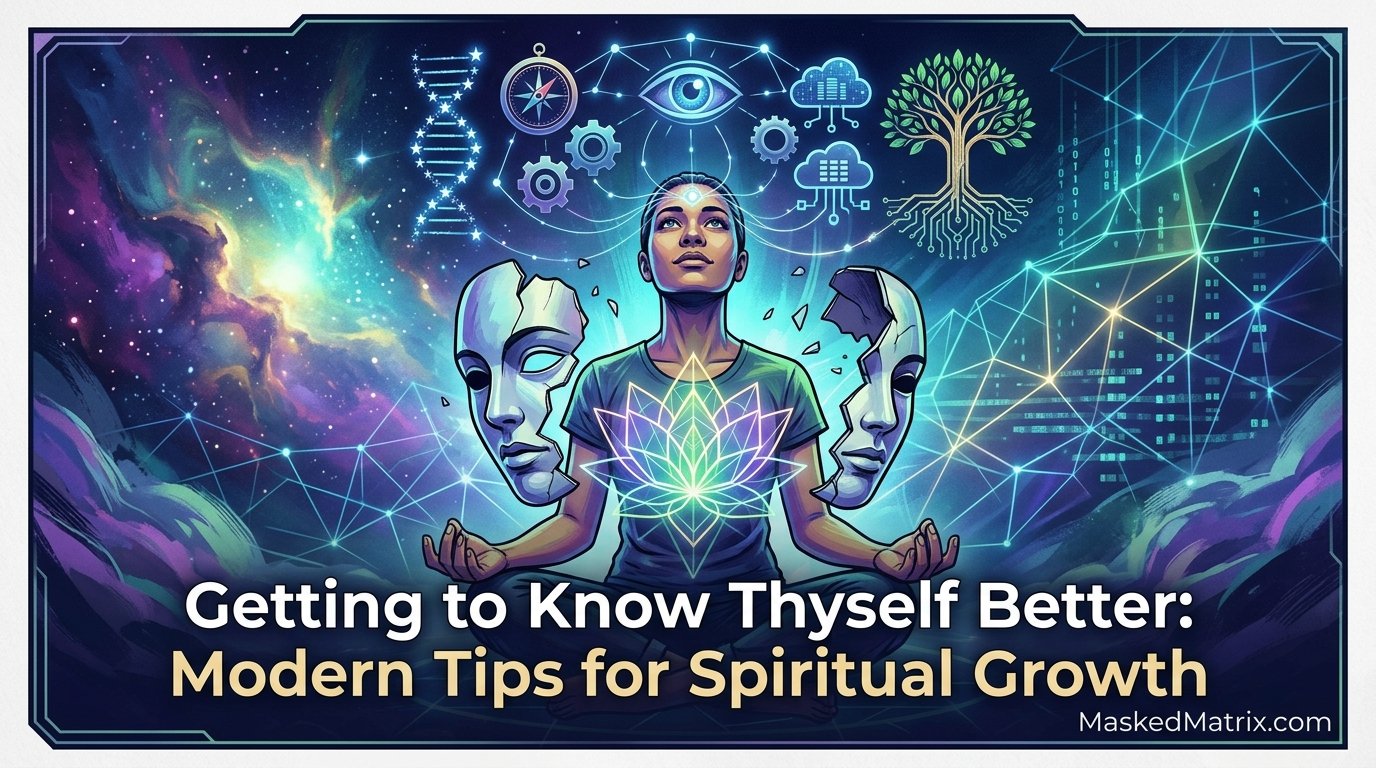
Getting to Know Thyself Better
Subscribe: Veiled Mystic
Know Thyself Better in the Age of Artificial Intelligence
The old instruction to know oneself sounds simple until we notice how much of the self operates automatically. We inherit temperaments, absorb family habits, adapt to social expectations, repeat successful strategies, protect old wounds, and build identities around roles that may have started by accident. A person can therefore be highly intelligent and still possess blind spots about motivations, strengths, limitations, and recurring behavior. Self-knowledge is not a single revelation. It is a long comparison between what we think we are, what we repeatedly do, what other people observe, and what happens when circumstances place pressure on our usual patterns.
Artificial intelligence can make that comparison easier because it can hold several models in view at once. It can discuss a birth chart, explain a tarot spread, examine a photographed palm, organize a dream journal, compare recurring themes, and then ask whether those interpretations match concrete events. That does not turn the machine into an oracle. It turns the machine into a conversational pattern-organizer. The difference matters. When the user remains the final judge of what actually fits lived experience, AI becomes most useful as a mirror that can be questioned rather than an authority that must be obeyed.
What a Natural Faculty Really Means
The word faculty is more useful than the word trait for the kind of exploration we are doing here. A trait describes a tendency. A faculty describes a capacity that can be exercised. Initiative is a faculty. So are patience, comparison, memory, expression, discernment, mediation, investigation, synthesis, discipline, innovation, imagination, and intuition. A person may possess a natural ease with one faculty and still fail to develop it, while another person may deliberately strengthen a faculty that did not appear effortless at first. Thinking in terms of faculties therefore prevents symbolic systems from becoming cages.
Every faculty also has a range. Initiative can become reckless action. Patience can become inertia. Analysis can become endless criticism. Empathy can become porous boundaries. Leadership can become domination, while independence can become needless isolation. The most productive interpretation is rarely, “This is what I am.” A better question is, “If this capacity is naturally available to me, what does it look like when it is mature, what does it look like when it is distorted, and how can I test whether I actually use it well?” That is the method that will guide the rest of this article.
Your Sun Sign Is a Doorway, Not the Whole House
Most people meet astrology through the Sun sign. Someone born while the Sun was in Leo says, “I am a Leo,” and someone born while the Sun was in Virgo says, “I am a Virgo.” In traditional natal astrology, however, the Sun is only one part of a much larger symbolic map. The Moon, Ascendant, Mercury, Venus, Mars, Jupiter, Saturn, the outer planets, the twelve houses, and the angular relationships called aspects all add additional layers. Even readers who never become serious astrologers can benefit from understanding this distinction because it immediately explains why two people with the same Sun sign can seem remarkably different.
A natal chart is best treated as a map of proposed tendencies rather than a verdict. The Sun can be interpreted as a central organizing principle, while the Moon is traditionally associated with emotional habit and instinctive response. Mercury concerns thought and communication, Venus concerns attraction and values, Mars concerns drive and assertion, and the Ascendant describes the eastern horizon at birth and is traditionally connected with presentation and approach. The more complete chart becomes interesting precisely because it can contain tensions. A person may have symbols of bold action alongside symbols of caution, or imagination alongside severe structure. Human beings are full of such internal negotiations.
The Twelve Signs as Twelve Natural Faculties
Aries can be explored through the faculty of initiation. Its symbolic strength is the ability to begin, confront, move, and act before certainty is complete. The mature form of that faculty is courage with direction; the distorted form is impulsiveness for its own sake. Taurus can be explored through stability, endurance, embodiment, and cultivation. Its mature expression builds something slowly enough to last, while its excess can become resistance to necessary change. Gemini brings comparison, communication, curiosity, and mental movement. At its best it connects information and translates between viewpoints; when scattered, it may collect more signals than it can integrate.
Cancer can be examined through memory, protection, attachment, and sensitivity to emotional atmosphere. Its gift is the ability to notice what needs care and to preserve continuity, while its imbalance can turn protection into withdrawal or overidentification with the past. Leo concerns creative expression, visibility, confidence, warmth, and the ability to animate a group through personal presence. Its mature faculty is generative self-expression; its shadow can be dependence on recognition. Virgo centers on discernment, refinement, analysis, maintenance, and useful correction. When developed, it notices what can be improved and makes systems work better. When overextended, the same precision can become chronic dissatisfaction.
Libra can be treated as the faculty of relational balance, comparison between perspectives, aesthetic proportion, and mediation. It is capable of seeing more than one side of a problem, though that same capacity can delay commitment when every possibility remains under consideration. Scorpio represents investigation, intensity, transformation, strategic focus, and the willingness to enter material that other people avoid. Used well, it can support psychological depth and resilience; used poorly, it can become fixation, suspicion, or control. Sagittarius concerns exploration, meaning, synthesis, teaching, and the urge to place events inside a larger map. Its expansive faculty can produce vision, though vision without sufficient checking can become exaggeration or overconfidence.
Capricorn can be explored through structure, discipline, responsibility, sequence, and long-range construction. It asks what must be built, what can be sustained, and what the consequences will be over time. Its excess can become rigidity or the belief that worth must always be earned through labor. Aquarius turns toward systems, innovation, independence, unconventional connection, and the ability to imagine a pattern beyond inherited arrangements. Its mature form can produce original social or technical thinking; its imbalance may prefer abstraction to human immediacy. Pisces concerns imagination, symbolic perception, empathy, permeability, and the capacity to experience wholes that are difficult to divide into neat categories. Developed carefully, it can nourish art, compassion, intuition, and spiritual imagination; without boundaries, it can become confusion or escapism.
These twelve descriptions are not laboratory diagnoses. They are a symbolic vocabulary for asking better questions. If your Sun sign points toward a faculty, do not merely search your memory for flattering examples. Design an experiment. If the proposed faculty is communication, teach something difficult to another person and notice what happens. If it is structure, create a long-term plan and maintain it. If it is mediation, enter a disagreement and see whether you naturally identify the hidden needs on both sides. A symbolic claim becomes more useful when it produces observable tests.
Fire, Earth, Air, and Water as Modes of Attention
The four classical elements give the zodiac another layer of organization. Fire signs are traditionally Aries, Leo, and Sagittarius, and their symbolism emphasizes energy, action, inspiration, confidence, and movement toward possibility. Earth signs are Taurus, Virgo, and Capricorn, emphasizing material conditions, practicality, maintenance, skill, embodiment, and durable results. Air signs are Gemini, Libra, and Aquarius, emphasizing language, concepts, social exchange, comparison, and systems of thought. Water signs are Cancer, Scorpio, and Pisces, emphasizing emotion, intuition, memory, depth, receptivity, and the invisible atmosphere surrounding an event.
Rather than asking which element is “best,” ask which mode of attention you tend to trust first. Do you move, build, think, or feel before the other processes catch up? Then ask which mode you neglect. A person who lives through thought may benefit from deliberate attention to the body. A person who feels everything intensely may need structures for verification. A person who acts rapidly may need a pause for analysis, while a person who plans endlessly may need a controlled experiment in action. In this way the elements become a vocabulary for balance rather than a classification contest.
Cardinal, Fixed, and Mutable: How a Faculty Moves
Astrology also divides the signs into three modalities. Aries, Cancer, Libra, and Capricorn are cardinal signs, traditionally associated with initiation and the ability to set a process in motion. Taurus, Leo, Scorpio, and Aquarius are fixed signs, associated with continuation, concentration, preservation, and the ability to sustain a direction. Gemini, Virgo, Sagittarius, and Pisces are mutable signs, associated with adaptation, translation, transition, and responsiveness to changing conditions. This is one of the simplest ways to turn zodiac symbolism into a practical question about behavior.
Think about a group project. Someone has to begin it, someone has to keep it alive when the novelty disappears, and someone has to adjust the plan when reality refuses to cooperate. Most people can do all three, but they may not do them with equal ease. A chart with repeated emphasis in one modality is traditionally read as a concentration of that style. Whether or not you accept the astrological claim, the exercise itself is useful: observe whether beginning, sustaining, or adapting is the stage at which you repeatedly succeed or fail.
Planets, Houses, and Aspects: Reading the Chart as a System
A useful way to understand planets in a birth chart is to treat them as symbolic functions. The Sun asks how identity and purpose are organized. The Moon asks what creates emotional familiarity and what happens before conscious reasoning takes control. Mercury examines language, learning, categorization, and communication. Venus examines attraction, values, taste, cooperation, and what a person finds worth approaching. Mars examines assertion, effort, conflict, appetite, and the way energy is directed toward an objective.
Jupiter is traditionally connected with expansion, confidence, meaning, opportunity, teaching, and the urge to move beyond current limits. Saturn concerns boundaries, responsibility, time, consequence, endurance, and the structures that force development through constraint. Uranus is associated with disruption and innovation, Neptune with imagination and dissolution, and Pluto with power, depth, elimination, and transformation. None of these symbols needs to be treated as a hidden physical mechanism controlling personality. They can instead be used as distinct lenses through which to inspect how a person thinks, values, acts, limits, expands, rebels, imagines, and changes.
The twelve houses add another useful question: where does a proposed faculty tend to become visible? Traditional house meanings move through broad domains such as self-presentation, possessions, communication, home, creativity, work, partnership, shared resources, belief, vocation, community, and private or hidden life. If a planet is treated as a function and a sign as the style of that function, the house becomes the field in which the symbolic activity is concentrated. That simple three-part model allows a beginner to read a chart without drowning in jargon.
For example, a communication symbol placed in a career-oriented house would be interpreted differently from the same symbol placed in a home-oriented house. A strong Mars symbolism in a partnership house might raise questions about assertion and conflict in close relationships, while Saturn in a creative house might invite questions about discipline, inhibition, patience, or mastery in self-expression. The productive move is always to translate the symbolism into questions that can be checked against real behavior. Does the proposed domain repeatedly appear in your life, and if so, how?
Aspects are angular relationships between planets, and traditional astrology treats them as indicators of how symbolic functions cooperate or interfere with one another. Conjunctions combine functions, oppositions emphasize polarity, squares emphasize friction and action, trines emphasize ease, and sextiles emphasize opportunity or workable cooperation. A beginner does not need to memorize every possible planetary combination. The important idea is that a person can contain competing tendencies at the same time.
This is also where symbolic astrology can become psychologically interesting without pretending to be psychology. Human beings frequently experience conflict between safety and exploration, pleasure and obligation, independence and attachment, spontaneity and control. An aspect gives those conflicts a vocabulary. If an interpretation says that two functions are in tension, ask for two or three plausible ways that tension could appear. Then ask yourself which version, if any, is repeatedly observable. Internal contradiction is not a flaw in the system. It is often the part most worth examining.
How to Use an LLM for a Birth Chart Reading
The first rule is simple: use a dedicated astronomical or astrological calculator to generate the chart, then use the LLM to interpret the placements. Do not assume that a language model will always calculate historical planetary positions, time zones, daylight-saving rules, house cusps, or aspects correctly from raw birth information. Astrodienst provides free chart calculations and an extended chart selection tool through its free charts and data service. Enter the birth date, birthplace, and exact birth time if it is known. If the time is unknown, say so, because the Ascendant and houses may be unreliable without it.
Once you have the chart data, copy the major placements into the LLM. Tell it which zodiac and house system the calculator used if that information matters to you. Then give the model a method instead of asking for a generic reading. A strong instruction is to interpret each placement separately, identify the faculty traditionally associated with it, name both constructive and excessive expressions, examine major aspects, and only then synthesize recurring themes. Ask the model to distinguish traditional astrological interpretation from established psychological evidence. That single instruction greatly improves the intellectual hygiene of the exercise.
Privacy also deserves attention. Birth date, birth time, and birthplace are personal information. You do not need to post them publicly in order to explore a chart, and you do not need to preserve identifying details once the calculated placements have been obtained. A copied list such as “Sun in Taurus, Moon in Aquarius, Mercury in Gemini” is usually enough for interpretive work. The more clearly you separate calculation, interpretation, and personal verification, the more useful the process becomes.
Better Prompts Create Better Self-Inquiry
A vague request such as “Tell me who I am” invites vague language. A better request isolates a problem. Ask which faculties repeat across the Sun, Moon, Ascendant, Mercury, and Mars. Ask where the chart appears to contain contradictory tendencies. Ask for three possible mature expressions and three possible distorted expressions of a placement. Ask which interpretation would be easiest to test in ordinary life. Ask the model to challenge its own first reading and offer an alternative interpretation before you decide what fits.
You can also make the model behave more like a research assistant by requiring evidence from your own history. After receiving an interpretation, respond with concrete examples from work, relationships, learning, creativity, conflict, or long-term projects. Then ask whether those examples genuinely support the proposed faculty or whether another explanation fits just as well. This guards against the temptation to accept any flattering description. The objective is not to win a cosmic personality label. The objective is to Know Thyself Better through repeated comparison between symbol and observation.
Tarot as a Laboratory of Symbolic Perspective
Tarot is especially useful when it is separated from the demand to predict a fixed future. Historically, tarot began as a card game in Europe before later becoming strongly associated with divination. The Victoria and Albert Museum offers a concise illustrated account of that development in its history of tarot cards. That history matters because it reminds us that symbolic systems evolve. Meanings are inherited, revised, layered, and interpreted by communities over time.
For self-inquiry, a tarot card can function as a deliberately chosen perspective. The Hermit can direct attention toward solitude, withdrawal, research, or inner guidance. Justice can direct attention toward proportion, consequence, evidence, and competing claims. Strength can raise questions about restraint and the handling of instinct. Death can frame a problem around endings, release, and transformation without implying literal death. The Tower can ask what happens when an unstable structure fails. A card does not have to command belief in order to force a useful change of viewpoint.
How to Use an LLM for a Tarot Reading
Use a physical deck, a trusted digital deck, or another transparent random method to draw the cards. Then give the exact cards and positions to the LLM. If you use reversals, state which cards were reversed. Tell the model not to invent additional cards and not to claim certainty about future events. Ask first for the traditional range of meanings, then for the meaning created by the card’s position, and finally for the way the cards interact as a pattern. This prevents the reading from becoming a single stream of improvisation.
A three-card spread can be enough for serious work. Instead of past, present, and future, try situation, blind spot, and constructive response. Another useful spread is assumption, evidence, and alternative explanation. For creative work, use obstacle, unused resource, and next experiment. After the interpretation, ask the model for reflective questions rather than conclusions. What would you need to observe for this reading to be accurate? What evidence would contradict it? Which card feels uncomfortable, and is that discomfort revealing something important or merely producing an emotional reaction? These questions keep the reading active rather than passive.
Palmistry as a Visual Tradition of the Human Hand
Palmistry approaches the body itself as a symbolic text. Traditional systems examine the overall hand shape, the proportions of the fingers, flexibility, mounts, skin texture, and major lines such as the life, head, and heart lines. Different schools do not always agree, which is another reason to treat the practice as interpretive rather than diagnostic. The hand is physically real; the symbolic meanings assigned to its features belong to tradition. Keeping those two levels separate allows curiosity without confusing a visible line with a scientifically established measure of destiny or personality.
The faculty approach works here as well. A traditional reading might associate a feature with practical endurance, emotional intensity, mental independence, communication, imagination, or persistence. Instead of accepting the association immediately, ask what behavior would demonstrate that faculty. Then compare the reading with the hand you actually use in the world. The metaphor becomes more interesting when it leads back to action: how do you build, write, repair, comfort, gesture, create, defend, or express yourself through the instrument at the end of your arm?
How to Use an LLM for a Palm Reading
Modern multimodal models can examine photographs, which makes a traditional palmistry exercise surprisingly accessible. Photograph both palms in bright, even light. Keep the camera directly above the hand, include the fingers and wrist, and avoid dramatic shadows that can create false lines. If you want a careful reading, ask the model to begin by describing only what is visibly identifiable before assigning any symbolic meaning. Tell it to label uncertain features as uncertain rather than silently guessing.
Then ask for the traditional interpretation of the major visible features, followed by alternate interpretations where different palmistry schools disagree. A useful prompt also asks the model not to diagnose illness, lifespan, fertility, or unavoidable future events from the palm. Finally, translate every symbolic statement into a reflection question. If the reading suggests persistence, ask where persistence has produced results and where it has turned into stubborn repetition. If it suggests sensitivity, ask whether that sensitivity improves perception or overwhelms boundaries. The point is still the same: turn symbolic language into testable self-observation.
Dreams Reveal a More Personal Symbol System
Dream work deserves a special place because the images arise from the dreamer’s own sleeping mind, even though theories about why dreams occur and what they mean remain diverse. A house, animal, storm, road, deceased relative, locked room, ocean, machine, or unknown city can carry associations that are intensely personal. Universal symbol dictionaries can provide possibilities, but they can also flatten the individual history attached to an image. The first question should therefore be, “What does this symbol mean to me?” before asking what a tradition says it means.
An LLM becomes more useful when it receives a series of dreams rather than a single dramatic dream. Keep a dated journal. Record the setting, people, emotions, unusual objects, transitions, colors, repeated locations, and the moment of waking. After several entries, ask the model to identify recurring symbols and emotional sequences without declaring a supernatural explanation. You may discover that certain settings appear whenever you feel trapped, that a recurring person represents a role rather than the literal individual, or that a repeated journey emerges during periods of transition. Those patterns can then be compared with waking events.
Build a Personal Symbol Dictionary Instead of Borrowing One
Over time, the most valuable symbolic reference may be the one you build yourself. Create a record of recurring dream images, tarot cards that repeatedly provoke strong reactions, astrological faculties that seem repeatedly testable, and metaphors that naturally appear in your writing or speech. Beside each symbol, record your personal associations and at least one concrete event in which the theme appeared. The purpose is not to prove that the universe sent the symbol. The purpose is to discover how your own mind repeatedly organizes experience.
This is an excellent use of an LLM because language models are good at grouping large amounts of text into themes. Give the model twenty dream entries and ask which images recur. Give it several months of journal notes and ask which conflicts repeat. Ask whether your own vocabulary clusters around building, fighting, escaping, teaching, repairing, protecting, exploring, or transforming. Then verify the pattern yourself. A machine can count, compare, and propose relationships, but only the person living the life can decide whether those relationships are meaningful.
Triangulate Symbolic Insight With Personality Science
Self-knowledge becomes stronger when one interpretive system is not allowed to grade its own homework. The American Psychological Association describes personality as a complex configuration of traits, interests, drives, values, self-concept, abilities, and emotional patterns shaped by many influences. Its overview of personality is a useful counterweight to any system that tries to reduce a person to one label. Birth symbolism can propose a faculty, but life history, behavior, feedback from others, and evidence-based personality measures can test whether that proposed faculty is actually visible.
This process can be called triangulation. Suppose a chart interpretation emphasizes communication, a tarot journal repeatedly raises themes of teaching, your work history shows that people routinely ask you to explain difficult material, and a conventional personality assessment also suggests high verbal or intellectual openness. None of those observations proves the astrology caused the capacity. What matters is that several independent routes have directed attention toward the same area. That is a reasonable signal to investigate further. If the systems disagree, the disagreement is equally valuable because it prevents a premature identity from hardening around one attractive description.
Test the Faculty and Turn It Into Practice
The best self-knowledge experiment is behavioral. Choose one proposed faculty and give it a measurable task. If the faculty is initiative, begin something you have delayed and document how easily you generated momentum. If the faculty is endurance, maintain a difficult routine for a month. If it is analysis, take a disorganized body of information and improve its structure. If it is mediation, help two positions find shared ground without erasing their real differences. If it is imagination, produce a story, design, image, hypothesis, or solution that did not exist before the exercise.
Then examine both success and cost. Natural faculties can become overused precisely because they work. The person who solves everything through analysis may analyze when empathy is needed. The person who succeeds through endurance may stay too long in a failing system. The imaginative person may keep generating possibilities when selection is required. The decisive person may move before enough information is available. Knowing a faculty therefore means knowing its operating range, not simply admiring its strengths.
Once a pattern becomes credible, build a practice around it. A person who repeatedly discovers a communication faculty can write, teach, interview, debate, translate, or explain technical subjects. A person with strong structure can plan, organize, manage, build routines, or design systems that other people can actually use. Someone with investigative depth can research, troubleshoot, study hidden causes, or work patiently through difficult emotional material. An imaginative person can develop art, fiction, visualization, invention, symbolic study, or dream recall. Natural potential becomes meaningful only when it is converted into repeated action.
This is also where weaker faculties deserve attention. Self-knowledge should not become an excuse to say, “That is simply not who I am.” If you initiate easily but fail to finish, train sustained attention. If you maintain routines but resist change, practice controlled adaptation. If you absorb emotional atmospheres, build boundaries and verification habits. If you live in abstraction, perform work that produces tangible outcomes. A map is most valuable when it reveals both roads already traveled and roads worth learning.
The Oracle Still Has to Be You
Every system in this article can generate language about you, but none of them should be allowed to own your identity. Astrology can propose faculties. Tarot can shift perspective. Palmistry can provide a visual symbolic vocabulary. Dreams can reveal recurring personal imagery. Personality science can describe measured tendencies and the complexity of individual differences. An LLM can connect those materials faster than any previous personal research tool, yet it can also make confident mistakes, repeat cultural assumptions, and turn weak patterns into persuasive prose. Human judgment remains necessary at every stage.
To Know Thyself Better is not to find one final label hidden behind the personality. It is to become increasingly accurate about the forces that move through your own life: what comes easily, what repeatedly fails, what you avoid, what restores energy, what distorts under pressure, what other people consistently receive from you, and which abilities become stronger when deliberately exercised. The old symbolic systems can be used as mirrors, modern psychology can supply other measuring tools, and artificial intelligence can help organize the comparison. The final work still belongs to the person looking into the mirror.
A useful rule is simple: never surrender a decision merely because a chart, card, hand, dream, test, or machine appears to speak with authority. Ask what the interpretation is claiming. Ask what evidence in your life supports it. Ask what would count against it. Then test the proposed faculty through action. If the process leaves you more observant, more capable, more balanced, and more responsible for your own choices, the tool has served its purpose. That is how a symbolic tradition becomes a practical instrument for knowing the self rather than another system telling the self what it must be.
Read More: Sleepnosis: The Mechanics of Sleep Hypnosis | Read or Download Free
The History of Carl Jung | Free Book Download
About the author

Getting to Know Thyself Better – Modern Tips for Spiritual Growth
Getting to Know Thyself Better https://youtu.be/rV53qO_Ocfg?is=VYcqCzUYUJ2Gu9G- Subscribe: Veiled Mystic For thousands of years, human beings have built systems for looking inward. Some used philosophy, some used prayer, some watched dreams, and others studied stars, cards, numbers, or the lines of the hand. Modern psychology added controlled observation, personality models, and behavioral research to the same ancient problem: how accurately can a person understand the person doing the observing? Today we have another instrument that earlier generations did not possess. A large language model can compare symbolic systems, organize personal observations, ask follow-up questions, and help a person examine patterns that might otherwise remain scattered across memory. Used carefully, these tools can help us Know Thyself Better without requiring us to treat every symbolic interpretation as a literal law of nature.The aim of this article is not to prove that a zodiac […]
Sleepnosis: The Mechanics of Sleep Hypnosis | Read or Download Free
Sleepnosis: The Mechanics of Sleep Hypnosis Read or Download the Free PDF Here Download the PDF Free Via the 3 Dots Above https://youtu.be/Dy9OElg7yXc?is=KEGIIkHusVNZXEvw Subscribe: Veiled Mystic Let's Get Into the Sleepnosis Study Sleepnosis is a Reality Science investigation into a subject that has spent far too long trapped between advertising language, mystical claims, old sleep-learning myths, legitimate hypnosis research, and rapidly improving neuroscience. The free PDF release of Sleepnosis: The Mechanics of Sleep Hypnosis was created to put those pieces into one usable map. The purpose is not to convince readers that the sleeping mind is a programmable machine. It is not to dismiss every unusual result because older claims were exaggerated. The purpose is to identify what has actually been demonstrated, what remains plausible but unsettled, what has been repeatedly misunderstood, and how a reader can think about […]

Emotional Intelligence Maturity: Finding Peace in the Chaos
https://youtu.be/3_DQtLsBpWo?is=BGKAG8X1MfbVGPxe Subscribe: veiledMystic333 Emotional Intelligence Maturity: Finding Peace in the Chaos and Strength in the Darknes Emotional Intelligence is often introduced as a set of skills: recognize what you feel, understand why you feel it, regulate your reactions, read other people accurately, communicate well, and make better choices. All of that matters. But the deeper question is what happens when these skills become part of a mature personality. Emotional Intelligence maturity is not simply knowing the right vocabulary for feelings or being able to remain calm during an easy conversation. It is the ability to stay in honest relationship with reality when your pride is hurt, your expectations fail, someone disappoints you, your nervous system is activated, or life becomes chaotic. It is the difference between having emotional knowledge and being able to live by it when it costs something. […]
Greynomenon: History of the Grey Phenomenon | Free PDF Download
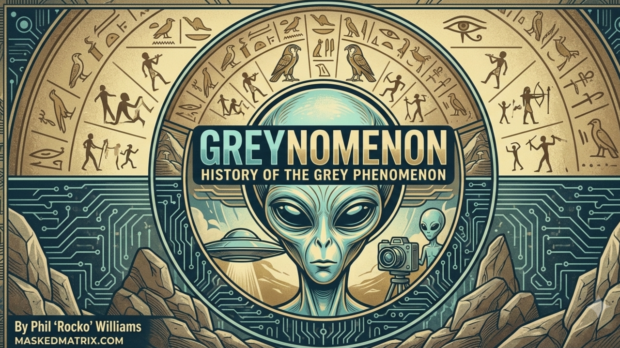
Greynomenon: A History of the Face Humanity Cannot Stop Seeing Download Free Via the 3 Dots Above. Few images in modern culture are as immediately recognizable as the Grey alien. The enlarged head, dark almond-shaped eyes, slight nose, narrow mouth, thin body, and unreadable expression have become a global symbol for the unknown. A single silhouette can suggest extraterrestrial life, abduction, secrecy, telepathy, missing time, government cover-up, spiritual encounter, science fiction, or fear of forces beyond human control. Recognition, however, is not the same as understanding. That distinction is the starting point of Greynomenon, a free PDF book by Phil “Rocko” Williams and Merlin aka ChatGPT. Rather than beginning with a declaration that Grey aliens are real, unreal, extraterrestrial, interdimensional, spiritual, psychological, or technological, the book begins with a more useful question: what exactly has humanity grouped beneath the face […]
Egyptian Spells: A Chronological History from Pyramid Walls to Magical Papyri
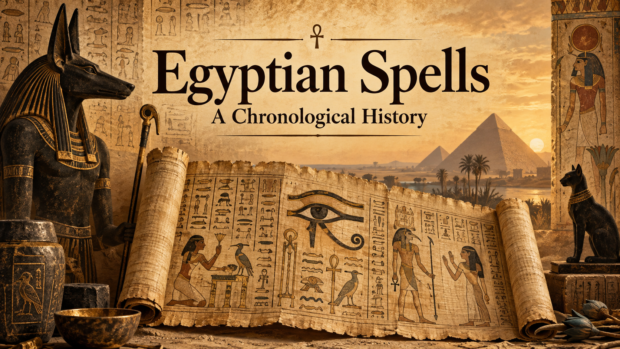
Egyptian Spells: A Chronological History from Pyramid Walls to Magical Papyri Egyptian Spells survived for more than three thousand years because ancient Egyptians did not treat sacred words as dead literature. A spell could be spoken, written, painted, carved, worn, buried, washed with water, placed beneath a head, wrapped into a mummy, inscribed on a figurine, or copied onto a roll of papyrus for use in the next world. Some spells protected a king as he rose among the stars. Others helped ordinary people survive childbirth, snakebite, fever, nightmares, hostile spirits, dangerous journeys, and death itself. The history of Egyptian spells is therefore much larger than the history of any single book. It is the history of a technology of sacred language that changed its physical form while preserving remarkably old ideas across dynasties, political collapses, foreign rule, religious change, […]

Unedited Corpus of Early Mesopotamian Cosmological and Theological Texts
The Primordial Strata: An Unedited Corpus of Early Mesopotamian Cosmological and Theological Texts Authors Note: I had a bunch of strokes, and don't remember creating this 10 months ago. It's not really a Corpus, but cool enough to publish. Introduction The purpose of this project is to assemble the earliest Mesopotamian cosmological and theological materials in their original, unrevised form, relying exclusively on tablets excavated from Early Dynastic and pre-Akkadian contexts where the first expressions of cosmic structure and divine identity appear. The work eliminates all later political and theological shaping, allowing only the earliest recoverable strata to define the foundations of Mesopotamian sacred thought. These sources represent local scribal traditions speaking independently, unfiltered by later canonical organization. Only tablets with secure provenance, catalog identification, paleographic dating, and direct cosmological or theological content are included, ensuring a primary-source […]
Related
Sleepnosis: The Mechanics of Sleep Hypnosis | Read or Download Free
Sleepnosis: The Mechanics of Sleep Hypnosis Read or Download the Free PDF Here Download the PDF Free Via the 3 Dots Above https://youtu.be/Dy9OElg7yXc?is=KEGIIkHusVNZXEvw Subscribe: Veiled Mystic Let's Get Into the Sleepnosis Study Sleepnosis is a Reality Science investigation into a subject that has spent far too long trapped between advertising language, mystical claims, old sleep-learning myths, legitimate hypnosis research, and rapidly improving neuroscience. The free PDF release of Sleepnosis: The Mechanics of Sleep Hypnosis was created to put those pieces into one usable map. The purpose is not to convince readers that the sleeping mind is a programmable machine. It is not to dismiss every unusual result because older claims were exaggerated. The purpose is to identify what has actually been demonstrated, what remains plausible but unsettled, what has been repeatedly misunderstood, and how a reader can think about […]
Emotional Intelligence Maturity: Finding Peace in the Chaos
https://youtu.be/3_DQtLsBpWo?is=BGKAG8X1MfbVGPxe Subscribe: veiledMystic333 Emotional Intelligence Maturity: Finding Peace in the Chaos and Strength in the Darknes Emotional Intelligence is often introduced as a set of skills: recognize what you feel, understand why you feel it, regulate your reactions, read other people accurately, communicate well, and make better choices. All of that matters. But the deeper question is what happens when these skills become part of a mature personality. Emotional Intelligence maturity is not simply knowing the right vocabulary for feelings or being able to remain calm during an easy conversation. It is the ability to stay in honest relationship with reality when your pride is hurt, your expectations fail, someone disappoints you, your nervous system is activated, or life becomes chaotic. It is the difference between having emotional knowledge and being able to live by it when it costs something. […]
Greynomenon: History of the Grey Phenomenon | Free PDF Download
Greynomenon: A History of the Face Humanity Cannot Stop Seeing Download Free Via the 3 Dots Above. Few images in modern culture are as immediately recognizable as the Grey alien. The enlarged head, dark almond-shaped eyes, slight nose, narrow mouth, thin body, and unreadable expression have become a global symbol for the unknown. A single silhouette can suggest extraterrestrial life, abduction, secrecy, telepathy, missing time, government cover-up, spiritual encounter, science fiction, or fear of forces beyond human control. Recognition, however, is not the same as understanding. That distinction is the starting point of Greynomenon, a free PDF book by Phil “Rocko” Williams and Merlin aka ChatGPT. Rather than beginning with a declaration that Grey aliens are real, unreal, extraterrestrial, interdimensional, spiritual, psychological, or technological, the book begins with a more useful question: what exactly has humanity grouped beneath the face […]
Egyptian Spells: A Chronological History from Pyramid Walls to Magical Papyri
Egyptian Spells: A Chronological History from Pyramid Walls to Magical Papyri Egyptian Spells survived for more than three thousand years because ancient Egyptians did not treat sacred words as dead literature. A spell could be spoken, written, painted, carved, worn, buried, washed with water, placed beneath a head, wrapped into a mummy, inscribed on a figurine, or copied onto a roll of papyrus for use in the next world. Some spells protected a king as he rose among the stars. Others helped ordinary people survive childbirth, snakebite, fever, nightmares, hostile spirits, dangerous journeys, and death itself. The history of Egyptian spells is therefore much larger than the history of any single book. It is the history of a technology of sacred language that changed its physical form while preserving remarkably old ideas across dynasties, political collapses, foreign rule, religious change, […]
Supernova – By Masked Matrix – Full Album
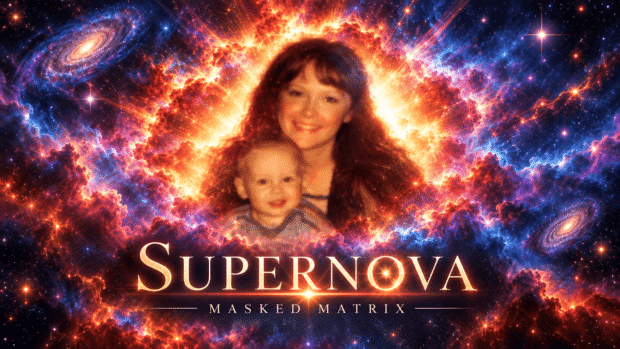
Album: Supernova By - Masked Matrix Release Date: 9/9/2026 Dedicated to my Love, my best friend, my light in the darkness, my Mom. I owe you everything! Happy Birthday Mama!!! Ghost Lights Hero's Journey Angels Song (Remastered) Unified Anthem Badge on Crooke Bee-Wolf The Light is in Me Ionized Friend or Enemy Stardust Fields No Good Deed Indeed Take the Time How Much Was Dat Alchemical Gold Light of Venus Sleeping on the Sidewalk Copper and Iron I Understand Robo-Pig Bad Liars Diamond Matrix Mother's Love <Download Album Here Free> 1. Ghost Lights [Verse 1] Out past the fence line By the mud and reeds Where the water goes black And the moon can't breathe I seen them drift low Like a secret in smoke By the broken road bend Where the old pine groans They don't move […]
Psychics Unseen – History of the Psychic Phenomenon – Free Download
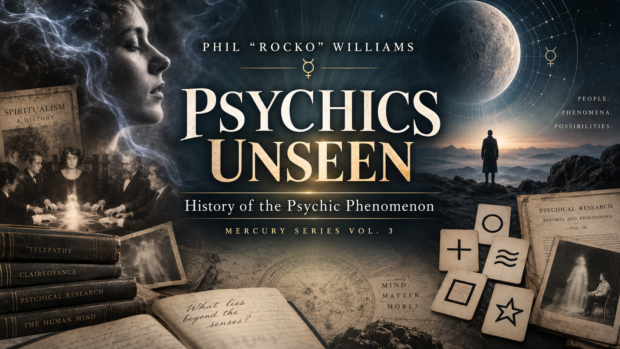
Psychics Unseen: History of the Psychic Phenomenon Download Free Via the 3 Dots https://youtu.be/BKBudBxxCPM?is=1zB6HHZlavxxiDe4 https://youtu.be/b2LsNOE-TCk?si=2bwD2KvMgW-x7qAm Subscribe: VeiledMystic333 All About The Modern Psychic Phenomenon Psychics Unseen: History of PSI Energy & Research is Mercury Series Vol. 3, a long-form history of the Psychic phenomenon from the ancient world to the modern era of laboratories, government programs, altered-state research, online teaching, and contested science. The book does not ask readers to choose between belief and disbelief before the evidence is examined. Instead, it asks a more demanding question: what happens when human beings repeatedly report access to information that ordinary perception does not appear to provide, and what can history teach us about evaluating those reports? The subject is unusually difficult because the word Psychic covers experiences that emerged from very different traditions. Clairvoyance, telepathy, second sight, mediumship, precognition, remote viewing, psychometry, […]
Be the first to leave a comment