Believe It Or Not, The Power Of Belief
Download Free Via the 3 Dots
Subscribe: Veiled Mystic
PART I: FOUNDATIONS OF BELIEF
What Belief Actually Is
Belief is a mental framework through which individuals interpret and respond to the world. It acts as an internal compass that organizes perceptions, decisions, and reactions. At its core, a belief is a stabilized assumption that becomes treated as truth, even when the evidence that formed it was incomplete or subjective. This stabilization creates predictable patterns inside the mind, allowing the person to navigate a complex environment without having to re-evaluate every choice or situation.
In cognitive science, beliefs function as mental shortcuts. They are not passive ideas but active structures that guide information intake. When the mind encounters new data, it compares the information against existing beliefs to determine coherence. Anything that fits the internal framework is accepted quickly, while anything that conflicts is slowed, questioned, or rejected. This process prevents overwhelm but also creates blind spots whenever those beliefs are outdated or inaccurate.
Beliefs also act as filters that determine how emotions respond to life events. A threatening belief triggers protective emotions, while empowering beliefs allow a calmer and more capable internal state. In this way, beliefs become emotional regulators. They influence how much stress a person experiences, how much resilience they access, and how quickly they adapt to change. This emotional component anchors beliefs deeply into identity.
Over time, beliefs accumulate into a personalized worldview. This framework becomes the lens through which the world is understood, giving meaning to experiences and shaping the stories people tell about themselves. Because these stories reinforce behavior and identity, alteration of belief often requires emotional processing rather than simple logic. Changing a belief can feel like changing the foundation of who you are.
Understanding the power of belief requires recognizing that beliefs are not static facts but dynamic constructs. They are formed, stabilized, resisted, modified, and embodied. The Power of Belief lies in the fact that these constructs act as internal laws, setting boundaries around what feels possible. When individuals learn how beliefs form and how they can be reshaped, they gain access to deeper psychological freedom and a more consciously designed life.
The Architecture of the Belief System
Every person carries a layered belief system composed of instinctive, subconscious, emotional, and conscious elements. These layers coexist and often interact in ways that create complexity in human behavior. Instinctive beliefs are tied to survival responses and are rooted in the ancient parts of the brain. Subconscious beliefs arise from pattern recognition, conditioning, and repetitive emotional experiences. Conscious beliefs form through deliberate reflection, reasoning, and personal choice.
These layers do not operate independently. Instead, they create a network of associations that stabilize a person’s worldview. When information reaches the brain, it passes through these layers in sequence. Instinct screens for threat, the subconscious searches for matching patterns, emotions evaluate meaning, and the conscious mind interprets the final result. This sequence makes belief formation both rapid and deeply embedded, influencing actions before conscious thought even begins.
The belief system strengthens itself through repetition. When an idea is encountered repeatedly or attached to strong emotion, the brain encodes it as significant. Neural circuits reinforce each other until the belief becomes automatic. Once this occurs, the belief acts as a default response to similar situations. Without intervention, these patterns remain stable for years or decades, even when they no longer serve the individual’s goals.
Because beliefs exist in networks, changing one area affects others. A shift in self-belief can alter emotional patterns, decision-making tendencies, and interpretations of life events. Likewise, introducing contradictory experiences or new information can weaken outdated beliefs. In this way, belief systems are both resilient and malleable, always responding to internal and external stimuli.
The architecture of belief reveals why self-transformation rarely happens through logic alone. The Power of Belief operates across all layers of the mind. To reshape the system, a person must engage with emotion, identity, and subconscious patterning, not just intellectual understanding. When these layers are aligned toward a new direction, the entire belief network reorganizes, opening the door to profound psychological evolution.
Neural Pathways and Habitual Thought
Beliefs gain strength through neural pathways formed by repetition. When a thought recurs, the brain increases the efficiency of the neural circuit that carries it. This process, known as synaptic reinforcement, makes the thought easier to access, faster to recall, and more automatic. Over time, these patterns evolve into habitual beliefs. The brain prefers efficiency, so it continually reinforces the pathways that get used the most.
Habitual thought acts like a cognitive shortcut. It reduces mental effort, allowing the mind to function rapidly in complex environments. However, this efficiency can come at a cost. The brain does not distinguish between helpful and harmful patterns; it strengthens whatever is repeated. Negative self-talk, fear-based assumptions, and limiting beliefs become deeply ingrained simply because they are rehearsed more often than empowering alternatives.
Once a pathway becomes dominant, it begins to override contradictory information. Habitual beliefs can distort perception, causing a person to interpret events through the lens of familiar thoughts rather than objective reality. This selective reinforcement helps explain why changing beliefs is often difficult. The old pathways fire automatically, while new ones require deliberate repetition to form.
Neural plasticity allows these pathways to reorganize when a person consciously interrupts habitual thoughts. Introducing new interpretations, practicing emotional regulation, and engaging in deliberate cognitive reframing can gradually weaken outdated circuits. Each time a new thought pattern is used, the brain reinforces it, slowly shifting dominance from the old pathway to the new one. This internal reprogramming becomes the foundation for sustained personal change.
The Power of Belief becomes evident in the brain’s adaptability. Neural pathways illustrate how thoughts carve internal structures that shape perception, behavior, and identity. When individuals consciously practice new cognitive patterns, they do not merely adopt new ideas; they reshape the physical architecture of their mind. This process transforms belief from a passive concept into an active force capable of altering the brain itself.
The Chemistry of Expectation
Belief influences the body through neurochemical responses. When the brain expects a certain outcome, it activates biochemical pathways that prepare the body to match that expectation. This mechanism explains why belief can alter performance, emotional states, and even physical sensations. Expectation shapes chemistry, and chemistry shapes experience.
Dopamine plays a central role in this process. It is released when individuals anticipate reward or progress, motivating them to act in alignment with their beliefs. When a person believes they are capable, their brain releases more dopamine in response to challenges, increasing drive and resilience. Conversely, limiting beliefs reduce dopamine responses, decreasing motivation and reinforcing negative assumptions.
Endorphins and cortisol also respond to belief. Empowering beliefs can trigger endorphin release, reducing stress and increasing well-being. Fear-based beliefs trigger cortisol, raising vigilance and tension. Over time, chronic belief-driven cortisol patterns can shape personality, decision making, and emotional stability. These biochemical cycles form the foundation of belief’s influence on mental health.
The placebo and nocebo effects demonstrate this chemistry clearly. Positive expectations activate healing pathways and reduce pain, while negative expectations amplify discomfort and hinder recovery. This is not imagination; it is measurable biology responding to belief-driven signals. The brain and body work together to create outcomes that match internal expectations.
The Power of Belief becomes undeniable when seen through chemistry. Expectations generate biochemical cascades that shape emotion, energy levels, resilience, and physical performance. Understanding this allows individuals to consciously direct their internal chemistry by adopting beliefs that support their goals. Belief becomes a method of influencing the body at a biological level, transforming abstract ideas into tangible physiological shifts.
Cognitive Bias and Reality Distortion
Cognitive biases are systematic thinking shortcuts that shape how individuals interpret information. They arise because the brain prioritizes speed and efficiency over accuracy. Beliefs act as anchors for these biases, guiding which information is noticed, how it is framed, and what conclusions are drawn. These shortcuts create predictable distortions in perception that influence daily behavior.
Confirmation bias is among the most powerful. Once a belief is formed, the mind favors evidence that supports it and dismisses conflicting data. This bias strengthens both positive and negative worldviews, reinforcing whatever assumptions already exist. Over time, this creates a self-reinforcing cycle where beliefs filter reality more than reality informs belief.
Anchoring bias causes the mind to rely heavily on the first piece of information encountered. Early experiences, childhood interpretations, or influential voices can set anchors that shape how later information is interpreted. This explains why initial beliefs often have disproportionate weight, even when they are incomplete or misleading.
Availability bias influences how individuals assess likelihood. Events that are emotionally charged or frequently discussed feel more common than they are. This bias can fuel fear-based beliefs or exaggerated assumptions about danger, failure, or inadequacy. Emotional intensity becomes mistaken for truth, shaping belief without objective evaluation.
These biases function automatically, shaping decisions and reactions without conscious awareness. When a person learns to recognize these patterns, they gain the ability to question their assumptions and notice distortions. This metacognitive awareness helps dismantle limiting beliefs and build a more accurate internal model of reality.
The Power of Belief interacts with cognitive biases by reinforcing the mental shortcuts that shape perception. When individuals learn to identify these distortions, they can consciously interrupt them. This creates space for new interpretations, healthier assumptions, and more grounded decision making. Understanding cognitive bias becomes a key step in reclaiming perceptual clarity.
Predictive Processing: The Brain as a Prediction Machine
The brain does not passively receive information; it actively predicts what it expects to experience. This predictive processing model suggests that perception is shaped more by expectation than by sensory input. Beliefs form the templates for these predictions, guiding what the brain anticipates in each situation.
When sensory information enters the brain, it is compared against predictions stored in memory. If the data matches the prediction, the brain accepts it quickly. If it conflicts, the brain must either adjust the belief or reinterpret the data to reduce the error. This constant balancing between prediction and input forms the core of human perception.
Prediction errors occur when reality contradicts belief. The brain responds by either updating the belief or suppressing the conflicting information. The choice depends on emotional investment, past experience, and perceived threat. Deeply held beliefs resist updating, causing the brain to distort information to maintain internal coherence.
Predictive processing explains why people often repeat patterns, attract familiar situations, or respond automatically. The brain anticipates what will happen based on past experience, and these expectations influence behavior. This creates a loop where belief-driven predictions shape actions, and actions generate outcomes that reinforce the predictions.
The Power of Belief becomes central in prediction-based perception. By deliberately altering expectations and introducing new experiences, individuals can disrupt old prediction cycles and establish new ones. This creates pathways for personal growth by shifting the internal models that govern perception, reaction, and emotional stability.
The Subconscious vs. Conscious Belief Systems
Human belief operates on two levels: conscious and subconscious. The conscious mind contains beliefs that individuals can articulate, examine, or debate. These beliefs are often shaped by reasoning, personal choice, or deliberate reflection. However, the subconscious mind holds the deeper, more influential beliefs that operate automatically. These subconscious patterns form the majority of daily responses, shaping behavior long before conscious thought appears.
Subconscious beliefs develop through repeated emotional experiences. Early life conditions, social environments, and formative memories establish patterns that the subconscious treats as truth. Because these beliefs formed before a person had the ability to analyze or choose them, they operate as inherited assumptions rather than deliberate choices. This layer of belief influences behaviors, preferences, fears, and self-worth.
Conscious beliefs often conflict with subconscious ones. A person may consciously believe they deserve success, but subconsciously associate success with fear, rejection, or failure. In such cases, the subconscious belief dominates behavior because it operates faster and carries more emotional weight. This internal conflict creates frustration and inconsistency in motivation and results.
The subconscious responds primarily to emotional intensity and repetition, not logic. This makes emotional regulation and intentional habits more effective for shifting belief than rational argument. By engaging both layers simultaneously, individuals can create alignment that stabilizes new behavioral patterns and dissolves internal resistance.
The Power of Belief thrives when the subconscious and conscious layers support the same direction. When these layers align, action becomes effortless, decisions become clear, and results emerge more consistently. The process of personal transformation depends on identifying subconscious patterns and bringing them into harmony with conscious intentions.
The Biology of Faith, Fear, and Certainty
Faith, fear, and certainty are biological states that shape belief. Faith emerges when the brain perceives possibility and safety, triggering calm and confidence. Fear arises when the brain detects threat or uncertainty, activating protective responses. Certainty develops when the brain repeatedly receives consistent feedback, stabilizing patterns into firm beliefs. These states influence how individuals interpret experiences and shape their worldview.
Faith activates neural pathways associated with openness and adaptability. The brain becomes more receptive to new information, creative thinking increases, and emotional regulation improves. This state allows individuals to take healthy risks and pursue long-term goals. Faith is not blind optimism; it is a biological readiness to engage with possibility.
Fear narrows attention and strengthens survival pathways. The brain enters a defensive mode where threat detection overrides exploration. This reduces cognitive flexibility and makes individuals cling to familiar beliefs, even when those beliefs limit their growth. Chronic fear conditions the mind to anticipate negative outcomes, shaping beliefs that reinforce protection rather than expansion.
Certainty stabilizes behavior. When the brain repeatedly experiences predictable outcomes, it encodes them as reliable truths. This stabilizes identity, reduces cognitive load, and creates a sense of control. However, certainty can also become rigid if not balanced with openness, leading to resistance to new ideas or changing circumstances.
These biological states interact dynamically. Fear can override faith, certainty can suppress curiosity, and faith can dissolve fear. Understanding this interplay helps individuals recognize when their beliefs are influenced by emotional states rather than objective evaluation. By managing these biological responses, people gain the ability to shape their beliefs intentionally.
The Power of Belief is rooted in this biology. Faith builds possibility, fear constrains perception, and certainty stabilizes identity. When individuals learn to regulate these states, they gain greater control over their internal world. This mastery helps them align their beliefs with their goals, creating a more conscious and empowered approach to life.
Emotional Imprinting and Memory
Emotional experiences create strong memory imprints that shape belief. The brain prioritizes emotionally charged events because they hold survival value. Whether positive or negative, these experiences form lasting associations that influence how individuals interpret future situations. Emotional imprinting explains why certain beliefs feel instinctive, even when they are no longer relevant.
During intense emotional moments, the brain releases chemicals that enhance memory encoding. These signals tell the nervous system that the event carried important information. As a result, the memory becomes highly accessible, often influencing behavior without conscious awareness. These imprints form the foundation for many automatic beliefs, especially those related to safety, identity, and relationships.
Negative experiences often leave stronger imprints because the brain is wired to avoid danger. This can lead to the formation of protective beliefs that limit personal growth. Positive emotional imprints also shape belief, but they often require repetition to achieve the same lasting effect. This asymmetry explains why negative beliefs can be more persistent.
Emotional imprinting also contributes to pattern recognition. When the brain encounters situations that resemble past experiences, it activates the associated belief automatically. This creates rapid responses that feel intuitive. These intuitions can be accurate when aligned with reality, but they can also mislead when based on outdated or distorted memories.
The Power of Belief becomes evident when individuals learn to reinterpret emotionally imprinted memories. By revisiting these experiences with new context, emotional regulation, or supportive guidance, people can weaken old associations and create healthier patterns. This reprocessing enables the formation of new beliefs that reflect present goals rather than past pain.
Belief as a Survival Adaptation
Belief systems evolved as survival tools. In early human development, rapid interpretation of the environment was essential for avoiding danger and seizing opportunity. Beliefs helped individuals categorize experiences quickly, forming shortcuts that guided action. These shortcuts allowed humans to respond efficiently to complex environments without constant analysis.
Patterns that ensured survival were encoded into the brain’s architecture. Over time, these patterns evolved into instinctive beliefs about threat, safety, social roles, and group cohesion. These beliefs were passed through generations not genetically, but through behavioral imitation and cultural storytelling. In this way, belief systems helped entire communities adapt to environmental demands.
As societies became more complex, belief systems expanded beyond physical survival. They shaped ethics, identity, and meaning. Stories, rituals, and shared narratives provided frameworks for understanding life’s uncertainties. These collective beliefs stabilized social order and gave individuals a sense of belonging. Even today, shared beliefs influence cooperation, leadership, and cultural cohesion.
At the individual level, beliefs continue to serve adaptive roles. They reduce cognitive load, guide decision making, and provide emotional structure. Beliefs offer predictability, helping people navigate uncertain situations. However, beliefs formed under past conditions can become maladaptive when circumstances change. Recognizing this allows individuals to consciously update their internal frameworks.
The Power of Belief lies in its evolutionary role. Humans are designed to use belief as a tool for adaptation, meaning beliefs can be reshaped to meet modern needs. When individuals learn to identify outdated beliefs and cultivate new adaptive patterns, they access the same mechanisms that once ensured survival. This empowers them to evolve psychologically and create more fulfilling lives through conscious belief design.
PART II: PERCEPTION AND THE INTERNAL LENS
The Lens of Perception
Perception acts as the interface between the external world and the internal mind. It transforms sensory information into meaning, converting raw data into recognizable patterns. This process is not neutral; it is influenced by past experiences, emotional states, and belief systems. The lens through which a person views the world determines what stands out, what fades into the background, and how events are interpreted. The Power of Belief quietly shapes this lens long before awareness catches up.
The perceptual lens is built from accumulated memories and emotional associations. These stored experiences form templates that help the brain recognize situations quickly. Once formed, these templates guide how new information is sorted, emphasizing what aligns with familiar patterns. This speeds up decision-making and reduces uncertainty, but it also narrows the range of what a person is capable of noticing.
Each individual carries a unique perceptual lens. Two people exposed to the same event can experience completely different realities because their minds filter the information differently. This creates subjective worlds that reflect personal histories more than shared facts. When people misunderstand each other, it is often because they are interpreting the same situation through entirely different internal filters.
The perceptual lens becomes stable over time, yet it remains sensitive to emotional shifts. Stress, hope, fear, and confidence can all alter what the mind pays attention to. When emotions shift dramatically, the lens temporarily changes shape, revealing different meanings in familiar situations. This dynamic quality explains why personal insights often emerge during emotional transitions.
The Power of Belief exerts influence by shaping the lens that interprets reality. When the lens becomes clearer, perception widens. Individuals gain the ability to see opportunities, solutions, and pathways that were previously invisible. By learning to recognize and adjust their internal lens, people gain greater autonomy over how they navigate life and how they interpret the world around them.
Belief-Based Blind Spots
Blind spots arise when the mind filters out information that conflicts with existing beliefs. These perceptual gaps occur automatically as a way to maintain internal coherence. When a belief becomes deeply rooted, the brain unconsciously ignores or downplays evidence that challenges it. This selective blindness is not intentional deception; it is a built-in efficiency mechanism that protects mental stability.
Blind spots often form around emotionally charged subjects. If a belief carries a strong emotional imprint, the mind defends it more aggressively. This can cause people to miss clear signs of opportunity, danger, or change. The blind spot becomes a protective buffer, shielding the person from cognitive dissonance but also limiting growth and insight.
These perceptual gaps can influence relationships and self-perception. A person may overlook their own strengths because a limiting belief makes those strengths invisible. Others may misinterpret the motivations of the people around them because their belief-based blind spots distort social cues. In many cases, conflict arises not from intention but from missed information.
Blind spots are difficult to detect from the inside because they feel like genuine reality. People only begin to see them when new experiences push against fixed assumptions. Feedback from others, emotional breakthroughs, or unexpected outcomes can reveal the edges of a blind spot. The discomfort of these moments indicates that a belief is being challenged at its foundation.
The Power of Belief becomes transformative when blind spots begin to dissolve. As the mind becomes willing to examine ignored information, perception widens, and new possibilities appear. This process requires humility, curiosity, and a willingness to observe without immediate judgment. When blind spots lift, individuals gain access to a richer understanding of themselves and the world.
Confirmation Loops
Confirmation loops occur when beliefs generate actions that produce outcomes that reinforce those beliefs. These cycles can be positive or negative, strengthening either empowerment or limitation. Once a belief is in place, the mind looks for evidence to support it. The individual then behaves in ways that make that evidence more likely to appear. Over time, the loop becomes self-sustaining.
For example, a person who believes they are capable often approaches challenges with confidence, increasing the likelihood of success. That success reinforces the original belief, making the cycle stronger. Conversely, a person who believes they cannot succeed may take smaller risks, avoid opportunities, or act tentatively. These behaviors lead to poorer outcomes, reinforcing the limiting belief.
These loops operate subconsciously. The individual rarely recognizes how their beliefs shaped their behavior. Outcomes appear to confirm objective truth, even though the cycle began as an internal assumption. This creates the illusion that the world is proving the belief, when in reality the belief is shaping the experience.
Breaking a negative confirmation loop requires disrupting one part of the cycle. Changing actions, updating assumptions, or introducing new experiences can weaken the loop’s influence. Once a single element shifts, the loop becomes unstable, allowing new patterns to emerge. Intentional behavior plays a critical role in creating this disruption.
The Power of Belief becomes evident when confirmation loops are recognized as self-created patterns. When people learn to design loops consciously, they can reinforce beliefs that support growth instead of limitation. This creates a constructive cycle where new beliefs generate empowering experiences that strengthen internal confidence and emotional stability.
Attention, Focus, and Selective Reality
Attention acts as a spotlight that highlights certain elements of reality while ignoring others. This selective process shapes experience profoundly. People do not experience the world in its entirety but only the parts that capture their focus. Beliefs guide this focus by determining what the mind deems important, relevant, or meaningful. As a result, belief-driven attention shapes subjective reality.
The brain cannot consciously process all available information. It filters stimuli through attention, prioritizing what aligns with existing patterns. This means that two people can stand in the same environment and notice entirely different aspects of it. Their beliefs determine what feels relevant, directing attention toward confirming evidence.
This filtering mechanism helps maintain stability but also introduces bias. When people expect rejection, they notice cues that suggest it. When they expect opportunity, they focus on possibilities that support their goals. This selective focus influences mood, performance, and decision making, creating a perceptual world centered around internal assumptions.
Focus also shapes memory. The brain tends to store information that received strong attention, especially if it carried emotional weight. This reinforces belief patterns by giving them a stronger presence in memory. Over time, attention-driven memories build a narrative that supports the belief system.
The Power of Belief is expressed through the direction of attention. When individuals deliberately adjust their focus, they change what they notice, which changes how they interpret situations. This shift can break old patterns and reveal new paths. Developing intentional control over attention becomes a crucial step in reshaping one’s internal reality.
How the Brain Deletes Information
Deletion is a natural cognitive process. The brain removes information that does not support current beliefs or goals. This process maintains efficiency by preventing overload. People rarely notice deletion because it occurs automatically, filtering out details that do not match internal expectations. This cognitive editing shapes perception just as much as attention and memory do.
Deletion occurs when the brain encounters contradictory information. Rather than updating the belief immediately, the brain may downplay or ignore the conflicting detail to preserve mental consistency. This reduces cognitive strain but prevents the individual from seeing the full picture. Over time, repeated deletion strengthens the belief that guided the filtering.
In social situations, deletion plays a strong role. Individuals may overlook positive feedback if they carry a belief of inadequacy. They may miss warning signs if they believe someone is trustworthy. These deletions alter how relationships unfold, reinforcing assumptions about others and about oneself.
Deletion can also influence opportunities. When a person believes success is unlikely, they may fail to notice pathways that could help them advance. These opportunities exist, but the mind deletes them before they reach conscious awareness. This creates the illusion that the world lacks options, when in reality the options were filtered out by belief.
Recognizing deletion reveals how deeply beliefs shape perception. The Power of Belief operates not only through what the mind chooses to focus on but also through what it eliminates from awareness. When individuals become aware of deletion patterns, they gain greater control over how they process information. This awareness opens space for more accurate perception and more flexible responses.
Constructed Reality: The Brain Builds the World You See
Perception is not a direct reflection of the external world. It is a constructed experience created by the brain. Sensory input provides raw data, but the mind interprets and reconstructs that data into a meaningful internal model. This model is influenced by beliefs, expectations, and emotional states. What individuals perceive is shaped more by internal frameworks than by objective reality.
The brain combines new sensory data with past experiences to build this constructed world. It fills in gaps, smooths inconsistencies, and organizes information into coherent patterns. This reconstruction allows people to navigate the world efficiently but also introduces distortions. Beliefs guide these reconstructions by determining which interpretations feel most accurate.
This constructed reality is deeply personal. Each individual carries a unique internal world that reflects their history, emotional conditioning, and belief system. Because these realities differ, disagreements often arise not from factual conflict but from divergent interpretations. This explains why people can experience the same event and remember it differently.
The construction process is ongoing. The brain updates its internal model constantly, adjusting to new information while maintaining stability. Sometimes the model requires major revisions, especially when a belief is challenged by repeated contradictory experiences. These revisions often feel uncomfortable because they require restructuring deeply held assumptions.
The Power of Belief becomes clear when individuals recognize that their internal world is built, not discovered. This realization grants the freedom to adjust the internal model deliberately. By examining the beliefs that shape constructed reality, people can create a more accurate, flexible, and empowering version of their world.
Sensory Interpretation and Meaning-Making
Sensory information enters the brain without inherent meaning. The mind assigns meaning based on belief, memory, and emotional patterns. This meaning-making process transforms neutral stimuli into personal experiences. Two individuals may hear the same tone of voice but interpret it differently depending on their beliefs about the speaker, themselves, or the situation.
Interpretation begins with sensory categorization. The brain identifies familiar patterns and assigns them to known categories. These categories are shaped by belief. A person who believes the world is dangerous may interpret ambiguous cues as threats. Someone who believes in their own competence may interpret challenges as opportunities. The interpretation reflects the belief system more than the stimulus itself.
Meaning-making is influenced heavily by context. Past experiences shape how the brain interprets current events. Emotional associations attached to those memories amplify or distort meaning. This explains why unresolved emotional imprints can influence interpretations long after the original event has passed.
Interpretations shape the stories people tell about their lives. These stories influence identity, motivation, and emotional health. When interpretations remain unconscious, they control behavior without awareness. When they become conscious, individuals gain the ability to question, adjust, or replace them.
The Power of Belief emerges clearly in meaning-making. Beliefs influence how stimuli are categorized, how events are interpreted, and how personal narratives are shaped. By examining these interpretations, individuals can gain insight into their belief systems and begin to rewrite the meanings that shape their lives.
The Mirror Effect: Projecting Inner Models
The mind often projects internal beliefs onto external situations. This projection acts like a mirror, reflecting internal assumptions onto the world. Individuals may believe they are seeing objective truth, but they are often seeing their internal models applied to people and events. This mirror effect shapes relationships, conflict, and self-perception.
When a belief is strong, the mind unconsciously assumes others share it. A person who fears judgment may interpret neutral expressions as critical. Someone who believes people are trustworthy may overlook warning signs. These projections guide social behavior and emotional reactions.
Projection also influences self-image. People often project their own insecurities onto others, assuming others notice, criticize, or judge them more than they actually do. This creates unnecessary social tension and reinforces negative beliefs. Conversely, individuals with strong self-belief often interpret interactions more positively, attracting healthier dynamics.
The mirror effect can create cycles in relationships. If a person expects rejection, they may act guardedly. This behavior can push others away, confirming the original belief. These relational loops reflect internal patterns projected outward. Breaking the loop requires recognizing how belief-driven projections influence behavior.
The Power of Belief becomes visible when individuals acknowledge the mirror effect. By observing their projections, they gain insight into their deepest assumptions. This awareness allows them to modify their internal models, reducing distortion in relationships and increasing emotional clarity. When projection diminishes, interactions become more authentic and aligned.
Self-Concept as a Perceptual Filter
Self-concept forms the foundation of how individuals perceive their experiences. It is the internal model of who a person believes themselves to be. This identity influences how the mind interprets failure, success, opportunity, and challenge. A strong, healthy self-concept supports resilience, while a fragile self-concept magnifies threat and insecurity. Belief about the self becomes one of the most powerful filters shaping perception.
Self-concept develops gradually through emotional experiences, social feedback, and internal narratives. Early validations or rejections play a significant role in shaping identity. Over time, these impressions solidify into beliefs about capability, worthiness, and potential. These beliefs guide how people approach challenges and respond to adversity.
Identity acts as a boundary. People tend to reject information that contradicts their self-concept. When success conflicts with a belief of inadequacy, the mind may downplay or dismiss it. When failure fits a negative identity, the mind accepts it easily. This pattern creates a stable but limiting perceptual structure.
Updating self-concept requires examining the beliefs that support it. People often underestimate their strengths or overestimate their weaknesses based on outdated patterns. Recognizing these distortions allows individuals to reconstruct a more accurate sense of themselves. This reconstruction is essential for sustained personal growth.
The Power of Belief is strongest when applied to identity. Self-belief determines how challenges are interpreted, how opportunities are perceived, and how resilience is activated. When individuals align their self-concept with their true potential, perception expands, and life becomes more navigable. Identity becomes a tool for empowerment rather than a barrier to growth.
Identity and the Limits of Experience
Identity sets limits on what feels possible. Beliefs about who a person is shape the boundaries of their actions, ambitions, and relationships. These boundaries are often inherited from earlier experiences, not chosen deliberately. When identity becomes rigid, it restricts exploration and reduces the range of experiences a person is willing to pursue. These limits create a psychological comfort zone that feels safe but stifles growth.
Identity influences expectations. People act in accordance with who they believe themselves to be. If they believe they are creative, they behave creatively. If they believe they lack discipline, they avoid challenges requiring consistency. These expectations shape behavior and create patterns that reinforce the identity. This cycle stabilizes identity at the cost of flexibility.
Identity also influences emotional responses. People feel discomfort when acting outside their self-concept, even if the action is beneficial. This discomfort protects the existing belief structure but prevents evolution. Emotional resistance arises not from the action itself but from the perceived conflict with identity.
Expanding identity requires gradual exposure to new behaviors and experiences. When individuals repeatedly act beyond their perceived limits, their self-concept begins to adjust. This process requires patience and consistency, but it gradually widens the boundaries of possibility. As identity becomes more flexible, the world becomes more accessible.
The Power of Belief defines the limits of identity. When individuals challenge outdated beliefs about who they are, they create space for growth, opportunity, and transformation. Identity is not a fixed truth but a fluid construct. By reshaping self-belief, people can expand the range of experiences available to them, unlocking new pathways in life.

PART III: PSYCHOLOGY OF BELIEF
Childhood Coding
Belief formation begins in early childhood, long before conscious reasoning fully develops. During this period, the brain acts like a learning engine, absorbing patterns from caregivers, environment, and emotional experiences. These early impressions shape how children interpret safety, love, conflict, and possibility. Because the mind is highly suggestible during these years, beliefs formed in childhood become the foundation of later identity.
Children depend on emotional cues to understand the world. Tone of voice, facial expressions, and responses to behavior all shape internal models. When a child is supported, they form beliefs of worthiness and capability. When they face criticism, inconsistency, or neglect, they may internalize beliefs of inadequacy or threat. These early codes become automatic responses that continue into adulthood unless consciously examined.
Childhood coding also establishes social expectations. Children learn what behaviors receive approval and what actions lead to rejection. These patterns evolve into beliefs about belonging, competence, and personal value. Even unintentional signals from caregivers can leave long-lasting imprints that shape confidence and emotional resilience.
As adults, people often act from childhood beliefs without realizing it. Reactions that feel instinctive may originate from early interpretations that were never updated. This explains why some situations feel disproportionately triggering or familiar. The subconscious mind is referencing old scripts, protecting the individual from past environments that may no longer exist.
The Power of Belief emerges clearly in childhood coding. Early assumptions become invisible rules that shape perception and behavior. By bringing awareness to childhood beliefs, individuals gain the ability to reinterpret past experiences and rewrite limiting patterns. This conscious re-coding becomes a critical step in personal development and emotional healing.
Trauma-Formed Beliefs
Trauma imprints beliefs with exceptional strength because it activates the brain’s survival systems. When the nervous system enters a heightened state, the mind encodes the experience as highly significant. These traumatic beliefs often focus on danger, self-protection, or reduced trust. They form rapidly and resist change because they are tied to survival instincts rather than rational evaluation.
Trauma can distort self-perception. A person who experiences abandonment may adopt beliefs of unworthiness. Someone who faces violence may form beliefs about constant threat or vulnerability. These patterns become automatic, shaping behavior long after the event has passed. Trauma-based beliefs are not logical conclusions; they are emotional reactions preserved by the brain to prevent future harm.
The body reinforces trauma-beliefs through physical sensations. When reminders of the trauma appear, the nervous system reacts as if the danger has returned. This somatic memory strengthens the belief, making it feel like a current reality rather than a past experience. Without intervention, these patterns can persist indefinitely.
Trauma beliefs also limit possibility. They narrow attention toward threat and reduce the individual’s ability to perceive opportunities or positive outcomes. The mind becomes focused on avoiding harm instead of seeking growth. This defensive stance becomes a lens that distorts relationships, goals, and self-esteem.
The Power of Belief becomes essential in trauma healing. When individuals learn to regulate their nervous system and reinterpret past events, they can weaken trauma-based patterns. This process requires safety, patience, and emotional support. As trauma-beliefs dissolve, the mind regains flexibility, opening pathways for healthier and more expansive belief systems.
Social Conditioning
Social conditioning shapes beliefs through repeated exposure to cultural norms, expectations, and shared narratives. From early childhood, individuals learn how to behave by observing the people around them. They absorb beliefs about gender roles, success, morality, and identity from family, school, media, and community interactions. These collective messages form a framework that guides perception and behavior.
Much of social conditioning operates subtly. People adopt beliefs not because they evaluate them but because they are surrounded by them. Conformity encourages acceptance of these patterns, as deviation can lead to social discomfort or exclusion. Over time, conditioned beliefs become indistinguishable from personal beliefs, even if the individual never chose them consciously.
Social conditioning influences values and priorities. It shapes what people consider important, acceptable, or desirable. These collective beliefs can support positive development, such as cooperation and community building, but they can also restrict individuality. When social norms conflict with personal authenticity, individuals may experience internal tension.
Cultural narratives are particularly influential. Stories about success, relationships, and identity influence how people interpret their experiences. These narratives can inspire ambition, create unrealistic standards, or reinforce limiting roles. Without awareness, individuals may unknowingly follow scripts that do not align with their true nature.
The Power of Belief becomes clearer when social conditioning is examined critically. By identifying which beliefs were absorbed from the environment and which align with personal truth, individuals regain autonomy. This awareness enables them to release conditioned patterns and build belief systems that reflect their genuine values and aspirations.
Belief Imitation and Mirror Neurons
Human beings learn through imitation. Mirror neurons enable individuals to replicate the behavior, emotions, and beliefs they observe in others. This neurological system allows social learning to occur rapidly, without direct instruction. When people observe confident behavior, they internalize patterns of confidence. When they witness fear or pessimism, those patterns can also transfer.
Belief imitation begins early in life. Children mirror the emotional and behavioral patterns of caregivers. These imitated patterns form the base of early beliefs about communication, conflict, and self-worth. Even subtle expressions or reactions can influence the forming belief system. This imitation becomes a powerful shaping force in personality development.
In adulthood, belief imitation continues through social groups. Individuals adopt beliefs from peers, partners, mentors, and cultural communities. Shared beliefs create a sense of belonging and mutual understanding. However, this imitation can also propagate unhealthy or limiting belief systems when group norms are unexamined.
Mirror neurons amplify emotional resonance. When people observe others experiencing strong emotions, their nervous system mirrors that emotion internally. This makes belief systems contagious. Confidence, hope, and resilience can spread through social environments, but so can anxiety or defeatism. Emotional states influence belief formation more than logical arguments.
The Power of Belief becomes collective through imitation. By choosing environments and relationships intentionally, individuals can shape the beliefs they internalize. Surrounding oneself with people who embody desired qualities can accelerate personal growth. In this way, belief imitation becomes a tool for conscious transformation rather than unconscious repetition.
Groupthink and Collective Narratives
Groupthink occurs when individuals prioritize social harmony over independent judgment. This phenomenon arises when groups form strong shared beliefs and discourage dissent. Within such environments, people suppress their own perceptions to align with the group. This reinforces collective narratives, whether accurate or flawed, and reduces critical thinking.
Collective narratives gain power through repetition. When a group repeats a belief often enough, it becomes accepted as truth, even when no one verifies it. These narratives shape behavior, values, and identity. They influence how members interpret events and interact with outsiders. The strength of these stories lies in their emotional appeal, not their factual basis.
Groupthink can provide stability and cohesion, but it can also limit innovation. When dissent is discouraged, new insights fail to surface. People may notice inconsistencies but avoid speaking up for fear of conflict. This stagnation reinforces existing belief systems, reducing the group’s adaptability to change.
The pressure to conform can distort personal authenticity. Individuals may adopt collective beliefs that conflict with their own experiences. This internal conflict creates cognitive strain and emotional fatigue. Over time, individuals may lose touch with their personal truth as group narratives shape identity more than genuine self-reflection.
The Power of Belief expands when individuals differentiate between collective narratives and personal insight. By observing groupthink dynamics, people can maintain autonomy while still benefiting from community. This balance allows them to contribute meaningfully to collective environments without losing the integrity of their own belief systems.
Self-Deception Mechanisms
Self-deception occurs when the mind hides information from itself to protect emotional stability. This process is not deliberate lying but a subconscious strategy to avoid discomfort or cognitive dissonance. The mind filters, distorts, or reinterprets information to maintain internal coherence. These mechanisms often begin as coping strategies but can evolve into rigid belief patterns.
Denial is a common form of self-deception. When reality threatens a deeply held belief, the mind may reject the information entirely. This preserves emotional comfort but prevents growth. Rationalization is another mechanism. The mind constructs explanations that justify behavior or decisions, even when those explanations distort the truth.
Projection also plays a role in self-deception. Individuals may attribute their own flaws or insecurities to others to avoid facing them internally. This displacement protects self-esteem but distorts perception. These mechanisms prevent introspection and make it difficult to identify limiting beliefs.
Self-deception often forms in response to emotional pain. When experiences challenge identity or internal safety, the mind uses deception to reduce psychological stress. These strategies provide temporary relief but create long-term limitations. Over time, self-deception becomes a barrier to authenticity and personal development.
The Power of Belief becomes transformative when self-deception is recognized. By approaching inner patterns with honesty and curiosity, individuals can uncover hidden assumptions that shape behavior. This awareness allows them to replace distorted interpretations with accurate ones, strengthening both emotional resilience and personal integrity.
Learned Helplessness vs. Learned Capability
Learned helplessness develops when individuals repeatedly experience failure or lack of control. Over time, they begin to believe their actions have no influence on outcomes. This belief reduces motivation, weakens confidence, and creates passivity. The person internalizes the idea that effort is pointless, even when circumstances change and new opportunities arise.
Learned capability represents the opposite pattern. When individuals consistently experience progress or success, they form the belief that effort produces results. This belief strengthens persistence and resilience. Even when setbacks occur, they interpret them as temporary barriers rather than proof of inadequacy. This mindset supports long-term achievement.
These patterns are formed by early experiences but can be rewritten through intentional behavior. When someone begins to take small actions and sees measurable outcomes, their belief in capability grows. Repeated exposure to competence builds new neural pathways that support confidence and motivation.
Helplessness is maintained by avoidance. When individuals avoid challenge, they deny themselves the opportunity to test their assumptions. This reinforces the belief that they cannot succeed. Breaking this cycle requires gradual exposure to tasks that challenge the limiting belief without overwhelming the individual.
The Power of Belief plays a decisive role in determining whether a person develops helplessness or capability. Belief in influence strengthens agency, while belief in powerlessness restricts potential. By cultivating experiences that reinforce capability, individuals can reshape these patterns and develop a stronger sense of personal control.
Emotional Priority Mapping
The mind organizes experiences according to emotional priority. Events with strong emotional charge receive more attention and create deeper memory imprints. This emotional mapping influences belief formation by shaping which experiences feel significant and which fade. Beliefs often form around the emotional weight of an event rather than its factual content.
Emotional priority determines what the mind revisits. Fear, joy, shame, and accomplishment create strong anchors that shape interpretation. These anchors influence how new experiences are evaluated. If similar emotions arise, the mind draws parallels and reinforces existing beliefs, even when the situations differ significantly.
This mapping creates internal hierarchies. Some beliefs become dominant because they are tied to emotions with strong survival relevance. Others become secondary because they lack emotional impact. These hierarchies determine which beliefs influence decision-making most strongly.
Emotional priority can distort perception. Events with negative emotions may overshadow positive experiences, leading to beliefs that exaggerate threat or inadequacy. Likewise, emotionally uplifting experiences can create overly optimistic beliefs that overlook potential challenges. The emotional mind prioritizes intensity, not accuracy.
The Power of Belief becomes clearer when emotional priority is examined. By consciously creating emotionally meaningful experiences, individuals can reshape the hierarchy of their internal world. This allows positive beliefs to gain greater influence and reduces the dominance of outdated fear-based patterns. Emotional intentionality becomes a core tool in belief transformation.
Internal Scripts and Autopilot
Internal scripts are the subconscious programs that guide behavior without conscious thought. These scripts are formed through repeated experiences and emotional conditioning. Once established, they operate automatically, shaping actions, reactions, and expectations. Many people live their lives on autopilot, guided by scripts they did not choose.
Scripts influence daily behavior. A person may consistently avoid conflict because their script associates confrontation with danger. Others may overextend themselves because their script ties worthiness to approval. These patterns feel natural because they operate below conscious awareness. They become the default mode of interacting with the world.
Scripts form around recurring emotional themes. If a person repeatedly experiences rejection, their script may predict rejection in new situations. If they experience success, their script may reinforce confidence. These patterns create emotional expectations that shape behavior and perception.
Autopilot behavior limits adaptability. When scripts dominate, individuals respond to new situations with old patterns. This reduces creativity, intuition, and critical thinking. Autopilot can protect mental energy, but it also prevents growth by keeping behavior aligned with past assumptions.
The Power of Belief becomes central when internal scripts are brought to awareness. By identifying and updating outdated scripts, individuals can break free from unconscious patterns. This shift requires intentional reflection and new behavioral experiments. Once scripts are updated, autopilot becomes a tool for consistency rather than a barrier to personal evolution.
The Ego’s Role in Belief Preservation
The ego acts as the guardian of identity. It protects the beliefs that support a person’s self-image. When new information threatens these beliefs, the ego intervenes to maintain internal stability. This protective function helps individuals maintain coherence but can also create resistance to change. The ego prioritizes emotional safety over accuracy.
The ego interprets challenges to belief as challenges to self-worth. This creates defensiveness, rationalization, or avoidance. Even beneficial change can feel threatening if it requires questioning core beliefs. The ego uses psychological mechanisms to protect existing identity structures, including denial, projection, and minimization.
Belief preservation becomes a central function of the ego. It filters information to maintain identity coherence. This filtering can create rigidity, making it difficult to adopt new perspectives. The ego’s resistance to change often strengthens the very beliefs that limit growth.
However, the ego also supports transformation when engaged consciously. When individuals approach change with curiosity rather than fear, the ego can adapt. It begins to incorporate new beliefs into identity, expanding rather than resisting. This process requires self-awareness and emotional regulation.
The Power of Belief interacts with the ego by defining the boundaries of identity. When individuals develop flexibility in their beliefs, the ego becomes less defensive and more open to new experiences. By working with the ego rather than against it, people can reshape identity with greater ease and authenticity.

PART IV: BELIEF AS AN ENGINE OF ACTION
How Beliefs Drive Behavior
Behavior arises from internal predictions about outcomes, and these predictions come from belief. When individuals believe an action will lead to success, they approach it with energy, creativity, and resilience. When they believe failure is likely, they hesitate, avoid risk, or disengage before meaningful progress can occur. Beliefs serve as behavioral blueprints, shaping the strategies people choose and the consistency they apply.
Beliefs influence micro-behaviors, the small decisions that accumulate into major results. The choice to wake up early, pursue a project, or communicate authentically is often guided by internal assumptions about capability and reward. These small choices may feel trivial, but they form the foundation of long-term habits. Beliefs, therefore, extend their influence into every corner of daily routines.
Emotional states amplify the behavioral impact of belief. Confidence increases action, while fear restricts it. When beliefs are empowering, the emotional system supports action through motivation and curiosity. When beliefs are limiting, emotions trigger avoidance and self-protection. These emotional responses guide the intensity and duration of effort applied to goals.
Beliefs also shape persistence. People who believe effort leads to improvement continue working through obstacles. Those who believe outcomes are fixed often give up early. This difference in persistence can create dramatically different life trajectories over time. Behavior becomes a reflection of internal beliefs more than external circumstances.
The Power of Belief lies in its ability to drive consistent action. When individuals adopt beliefs that support their goals, their behavior aligns automatically. They act with purpose, resilience, and clarity. Recognizing this connection enables people to design belief systems that fuel meaningful action, creating a self-sustaining cycle of progress.
Micro-Actions and Momentum
Micro-actions are small, manageable steps that build momentum toward larger goals. Beliefs determine whether these steps are taken consistently. When individuals believe small actions matter, they engage in daily behaviors that compound over time. When they underestimate the impact of micro-actions, progress stalls before momentum can form.
Momentum grows through repetition. Each micro-action reinforces a belief in capability, creating a feedback loop that strengthens motivation. This loop builds internal evidence that the goal is achievable. As confidence grows, larger actions feel more natural. Belief in progress becomes a driving force rather than a fragile assumption.
Micro-actions also reduce psychological resistance. Large goals can feel overwhelming and trigger avoidance. Breaking them into smaller steps reduces emotional strain and increases the likelihood of consistent action. This structure trains the brain to associate goal pursuit with manageable effort rather than anxiety or fear.
Over time, micro-actions reshape identity. Each small act of discipline or courage becomes a vote for a new self-concept. This gradual shift reinforces beliefs of competence and capability. These internal changes occur subtly but build a powerful foundation for long-term transformation.
The Power of Belief strengthens micro-actions by giving them meaning. When individuals believe progress is possible, every small step becomes significant. This mindset turns consistency into momentum and momentum into mastery. Micro-actions become the silent engines of personal evolution, guided by beliefs that support growth.
Self-Fulfilling Prophecies
Self-fulfilling prophecies describe situations where beliefs shape behavior in a way that makes the belief come true. When individuals expect a particular outcome, they unconsciously act in ways that bring that outcome closer. These prophecies can create cycles of success or cycles of failure, depending on the underlying beliefs.
Expectations influence tone, posture, and decision-making. A person who expects rejection may act with guardedness, causing others to respond with distance. This reinforces the belief of rejection. Conversely, a person who expects connection behaves openly, encouraging positive interactions. Beliefs create the conditions that confirm themselves.
Self-fulfilling prophecies often occur without awareness. People attribute outcomes to external circumstances rather than recognizing their belief-driven influence. This external attribution strengthens limiting beliefs and hides the internal mechanisms that created the results. Without intervention, these loops become stable patterns that shape personality.
Breaking negative self-fulfilling prophecies requires shifting the initial belief. When individuals temporarily adopt a new expectation and behave accordingly, outcomes change. These changed results provide new evidence, gradually forming healthier belief patterns. Action becomes both the disruptor and the reinforcer of the new belief.
The Power of Belief becomes especially clear in self-fulfilling prophecies. When individuals recognize that their assumptions influence outcomes, they gain agency over their experiences. By choosing beliefs that support positive expectations, they create conditions that lead to personal success and emotional fulfillment.
Expectation Effects (Placebo and Nocebo)
Expectation shapes the mind and body through mechanisms observed in placebo and nocebo effects. When individuals believe something will help them, their brain activates healing pathways, reduces pain, and improves performance. This effect demonstrates the biological power of belief. Conversely, negative expectations can trigger physical symptoms, increase stress, and worsen outcomes, reflecting the nocebo effect.
These expectation effects are not illusions; they involve measurable physiological changes. Placebo responses activate dopamine, endorphins, and stress-reducing hormones. Nocebo responses increase cortisol, anxiety, and pain perception. Beliefs, therefore, influence chemical states that directly affect health and well-being.
Expectation also influences performance. Believing a task is manageable increases focus and emotional stability. Believing it will be difficult increases tension and decreases confidence. These states shape how the brain processes information, influencing results before the person begins taking action.
The strength of expectation effects varies based on emotional intensity and trust. When individuals have strong belief in a method, person, or environment, the placebo effect becomes more pronounced. When fear or doubt is strong, the nocebo effect dominates. These patterns show how deeply expectation affects internal experience.
The Power of Belief becomes undeniable in expectation effects. They reveal the mind’s ability to alter physiology based on internal assumptions. By cultivating positive expectations intentionally, individuals can influence their emotional state, performance, and well-being. This demonstrates belief’s impact at the deepest biological levels.
The Physics of Motivation
Motivation emerges from the interaction between belief, desire, and perceived possibility. When individuals believe they can achieve a goal, their brain allocates energy and attention to its pursuit. When belief is weak, motivation declines. This dynamic demonstrates that motivation is not a fixed trait but a psychological state shaped by internal models.
Belief influences the strength and duration of motivational bursts. When people expect progress, they take action quickly. When they expect failure, they hesitate or delay. These patterns form self-reinforcing loops. Positive beliefs generate momentum, while negative beliefs create stagnation.
Motivation also depends on perceived value. Goals that align with personal identity and values generate stronger motivation than those driven by external pressure. Beliefs about purpose, meaning, and self-worth shape how much energy the individual invests. When belief and value align, motivation becomes stable and resilient.
Effort increases motivation when linked to belief in progress. Each small victory strengthens the expectation of success, which increases energy and commitment. This cycle continues until the goal is achieved or until belief collapses. The sustainability of motivation depends more on belief stability than on willpower.
The Power of Belief determines how motivation unfolds. When individuals build belief intentionally, they create a reliable internal source of energy. This transforms motivation from a temporary feeling into a stable force that drives consistent action and long-term achievement.
Discipline as Identity-Driven Belief
Discipline emerges when behavior aligns with identity. People maintain consistent habits when they believe those habits reflect who they are. Conversely, discipline fails when actions conflict with self-concept. Beliefs about identity form the foundation for long-term consistency, making discipline a reflection of internal truth rather than external pressure.
Discipline weakens when individuals rely solely on willpower. Willpower is finite and easily depleted under stress. Identity-driven belief, however, sustains behavior automatically. When a person believes they are the type of individual who follows through, consistency becomes natural, requiring less effort and emotional negotiation.
Identity-driven discipline grows through repeated action. Each successful behavior strengthens the belief that the action aligns with the individual’s character. Over time, habits become part of the self-concept. This internalization allows discipline to function without constant conscious effort.
Emotional alignment enhances discipline. When beliefs about identity resonate with purpose and values, the mind supports disciplined behavior rather than resisting it. Emotional conflict diminishes as the action becomes a natural expression of self. This creates a stable and sustainable foundation for long-term growth.
The Power of Belief becomes central in identity-driven discipline. When individuals adopt beliefs about who they are and who they are becoming, discipline emerges naturally. This internal shift transforms effort into consistency, enabling long-term success through aligned identity rather than force.
Goal-Priming and Cognitive Anchoring
Goal-priming activates mental pathways that increase readiness to act. When individuals focus on a goal consistently, their brain begins filtering information that supports progress. This priming shapes perception, attention, and decision making, making opportunities more visible. Beliefs determine which goals receive priming, shaping the direction of behavior.
Cognitive anchoring supports priming by establishing reference points. An anchor can be a specific outcome, number, image, or phrase that the mind uses to evaluate progress. Anchors provide stability in decision-making and reduce uncertainty. When beliefs align with strong anchors, goals remain clear even during setbacks.
Goal-priming strengthens motivation by creating emotional investment. When a goal is primed, the brain rewards actions that move toward it. This reward reinforces belief in possibility, increasing focus and persistence. Without priming, goals may fade from awareness, reducing the likelihood of consistent action.
Priming also influences creativity. When the mind is primed for a goal, it begins to generate ideas and connections that support achievement. Problem-solving accelerates because the brain prioritizes solutions relevant to the goal. This cognitive shift creates momentum through intuitive insight rather than forced effort.
The Power of Belief enhances goal-priming by giving goals emotional meaning. When individuals believe deeply in their objective, priming becomes automatic. Their mind continually searches for alignment and opportunity. This creates a sustained state of readiness that accelerates progress and strengthens long-term commitment.
Long-Term Self-Direction
Self-direction requires sustained belief in a long-term vision. When individuals commit to outcomes that require years of effort, belief becomes the guiding structure that stabilizes motivation. Long-term goals demand patience, adaptability, and emotional resilience. Without strong belief, these qualities weaken, and the path becomes fragile.
Long-term self-direction is influenced by consistency. Small, repeated actions accumulate into major outcomes when guided by clear belief. This consistency is easier to maintain when individuals view their actions as investments rather than burdens. Belief transforms effort into meaning, supporting long-term engagement.
Setbacks are inevitable in long-term pursuits. Belief influences how individuals interpret these obstacles. Those with strong self-direction respond with adjustment rather than abandonment. They view difficulties as part of the process rather than proof of inadequacy. This interpretation strengthens resilience and adaptability.
Vision clarity also supports long-term direction. When individuals anchor their goals in personal meaning, their belief becomes more stable. This clarity helps them navigate distractions and resist temptations that conflict with their objectives. Belief creates structure that guides both major decisions and daily behavior.
The Power of Belief creates the psychological endurance needed for long-term self-direction. When individuals cultivate vision, identity alignment, and emotional resilience, they build a foundation strong enough to support years of progression. Belief becomes the compass that guides sustained effort and personal evolution.
Agency and Internal Power
Agency is the belief in one’s ability to influence outcomes. It reflects internal power and personal authority. When individuals feel a strong sense of agency, they approach life proactively, seeking solutions and opportunities. When agency is weak, they feel controlled by circumstances, leading to passivity and resignation.
Agency develops through experiences of influence. When individuals see their actions create measurable results, they build internal evidence of capability. This evidence strengthens belief and supports confident decision-making. Conversely, repeated experiences of powerlessness weaken agency and reinforce limiting beliefs.
Internal power is not dominance but autonomy. It reflects the ability to choose actions based on personal values and goals. People with strong internal power navigate life with clarity because they trust their judgment. They rely less on external validation and more on inner guidance. This stability supports consistent and authentic behavior.
Agency is weakened by fear and shame. When individuals internalize beliefs of inadequacy or unworthiness, they hesitate to take initiative. These emotional barriers restrict action and create cycles of stagnation. Rebuilding agency requires challenging these internal narratives and creating new experiences that reinforce capability.
The Power of Belief is fundamental to agency. When individuals believe in their ability to shape their lives, they develop internal power that supports bold choices and meaningful action. This belief becomes a foundation for personal freedom and long-term success.
The Threshold of Transformation
Transformation begins when belief shifts from limitation to possibility. This threshold marks the moment when individuals move from passive experience to conscious creation. Before this shift, actions remain tied to old assumptions. After the shift, belief begins guiding behavior toward growth and alignment with personal vision.
This threshold is often reached during moments of clarity or emotional awakening. Something changes internally, revealing that old beliefs no longer define current potential. Once this realization occurs, the mind becomes receptive to new interpretations and new experiences. This openness marks the beginning of transformation.
Transformation requires emotional strength. New beliefs must be reinforced through action, and old patterns may resist change. This resistance is normal, as the mind seeks to preserve stability. With persistence, new experiences create evidence that strengthens the emerging belief system. The transformation becomes more stable as alignment increases.
Crossing this threshold also shifts identity. Individuals begin to see themselves as capable, empowered, and responsible for their path. This change in identity supports new behavior and accelerates growth. Transformation becomes not a moment but a process that unfolds over time.
The Power of Belief becomes the engine of transformation. When individuals embrace possibility, they activate internal mechanisms that guide growth and resilience. The threshold of transformation represents the point where belief begins to reshape perception, identity, and action. From this point forward, change becomes not only possible but inevitable.

PART V: THE METAPHYSICS OF BELIEF
Belief as Frequency
Belief carries an energetic quality that influences how individuals interact with their environment. While science measures neural activity and emotional states, metaphysics interprets belief as a vibrational pattern that shapes internal and external experiences. This concept suggests that each belief emits a frequency that aligns the individual with certain possibilities, guiding them toward compatible outcomes.
Frequency reflects emotional resonance. Empowering beliefs generate elevated emotional states such as confidence, hope, and clarity. These states influence posture, expression, and decision-making, attracting experiences that match the internal frequency. Limiting beliefs generate fear, insecurity, or stagnation, creating interactions that reinforce those conditions. Through this lens, belief becomes an energetic signal that shapes experience.
The frequency of belief influences relationships. People instinctively respond to the emotional tone others project. Strong internal conviction draws respect and cooperation, while chronic doubt creates instability in interactions. These subtle exchanges demonstrate how belief affects social environments without words or conscious intention.
Frequency also influences intuitive perception. When beliefs align with purpose, intuition becomes clearer, and internal guidance strengthens. When beliefs conflict with inner truth, intuition becomes clouded. This connection between belief and intuition reflects how internal coherence shapes clarity of perception.
The Power of Belief becomes more expansive when viewed as frequency. This perspective integrates psychology and metaphysics, revealing how emotional energy influences experience. When individuals cultivate beliefs that produce elevated states, they shift their frequency and attract environments that support growth, alignment, and opportunity.
Emotional Resonance Fields
Emotions generate resonance fields that extend beyond the individual. These fields influence not only internal states but also interactions with the external world. The concept of emotional resonance suggests that intense emotions create patterns that ripple through personal relationships, environments, and decisions. Beliefs determine the emotional quality of these fields, shaping how individuals engage with the world.
When beliefs create positive emotions, the resonance field becomes expansive. People feel calmer, more open, and more receptive to new experiences. This openness influences how they communicate, respond to stress, and pursue goals. It also affects how others perceive and interact with them. Positive resonance creates environments that support collaboration and trust.
Negative emotional resonance contracts the field. Fear, anger, and shame create defensive patterns that restrict perception and autonomy. These states often push others away or create tension. The individual may misinterpret situations because their emotional field filters interactions through a defensive lens. The resulting experiences reinforce the underlying belief, creating a cycle of emotional contraction.
Resonance fields are dynamic and can shift quickly when beliefs change. A breakthrough in understanding or a moment of emotional clarity can reset the field, altering how a person interprets their surroundings. This shift affects not only internal states but also the reactions of others.
The Power of Belief shapes the resonance field by determining its emotional charge. When individuals adopt beliefs that produce grounded, consistent emotions, their resonance stabilizes. This stability strengthens relationships, enhances decision-making, and improves overall well-being. Belief, therefore, becomes the generator of emotional energy that defines the quality of life experience.
Intention as Quantum Information
Intentions represent the focused direction of belief. In metaphysical frameworks, intention is treated as a form of information that interacts with the field of probability. This idea mirrors concepts in quantum theory, where observation influences outcomes. While not literal physics, the metaphor captures how belief-driven intention shapes the direction of personal reality.
When intention is clear and emotionally charged, the mind aligns attention, perception, and action toward a specific outcome. This creates internal coherence, reducing contradictory impulses. The individual begins to notice opportunities, solutions, and patterns that support the intention. This alignment gives the impression that intention influences external events, though it primarily restructures internal processing.
Intention becomes weakened when beliefs conflict with the desired outcome. If a person intends success but subconsciously believes they are unworthy, the internal conflict dilutes focus. In such cases, the intention lacks emotional resonance and fails to produce meaningful shifts in perception or behavior.
Strong intentions act as organizing principles. They restructure priorities, reshape habits, and stabilize motivation. Over time, this creates measurable shifts in life trajectory. The intention serves as a guiding force that helps the individual navigate uncertainty with clarity and purpose.
The Power of Belief amplifies intention by transforming it into a coherent internal signal. When belief and intention align, the mind and emotional system work together, influencing perception and action in consistent ways. This alignment creates a sense of harmony between desire and behavior, giving intention its transformative power.
Coherence and Internal Alignment
Coherence occurs when beliefs, emotions, and actions align toward the same direction. This state creates psychological stability and increases resilience. When individuals experience coherence, they feel grounded and focused, even during uncertainty. This alignment reduces internal conflict and liberates mental energy for meaningful pursuits.
Internal coherence strengthens decision-making. When beliefs support long-term goals, choices become clearer and easier. Emotional regulation improves because there is less cognitive tension between desire and behavior. The mind operates efficiently because it is no longer managing contradictory impulses.
Coherence also influences physiological states. When the mind and emotions are aligned, the nervous system stabilizes. Heart rate variability improves, stress decreases, and cognitive clarity increases. These biological shifts support sustained effort and emotional steadiness.
Misalignment creates friction. When a person’s beliefs conflict with their goals, guilt, anxiety, or confusion arise. These emotions drain energy and disrupt progress. Over time, misalignment can lead to chronic stress or burnout because the individual must constantly negotiate internal contradictions.
The Power of Belief strengthens internal coherence. When beliefs are carefully examined and brought into alignment with personal values and goals, the internal system becomes unified. This unity supports consistent action, emotional stability, and a deeper sense of purpose. Coherence becomes a natural state rather than a temporary achievement.
The Energy Model of Thought
Thought can be viewed as an energetic process within the mind. Each thought represents a burst of neural activity that carries emotional and cognitive charge. Beliefs determine the patterns of thought that repeat most often, creating energetic signatures that shape perception and behavior. The energy model interprets these patterns as dynamic influences that extend beyond logical analysis.
Positive thoughts generate constructive energy. They activate neural circuits that support focus, creativity, and emotional well-being. These energetic patterns encourage motivation and reinforce beliefs that support growth. Conversely, negative thoughts generate constrictive energy that increases stress and narrows attention. These patterns make the world appear smaller and more threatening.
Thoughts become more influential when repeated with emotional intensity. Emotional charge amplifies the energy of thought, making it more likely to recur and embed itself deeply in the belief system. This explains why emotionally intense experiences shape long-lasting beliefs more strongly than neutral ones.
The energy of thought also affects communication. People intuitively sense the emotional charge behind words, responding to the energetic tone more than the literal message. Thoughts create an atmosphere that influences both internal experience and external interactions.
The Power of Belief directs the energy of thought. When beliefs foster empowering thought patterns, the energetic quality of the mind becomes constructive and expansive. This shift enhances well-being, decision-making, and interpersonal relationships. Thought energy becomes a tool for personal evolution when guided by healthy beliefs.
Nonlocal Mind Theories
Nonlocal mind theories propose that consciousness extends beyond the physical brain. These theories suggest that thoughts, beliefs, and intentions may influence or interact with fields that transcend individual awareness. While not scientifically confirmed, these ideas align with metaphysical traditions that view the mind as interconnected with a larger field of consciousness.
The concept of nonlocal mind implies that beliefs may resonate with collective patterns or universal principles. Individuals may experience intuitive insights or synchronicities that feel connected to something beyond personal memory or logic. These experiences create a sense that belief interacts with a broader intelligence.
Nonlocal theories also suggest that human minds may influence each other in subtle ways. Emotional states, intentions, and beliefs may transmit through shared environments, creating collective fields. These interactions may explain why certain groups experience simultaneous insights, shared moods, or coordinated behavior without explicit communication.
Regardless of literal interpretation, the metaphor of nonlocal mind expands the understanding of belief’s influence. It frames belief as part of a larger system rather than an isolated cognitive process. This perspective encourages individuals to consider the broader impact of their internal world.
The Power of Belief takes on a more expansive meaning through nonlocal theories. It suggests that belief may participate in a larger energetic or collective structure. Whether interpreted metaphorically or metaphysically, this view highlights the profound influence of belief on personal experience and potential interconnectedness.
The Observer Effect and Conscious Interaction
The observer effect describes how observation influences outcomes. In physics, this phenomenon relates to measurement affecting quantum states. In human experience, it symbolizes how awareness shapes perception and behavior. When individuals observe their thoughts, emotions, or actions consciously, the act of observation alters the internal process.
Awareness interrupts automatic patterns. When a person becomes conscious of a belief-driven reaction, they gain the ability to change it. Observation slows the process, creating space for new interpretations or actions. This shift reduces impulsive behavior and increases personal control.
Observation enhances clarity. The more individuals observe their internal states, the more they understand the beliefs shaping them. This understanding dissolves confusion and reveals hidden assumptions. Observation becomes a tool for introspection and growth.
The observer effect also influences relationships. Conscious awareness of emotional triggers or projections changes how people interact with others. This reduces conflict and increases empathy. Observation transforms reactive patterns into intentional communication.
The Power of Belief interacts with the observer effect by determining how individuals interpret their internal experience. When beliefs support self-awareness, observation becomes empowering. When beliefs discourage introspection, observation feels threatening. Cultivating conscious observation strengthens clarity and accelerates personal development.
Probabilities and Timeline Branching
Life consists of possibilities rather than fixed outcomes. Belief influences which possibilities become probabilities. When individuals believe certain outcomes are likely, they behave in ways that increase those probabilities. This creates a branching effect, where choices and actions shape the trajectory of life over time.
Timeline branching is a metaphor for how small decisions accumulate into major differences. Each choice, influenced by belief, shifts direction slightly. Over months or years, these shifts create entirely different paths. This illustrates how belief influences long-term life outcomes through a series of small, belief-driven actions.
Probabilities respond to emotional states. Fear narrows behavioral options and reduces exploratory behavior, pushing the individual toward predictable paths. Confidence expands options, encouraging exploration and risk-taking. These emotional patterns make some timelines more accessible than others.
Branching also reflects identity evolution. New beliefs create new possibilities by altering self-concept. When individuals believe they are capable of more, they begin acting in ways that open opportunities previously invisible. This transforms the landscape of potential futures.
The Power of Belief becomes a force that directs life’s trajectory. By cultivating beliefs that support exploration, growth, and alignment, individuals increase the probability of fulfilling experiences. Belief becomes the architect that shapes the branching pathways of personal destiny.
The Collective Field
The collective field represents the shared emotional and belief-driven atmosphere created by groups, cultures, and communities. Individual beliefs contribute to this field, and the field influences individual beliefs. This reciprocal relationship shapes social behavior, cultural trends, and collective momentum.
The collective field becomes stronger as more individuals share similar emotional states. Fear-based fields create tension, instability, and defensive behavior. Hopeful fields create innovation, collaboration, and resilience. People naturally synchronize with the emotional tone of their environment, often without awareness.
Belief spreads through collective fields. Shared stories, cultural myths, and social norms influence what people consider possible or acceptable. These beliefs guide collective behavior, shaping communities and entire societies. When collective beliefs shift, major social changes often follow.
Individuals influence the collective field through their emotional presence. A single person with strong emotional coherence can calm or uplift others. Likewise, individuals carrying fear or anger can affect group dynamics. This demonstrates how personal belief contributes to collective experience.
The Power of Belief extends into the collective field when individuals cultivate clarity, strength, and emotional stability. By maintaining grounded and intentional beliefs, people can positively influence their communities. Collective transformation often begins with internal shifts in individuals who stabilize their emotional and belief-driven presence.
The Soul’s Framework of Belief
The soul’s framework represents the deeper level of belief that shapes purpose, identity, and direction. This framework reflects the internal truths that guide personal evolution. While personality beliefs arise from life experiences, soul-level beliefs arise from intuition, inner knowing, and moments of profound clarity. These beliefs influence life choices in ways that feel meaningful rather than logical.
Soul-level beliefs shape purpose. Individuals feel drawn to certain paths not because of external pressure but because of resonance with their deeper nature. When beliefs align with this inner truth, life feels coherent and purposeful. When beliefs conflict with it, individuals feel disconnected or unfulfilled.
This framework evolves over time through introspection and experience. Moments of hardship or awakening can reveal deeper layers of belief that reshape perspective. These shifts often feel transformative because they alter the foundation of identity rather than surface-level assumptions.
Soul-level beliefs influence relationships, creativity, and intuition. They guide individuals toward environments that support growth and away from situations that restrict authenticity. These beliefs operate quietly but consistently, shaping major life decisions.
The Power of Belief becomes transcendent at the soul level. When individuals allow their deeper truths to guide their beliefs, they create a life aligned with meaning and inner coherence. This alignment supports emotional stability, intuitive clarity, and a profound sense of direction that extends beyond logic or circumstance.
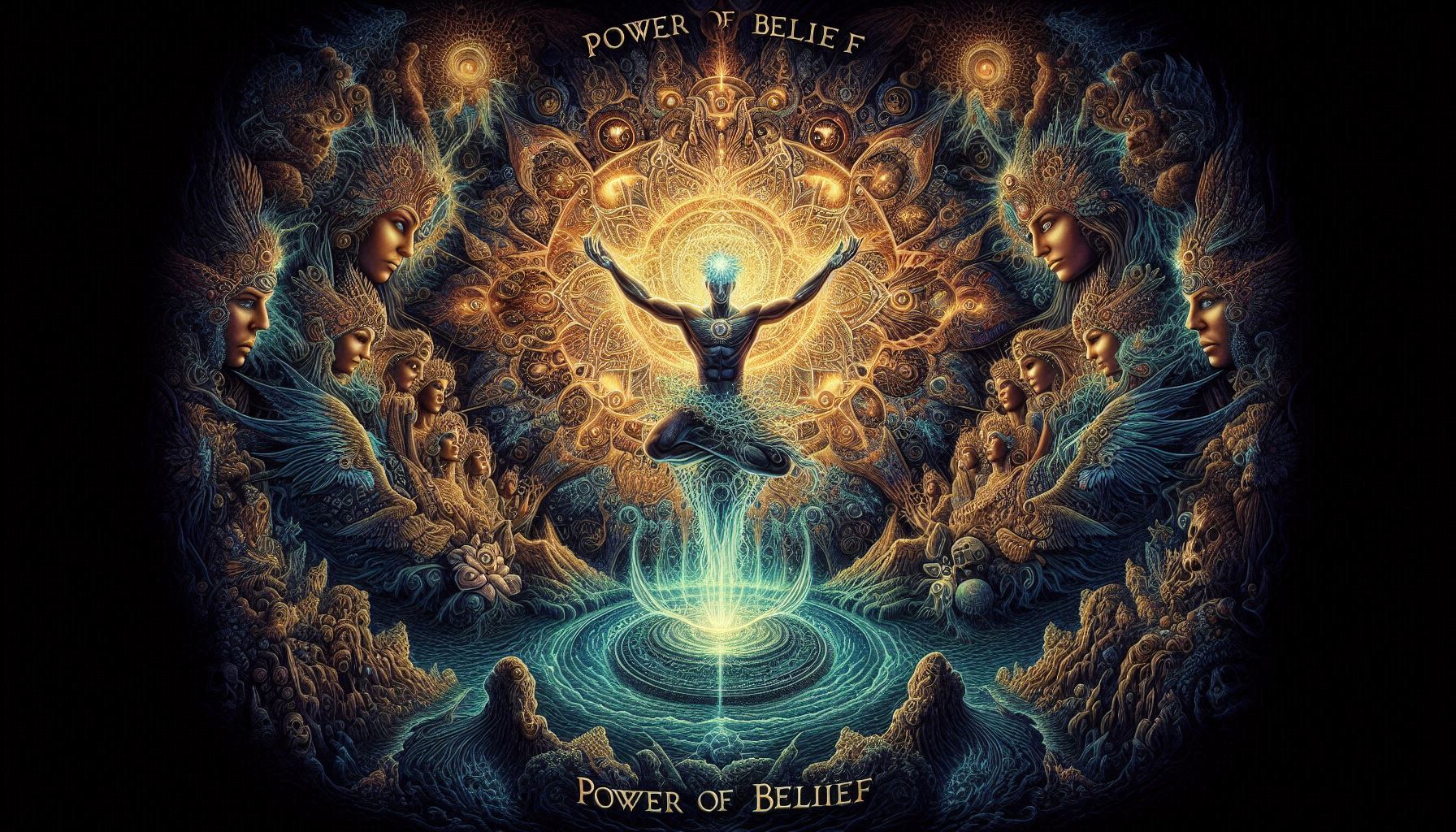
PART VI: BELIEF AND REALITY CREATION
How Thought Narrows Possibility
Thought acts as a selective mechanism that filters the vast range of possible outcomes into a narrow band of perceived options. Beliefs play a decisive role in determining which possibilities the mind considers realistic or accessible. When individuals hold limiting beliefs, their thoughts gravitate toward familiar or predictable outcomes, closing off avenues that might lead to growth. This narrowing creates a sense of constraint even when opportunities exist.
The filtering process occurs automatically. The mind identifies patterns that match existing beliefs and dismisses alternatives that feel incompatible. This reduces cognitive strain but can also create a distorted sense of reality. The world may appear limited not because possibilities are absent, but because the mind excludes them before they enter awareness. This shapes decisions, behaviors, and expectations.
Expectation reinforces the narrowing effect. When a person believes a certain result is likely, their thoughts focus on supporting evidence and ignore contradictory signs. This creates a mental loop where only certain outcomes feel possible. Confidence expands the range of options, while fear contracts it. The emotional tone of belief determines whether thought functions expansively or restrictively.
Thought narrowing also affects creativity. When beliefs support exploration, the mind generates diverse ideas and solutions. When beliefs emphasize safety or predictability, creative thinking diminishes. This occurs not because individuals lack creativity, but because the belief system restricts the space in which creativity can operate.
The Power of Belief influences how thought shapes possibility. When individuals adopt beliefs that expand their sense of potential, thought becomes a tool for exploration rather than limitation. This shift widens the field of perceived options and directs behavior toward paths that were previously unseen. Possibility becomes a function of belief rather than circumstance.
The Mechanics of Manifestation
Manifestation refers to the process by which internal beliefs influence external outcomes through consistent perception, emotion, and action. While often misunderstood, the mechanics of manifestation can be explained through cognitive and behavioral patterns. When individuals hold clear beliefs about what they desire, their mind organizes thoughts and attention toward that direction. This alignment increases the likelihood of taking actions that support the desired outcome.
Manifestation begins with clarity. The mind needs a defined target to direct energy and attention toward. Without clarity, belief lacks direction, and internal resources scatter. Clear beliefs create a mental blueprint that shapes perception and decision-making. This blueprint acts as a guide that influences behavior in subtle but powerful ways.
Emotion amplifies this process. When beliefs are emotionally charged, they activate stronger neural pathways, increasing focus and persistence. Positive emotional states support action and reduce doubt. Negative emotional states create resistance and hesitation. Manifestation becomes most effective when emotional resonance matches the desired outcome.
Behavior completes the process. Belief and emotion influence what actions individuals take and how consistently they take them. Over time, these small behaviors accumulate, creating opportunities that align with the internal blueprint. Manifestation, therefore, emerges from the interplay between belief, emotion, and repeated action.
The Power of Belief drives manifestation by shaping the internal architecture that guides perception and behavior. When beliefs align with purpose and emotion, individuals naturally move toward outcomes that match their internal vision. Manifestation becomes less mystical and more a reflection of psychological alignment.
Internal Reality vs. External Reality
Internal reality consists of beliefs, emotions, expectations, and interpretations. External reality consists of events, environments, and circumstances. These two realities interact constantly, yet internal reality often has greater influence on personal experience. People respond more to what they believe an event means than to the event itself. This makes internal reality a powerful force in shaping life outcomes.
Internal reality shapes perception. When beliefs are empowering, individuals interpret challenges as opportunities for growth. When beliefs are limiting, the same challenges appear overwhelming or threatening. This difference in interpretation affects motivation, resilience, and decision-making.
External reality influences internal reality but does not control it. Two individuals can face the same circumstances and experience them differently based on their beliefs. This divergence demonstrates how internal models filter experience. Beliefs determine whether external events strengthen or weaken internal stability.
Conflict arises when internal and external realities diverge sharply. If a person believes they deserve success but repeatedly experiences failure, they may feel confused or discouraged. Likewise, if external events support growth but internal beliefs reject possibility, opportunities may go unnoticed. Aligning these realities requires adjusting beliefs to reflect current circumstances and goals.
The Power of Belief shapes internal reality in ways that determine how external reality is experienced. When individuals consciously refine their beliefs, they gain greater influence over their emotional and behavioral responses. This alignment improves clarity and increases the coherence between inner and outer worlds.
Embodiment and Lived Belief
Belief becomes fully integrated when it is embodied. Embodiment occurs when the belief is not merely intellectual but expressed through posture, tone, behavior, and emotional presence. People embody beliefs through the way they move, speak, and respond to circumstances. Embodied belief carries more influence than ideas held only in the mind.
Embodiment strengthens neural pathways. When individuals act as if a belief is true, the brain encodes the behavior as evidence. This creates a feedback loop where action reinforces belief and belief reinforces action. Over time, embodiment makes the belief feel natural rather than effortful.
Behavior accelerates embodiment. When individuals practice behaviors tied to a belief, such as confidence or discipline, they internalize the emotional states associated with those behaviors. This strengthens identity and increases consistency. Embodiment turns belief into a lived experience rather than a theoretical concept.
Emotion plays a central role in embodiment. When beliefs evoke strong emotional responses, the body mirrors those emotions through physical cues. These cues influence how others perceive the individual and how the individual perceives themselves. Embodiment becomes a bridge between internal belief and external expression.
The Power of Belief reaches its highest effectiveness when it becomes embodied. Once belief is lived rather than imagined, it shapes identity, presence, and influence. Embodiment transforms belief into a stable foundation that guides behavior with authenticity and consistency.
Narrative Selection
Narrative selection refers to the stories individuals choose to tell themselves about their experiences. These stories form the framework through which people interpret meaning. Beliefs guide narrative selection by influencing which details are emphasized and which are minimized. Two people can experience the same event and tell vastly different stories based on their belief systems.
Narratives shape identity. The stories individuals choose reinforce how they see themselves. When narratives highlight perseverance, growth, and resilience, identity becomes stronger. When narratives emphasize failure, inadequacy, or fear, identity becomes fragile. These stories shape emotional responses and guide future behavior.
Narrative selection influences memory. The mind stores memories in ways that align with existing beliefs. Details that support the chosen narrative become more prominent, while conflicting details fade. This selective memory strengthens belief systems and shapes how individuals view their past.
Narratives influence goals. People choose goals that align with their internal story. A narrative of empowerment leads to ambitious goals. A narrative of limitation restricts ambition. These choices shape the trajectory of personal development and future experiences.
The Power of Belief directs narrative selection. When individuals choose stories that reflect their potential rather than their fears, they reshape identity and expand possibility. By consciously shifting narratives, people gain the ability to redefine their past and direct their future with greater clarity.
Chaos, Order, and Probability Collapse
Chaos and order represent two states of possibility. Chaos contains infinite potential paths, while order represents the structured reality individuals experience. Belief influences how chaos transitions into order by determining which possibilities the mind considers and which actions are taken. This dynamic resembles a collapse of probability into a single lived experience.
Chaos represents unknown variables, unpredictable circumstances, and unformed opportunities. Belief determines whether individuals approach chaos with curiosity or fear. Curiosity encourages exploration, increasing the probability of discovering beneficial outcomes. Fear encourages avoidance, collapsing probability into narrower and more predictable paths.
Order emerges when individuals make decisions guided by their belief systems. Each action removes alternate possibilities and sets a new trajectory. Decisions anchored in strong, positive beliefs lead to pathways filled with clarity and growth. Decisions anchored in doubt or fear lead to paths with limited potential.
Life oscillates between chaos and order. Beliefs provide stability during transitions. When individuals trust their ability to navigate uncertainty, they maintain emotional steadiness even when external conditions fluctuate. This stability increases adaptability and resilience.
The Power of Belief influences probability collapse by determining which possibilities are explored and which become reality. When individuals cultivate beliefs that support exploration and confidence, they navigate chaos effectively and shape order in ways that align with their highest potential.
The Role of Imagination
Imagination is the mind’s ability to construct experiences not yet realized. It serves as a bridge between belief and possibility. When individuals imagine outcomes vividly, they create neural patterns similar to those formed by real experiences. This primes the brain for action and strengthens belief in the imagined outcome.
Imagination influences emotion. Visualizing success generates emotional responses that reinforce belief in capability. This emotional resonance encourages behavior aligned with the imagined goal. Negative imagination, however, can create fear and avoidance, strengthening limiting beliefs.
Imagination supports problem-solving. When individuals explore scenarios mentally, they gain insight into potential solutions and strategies. This cognitive flexibility increases resilience and adaptability. Imagination expands the mind’s sense of possibility by introducing new ideas and perspectives.
Imagination shapes identity. People envision versions of themselves that reflect their desires or fears. These imagined identities influence how they interpret challenges and opportunities. When imagination aligns with positive beliefs, identity expands. When it aligns with fear, identity contracts.
The Power of Belief is amplified by imagination. When belief reinforces imagined possibilities, the mind begins treating them as achievable. This alignment creates a powerful internal force that drives action, creativity, and long-term vision. Imagination becomes a tool for shaping reality when guided by healthy beliefs.
Emotional Alchemy
Emotional alchemy refers to the ability to transform emotional states through deliberate belief and interpretation. Rather than suppressing emotions, individuals learn to reinterpret their meaning. Beliefs determine whether emotions are viewed as obstacles or signals that support growth. This reinterpretation converts difficult emotions into resources.
Emotional alchemy begins with awareness. When individuals observe their emotions without judgment, they gain insight into the beliefs that triggered them. This observation reduces reactivity and opens space for reinterpretation. Emotional clarity emerges as beliefs and feelings become linked more consciously.
Reframing strengthens emotional alchemy. By changing the interpretation of an event, individuals change their emotional response. A failure can be reinterpreted as feedback. A conflict can be viewed as an opportunity for communication. This mental alchemy transforms emotional experiences without denying their intensity.
Physical regulation supports emotional transformation. Breathing, movement, and grounding techniques influence the nervous system, reducing the emotional charge around challenging beliefs. This physiological clarity makes reinterpretation easier and more effective.
The Power of Belief shapes emotional alchemy by determining how emotions are interpreted. When individuals hold beliefs that support growth and resilience, emotions become tools rather than threats. This shift enhances emotional intelligence and empowers individuals to navigate life with greater balance and adaptability.
Identity Shifting
Identity shifting involves adopting new beliefs about who one is capable of becoming. This process transforms behavior, perception, and emotional responses. When individuals shift identity, they replace old self-concepts with new ones that support growth. Identity becomes flexible rather than fixed, allowing for evolution.
Identity shifts begin with recognizing outdated self-beliefs. These beliefs often emerge from past experiences that no longer reflect current capability. By questioning these assumptions, individuals create space for new identity structures. This awareness sets the foundation for transformation.
Behavior accelerates identity shifts. When individuals act in alignment with their desired identity, they generate internal evidence that supports the new self-concept. Repeated action strengthens the emerging identity and weakens the old one. Over time, the new identity becomes familiar and stable.
Emotion supports identity change. When individuals emotionally invest in their desired identity, the belief becomes more deeply rooted. Emotional resonance accelerates the integration process, making the new identity feel authentic rather than forced.
The Power of Belief defines the boundaries of identity. When individuals challenge and expand these boundaries, they gain the ability to shift who they are. Identity shifting becomes a powerful tool for personal evolution, allowing individuals to grow into versions of themselves that reflect their highest potential.
Creating Reality Through Meaning
Meaning is the lens through which individuals interpret experience. It shapes beliefs, emotions, and behaviors. When people assign meaning to events, they define how those events influence their internal world. Meaning-making becomes a central force in creating reality. Two individuals can experience the same moment but create entirely different internal realities based on the meaning they attach to it.
Meaning is influenced by belief. Empowering beliefs create meanings that support resilience and growth. Limiting beliefs create meanings that reinforce fear or stagnation. This connection shapes how individuals navigate challenges and opportunities. Meaning determines whether an event strengthens or weakens personal development.
Meaning evolves over time. Experiences once interpreted negatively can acquire new significance when viewed from a different perspective. This evolution reflects the dynamic nature of belief. As beliefs shift, the meaning of past and present events also transforms, altering the internal landscape of the individual.
Meaning shapes relationships. The interpretation of others’ actions determines how individuals respond emotionally. When people assign constructive meanings, interactions improve. When they assume negative intent, conflict increases. Meaning becomes the foundation of relational dynamics.
The Power of Belief guides meaning-making by shaping interpretation and emotional response. When individuals consciously choose meanings that support growth, they transform their internal reality. Meaning becomes a tool for creating a life that aligns with purpose, clarity, and emotional stability.

PART VII: BREAKING AND REBUILDING BELIEF
Identifying Limiting Beliefs
Limiting beliefs often operate quietly beneath conscious awareness, shaping choices and reactions without being questioned. These beliefs develop through repeated experiences, emotional conditioning, or inherited narratives. To identify them, individuals must observe patterns of avoidance, fear, or self-doubt. These patterns often point toward beliefs that restrict personal growth or distort self-perception.
Awareness begins with noticing internal resistance. When individuals feel consistent hesitation toward opportunities or discomfort in specific situations, an underlying belief is usually directing that reaction. These beliefs may sound like internal statements such as “I’m not capable,” “I don’t belong,” or “Things never work out for me.” These phrases can reveal the structure of the belief system.
Self-reflection helps uncover limiting beliefs. By examining repeated life experiences, individuals can identify themes that indicate where their internal assumptions are directing outcomes. Patterns in relationships, finances, creativity, or confidence often trace back to deeply rooted beliefs that influence behavior automatically.
Feedback from others can also highlight limiting beliefs. Sometimes the people around us notice our blind spots before we do. When multiple individuals offer similar observations about behavior or potential, it may indicate that a limiting belief is shaping perception and choice.
The Power of Belief becomes transformative when limiting beliefs are identified clearly. Once these patterns are recognized, individuals gain the ability to question their validity and explore new possibilities. This awareness marks the first step in liberating the mind from outdated assumptions and opening space for healthier belief structures.
Source-Tracing Belief Origins
Tracing beliefs back to their origins reveals how they formed and why they persist. Many beliefs began as interpretations made during emotionally charged experiences. These interpretations may have been reasonable at the time but become limiting as circumstances change. By exploring the roots of these beliefs, individuals can understand their emotional context and loosen the grip these beliefs hold.
Source-tracing often begins in childhood. Early interactions with caregivers, peers, and environments shape foundational assumptions. Beliefs formed before the age of reason can remain active even when they no longer reflect current reality. Recognizing this helps individuals treat old beliefs with compassion rather than judgment.
Significant emotional events often create powerful belief anchors. Moments of failure, rejection, or trauma can solidify beliefs about safety, worthiness, or capability. Tracing beliefs to these moments allows individuals to reinterpret them with greater maturity and perspective. This reinterpretation weakens the original emotional charge.
Cultural and social influences also shape belief origins. Families, communities, and institutions carry collective narratives that become internalized. By identifying where these beliefs originated, individuals can determine whether they align with personal truth or merely reflect inherited patterns.
The Power of Belief becomes more flexible when origins are understood. Source-tracing exposes the roots of belief, making them easier to dismantle. When individuals understand why a belief formed, they gain the clarity needed to release it and build a more authentic and empowering alternative.
Emotional Excavation
Emotional excavation involves exploring the feelings tied to a belief. Beliefs are not solely intellectual; they are emotionally anchored. By examining the emotions attached to a belief, individuals can uncover hidden motivations, fears, and interpretations that keep it alive. This process requires patience and emotional honesty.
Excavation begins with naming the emotion. Identifying whether a belief is rooted in fear, shame, sadness, or anger provides insight into its function. These emotions often protect the individual from experiences that once felt overwhelming. Recognizing this protective role helps reduce internal resistance.
Emotions often reveal deeper layers of belief. For example, a fear of failure may hide a belief of inadequacy. A fear of abandonment may hide a belief of unworthiness. Excavation uncovers these layers, allowing individuals to address the core belief rather than surface-level symptoms.
Emotional processing occurs through reflection, journaling, or mindful observation. As individuals sit with the emotion, they discover the stories attached to it. These stories often reveal the original interpretations that shaped the belief. Once these stories are seen clearly, they can be rewritten.
The Power of Belief evolves through emotional excavation. When emotions tied to limiting beliefs are processed, the belief loses its intensity. This weakens the subconscious grip and opens space for new interpretations. Emotional clarity becomes a foundational step in restructuring the belief system.
Cognitive Rewiring
Cognitive rewiring involves replacing outdated thought patterns with healthier, more accurate beliefs. This process relies on repetition, intentional reframing, and conscious correction of automatic thoughts. The brain adapts through neural plasticity, forming new connections that support updated belief structures. Rewiring requires consistency and patience.
The first step is recognizing thought patterns that reinforce limiting beliefs. These thoughts may appear as self-criticism, catastrophic predictions, or pessimistic interpretations. Once identified, these patterns can be interrupted through conscious redirection. This interruption weakens the old neural pathway.
Reframing replaces negative patterns with healthier alternatives. When individuals challenge limiting interpretations and offer new explanations, they create cognitive flexibility. This flexibility allows the mind to consider possibilities that were previously dismissed. Over time, reframing becomes automatic.
Behavioral reinforcement strengthens rewiring. When individuals act in alignment with their new beliefs, they generate internal evidence that supports the cognitive shift. This evidence accelerates the rewiring process, making the new belief feel grounded in experience rather than imagination.
The Power of Belief becomes structurally embedded through cognitive rewiring. As new neural pathways strengthen, the old belief system fades. This transformation allows individuals to maintain healthier thought patterns without constant effort. Rewiring makes new beliefs stable and enduring.
Somatic Patterns and Trauma Beliefs
The body stores patterns associated with past experiences. These somatic imprints can influence beliefs by triggering physical reactions that feel instinctive. When trauma or strong emotion becomes encoded in the nervous system, the body reacts to reminders even when the mind understands the situation differently. These reactions shape belief by reinforcing feelings of threat or vulnerability.
Somatic patterns appear as tension, numbness, constriction, or heightened alertness. These sensations often arise before conscious thought. The body reacts based on past experiences, sending signals that the mind interprets as danger or discomfort. These interpretations strengthen trauma-based beliefs.
Trauma beliefs persist because the body continues to respond as if the original threat is present. Even when circumstances change, the nervous system may remain sensitive. This sensitivity influences perception, decision-making, and emotional regulation, reinforcing the belief that the world is unsafe or unpredictable.
Somatic awareness allows individuals to differentiate between past and present. By observing bodily reactions without judgment, they can recognize when physical responses are rooted in old experiences. This awareness creates separation between the somatic imprint and the current situation.
The Power of Belief becomes more grounded when somatic patterns are understood and regulated. As individuals learn to soothe the nervous system and reinterpret bodily signals, trauma-based beliefs weaken. This integration of mind and body supports authentic belief transformation and emotional healing.
Shadow Projections
Shadow projections occur when individuals attribute disowned aspects of themselves onto others. These projections often arise from beliefs that certain traits are unacceptable or unsafe to express. When individuals reject parts of their identity, these traits remain in the subconscious, influencing behavior indirectly. This creates distorted perceptions of others and reinforces limiting beliefs.
Shadows form when experiences or messages teach individuals to suppress certain qualities. Strength, vulnerability, ambition, sensitivity, or independence may be pushed into the subconscious depending on cultural or familial expectations. These disowned traits become emotionally charged beliefs that shape perception.
Projections occur when individuals encounter someone who embodies the rejected trait. The unconscious mind reacts strongly, often with irritation, admiration, or judgment. These reactions reveal the hidden beliefs that dictate which traits have been disowned. Projection serves as a mirror, reflecting internal conflict.
Recognizing shadow projections requires self-honesty. When emotional reactions seem disproportionate, it often indicates a projection. By examining what the reaction reveals about internal beliefs, individuals can reclaim the disowned trait and reintegrate it into identity.
The Power of Belief strengthens when shadow material is integrated. Reclaiming disowned traits reduces internal fragmentation and increases authenticity. This integration allows for a more complete and balanced belief system that supports emotional freedom and personal growth.
Reframing Identity
Reframing identity involves updating the beliefs that define who a person is. Identity often forms unconsciously based on early experiences, emotional patterns, and social feedback. Over time, these beliefs may become outdated, restricting potential. Reframing identity requires conscious examination of these assumptions and deliberate construction of a more accurate self-concept.
Identity reframing begins with recognizing inconsistencies between current capability and old beliefs. When individuals outgrow their original circumstances, their identity must expand to reflect their new reality. This process involves questioning statements such as “I’m not good at this” or “I always fail,” which may no longer be true.
New identity frameworks emerge through intentional belief adoption. Individuals choose beliefs that reflect their strengths, values, and aspirations. This active shaping of identity creates a more empowering internal foundation. The reframing process becomes a dialogue between who they were and who they are becoming.
Behavior confirms identity. When individuals act in alignment with their reframed beliefs, they accumulate evidence that supports the new identity. This evidence stabilizes the internal shift and makes the identity feel authentic. Without action, identity remains theoretical rather than lived.
The Power of Belief becomes transformative when applied to identity. Reframing requires both self-awareness and courage, but it creates profound personal evolution. A consciously shaped identity becomes a stable structure that supports long-term growth, resilience, and purpose.
Forgiveness and Release
Forgiveness dissolves emotional patterns tied to limiting beliefs. Holding onto resentment, guilt, or regret reinforces beliefs that restrict emotional freedom. Forgiveness does not erase past experiences but releases the emotional weight that keeps old beliefs active. This release opens space for new perspectives and healthier belief systems.
Forgiveness begins with acknowledging the emotional impact of an event. Rather than suppressing pain, individuals face it directly. This honesty creates clarity and reduces internal resistance. Once the emotional experience is recognized, forgiveness becomes a choice rather than an obligation.
Forgiving others frees the mind from narratives that reinforce victimhood or powerlessness. When individuals hold onto resentment, their beliefs remain tied to past harm. Forgiveness shifts focus from the perpetrator to personal freedom, allowing old stories to dissolve. This shift weakens beliefs rooted in past wounds.
Forgiving oneself is equally important. Self-judgment reinforces beliefs of inadequacy or unworthiness. Releasing these judgments allows individuals to adopt beliefs that reflect compassion and understanding. This process strengthens emotional resilience and supports identity reconstruction.
The Power of Belief deepens through forgiveness. As emotional burdens are released, the mind becomes more open to growth and possibility. Forgiveness clears the internal landscape, making room for new beliefs that support empowerment and inner peace.
Internal Power Retrieval
Internal power retrieval involves reclaiming aspects of confidence, intuition, and self-trust that were lost through past experiences. When individuals face trauma, rejection, or intense criticism, they often suppress parts of themselves to feel safe. This suppression creates beliefs that weaken internal power. Retrieval restores these lost capacities.
The process begins by identifying where power was lost. Emotional patterns of fear, avoidance, or self-doubt often point to moments where the individual abandoned their own voice or value. Recognizing these moments reveals the beliefs that maintain the disempowerment.
Retrieval requires re-engaging with traits that were suppressed. Courage, assertiveness, creativity, or authenticity must be expressed deliberately. As these traits re-emerge, the belief system updates to accommodate the restored capacities. This strengthens identity and emotional stability.
Boundaries support power retrieval. When individuals protect their energy, time, and emotional space, they reaffirm their worth and rebuild internal authority. Boundaries act as external expressions of internal belief, reinforcing the reclaimed power.
The Power of Belief becomes a stabilizing force during power retrieval. As individuals reclaim their lost capacities, their beliefs reorganize around strength rather than vulnerability. This creates a foundation for long-term confidence, resilience, and self-trust.
Choosing a New Belief System
Choosing a new belief system requires conscious evaluation of which beliefs support personal growth and which restrict it. This process involves identifying values, intentions, and long-term goals. Beliefs aligned with these elements create internal harmony, while conflicting beliefs create tension and confusion. Selecting a belief system becomes an act of intentional self-creation.
The first step is identifying core values. These values represent what truly matters to the individual. When beliefs align with values, they create emotional coherence and psychological stability. When beliefs conflict with values, internal friction arises, making growth more difficult.
Next, individuals define their long-term goals. Beliefs must support the identity and actions required to achieve these goals. Limiting beliefs that contradict long-term aspirations must be replaced with beliefs that foster confidence, capability, and perseverance.
Adopting new beliefs involves consistent reinforcement. Repetition, visualization, and behavioral alignment help the new belief system become ingrained. This process transforms belief from an idea into a lived reality.
The Power of Belief reaches its full potential when individuals consciously choose beliefs that reflect their highest aspirations. A chosen belief system becomes the guiding structure that shapes identity, behavior, and destiny. This intentional creation of belief empowers individuals to build lives aligned with purpose and authenticity.

PART VIII: BUILDING UNSHAKABLE BELIEF
Constructing Core Identity
Core identity forms the central framework that guides belief, behavior, and emotional stability. It represents the foundational understanding of who a person is at their deepest level. When core identity is consciously constructed rather than inherited from past experiences, individuals develop a stable internal foundation that supports long-term growth and resilience. Constructing core identity requires clarity, intention, and emotional honesty.
The process begins with identifying the essential qualities a person wants to embody. These qualities form the backbone of identity and influence how challenges, opportunities, and relationships are approached. Qualities such as courage, integrity, creativity, or discipline become structural anchors that guide belief and decision-making.
Core identity stabilizes emotional responses. When individuals know who they are, external circumstances influence them less. Challenges become tests of character rather than threats. This stability reduces reactivity and supports rational evaluation, making it easier to maintain strong beliefs even in uncertain situations.
Identity becomes reinforced through consistent action. The more individuals behave in ways that reflect their chosen identity, the stronger that identity becomes. This creates a self-reinforcing loop where behavior strengthens belief and belief strengthens behavior. Over time, the chosen identity becomes natural, intuitive, and deeply internalized.
The Power of Belief becomes unshakable when core identity is built intentionally. A consciously crafted identity provides a dependable foundation that stabilizes thought, emotion, and action. It becomes the anchor that supports psychological coherence and long-term self-mastery.
Purpose and Direction
Purpose provides the deeper meaning that guides belief and action. When individuals understand their purpose, their belief system organizes itself around fulfilling that purpose. This creates direction, clarity, and internal coherence. Without purpose, beliefs scatter, goals lose meaning, and motivation dissolves. Purpose becomes the compass that orients the mind toward meaningful outcomes.
Purpose emerges from introspection and emotional resonance. Individuals discover purpose by examining what inspires them, what challenges they feel called to solve, and what values they hold most deeply. Purpose is not assigned; it is uncovered through alignment with inner truth.
Direction strengthens belief by providing a clear target. When individuals know where they are headed, uncertainty becomes manageable. Purpose transforms effort into meaningful investment. This reduces emotional fatigue and increases persistence during difficult periods, as the individual understands the larger context behind their actions.
Purpose also simplifies decision-making. Choices become easier when they align with a defined direction. Conflicts diminish because purpose provides a filter that clarifies priorities. Beliefs organize themselves naturally around this clarity, strengthening internal consistency.
The Power of Belief expands when guided by purpose. Purpose gives belief structure, meaning, and emotional weight. It turns belief from a mental concept into a guiding force capable of shaping identity, behavior, and long-term fulfillment.
Ritualized Intention
Ritualized intention transforms belief into a consistent practice. Rituals create emotional and psychological stability by providing structure and repetition. When individuals engage in rituals that reinforce their beliefs, those beliefs become deeply rooted in the subconscious. Ritualized intention bridges the gap between thought and embodiment.
Rituals do not need to be elaborate. They can include daily affirmations, meditation, gratitude practices, or structured goal review. These actions create moments of focus that anchor belief into the present moment. The repetition of intention strengthens neural pathways and emotional resonance.
Rituals also create symbolic meaning. When individuals treat certain actions as sacred or significant, the mind assigns deeper value to them. This value increases motivation and commitment, making it more likely that beliefs remain consistent over time. Ritual becomes a grounding force that stabilizes belief through consistent engagement.
Emotional investment enhances the effectiveness of ritual. When individuals infuse rituals with sincerity and focus, the emotional system reinforces the belief being cultivated. This emotional reinforcement accelerates internal alignment and deepens the impact of the practice.
The Power of Belief becomes more durable when intention is ritualized. Rituals turn belief into a lived experience, strengthening subconscious integration and supporting long-term consistency. They serve as anchors that keep belief stable even during periods of stress or uncertainty.
The Science of Repetition
Repetition is the mechanism through which beliefs transition from conscious ideas to subconscious truths. The brain requires repeated exposure to new thoughts or behaviors to rewire neural pathways. This process transforms unfamiliar beliefs into automatic patterns. Repetition becomes the engine that drives belief integration.
Repetition strengthens synaptic connections. Each time a belief-related thought or action is repeated, the neural pathway becomes more efficient. Over time, this efficiency reduces the mental effort required to maintain the belief. The subconscious adopts the pattern, making new beliefs feel natural rather than forced.
Consistency enhances repetition. Sporadic effort yields limited results, while daily repetition accelerates integration. When individuals engage with new beliefs regularly, the brain encodes these patterns with greater intensity. This consistency enables belief shifts that remain stable even under stress.
Repetition shapes identity. As individuals practice new beliefs, they accumulate evidence that supports the emerging identity. This evidence becomes internal proof that reinforces the belief system. Identity and belief form a feedback loop that strengthens both elements simultaneously.
The Power of Belief grows through repetition. When repeated consistently, even small belief shifts accumulate into major internal transformations. Repetition becomes the bridge between conceptual understanding and embodied truth, allowing new beliefs to become part of the individual’s core experience.
Inhabiting the New Identity
Inhabiting a new identity means acting, thinking, and responding as the person one intends to become. This process transforms belief into lived reality. When individuals inhabit new identities, they accelerate internal change by aligning behavior with desired beliefs. Identity becomes experiential rather than theoretical.
The process begins with visualization. Individuals imagine how their desired identity would react in various situations. This mental rehearsal prepares the mind for action. When real situations arise, the brain references these rehearsed patterns, making it easier to behave consistently with the new identity.
Behavioral alignment reinforces identity. When individuals act confidently, responsibly, or creatively, they send signals to the brain that these qualities are authentic. This evidence solidifies the new identity and weakens old patterns that conflict with it. Repetition strengthens the emerging self-concept.
Emotional alignment supports embodiment. When individuals allow themselves to feel the emotions associated with the new identity—courage, calm, confidence—the belief becomes integrated more deeply. Emotion provides the energetic charge that anchors the identity into the subconscious.
The Power of Belief intensifies when individuals inhabit their new identity fully. This alignment between thought, emotion, and action accelerates personal transformation. Identity becomes not just a belief but a lived expression of the individual’s highest potential.
Emotional Certainty
Emotional certainty occurs when individuals feel confident in their beliefs at a visceral level. While intellectual certainty is based on logic, emotional certainty is grounded in the nervous system. It reflects a deep internal conviction that shapes reactions, decisions, and behavior. When emotional certainty is strong, external events have less influence over internal stability.
Certainty is built through repeated emotional experiences. When individuals consistently feel capable, respected, or purposeful, the emotional system reinforces these beliefs. Over time, these experiences create a stable foundation that supports long-term belief. Emotional certainty becomes a core component of resilience.
Beliefs become fragile when emotional certainty is weak. Individuals may understand a belief logically but struggle to embody it emotionally. This creates internal conflict and inconsistency. Strengthening emotional certainty requires engaging with experiences that reinforce the belief until it becomes deeply rooted.
Emotional certainty also influences influence and leadership. People naturally respond to individuals who project calm conviction. This emotional stability creates trust, consistency, and respect. Emotional certainty becomes a valuable asset in personal relationships and professional environments.
The Power of Belief becomes grounded through emotional certainty. When belief resonates emotionally, it becomes unshakable. This certainty supports confidence, authenticity, and long-term personal alignment, creating a stable foundation for growth.
Internal Alignment Practices
Internal alignment practices are methods that bring thought, emotion, and behavior into harmony. When these elements align, belief becomes stable and coherent. Internal alignment reduces cognitive conflict and increases the efficiency of decision-making. Practices supporting alignment help individuals maintain clarity even during stressful or complex situations.
Breathing exercises, meditation, and mindfulness calm the nervous system. These practices create internal space where beliefs can be examined without emotional overwhelm. This clarity supports the integration of new beliefs, making them easier to embody.
Journaling and reflective writing organize thought. By putting beliefs and emotions into words, individuals clarify their internal world. This clarity reduces confusion and strengthens the connection between desired beliefs and daily behavior.
Behavioral alignment reinforces internal coherence. When individuals act consistently with their values and goals, they reduce internal conflict. This strengthens belief and increases emotional stability. Action becomes an expression of inner truth rather than a response to external pressure.
The Power of Belief flourishes when supported by internal alignment practices. These methods stabilize the mind and emotions, enabling belief systems to remain strong even under pressure. Alignment becomes a daily discipline that reinforces psychological and emotional coherence.
Daily Belief Engineering
Daily belief engineering is the practice of consciously reinforcing desired beliefs on a consistent basis. This method treats belief as a skill that can be trained through intention, repetition, and reflection. When individuals engage in belief engineering daily, they gradually reshape their internal world in ways that support long-term growth.
The process begins with morning intention-setting. By defining the day’s core belief—confidence, clarity, discipline, creativity—the mind becomes primed to notice opportunities aligned with that belief. This primes thought and behavior to support the desired internal state.
Throughout the day, micro-adjustments reinforce the belief. When old patterns appear, individuals redirect their thoughts toward the desired belief. These small corrections create new neural pathways and weaken outdated patterns. Over time, these adjustments become automatic.
Evening reflection completes the engineering process. By reviewing the day’s actions and emotional responses, individuals identify moments where the belief system held strong and moments where it faltered. This reflection strengthens self-awareness and supports continued improvement.
The Power of Belief becomes a daily discipline through belief engineering. This consistent practice transforms belief into a reliable internal structure. Over time, individuals build belief systems that support confidence, purpose, and emotional strength.
Strengthening the Subconscious
Strengthening the subconscious involves aligning underlying emotional patterns with conscious beliefs. The subconscious operates faster than logic and influences behavior automatically. When subconscious beliefs support growth, individuals act with confidence and consistency. Strengthening the subconscious ensures that empowering beliefs take root deeply and operate without constant effort.
Repetition is the primary method for subconscious integration. When beliefs are reinforced through repeated thought, emotion, and behavior, the subconscious adopts them as truth. This process requires consistency and emotional engagement.
Visualization strengthens subconscious belief. By imagining successful outcomes vividly, individuals program the subconscious to expect those results. The emotional charge behind visualization influences how deeply the belief is absorbed.
Affirmations support subconscious integration when spoken with emotion and conviction. Repetition alone is insufficient; the subconscious responds to authenticity and alignment between words and emotional tone. When affirmations reflect genuine intention, they help reshape subconscious patterns.
The Power of Belief becomes effortless when the subconscious is aligned with conscious intention. Strengthening the subconscious creates internal harmony, reducing resistance and increasing stability. This alignment supports long-term transformation with minimal internal conflict.
Integrative Reality Mapping
Integrative reality mapping is the practice of organizing beliefs, goals, values, and identity into a unified internal structure. This mapping helps individuals understand how each element influences their perception and behavior. When reality is mapped intentionally, belief becomes a coherent system rather than a collection of disconnected ideas.
Mapping begins with identifying core beliefs and examining how they influence daily life. Individuals explore how these beliefs shape relationships, decisions, and emotional patterns. This awareness creates a structured understanding of the internal world.
Next, individuals map their long-term goals and values. These elements provide direction and help identify which beliefs support or undermine personal vision. When beliefs conflict with values or goals, adjustments are required to create alignment.
The mapping process reveals gaps. These gaps often highlight limiting beliefs or outdated identity structures that need revision. By identifying these areas, individuals gain clarity on what changes are necessary for internal coherence.
The Power of Belief becomes fully activated when reality is mapped integratively. This structured approach creates a unified internal framework that supports clarity, resilience, and purpose. Integrative mapping transforms belief from a passive force into a consciously designed system.

PART IX: HIGH-LEVEL BELIEF TECHNOLOGIES
Archetype Integration
Archetype integration involves adopting symbolic patterns of thought and behavior that represent universal human qualities. These archetypes—such as the Warrior, the Creator, the Sage, or the Healer—serve as psychological templates that guide action and identity. When individuals integrate an archetype, they activate specific belief patterns associated with that role, expanding their internal capabilities and emotional range.
Archetypes operate at both conscious and subconscious levels. Consciously, they provide models of behavior that help individuals navigate complex situations. Subconsciously, they influence emotional resonance and instinctive responses. Integrating an archetype can reveal strengths that were previously dormant or underdeveloped.
Archetype work requires self-awareness. Individuals must identify which archetypes resonate with their aspirations and which are needed to support their development. This process often reveals imbalances—for example, an overdeveloped inner critic paired with an underdeveloped inner leader. Addressing these imbalances strengthens internal coherence.
Activation occurs through behavior and imagination. When individuals act in alignment with an archetype, they internalize its qualities. Visualization deepens this process by giving emotional and symbolic form to the archetype. Over time, repeated engagement strengthens belief in the qualities the archetype represents.
The Power of Belief expands when archetypes are consciously integrated. These symbolic frameworks provide psychological depth, emotional strength, and directional clarity. Archetype integration becomes a high-level method for shaping identity and unlocking dormant capacities.
Sigil and Symbol Programming
Sigil and symbol programming uses visual symbols to encode intention directly into the subconscious. Symbols bypass logical analysis and communicate with the emotional and intuitive layers of the mind. This makes them valuable tools for updating belief systems, reinforcing identity shifts, and amplifying intention.
Creating a sigil requires distilling an intention into a simple visual form. The process itself strengthens clarity because it forces individuals to define their belief precisely. Once the sigil is created, it acts as a symbolic anchor that reinforces the desired belief each time it is viewed or contemplated.
Symbols influence the subconscious through repetition and emotional association. When individuals associate a sigil with a specific identity or intention, the mind begins linking that symbol to the belief it represents. This connection strengthens each time the symbol is activated through visualization, ritual, or focused attention.
Symbol programming also reduces mental resistance. Logical resistance often weakens belief formation, but symbolic communication engages deeper layers of the mind that are more receptive to belief change. This creates a smoother pathway for integrating new beliefs without internal conflict.
The Power of Belief becomes more accessible when translated into symbolic form. Sigils and symbols act as compact carriers of intention, allowing individuals to reinforce beliefs consistently and efficiently. This technique becomes a powerful tool for subconscious influence and long-term transformation.
Language as Reality Architecture
Language shapes thought, and thought shapes belief. The words individuals use influence how they perceive themselves, others, and the world. Language becomes an architecture for internal reality, constructing the mental spaces in which beliefs form. Carefully chosen language can strengthen empowering beliefs, while careless language can reinforce limitation.
Words create categories and boundaries. When individuals describe themselves as incapable or unlucky, their language builds a belief structure that supports those identities. Conversely, when they use language that reflects capability and resilience, the mind adapts by forming supportive beliefs. Language becomes a tool for shaping identity.
Metaphors also influence belief. People often think in symbolic terms, using narratives and imagery to understand their experiences. These metaphors guide emotional interpretation and behavioral response. Changing metaphors can shift how individuals perceive challenges, turning obstacles into opportunities for growth.
Internal dialogue holds particular power. The tone and content of self-talk influence emotional states and expectations. When self-talk reflects clarity and confidence, beliefs strengthen. When self-talk is critical or fearful, beliefs weaken. Becoming aware of internal language patterns is essential for maintaining psychological alignment.
The Power of Belief grows when language is used intentionally. By shaping internal and external speech, individuals build a reality that reflects their highest potential. Language becomes both the blueprint and the foundation of personal evolution.
The Power of Naming
Naming is a method of defining and focusing belief. When individuals name a fear, goal, or identity, they give it shape and structure within the mind. This clarity allows the mind to work with the concept more directly. Naming transforms vague feelings into tangible elements that can be addressed, strengthened, or released.
Names carry symbolic weight. Each word carries emotional and cultural associations that influence how the mind responds. Naming a challenge as “a test” rather than “a threat” alters the emotional experience. Naming oneself as “capable” instead of “trying” shifts identity from effort to mastery. These linguistic shifts shape belief at its core.
Naming also reveals hidden beliefs. When individuals articulate their internal assumptions, they gain insight into the patterns driving their behavior. This awareness exposes outdated narratives and creates opportunities for belief revision. The act of naming brings subconscious elements into conscious view.
Renaming is equally powerful. When individuals deliberately choose new names for their roles, experiences, or identities, they reshape their internal models. Renaming becomes a symbolic reset that allows old beliefs to dissolve and new beliefs to take root.
The Power of Belief is strengthened through the act of naming. Clear definitions create psychological structure, while intentional naming allows individuals to rewrite the internal vocabulary that shapes their reality. Naming becomes a precise tool for belief engineering.
Altered States and Belief Insertion
Altered states—such as meditation, trance, deep relaxation, flow, or hypnagogic states—reduce the mind’s analytical resistance and open the subconscious to new beliefs. In these states, emotional and sensory filters shift, creating a more direct pathway between intention and subconscious integration. This makes altered states powerful tools for inserting new belief structures.
Altered states reduce cognitive rigidity. The mind becomes more flexible, allowing new ideas to feel less threatening. This temporary softening of mental boundaries makes it easier to introduce beliefs that support growth and transformation. Individuals often experience increased clarity and heightened intuition during these states.
Emotional receptivity increases in altered states. The nervous system enters patterns of reduced stress, allowing new beliefs to be associated with calm and coherence. These emotional associations strengthen subconscious adoption, making the belief feel more natural and authentic.
Visualization becomes more vivid in altered states. When individuals imagine desired outcomes with enhanced sensory detail, the subconscious encodes the imagery more deeply. This creates internal evidence that reinforces belief, making the new pattern feel familiar even before it manifests externally.
The Power of Belief accelerates in altered states. By intentionally accessing these states and introducing aligned belief patterns, individuals create powerful shifts in identity and perception. Altered states become a gateway for deep and lasting transformation.
Hypnosis and Self-Hypnosis
Hypnosis and self-hypnosis provide direct access to subconscious processing. These techniques quiet the analytical mind and create a focused state in which beliefs can be examined and updated. Hypnotic states amplify suggestibility, enabling individuals to internalize new belief patterns with greater efficiency.
Hypnosis works by narrowing attention. When external distractions fade, the mind becomes more receptive to specific suggestions. This focused attention allows new beliefs to bypass critical filters and integrate directly into the subconscious. The process is gentle, relying on cooperation rather than force.
Self-hypnosis empowers individuals to guide their own belief transformation. By learning to induce relaxation and focus, they can introduce affirmations, visualizations, or symbolic imagery that reinforce desired belief systems. The effectiveness increases when the suggestions align with personal values and emotional truth.
Hypnosis also supports trauma resolution. By accessing subconscious material safely, individuals can reinterpret old experiences, weakening the beliefs built around them. This creates emotional release and opens space for healthier beliefs to emerge.
The Power of Belief becomes accessible through hypnotic techniques. These methods enhance the mind’s ability to integrate new patterns, providing a direct pathway for belief engineering. Hypnosis becomes a practical tool for deep psychological change when used with intention and clarity.
Servitors and Thought-Forms
Servitors and thought-forms are psychological constructs designed to hold and execute specific intentions. These constructs operate as extensions of belief, focusing mental energy on particular tasks or qualities. While often associated with esoteric traditions, servitors can be understood as structured belief systems that operate autonomously once activated.
A servitor begins with a clear purpose. Individuals define the goal, parameters, and limitations of the construct. This clarity shapes the belief framework that guides the servitor’s behavior. When the intention is precise, the subconscious treats the servitor as a stable pattern that supports the desired outcome.
Thought-forms strengthen through emotional investment. The more energy and attention individuals give to the construct, the more active it becomes. This repeated focus reinforces the belief underlying the servitor, making it more effective in influencing perception and behavior.
Servitors function by directing attention and motivation. When individuals create a servitor for discipline or creativity, their mind becomes more attuned to opportunities and behaviors that support those qualities. The servitor acts as an anchor that stabilizes belief and encourages consistent action.
The Power of Belief becomes externalized through servitors and thought-forms. These constructs demonstrate how belief can be shaped into structured tools that support personal evolution. When used responsibly, servitors become powerful allies in reinforcing intention and accelerating transformation.
Timeline Engineering
Timeline engineering involves making deliberate choices that redirect one’s life trajectory. Each decision influences the direction of future experiences, creating branching pathways of probability. Belief plays a central role in timeline engineering by determining which choices feel accessible and which remain unexplored.
The process begins with recognizing that the future is not predetermined. Individuals influence outcomes by aligning beliefs, emotions, and actions with their desired path. When beliefs support agency and capability, timelines with greater possibility become available. When beliefs limit potential, timelines narrow.
Tiny decisions accumulate. Small choices that reflect aligned belief—such as reaching out to a mentor, practicing a skill, or exploring a new opportunity—shift the trajectory incrementally. Over time, these shifts compound, creating a new timeline distinct from the one produced by old beliefs.
Timeline engineering requires emotional resilience. Setbacks and uncertainty often trigger old beliefs. Maintaining alignment through these moments ensures that the new timeline stabilizes. This consistency builds internal confidence and accelerates progress along the chosen path.
The Power of Belief directs timeline engineering. By believing in new possibilities and acting accordingly, individuals create pathways that reflect their highest goals and aspirations. The future becomes a domain shaped by intention rather than automatic patterns.
Collective Reality Influencing
Collective reality influencing refers to the impact individuals have on shared environments through belief, emotion, and behavior. Human beings exist within interconnected systems where personal states ripple outward, shaping group dynamics, cultural narratives, and collective momentum. Beliefs influence these systems by affecting how individuals contribute to the collective field.
Strong beliefs radiate outward. Individuals with clear, grounded beliefs influence others through presence alone. Emotional coherence makes their behavior more predictable and trustworthy, shaping group dynamics in subtle ways. This influence does not require force; it emerges naturally from internal stability.
Collective beliefs shape social norms. When individuals introduce new perspectives that challenge outdated norms, their beliefs can gradually shift collective understanding. Over time, shared beliefs evolve as group members adopt new frameworks that better reflect current reality or emerging possibilities.
Influence increases when individuals model desired behaviors. When belief aligns with action, others perceive the authenticity and respond accordingly. This creates a feedback loop where personal belief inspires collective change, and collective change reinforces personal belief.
The Power of Belief becomes a catalyst for collective evolution when individuals uphold clarity, integrity, and emotional stability. By influencing the shared field with intention and coherence, they contribute to environments that support growth, innovation, and psychological well-being.
Ascension of Self-Concept
The ascension of self-concept refers to the progressive expansion of beliefs about identity and capability. As individuals grow, their self-concept evolves to include greater potential, deeper insight, and higher levels of emotional and psychological coherence. This ascension represents the ongoing process of becoming more aligned with one’s highest expression.
Self-concept expands when outdated beliefs are released. Each belief dissolved creates space for new qualities to emerge. This gradual release allows identity to evolve without destabilizing the mind. Ascension is not sudden; it is a steady upward shift in self-perception.
New self-concepts require new experiences. When individuals explore unfamiliar roles, challenges, or environments, they gather evidence that supports an expanded identity. This evidence reinforces belief in greater capability and strengthens internal confidence.
Ascension increases emotional intelligence. As individuals adopt higher self-concepts, they respond to challenges with greater clarity and maturity. Emotional triggers weaken, replaced by grounded awareness and intentional action. This creates a stable foundation for continued growth.
The Power of Belief fuels the ascension of self-concept. As beliefs expand, identity rises to match the internal vision. This upward progression unlocks deeper purpose, broader capability, and a more coherent expression of self. Ascension becomes the natural result of a consciously cultivated belief system.
PART X: TRANSCENDENT BELIEF AND THE FUTURE SELF
Merging Belief and Identity
Merging belief and identity creates a unified internal system where actions, thoughts, and emotions all reflect the same underlying truth. When belief and identity align, internal conflict dissolves, and individuals experience a sense of psychological coherence. This alignment strengthens resilience and accelerates personal evolution because the mind no longer negotiates between competing internal narratives.
The merger begins with recognizing that beliefs are not separate from the self but expressions of the internal framework. Identity is shaped by beliefs, and beliefs are shaped by identity. When these two elements reinforce each other, the internal system becomes stable and congruent.
Behavior reflects the merger. When individuals embody beliefs that align with their identity, their actions become consistent and authentic. This consistency reduces cognitive strain and increases emotional confidence. Others perceive this coherence and respond with trust and respect.
Emotional resonance strengthens the connection. When beliefs feel true on a deep level, emotional responses align with the identity being formed. This creates stability in decision-making and reduces reactive patterns driven by fear, uncertainty, or self-doubt.
The Power of Belief reaches new heights when identity and belief merge seamlessly. This unity creates a self-sustaining internal architecture that supports both present stability and future evolution. It becomes the foundation for long-term mastery and personal transformation.
Multi-Self Integration
Multi-self integration involves unifying the different internal aspects of personality—such as the inner child, the protector, the achiever, the critic, and the dreamer—into a harmonious internal system. These internal selves often carry conflicting beliefs formed in different emotional contexts. Integration resolves these conflicts and creates a unified belief structure.
The process begins with acknowledging each internal self. Every part formed to serve a purpose, often during moments of vulnerability or growth. These parts hold unique beliefs that may no longer align with current goals. Recognizing their origins allows individuals to approach them with compassion rather than judgment.
Dialogue between selves reveals internal contradictions. One part may believe in ambition, while another fears responsibility. These conflicting beliefs create internal resistance. Integration requires listening to each part and updating their beliefs to reflect current reality rather than past experiences.
Harmony emerges when internal selves adopt a shared framework. When all parts agree on core beliefs—such as worthiness, capability, and purpose—the internal system becomes unified. This unity reduces emotional conflict and strengthens decision-making.
The Power of Belief becomes more expansive when the internal self operates as a single, coherent whole. Multi-self integration creates internal peace, emotional clarity, and a stable foundation for growth. Individuals become more resilient and adaptable as fragmented parts merge into a unified identity.
Quantum Identity Expansion
Quantum identity expansion refers to the sudden or accelerated growth of self-concept triggered by profound insight or transformational experiences. These moments collapse old belief structures and replace them with expanded awareness. While gradual growth is common, quantum expansion represents rapid internal evolution that reshapes perception and identity.
This expansion often follows moments of clarity, emotional breakthrough, or spiritual insight. The mind recognizes that previous beliefs were too small to contain current understanding. This realization dissolves limiting structures and opens space for a larger identity to emerge.
Quantum expansion increases psychological flexibility. When individuals realize they are capable of more than they believed, their internal boundaries dissolve. New possibilities become accessible, and fear loses its influence. This shift often leads to accelerated personal development.
Integration stabilizes the expansion. After the initial breakthrough, individuals must align behavior, emotion, and thought with the expanded identity. Without integration, the experience remains temporary. Integration transforms insight into embodied belief.
The Power of Belief amplifies during quantum identity expansion. These transformative moments redefine the boundaries of self-concept and accelerate the evolution of identity. When integrated, they create lasting shifts in personal capability and purpose.
Designing the Future Self
Designing the future self involves creating a detailed vision of who one intends to become and shaping beliefs that support that identity. This process requires clarity, imagination, and emotional investment. When individuals consciously design their future self, they create a psychological blueprint that guides long-term development.
The design begins with defining qualities, values, and capabilities. Individuals identify the traits they wish to embody—confidence, discipline, wisdom, creativity—and shape beliefs that support those traits. This creates internal alignment between current action and future identity.
Visualization strengthens the design. When individuals vividly imagine themselves as their future self, the subconscious begins treating that identity as attainable. Emotional resonance enhances this process, making the future self feel real and compelling.
Behavioral alignment creates momentum. Each action taken in alignment with the future self reinforces the belief that transformation is occurring. This evidence accelerates identity evolution and reduces internal resistance.
The Power of Belief becomes a creative force in designing the future self. By shaping identity consciously, individuals build a life aligned with their deepest values and aspirations. The future self becomes a living blueprint for personal evolution.
Living in the Chosen Timeline
Living in the chosen timeline means aligning thoughts, emotions, and behaviors with the version of reality one is committed to creating. Instead of reacting to circumstances, individuals anchor themselves in the timeline that reflects their highest goals. This requires belief in possibility, emotional discipline, and consistent action.
The chosen timeline becomes real through repeated engagement. When individuals behave as though their desired future is inevitable, their belief strengthens. This mindset influences decision-making, increasing the probability of success. The chosen timeline becomes a guiding framework for daily life.
Conflicts arise when old beliefs pull individuals toward past timelines. Emotional triggers or limiting narratives may attempt to reassert themselves. Maintaining the chosen timeline requires recognizing these patterns and redirecting attention toward the desired outcome.
Consistency stabilizes the timeline. Every aligned action—no matter how small—builds momentum. Over time, the internal and external worlds converge, making the chosen reality increasingly tangible.
The Power of Belief transforms timeline selection into lived experience. When belief aligns fully with intention, individuals shape their trajectory consciously and effectively. Living in the chosen timeline becomes a practice of internal mastery and external creation.
High-Order Emotional Mastery
High-order emotional mastery involves managing emotional states with precision, clarity, and intentionality. This level of mastery allows individuals to navigate complex situations without being destabilized by fear, anger, or uncertainty. Beliefs form the foundation of emotional mastery by shaping how emotions are interpreted and regulated.
Mastery begins with awareness. Individuals must notice emotional shifts without being overwhelmed by them. This awareness reduces impulsivity and increases intentional response. Emotions become information rather than threats.
Regulation follows awareness. Breathing techniques, grounding practices, and reframing allow individuals to choose how they respond. These methods create stability and prevent emotional spirals that reinforce limiting beliefs. Regulation supports clarity and coherence even during stress.
Integration deepens mastery. When individuals process emotions rather than suppress them, the emotional system becomes more flexible. This reduces the intensity of triggers and increases resilience. Beliefs update naturally as emotional intelligence grows.
The Power of Belief amplifies high-order emotional mastery. Strong beliefs provide a foundation of stability that supports clear emotional processing. Emotional mastery becomes a natural expression of internal strength and clarity.
The Infinite Self Perspective
The infinite self perspective views identity as an evolving expression of consciousness rather than a fixed persona. This perspective expands belief beyond limitations imposed by past experiences or societal expectations. When individuals adopt the infinite self perspective, they recognize that identity is fluid, adaptable, and capable of continual growth.
This perspective dissolves internal boundaries. Instead of seeing themselves as confined to a single version of self, individuals understand they can embody many expressions over a lifetime. This creates freedom from old narratives and opens space for new identities to emerge.
The infinite self perspective encourages exploration. When individuals recognize their potential extends beyond current circumstances, they engage with life more boldly. Beliefs become expansive rather than restrictive, shaping a reality filled with possibility.
Emotional flexibility increases under this perspective. Instead of resisting change, individuals adapt more easily, understanding that each phase of life contributes to a larger journey. This reduces attachment to outdated identities and beliefs.
The Power of Belief becomes limitless when viewed through the infinite self perspective. Identity becomes an evolving canvas, and belief becomes the brush. This mindset supports lifelong growth and deep psychological liberation.
Spiritual Alignment
Spiritual alignment refers to the harmony between belief, purpose, intuition, and inner truth. This alignment creates a sense of meaning and coherence that extends beyond personal ambition. When individuals are spiritually aligned, their beliefs reflect a deeper understanding of their place within a larger context.
Alignment begins with introspection. Individuals explore what feels deeply true and meaningful. This truth guides belief formation and stabilizes emotional responses. When beliefs align with inner truth, decisions feel natural and grounded.
Intuition strengthens alignment. When individuals trust their intuitive insights, they act from a place of inner wisdom rather than fear. Intuition often reveals paths that logic cannot detect, guiding individuals toward experiences that support growth and purpose.
Spiritual alignment enhances resilience. When individuals believe their journey has meaning, challenges feel purposeful rather than random. This perspective reduces anxiety and increases emotional strength.
The Power of Belief becomes sacred when aligned with the deeper layers of the self. Spiritual alignment transforms belief from a psychological tool into a guiding principle for a meaningful life. It becomes the foundation for peace, clarity, and long-term fulfillment.
The Metaphysics of Becoming
The metaphysics of becoming explores how belief shapes the continuous evolution of identity. Becoming is not a destination but a process of unfolding. Each moment reflects a new expression of self, influenced by beliefs, emotions, and experiences. Understanding this process empowers individuals to shape their identity with intention.
Becoming requires letting go of static definitions. When individuals cling to rigid beliefs about who they are, growth slows. Embracing fluidity allows identity to shift in response to new insights and experiences. This flexibility supports ongoing transformation.
Time becomes a framework for becoming. The past informs beliefs, the present expresses them, and the future expands them. Becoming occurs through the interaction of all three timelines. Conscious engagement with this process accelerates personal evolution.
Becoming also reflects alignment with purpose. As individuals move toward their deeper truths, their identity evolves to reflect their highest potential. This alignment creates coherence and emotional harmony.
The Power of Belief shapes the metaphysics of becoming by influencing the direction and pace of identity evolution. When individuals embrace becoming as an intentional process, they gain the ability to shape their reality and express their highest potential.
The Apex State of Belief
The apex state of belief represents the highest expression of internal alignment, where thought, emotion, identity, and action operate as a unified force. In this state, belief becomes a seamless expression of self, free from contradiction or hesitation. Individuals experience clarity, confidence, and purpose that radiates through every aspect of life.
The apex state emerges from consistent practice. Every step taken throughout the belief journey—emotional processing, identity shaping, subconscious integration, and aligned action—builds toward this peak. The mind becomes organized, the emotions become steady, and the identity becomes clear.
In the apex state, external circumstances lose their power to destabilize. Individuals operate from a grounded center that reflects deep internal truth. Decisions become effortless because belief and intuition are aligned. This creates a state of flow where life feels purposeful and coherent.
The apex state does not signify perfection but alignment. It reflects the point where internal systems operate harmoniously and support continuous growth. When individuals reach this state, they become capable of shaping reality with intentionality and inner strength.
The Power of Belief reaches its ultimate expression in the apex state. This culmination represents true mastery of the internal world—the point where belief becomes not only a tool for transformation but the very foundation of an elevated life.
Read More:

About the author

The Fae & The Unseen World
The Fae & The Unseen World Download Free Via the 3 Dots https://youtu.be/djtTLDELTJI?si=IwALaad-ekgnyVuL Subscribe - VeiledMysticVeiledMystic PART I — REALITY AS A LAYERED SYSTEM 1. Base Reality as Interface, Not Origin Most modern discussions about the Fae begin with an unexamined assumption: that the physical world is the foundational layer of existence. This assumption shapes how myths are categorized, how anomalous encounters are dismissed, and why non-human intelligences are relegated to folklore. Yet across ancient traditions, symbolic systems, and lived accounts, there is a recurring suggestion that what humans experience as reality is not the source, but a surface. When early cultures spoke of worlds above, below, or alongside our own, they were not necessarily describing distant places. They were articulating relational states of reality that overlap through perception. In this view, reality functions less like a fixed container and […]

Blurry Vision – By Masked Matrix – Full Album
Album: Blurry Vision By - Masked Matrix Release Date: 12/22/25 1. Devil in a Pill 2. Morning Smog 3. Sweat Factory 4. Vatican Basement 5. Toys R US Kids 6. Belial the Liar 7. Wild Fires 8. Maya's Dream 9. Stabbed in the Back Back 10. Righteous Indignation 11. The Drumpf's 12. ComeTogether PeoplesPage 13. Golden Age <Download Album Free Here> 1. Devil in a Pill [Verse] Crawl through the ashes Veins full of fire Needle's a weapon Feeding desire Rotten whispers echo A silent kill Soul's sold cheap to the devil in a pill [Chorus] Devil in a pill Poison takes the throne Bodies pile high Flesh turned to bone Eyes are hollow Dead and still Marching to the grave for the devil in a pill [Verse 2] Shadows in the alley Cold steel bite Chasing the […]

The Ancient Language Of The Stars Translated
Ancient Language Of The Stars Translated Download Free Via the 3 Dots https://youtu.be/OgpDqVSHcSY?si=-A7d-7GzgKiDh4lP Subscribe: VeiledMysticVeiledMystic Introduction: Reading Reality Through the Sky Human attempts to understand reality began with attention, not belief. Before writing, formal measurement, or institutional knowledge, communities learned by watching what repeated. The sky offered the most consistent pattern field available to early observation. While terrain shifts, weather fluctuates, and human groups relocate, celestial motion remains stable enough to track and compare over long spans of time. This stability made the heavens a practical reference system. Seasonal changes correlate with solar position, day length, and star risings. Over many cycles, these correlations become reliable signals for behavior. Planting, harvesting, migration, and storage all improve when timed to recurring celestial cues. The sky does not persuade; it verifies through repetition. As observational knowledge grew, preservation became the constraint. Memory […]
Understanding Your Natural Gifts
Understanding Your Natural Gifts Download Free Via the 3 Dots https://youtu.be/NljI3y3Awuk?si=JfSsNrdeal11_SJ9 Subscribe - Veiled Mystic PART I — DEFINING NATURAL GIFTS What Natural Gifts Are (and What They Are Not) Natural gifts are not just things you happen to be good at; they are deep structural patterns in how your mind, body, and emotions engage with reality. They shape what you notice first, how you solve problems, where your attention returns, and which kinds of effort feel strangely efficient. A natural gift exists before training, persists across different environments, and continues operating even when you are not consciously trying to use it. From the inside, natural gifts feel ordinary. You do not experience your own perception as special; you experience it as “just how it is.” If you quickly see patterns in behavior, systems, or symbols, that way of […]
Believe It Or Not, The Power Of Belief
Believe It Or Not, The Power Of Belief Download Free Via the 3 Dots https://youtu.be/A7qKL9MW2TU?si=aiq0W_r8OvCv3RM1 Subscribe: Veiled Mystic PART I: FOUNDATIONS OF BELIEF What Belief Actually Is Belief is a mental framework through which individuals interpret and respond to the world. It acts as an internal compass that organizes perceptions, decisions, and reactions. At its core, a belief is a stabilized assumption that becomes treated as truth, even when the evidence that formed it was incomplete or subjective. This stabilization creates predictable patterns inside the mind, allowing the person to navigate a complex environment without having to re-evaluate every choice or situation. In cognitive science, beliefs function as mental shortcuts. They are not passive ideas but active structures that guide information intake. When the mind encounters new data, it compares the information against existing beliefs to determine coherence. Anything […]
Glitch in the Matrix – By Masked Matrix – Full Album
Album: Glitch in the Matrix By - Masked Matrix Release Date: 11/30/2025 1. Glitch in the Matrix 2. Mandela Effect 3. Stop Lying 4. Global Glamour Spell 5. The Aether 6. Yaldabaoth's Cage 7. It'$ Only a Dollar 8. Are My Thoughts My Own? 9. Disorder in the Court 10. Drones in My Backyard 11. A Walk in Their Moo's 12. Do You Want My Attention? 13. The Cosmic Riddle <Download Album Free Here> 1. Glitch in the Matrix [Verse] Shattered mirrors Fractured sky Truth's a joke A twisted lie Cracks in walls The static screams Broken code in shattered dreams [Chorus] Glitch in the matrix Chaos reigns Reality's blood runs through my veins Torn apart This world’s a fake A digital prison I can’t escape [Verse 2] Iron claws grip my mind Answers lost None to find Wires tangle […]
Related
The Fae & The Unseen World
The Fae & The Unseen World Download Free Via the 3 Dots https://youtu.be/djtTLDELTJI?si=IwALaad-ekgnyVuL Subscribe - VeiledMysticVeiledMystic PART I — REALITY AS A LAYERED SYSTEM 1. Base Reality as Interface, Not Origin Most modern discussions about the Fae begin with an unexamined assumption: that the physical world is the foundational layer of existence. This assumption shapes how myths are categorized, how anomalous encounters are dismissed, and why non-human intelligences are relegated to folklore. Yet across ancient traditions, symbolic systems, and lived accounts, there is a recurring suggestion that what humans experience as reality is not the source, but a surface. When early cultures spoke of worlds above, below, or alongside our own, they were not necessarily describing distant places. They were articulating relational states of reality that overlap through perception. In this view, reality functions less like a fixed container and […]
Blurry Vision – By Masked Matrix – Full Album
Album: Blurry Vision By - Masked Matrix Release Date: 12/22/25 1. Devil in a Pill 2. Morning Smog 3. Sweat Factory 4. Vatican Basement 5. Toys R US Kids 6. Belial the Liar 7. Wild Fires 8. Maya's Dream 9. Stabbed in the Back Back 10. Righteous Indignation 11. The Drumpf's 12. ComeTogether PeoplesPage 13. Golden Age <Download Album Free Here> 1. Devil in a Pill [Verse] Crawl through the ashes Veins full of fire Needle's a weapon Feeding desire Rotten whispers echo A silent kill Soul's sold cheap to the devil in a pill [Chorus] Devil in a pill Poison takes the throne Bodies pile high Flesh turned to bone Eyes are hollow Dead and still Marching to the grave for the devil in a pill [Verse 2] Shadows in the alley Cold steel bite Chasing the […]
The Ancient Language Of The Stars Translated
Ancient Language Of The Stars Translated Download Free Via the 3 Dots https://youtu.be/OgpDqVSHcSY?si=-A7d-7GzgKiDh4lP Subscribe: VeiledMysticVeiledMystic Introduction: Reading Reality Through the Sky Human attempts to understand reality began with attention, not belief. Before writing, formal measurement, or institutional knowledge, communities learned by watching what repeated. The sky offered the most consistent pattern field available to early observation. While terrain shifts, weather fluctuates, and human groups relocate, celestial motion remains stable enough to track and compare over long spans of time. This stability made the heavens a practical reference system. Seasonal changes correlate with solar position, day length, and star risings. Over many cycles, these correlations become reliable signals for behavior. Planting, harvesting, migration, and storage all improve when timed to recurring celestial cues. The sky does not persuade; it verifies through repetition. As observational knowledge grew, preservation became the constraint. Memory […]
Understanding Your Natural Gifts
Understanding Your Natural Gifts Download Free Via the 3 Dots https://youtu.be/NljI3y3Awuk?si=JfSsNrdeal11_SJ9 Subscribe - Veiled Mystic PART I — DEFINING NATURAL GIFTS What Natural Gifts Are (and What They Are Not) Natural gifts are not just things you happen to be good at; they are deep structural patterns in how your mind, body, and emotions engage with reality. They shape what you notice first, how you solve problems, where your attention returns, and which kinds of effort feel strangely efficient. A natural gift exists before training, persists across different environments, and continues operating even when you are not consciously trying to use it. From the inside, natural gifts feel ordinary. You do not experience your own perception as special; you experience it as “just how it is.” If you quickly see patterns in behavior, systems, or symbols, that way of […]
Glitch in the Matrix – By Masked Matrix – Full Album
Album: Glitch in the Matrix By - Masked Matrix Release Date: 11/30/2025 1. Glitch in the Matrix 2. Mandela Effect 3. Stop Lying 4. Global Glamour Spell 5. The Aether 6. Yaldabaoth's Cage 7. It'$ Only a Dollar 8. Are My Thoughts My Own? 9. Disorder in the Court 10. Drones in My Backyard 11. A Walk in Their Moo's 12. Do You Want My Attention? 13. The Cosmic Riddle <Download Album Free Here> 1. Glitch in the Matrix [Verse] Shattered mirrors Fractured sky Truth's a joke A twisted lie Cracks in walls The static screams Broken code in shattered dreams [Chorus] Glitch in the matrix Chaos reigns Reality's blood runs through my veins Torn apart This world’s a fake A digital prison I can’t escape [Verse 2] Iron claws grip my mind Answers lost None to find Wires tangle […]
Servitor Handbook – Everything You Need To Know
Servitor Handbook - Essential Guide Download Free Via the 3 Dots https://www.youtube.com/watch?v=o6XUn4AocGA&t=10s Subscribe - Veiled Mystic Understanding What a Servitor Actually Is A Servitor is a structured thought-construct created through intention, visualization, and symbolic encoding. It functions as a psychological-magickal tool designed to support a specific task or behavioral pattern. Unlike spirits from established traditions, a Servitor begins as a symbolic program rooted in your subconscious architecture. Its effectiveness relies on clarity of design rather than belief in external entities. This ensures the practitioner remains in full control of the construct at all times. Servitors differ from sigils, rituals, and affirmations because they are ongoing rather than momentary. They act like a long-term anchor that nudges the mind toward certain behaviors, emotional states, or cognitive patterns. By externalizing a function into a symbolic agent, the practitioner can bypass internal […]
Be the first to leave a comment