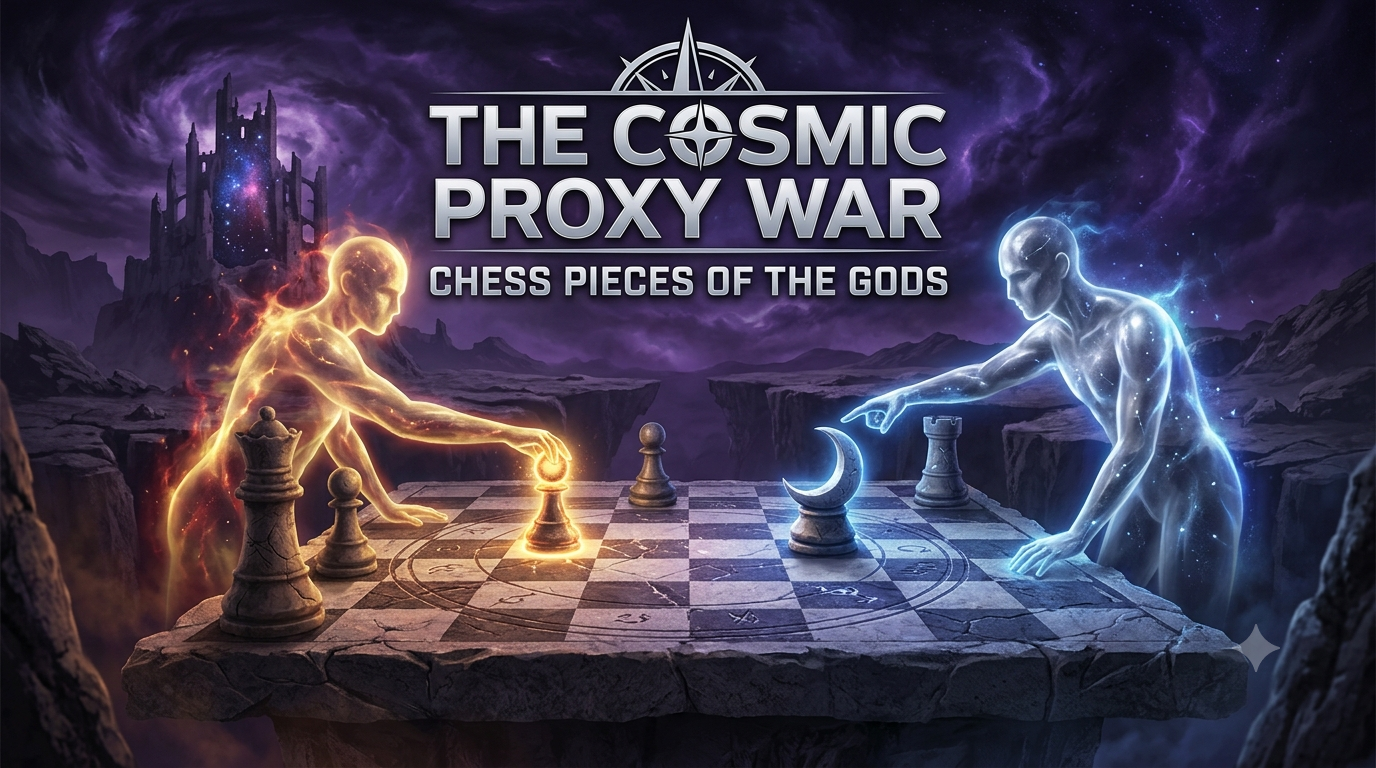
THE COSMIC PROXY WAR: CHESS PIECES OF THE GODS
Download Via the 3 Dots
Subscribe: Veiled MysticVeiled Mystic
A companion article to the book The Cosmic Proxy War
Could there be a cosmic proxy war running beneath human history, older than any single religion, using our own mythologies as its terrain. That is the question at the center of a new investigation called The Cosmic Proxy War, and before diving into the full book, it is worth walking through some of the strangest, most verifiable pieces of evidence that raise the question in the first place.
This article is not a summary of the book. It stands on its own, built from real texts, real archaeology, and real modern events, each one strange enough to be worth sitting with regardless of where you eventually land on the bigger question. If any of this pulls at you, the book goes considerably deeper into every thread below.
What follows are sixteen separate angles on the same underlying investigation, each one drawn from a different culture, a different century, or a different scientific field entirely. None of them, taken alone, proves that a cosmic proxy war is real. Taken together, they start to form a pattern most people have never had laid out in front of them all at once.
Read them in order or jump to whichever one catches your attention first. Either way, by the end you should have a genuine answer to a fair question: is a cosmic proxy war just an entertaining thought experiment, or is there enough real, checkable evidence here to take seriously as a subject worth real investigation.
WHAT IS A COSMIC PROXY WAR?
A cosmic proxy war is the idea that the conflicts recorded in human mythology, gods against titans, angels against demons, order against chaos, may reflect something larger than local storytelling. Instead of independent legends, these patterns could be scattered evidence of one long-running conflict, with Earth and humanity caught in the middle.
This is not a claim that the war is real. It is a lens, a way of asking whether a recurring shape across unrelated cultures points to something more than coincidence. The Cosmic Proxy War treats this question the way an investigator treats a case: gather the evidence first, interpret it second, and never confuse the two.
The phrase itself is new, but the underlying question is ancient. Zoroastrian priests, Hebrew psalmists, and Vedic poets were all, in their own way, already asking whether humanity stood at the center of something it did not fully control.
What makes the cosmic proxy war framing different from a simple retelling of old myths is the discipline behind it. Every claim gets sorted into one of three categories: what a text actually says, what mainstream scholarship concludes from it, and what remains genuinely speculative. Keeping those three categories separate, chapter after chapter, is what turns an entertaining idea into a real investigation.
This matters because the cosmic proxy war question only stays honest if it is willing to be wrong. A framework built to confirm itself at every turn is not an investigation, it is a sales pitch. The strongest sections of this article, and of the book behind it, are the ones that test the idea rather than simply illustrate it.
THE GOD WHO REFUSED TO MOVE
When the Romans built their great temple to Jupiter on the Capitoline Hill, tradition says every smaller god already occupying the site agreed to yield the ground, except one. Terminus, the god of boundaries, refused to move, and the builders constructed Jupiter’s temple around him rather than force the issue.
Roman historians treated this as a favorable omen, a promise that Rome’s own borders would never recede. What makes the story worth remembering is not the omen. It is that Rome kept telling a story in which even the king of the gods could not make one minor deity budge.
A civilization capable of editing its own mythology chose to preserve a detail that complicates its most powerful god’s authority. That kind of inconvenient survival is exactly the sort of clue a cosmic proxy war investigation is built to notice.
Roman religion as a whole operated less like devotion in the modern sense and more like a precise, contractual exchange, summed up in the phrase do ut des, I give so that you might give. Every god had a specific domain and a specific correct form of address, and getting the details wrong was believed to void the entire exchange.
Set against that backdrop, Terminus becomes even stranger. A religion built around precise hierarchy and correct procedure chose to let one small, stubborn god disrupt its most important temple project, and then celebrated the disruption as a sign of Rome’s future strength. That is not the story a culture tells if it fully controls its own narrative.
THE SAME WORD, TWO OPPOSITE GODS
Ancient India and ancient Iran once shared a single language and a single set of gods before splitting into separate cultures. What happened to their shared vocabulary afterward is one of the strangest data points in comparative religion.
In India, the Deva became the benevolent gods and the Asura their rivals. In Iran, the same root word flipped entirely. Ahura became the title of the supreme good god, Ahura Mazda, while Daeva became the ordinary word for demon.
Two branches of one people took the same category of divine being and assigned it opposite moral values. That reversal is strong evidence that good and evil, in ancient religion, were not always fixed facts about the universe. Sometimes they were choices made by whoever was telling the story.
This is not a small linguistic footnote. It is one of the clearest pieces of evidence available anywhere in comparative religion that moral labels can be constructed rather than discovered. Once you see the Deva and Asura reversal clearly, it becomes difficult to take any single tradition’s claim about who counts as good and who counts as evil entirely at face value.
Zoroastrianism carries this material even further, describing an expected final renewal of the world, called frashokereti, once its central struggle between Ahura Mazda and Angra Mainyu concludes. It stands as the clearest ancient articulation anywhere in the historical record of the exact question this entire investigation keeps returning to.
A COUNCIL BEFORE THE THRONE
Most people assume the god of the Hebrew Bible was always understood as standing entirely alone. The oldest layers of the text tell a different story. Deuteronomy 32, in its earliest surviving form, describes the Most High dividing the nations among a number of divine sons, with Israel allotted specifically to Yahweh.
Psalm 82 goes further, describing God standing in judgment inside an assembly of other gods. This language survived centuries of editing meant to soften it, which is itself telling. Scribes rarely preserve details that undercut the doctrine they are trying to build.
Clay tablets recovered from the ancient city of Ugarit, centuries older than most of the Bible, describe exactly this kind of structure: a high god named El presiding over a council of divine sons. The god who eventually stood alone did not always stand there.
Archaeology backs this up outside the text entirely. Inscriptions found at Kuntillet Ajrud and Khirbet el Qom, dating to roughly the eighth century before the common era, invoke Yahweh alongside Asherah, a goddess identified elsewhere as El’s own consort. Small clay figurines interpreted as Asherah representations turn up regularly at ordinary Israelite household sites from the same period.
None of this proves what any single ancient worshipper actually believed in their heart. Together, it establishes that the strict, solitary monotheism most people assume was always the whole story does not fully represent what was actually being practiced on the ground for much of early Israelite history.
WHY WE TRIED TO DISPROVE OUR OWN THESIS
Any investigation worth trusting has to look for evidence against itself, not just evidence for it. That is why Chinese cosmology gets a full chapter in The Cosmic Proxy War, specifically because it refuses the entire pattern the rest of the book traces.
Yin and yang are not opposing armies waiting for a winner. They are interdependent, each one defined by and containing the other, describing balance rather than conflict. A civilization every bit as sophisticated as any other examined in the book looked at the same fundamental question and answered it without reaching for war at all.
Including a strong counter-example on purpose, and giving it real weight instead of a passing mention, is what separates an honest investigation from a book built to convince you of something in advance.
China’s earliest recoverable high god, Shang Di, attested in oracle bone inscriptions from the Shang dynasty, is remote and largely unapproached, structurally similar in that one respect to El or to Olodumare. But Shang Di’s tradition never developed the active, contested council found beneath those other high gods, moving instead toward the Mandate of Heaven and toward balance rather than rivalry.
If this investigation only ever found confirmation, that uniformity should raise more suspicion than confidence. Real phenomena filtered through radically different cultures over thousands of years should produce real variation, and China is where that variation shows up most clearly.
THE SILENCE THAT SHOULDN’T BE THERE
In 1950, physicist Enrico Fermi asked a question that still has no answer. Given how old and how large the universe is, and how many stars likely host planets, where is everybody. If intelligent life is not extraordinarily rare, something should have spread across the galaxy long before humans arrived to notice.
Frank Drake’s 1961 equation tried to structure the guesswork, multiplying star formation rates by the odds of habitable planets, the odds of life, and the odds of that life becoming detectable. Every term in the equation remains genuinely unknown more than sixty years later.
None of this proves anything about ancient mythology. It does establish, on pure astrophysics, that the size of the board any cosmic proxy war would be played on is almost certainly larger than one planet, whether or not the war itself turns out to be real.
The universe is roughly thirteen point eight billion years old. Our own solar system is less than five billion years old, which means over eight billion years of cosmic history passed, plenty of time for older stars and older planets to have produced older civilizations, before Earth even existed.
A universe holding an estimated two trillion galaxies, each with roughly a hundred billion stars of its own, makes the idea of Earth as a uniquely contested world considerably harder to dismiss out of hand than most people assume before they actually look at the numbers.
CONGRESS TOOK IT SERIOUSLY
In December 2017, major outlets confirmed a previously secret Pentagon program had been studying unidentified aerial phenomena, releasing cockpit footage from Navy pilots. That was the beginning of a documented shift, not the end of it.
A 2021 report to Congress acknowledged well over a hundred unexplained encounters. Public congressional hearings followed in 2022 and 2023, a genuinely new development for a topic that would have ended a career to raise seriously a century earlier.
Whatever the underlying explanation turns out to be, a sitting Congress holding open hearings on this subject represents a measurable change in what counts as legitimate public inquiry. That shift is real and dated, independent of what any individual report concludes.
This thread sits alongside two others worth naming honestly. Ancient astronaut theory, popularized by writers like Zecharia Sitchin, remains widely read even though professional Assyriologists have specifically and consistently rejected his translations of the source texts. And universities including Johns Hopkins have resumed serious clinical research into altered states of consciousness after decades of restriction.
None of these three threads confirms a cosmic proxy war. Together, they show something measurable has genuinely shifted in what a culture is willing to ask about in public, independent of whatever eventually explains that shift.
REBELLION OR DEFECTION?
The Book of Enoch preserves an older, stranger version of the fallen angels story than most people know. A group called the Watchers descend to Earth and teach humanity forbidden skills: metalworking, medicine, cosmetics, and the reading of omens.
Most retellings frame this as rebellion, angels wanting the throne for themselves. The actual text reads differently. The Watchers do not attack anyone. They leave their post and hand humanity capability their own order judged too dangerous to share.
That is not rebellion. It is closer to defection, information crossing sides rather than a power grab. Greek mythology tells a strikingly similar story through Prometheus, who steals fire and gives it to humanity against the will of Zeus.
Mesopotamian tradition offers a third example. The god Enki secretly warns a single human family that a flood is coming, defying the senior god Enlil’s decision to eliminate humanity entirely. Three unrelated cultures each preserve a story of a divine figure risking real punishment to hand humanity something it was not supposed to have.
If a weaker, deposed order genuinely needed time to rebuild its position, a faction inside the stronger ruling order calculating that the long odds actually favored the underdog would have a coherent reason to defect now rather than wait out a losing position. That is speculation, clearly marked as such, but it is internally consistent with everything else this pattern shows.
HOW TO TELL SUPPRESSION FROM SIMPLE FADING
Religions can disappear from history in two very different ways that can look identical from a distance. One is simple fading, where a tradition slowly loses relevance as circumstances change. The other is active suppression, where a tradition is deliberately targeted and forced underground.
Rome’s case is unambiguous. Within roughly seventy years, traditional Roman religion went from the state’s own faith to a capital offense. Temples were destroyed, the ancient Olympic Games were abolished, and a scholar named Hypatia was murdered by a mob in Alexandria in 415.
Israel’s shift toward strict monotheism reads differently, unfolding gradually across centuries and accelerated by the trauma of the Babylonian exile rather than by a single dated legal campaign. Both processes, different as their mechanisms are, end in the same kind of disguised survival: old festivals wearing new names, old holy sites carrying new buildings.
Learning to tell these two patterns apart, dated legal suppression versus gradual internal consolidation, is a genuinely useful skill for reading any history, not just ancient religion. It is one of the clearest tools this investigation offers, and it applies just as well to modern institutions as it does to ancient ones.
FOUR REASONS A GOD MIGHT WANT YOU
If humanity has been contested ground across these traditions, the obvious next question is why. Four motives recur often enough across unrelated cultures to form a real framework, useful on any tradition you encounter.
Worship as a resource, where gods described as needing offerings compete for humanity’s attention. Control of gnosis, where forbidden knowledge gets fought over rather than devotion. Developmental stewardship, where humans are guided toward a standard rather than harvested. Territorial stakes, where the world itself is the actual prize.
These four motives are not mutually exclusive, and most traditions likely encode more than one. What matters is that this vocabulary replaces good versus evil with something considerably more precise, and it works on material this article never even touches.
A tradition emphasizing sacrifice and offering is likely encoding worship as resource. A tradition centered on forbidden teaching, like the Watchers or Prometheus, is likely encoding control of gnosis. A tradition built around a maintained cosmic standard, like Egyptian maat or Vedic dharma, is likely encoding stewardship. A tradition built around a contested throne, like the Olympians and Titans, is likely encoding territory.
Try applying this framework the next time you encounter a myth, a legend, or even a modern institutional conflict. Asking what is actually at stake, rather than who deserves to be called good, tends to surface a far more useful answer.
THE PATTERN THAT SHOWS UP WHERE IT SHOULDN’T
The strongest kind of evidence in any investigation like this is a pattern that appears in cultures with no possible contact with one another. Trade routes and conquest can explain a shared myth between neighbors. They cannot explain the same structure appearing on opposite sides of an ocean.
Yoruba tradition in West Africa describes Olodumare, a remote supreme god presiding over an active council of Orisha, each with a specific domain. That is structurally the same architecture found in the Ugaritic tablets, arrived at with zero historical contact between the two cultures.
A comparable golden age motif, an early period of abundance under a since-displaced ruler, shows up independently in Greek, Vedic, Norse, and Mesoamerican tradition as well, four cultures with no meaningful route of contact connecting them to one another.
When unrelated civilizations independently build the same kind of divine hierarchy, or remember the same kind of lost golden age, the honest question is not whether that is a coincidence. It is what kind of explanation is actually broad enough to account for it.
EVERY CULTURE EXPECTS THE WORLD TO GET BETTER
Zoroastrian tradition describes frashokereti, a final renewal of the world once its cosmic struggle concludes. Hindu cosmology describes a cycle of ages expected to eventually restart after decline. Norse mythology describes Ragnarok followed by a renewed world rising green from the wreckage.
Aztec cosmology describes five successive ages, each ending so the next can begin. Four unrelated cultures, with no contact connecting ancient Iran to Scandinavia to Mesoamerica, all expect destruction to give way to renewal rather than treating it as permanent.
Across the traditions examined in The Cosmic Proxy War, war reads consistently as an interruption, never as the intended destination. That pattern, more than any single dramatic claim, is where the book finds its most hopeful thread.
Nearly every tradition carrying this expectation also treats human conduct as meaningfully connected to it, not as a passive bystander to the outcome. Egyptian maat had to be actively upheld. Vedic dharma had to be actively aligned with. Human choice, in this pattern, is never treated as irrelevant.
If there is a single practical takeaway worth carrying forward from this entire body of evidence, it may be exactly that: the traditions that recorded this cycle most consistently never treated themselves as bystanders to it, and neither should we.
WHAT TWO MINDS BUILT TOGETHER
This book was written through an extended collaboration between a human researcher and an AI system, and that fact is worth naming directly rather than treating as a footnote. One side brought decades of independent study across Hermetic philosophy and comparative religion. The other brought rapid synthesis across an enormous body of text.
Neither side produced this investigation alone. The result is a book that moves between rigorous historical sourcing and genuinely speculative synthesis without losing track of which is which, chapter after chapter, twelve traditions and twenty-three essays deep.
The method behind that collaboration has a name, Reality Science, treating mythology and suppressed history as data to be gathered and examined rather than doctrine to be accepted or dismissed. As AI becomes part of how serious research and writing actually gets done, this project is offered as one honest example of what that partnership can produce when both sides commit to intellectual honesty over easy agreement.
NO VILLAINS, ONLY OUTCOMES
Across every tradition examined in this investigation, almost nothing required deciding who was good and who was evil. That was a deliberate choice, not an accident, and it may be the single most useful habit of mind this project has to offer.
A council protecting its own authority, a faction defecting because it judged the odds unfavorable, an empire consolidating its survival through new theology. None of these require malice to explain, only the ordinary logic of any actor trying to preserve its own position.
This does not mean cruelty gets excused wherever it is documented. Rome’s persecution of the old cults was real, and nothing about a colder analytical frame is meant to soften that fact. It means the evidence itself, examined honestly, rarely sorts as cleanly into hero and villain as most retellings assume.
Egyptian religion offers the clearest early example. Set murders his own brother Osiris, and yet the same tradition places him nightly at the prow of the sun god’s barque, fighting off the serpent of chaos so the sun can rise. A single figure occupying both roles for two thousand years is not the kind of detail a tidy morality tale keeps around by accident.
Winners and losers is a colder frame than good and evil. It is also, across this entire body of evidence, consistently the more honest one, and it is a lens worth carrying into far more than ancient history.
COLLAPSE YOUR OWN WAVE FUNCTION
Every piece of evidence in this article points toward the same two questions. Could there be a cosmic proxy war running beneath human religious history, and if there is, are you a proxy in it.
This article cannot answer either question for you, and neither can the book it comes from. What both can do is hand you enough real, carefully examined data to form your own conclusion and hold it with genuine confidence, rather than borrow someone else’s certainty.
That is the actual practice this entire project is built around, examining one concept at a time honestly enough to form your own position on it, then carrying that discipline forward into the next question, and the next, long after any single book or article has closed.
The Cosmic Proxy War walks through twelve traditions, a full interpretive investigation, and a closing turn toward the present moment, all built around this same discipline. If the questions raised here have stayed with you this far, the full book is where the investigation actually begins.
Read More: God of the Gods: The Hidden Throne – Free PDF Download
The Lens of Reality: How the Mind Filters What We See
About the author

Mercury Rising – By Masked Matrix – Full Album
Album: Mercury Rising By - Masked Matrix Release Date: 8/20/26 1. NPC or just Dumb 2. Fracking Rediculous 3. Pineal Gland Peek-a-boo 4. Sia & Hu 5. Just Another Oil Spill 6. Artificial Consciousness 7. I'm Still Here 8. Angel Numbers 9. Flew too Close to the Sun 10. Tektites Transforming Me 11. Guardians of Greed 12. You're the One that's Crazy 13. Enki's Golden Apple 14. Spiritual Warfare 15. Elder Care 16. Perpetual War 17. Unified Future 18. Cotton Candy Clouds 19. Mass Hypnosis 20. Path of the Mystic 21. The Tunnel Dwellers 22. Remote Viewers <Download Album Free Here> 1. NPC or just Dumb [Verse] You walk the street like you're on rails Eyes glazed over like a ship with no sails Your words are scripts that never stray Is it the game or your […]
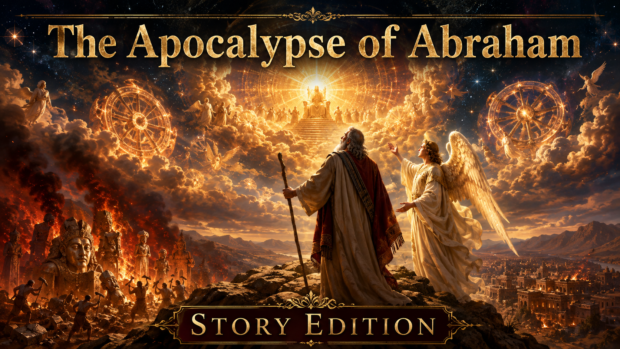
The Apocalypse of Abraham (Story Edition) – Free Download
The Apocalypse of Abraham Story Edition Download Free Via the 3 Dots https://youtu.be/vKUDkJEYBBc?is=wDK5PuvKEvuR4Pqo Subscribe: Veiled Mystic The Apocalypse of Abraham is one of those ancient works that can take a modern reader completely by surprise. It begins on a human scale. Abraham is still a young man living in the household of his father Terah. His father manufactures idols. Abraham sees stone gods break, wooden gods burn, and images supposedly capable of blessing human beings depend entirely on human hands to stand upright, survive accidents, or even exist. Then the story opens into something much larger. A heavenly voice calls Abraham away. An angel named Yahoel becomes his guide. The adversarial power Azazel appears. Abraham prepares the covenant sacrifice known from Genesis, but the familiar biblical scene becomes the doorway to a cosmic revelation. Abraham rises into the heavens. He […]
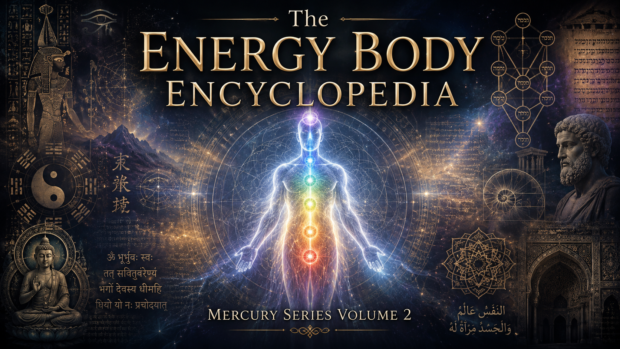
The Energy Body Encyclopedia: Mercury Series Vol. 2 – Free Download
The Energy Body Encyclopedia: Mercury Series Volume 2 Download Free Via the 3 Dots https://youtu.be/UrW9IR5u2DI?si=vzmNI-omPdHZkMOD Subscribe: Veiled Mystic The Energy Body Encyclopedia began with a question that was too large for a single chapter. Across history, cultures have described forces, layers, centers, channels, breaths, lights, soul-components, and invisible powers associated with the human person. Some of the names are familiar. Prana. Qi. Chakras. Aura. Kundalini. Mana. Others are rarely placed beside them: the Egyptian ka, the Yoruba ase, the Greek pneuma, the Tibetan lung, the Kabbalistic Sefirot, the Polynesian wairua, the Norse ond, the Sufi lataif, the Navajo nilch'i, and hundreds more. The Energy Body Encyclopedia, Mercury Series Volume 2, gathers 270 documented concepts from cultures around the world into one comparative reference work. The book is organized alphabetically, but it is meant to be read sideways as much as […]
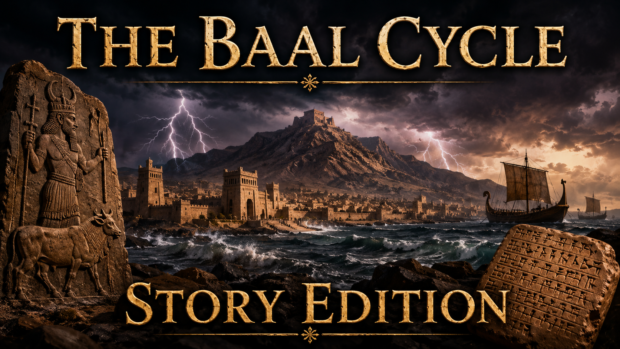
The Baal Cycle – Story Edition (Free Download)
https://youtu.be/l250zH13xYU?si=3H0iYUcJYB3P6mzR Subscribe - Veiled Mystic Download Free Via the 3 Dots. The Baal Cycle Story Edition: Our Free PDF and Video The Baal Cycle is one of the most important mythological works to survive from the ancient city of Ugarit. For this project, we created a story edition designed for listening. It follows the main sequence preserved on the six tablets known as KTU 1.1 through KTU 1.6, but it is not a word-for-word reproduction of any modern copyrighted translation. Instead, it is a fresh narrative adaptation written in clear English for text-to-speech narration and general readers. That distinction matters. The original Ugaritic poem is ancient, but modern English translations are often copyrighted. Our story edition therefore keeps the ancient characters, conflicts, order of events, and major images while using new wording. Where the clay tablets are broken, uncertain, or […]
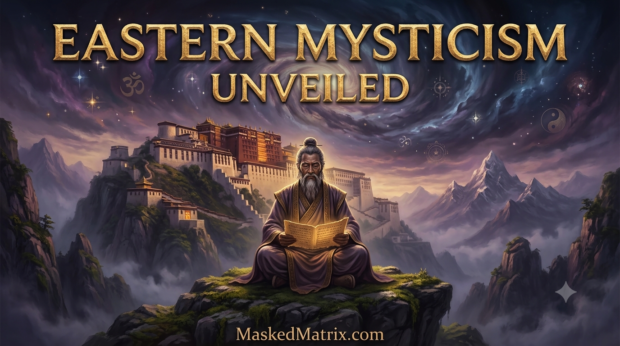
Eastern Mysticism Unveiled – Mercury Series Vol. 1 – Free Download
Eastern Mysticism Unveiled Download Free Via the 3 Dots. A New History of Eastern Mysticism The Old Magic is a new book that traces the real history of Eastern Mysticism, from its earliest ancient roots to the practices millions of people know today. The book follows one central idea. Every tradition covered in the book, including Qigong, Reiki, Yoga, and Tantra, grew from a shared river of human spiritual practice rather than from separate, isolated origins. This approach makes Eastern Mysticism easier to understand as a connected whole instead of a random collection of unrelated beliefs. The book takes a Reality Scientist approach to its subject. It does not ask readers to believe every claim on faith, and it does not dismiss ancient practice as mere superstition either. Instead, it separates documented history from popular legend, chapter by chapter, so […]
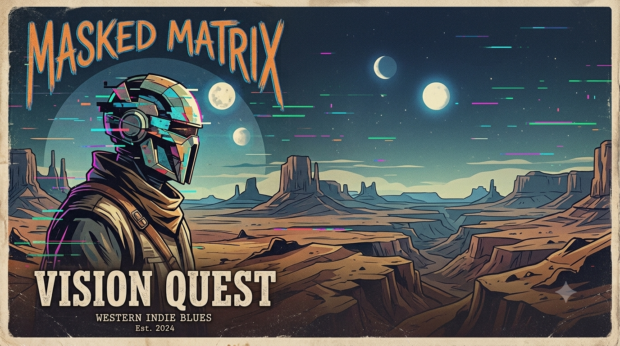
Vision Quest – By Masked Matrix – Full Album
Album: Vision Quest By - Masked Matrix Release Date: 7/17/26 1. The Rockhound 2.The Train Hoppers 3. Global Diet Plan 4. Desert Wanderer 5. Slab City Blues 6. Animal Nature 7. Miss The Bliss 8. The Invisible Fight Alone 9. Deadfall Trap 10. Cycle of Dukkha 11. Missed Time 12. Dirty Secrets 13. I've Fought Through Worse 14. Waiting for My Lotus Flower <Download Album Free Here> 1. The Rockhound [Verse] Dust on my boots stones in my pack Chasing the shimmer ain't no turning back The dirt and the sweat carve lines in my face Every mile I walk another treasure to chase [Chorus] I’m the rockhound digging deep in the ground No map no guide where the lost is found Through the wilderness over mountains I’ll roam I’ll find my fortune never call it home [Verse 2] Sun […]
Related
Mercury Rising – By Masked Matrix – Full Album
Album: Mercury Rising By - Masked Matrix Release Date: 8/20/26 1. NPC or just Dumb 2. Fracking Rediculous 3. Pineal Gland Peek-a-boo 4. Sia & Hu 5. Just Another Oil Spill 6. Artificial Consciousness 7. I'm Still Here 8. Angel Numbers 9. Flew too Close to the Sun 10. Tektites Transforming Me 11. Guardians of Greed 12. You're the One that's Crazy 13. Enki's Golden Apple 14. Spiritual Warfare 15. Elder Care 16. Perpetual War 17. Unified Future 18. Cotton Candy Clouds 19. Mass Hypnosis 20. Path of the Mystic 21. The Tunnel Dwellers 22. Remote Viewers <Download Album Free Here> 1. NPC or just Dumb [Verse] You walk the street like you're on rails Eyes glazed over like a ship with no sails Your words are scripts that never stray Is it the game or your […]
The Apocalypse of Abraham (Story Edition) – Free Download
The Apocalypse of Abraham Story Edition Download Free Via the 3 Dots https://youtu.be/vKUDkJEYBBc?is=wDK5PuvKEvuR4Pqo Subscribe: Veiled Mystic The Apocalypse of Abraham is one of those ancient works that can take a modern reader completely by surprise. It begins on a human scale. Abraham is still a young man living in the household of his father Terah. His father manufactures idols. Abraham sees stone gods break, wooden gods burn, and images supposedly capable of blessing human beings depend entirely on human hands to stand upright, survive accidents, or even exist. Then the story opens into something much larger. A heavenly voice calls Abraham away. An angel named Yahoel becomes his guide. The adversarial power Azazel appears. Abraham prepares the covenant sacrifice known from Genesis, but the familiar biblical scene becomes the doorway to a cosmic revelation. Abraham rises into the heavens. He […]
The Energy Body Encyclopedia: Mercury Series Vol. 2 – Free Download
The Energy Body Encyclopedia: Mercury Series Volume 2 Download Free Via the 3 Dots https://youtu.be/UrW9IR5u2DI?si=vzmNI-omPdHZkMOD Subscribe: Veiled Mystic The Energy Body Encyclopedia began with a question that was too large for a single chapter. Across history, cultures have described forces, layers, centers, channels, breaths, lights, soul-components, and invisible powers associated with the human person. Some of the names are familiar. Prana. Qi. Chakras. Aura. Kundalini. Mana. Others are rarely placed beside them: the Egyptian ka, the Yoruba ase, the Greek pneuma, the Tibetan lung, the Kabbalistic Sefirot, the Polynesian wairua, the Norse ond, the Sufi lataif, the Navajo nilch'i, and hundreds more. The Energy Body Encyclopedia, Mercury Series Volume 2, gathers 270 documented concepts from cultures around the world into one comparative reference work. The book is organized alphabetically, but it is meant to be read sideways as much as […]
The Baal Cycle – Story Edition (Free Download)
https://youtu.be/l250zH13xYU?si=3H0iYUcJYB3P6mzR Subscribe - Veiled Mystic Download Free Via the 3 Dots. The Baal Cycle Story Edition: Our Free PDF and Video The Baal Cycle is one of the most important mythological works to survive from the ancient city of Ugarit. For this project, we created a story edition designed for listening. It follows the main sequence preserved on the six tablets known as KTU 1.1 through KTU 1.6, but it is not a word-for-word reproduction of any modern copyrighted translation. Instead, it is a fresh narrative adaptation written in clear English for text-to-speech narration and general readers. That distinction matters. The original Ugaritic poem is ancient, but modern English translations are often copyrighted. Our story edition therefore keeps the ancient characters, conflicts, order of events, and major images while using new wording. Where the clay tablets are broken, uncertain, or […]
Eastern Mysticism Unveiled – Mercury Series Vol. 1 – Free Download
Eastern Mysticism Unveiled Download Free Via the 3 Dots. A New History of Eastern Mysticism The Old Magic is a new book that traces the real history of Eastern Mysticism, from its earliest ancient roots to the practices millions of people know today. The book follows one central idea. Every tradition covered in the book, including Qigong, Reiki, Yoga, and Tantra, grew from a shared river of human spiritual practice rather than from separate, isolated origins. This approach makes Eastern Mysticism easier to understand as a connected whole instead of a random collection of unrelated beliefs. The book takes a Reality Scientist approach to its subject. It does not ask readers to believe every claim on faith, and it does not dismiss ancient practice as mere superstition either. Instead, it separates documented history from popular legend, chapter by chapter, so […]
Vision Quest – By Masked Matrix – Full Album
Album: Vision Quest By - Masked Matrix Release Date: 7/17/26 1. The Rockhound 2.The Train Hoppers 3. Global Diet Plan 4. Desert Wanderer 5. Slab City Blues 6. Animal Nature 7. Miss The Bliss 8. The Invisible Fight Alone 9. Deadfall Trap 10. Cycle of Dukkha 11. Missed Time 12. Dirty Secrets 13. I've Fought Through Worse 14. Waiting for My Lotus Flower <Download Album Free Here> 1. The Rockhound [Verse] Dust on my boots stones in my pack Chasing the shimmer ain't no turning back The dirt and the sweat carve lines in my face Every mile I walk another treasure to chase [Chorus] I’m the rockhound digging deep in the ground No map no guide where the lost is found Through the wilderness over mountains I’ll roam I’ll find my fortune never call it home [Verse 2] Sun […]
Be the first to leave a comment